Webinar: The Biggest Release Sales Comp Has Ever Seen. Come See For Yourself (Wednesday, October 7)
Register
- Before diving into the solution, it’s crucial to understand the real-world consequences of relying on manual processes, especially in a large organization.
- Streamlining your commission process requires a methodical approach that combines clear processes, clean data, and the right technology.
- Once you have a clean process and reliable data, you can introduce automation to eliminate manual work and scale your operations.
- Technology is only part of the solution.
A well-designed commission plan is a powerful engine for growth, but its impact is blunted if the payout process is broken. Inefficiencies lead to delayed payments, inaccurate rewards, and a lack of trust between salespeople and the company. To transform your commission process from an administrative bottleneck into a strategic advantage, you need a scalable, transparent, and automated system.
The Hidden Costs of a Manual Commission Process
Before diving into the solution, it’s crucial to understand the real-world consequences of relying on manual processes, especially in a large organization. The problems extend far beyond a few calculation errors in a spreadsheet.
- Financial Inaccuracies and Disputes: Manual data entry and complex formulas are breeding grounds for errors. A single mistake can lead to underpayments that demotivate reps or overpayments that hurt your bottom line. The resulting disputes consume valuable time for sales managers, finance teams, and operations leaders who must investigate and resolve each claim.
- Decreased Sales Motivation: Salespeople thrive on momentum and clear rewards. When payouts are consistently late or incorrect, it creates a disconnect between performance and compensation. Reps lose trust in the process and may even question the company’s stability, causing their focus to shift from selling to chasing down their earnings.
- Lack of Strategic Insight: When your finance and RevOps teams spend dozens of hours each month simply calculating payments, they have no time for strategic analysis. They can't easily model the impact of new compensation plans, forecast commission expenses accurately, or identify performance trends across different segments.
- Compliance and Audit Risks: A patchwork of spreadsheets lacks a clear audit trail. This makes it difficult to ensure compliance with financial regulations and contractual obligations. In the event of an audit, demonstrating the accuracy and fairness of your payouts becomes a significant challenge.
A Blueprint for Optimizing Your Commission Payouts
Streamlining your commission process requires a methodical approach that combines clear processes, clean data, and the right technology. Here is a step-by-step guide to building a scalable and reliable system.
Step 1: Map Your Entire Commission Payout Process
You cannot fix a process you don't fully understand. The first step is to create a detailed map of your entire commission workflow, from the moment a deal is marked "Closed-Won" to when the money hits your salesperson's bank account.
Gather stakeholders from Sales, Finance, Operations, and HR to document each stage:
- Trigger Event: What action initiates the commission calculation? (e.g., contract signed, first invoice paid, project kickoff).
- Data Collection: Where does the data come from? (e.g., CRM, billing software, ERP). Who is responsible for its accuracy?
- Calculation: Who performs the calculations? What tools are used (spreadsheets, custom scripts)?
- Verification & Approval: Who reviews the calculations for accuracy? What is the approval workflow (e.g., Sales Manager -> Director of Finance)?
- Dispute Resolution: How are discrepancies reported and resolved?
- Submission to Payroll: How are the final figures communicated to the payroll team?
- Payout & Reporting: When are commissions paid? How are reps notified and provided with a breakdown of their earnings?
This exercise will immediately highlight bottlenecks, redundant steps, and areas of high risk, giving you a clear picture of what needs to be improved.
Step 2: Standardize and Document Commission Rules
Ambiguity is the enemy of a scalable commission process. For large teams with multiple roles, territories, and product lines, your compensation rules must be crystal clear and centrally documented. Avoid leaving room for interpretation.
A robust compensation plan document should define:
- Commission Structures: Whether you use a base salary plus commission, tiered accelerators, or gross margin-based plans, each structure must be explained with concrete examples.
- Eligibility Criteria: Define exactly when a deal becomes commissionable. Is it upon signature, or after the client’s first payment is received?
- Handling Exceptions: Create clear policies for common exceptions like clawbacks for canceled contracts, split commissions for team selling, and adjustments for discounts.
- Payout Cadence: Specify whether commissions are paid monthly, quarterly, or on a different schedule.
Compare the following examples:
Ambiguous Rule (❌)Clear, Standardized Rule (✅)
Reps earn 10% commission on new deals.
Account Executives earn a 10% commission on the Annual Recurring Revenue (ARR) of new business deals. Commission is calculated upon receipt of the customer's first invoice payment and is paid out on the 15th of the following month.
Bonuses are given for big deals.
A "Deal Size Kicker" of 2% of total contract value is awarded for any single contract exceeding £250,000 in ARR, in addition to the standard commission rate.
Splits are handled by managers.
For deals involving both an AE and a Solutions Consultant (SC), the commission is split 70/30, respectively. Both reps must be listed on the opportunity record in Salesforce for the split to be automated.
This level of clarity minimizes disputes and provides a solid foundation for automation. If you're looking to redesign your plans, it's essential to follow best practices for reviewing and updating your sales commission structure.
Step 3: Centralize Your Data and Ensure Quality
The principle of "Garbage In, Garbage Out" is especially true for commission calculations. The accuracy of your payouts is entirely dependent on the quality of your source data. For most organizations, the Customer Relationship Management (CRM) system should be the single source of truth for all sales-related data.
Before you can automate, you must enforce data hygiene.
- Mandatory Fields: Make key fields required in your CRM for a deal to be moved to the "Closed-Won" stage (e.g., contract value, product type, close date).
- Regular Audits: Implement a process for regularly auditing CRM data to catch and correct inconsistencies.
- Ownership: Assign clear ownership of data quality to sales operations or the sales managers themselves.
A dedicated commission platform does not replace your CRM; it relies on it. At Qobra, our platform integrates directly with CRMs like Salesforce and HubSpot to pull deal data automatically. This eliminates manual data entry but reinforces the need for the data in your CRM to be clean, accurate, and up-to-date.
Embracing Automation: The Key to Scalability
Once you have a clean process and reliable data, you can introduce automation to eliminate manual work and scale your operations. Spreadsheets can't support the complexities of a large sales team, from tiered rates and accelerators to complex splits and overrides.
Move Beyond Spreadsheets
For high-growth and large sales teams, compensation plans become too sophisticated for spreadsheets. Continuing to use them introduces unacceptable levels of risk and inefficiency. To support long-term, sustainable growth, you need a dedicated, data-driven solution. Many of our clients, including major scale-ups like Doctolib, made the switch to escape the administrative burden and strategic limitations of Excel.
Choosing the Right Commission Automation Platform
Selecting the right software is a critical decision. Not all platforms are created equal, especially when it comes to the needs of a large organization. Here are the key criteria to evaluate:
- Flexible Calculation Engine: Your business goals will change, and your compensation plans will evolve. The platform must be able to handle any rule you can devise without requiring custom code. A "no-code" engine, like the one we've built at Qobra, empowers finance and RevOps teams to model and deploy complex plans—including tiers, kickers, and multipliers—with ease.
- Seamless Integrations: The platform must connect natively with your existing tech stack. At a minimum, this includes your CRM (for sales data) and your payroll/HRIS system (for payout execution). Deeper integrations with your ERP or billing systems can further automate the validation of commissionable events.
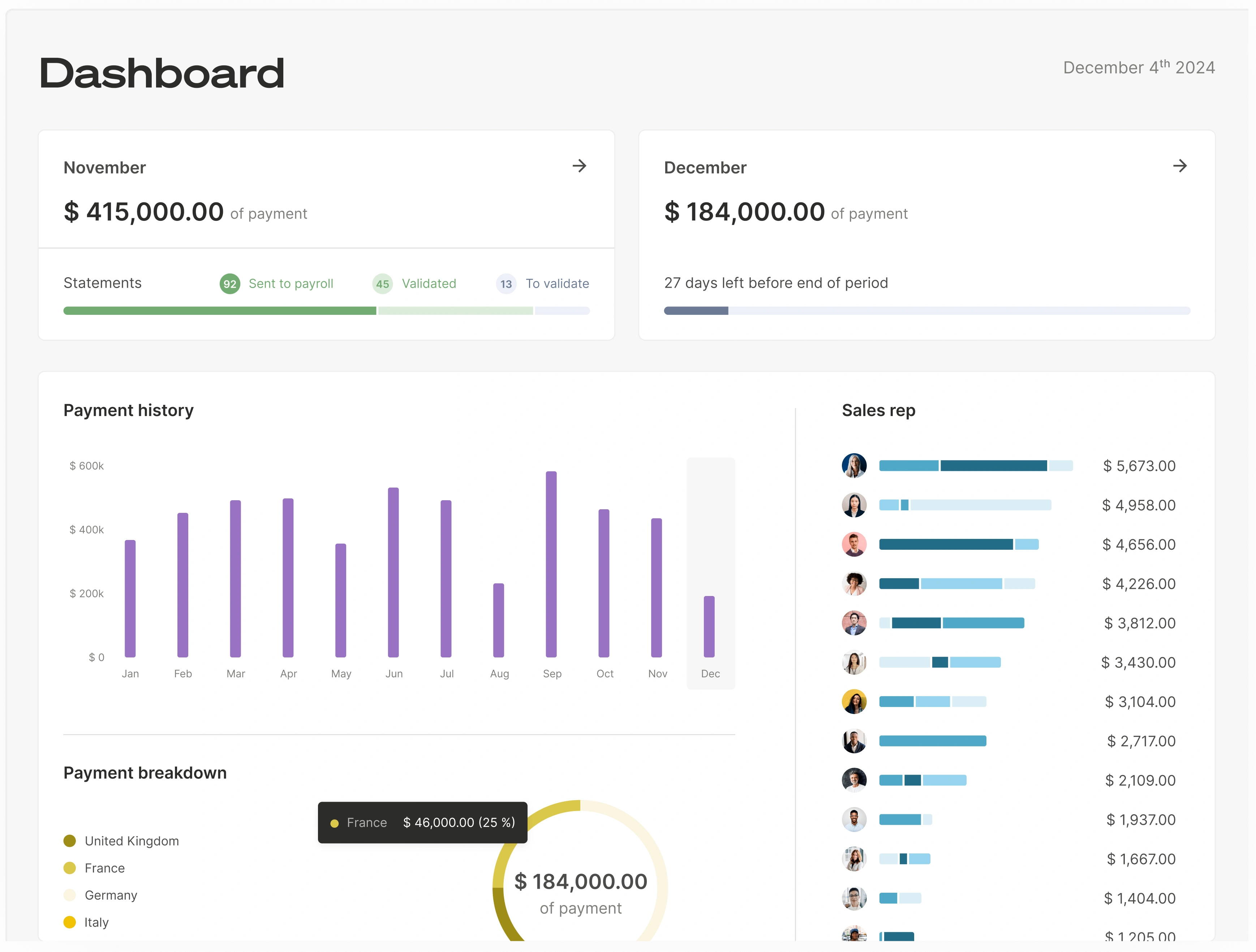
- Real-Time Transparency for Reps: The biggest driver of trust is transparency. The ideal solution provides each salesperson with a personal dashboard where they can see their calculated commissions in real-time. This allows them to track their progress toward quotas and even simulate potential earnings on deals in their pipeline, turning their compensation plan into a true motivational tool.
- Integrated Dispute and Adjustment Workflow: Even with automation, exceptions occur. The platform should include a streamlined workflow for reps to raise a dispute, for managers to review and approve adjustments, and for finance to have a clear audit trail of every change. This centralizes communication and resolves compensation disputes quickly and fairly.
- Robust Reporting and Analytics: A modern platform goes beyond calculation; it provides strategic insights. Look for robust dashboards that help you analyze performance, forecast commission expenses, and assess the effectiveness of your compensation plans.
The Power of an Integrated Payout Workflow
Data flows automatically from your CRM into the commission platform. The no-code engine calculates earnings for every rep based on your documented rules. Managers review and approve the totals within the platform. Finally, a validated payout report is exported directly to your payroll system.
This integrated flow reduces the time spent on commission management by up to 80%, frees up your teams for more strategic work, and ensures your sales force is paid accurately and on time, every time. It’s about creating a system where commissions are real-time, accurate, and transparent.
Fostering Trust Through Governance and Communication
Technology is only part of the solution. To ensure a smooth transition and long-term success, you must establish strong governance and communicate openly with your sales team.
Establish a Clear Communication Plan
When rolling out a new system or process, over-communication is key. Don't rely on a single email announcement.
- Announce Early: Let the team know that changes are coming and explain the "why" behind them—to ensure faster, more accurate, and more transparent payments.
- Dedicated Training: Hold team-wide meetings and 1:1 sessions to walk through the new platform and process.
- Accessible Documentation: Create a central knowledge base with plan documents, process guides, and FAQs.
- Focus on the Benefits: Emphasize how the new system will help them by providing real-time visibility into their earnings and a faster path to resolving issues.
A transparent rollout builds trust and encourages adoption. It shows the sales team that this change is being made for them, not to them.
What Automation Software Does (and Doesn't) Do
It's important to understand the role of a commission automation platform within your ecosystem. A tool like Qobra automates the calculation of variable pay, provides transparency, and manages workflows. However, it is not a payroll execution system; it provides the finalized amounts to be processed by your dedicated payroll software. Similarly, it is not a CRM; it depends on clean data from your CRM to function correctly.
By mapping your processes, standardizing your rules, cleaning your data, and leveraging powerful automation, you can transform your commission payouts from a complex, error-prone burden into a streamlined, strategic asset. This not only saves countless administrative hours but also builds a foundation of trust and motivation that empowers your sales team to drive predictable, sustainable growth.
Ready to see how you can turn your commission process into a revenue accelerator? A purpose-built platform can make all the difference.
FAQ
How often should commissions be paid to a large sales team?
The most common payout frequency is monthly. This provides a regular, predictable incentive for salespeople without creating the immense administrative burden of a bi-weekly cycle. For roles with very long sales cycles, a quarterly cadence can also be effective. The key is to pay out close enough to the deal closing to reinforce the connection between effort and reward.
What is the role of a commission automation tool versus our payroll software?
Think of it as a two-step process. A commission automation platform like Qobra connects to your data sources (like a CRM), applies your complex compensation rules to calculate the exact variable pay for each employee, and manages the approval and dispute process. Once the amounts are finalized, the platform generates a report that is exported to your payroll software (like PayFit or ADP). The payroll software then handles the final step: executing the bank transfer and managing tax withholdings and social contributions as part of the overall salary payment.
How do we handle complex situations like team selling or commission splits?
This is a primary reason to move away from spreadsheets. A robust commission automation platform allows you to build rules to handle these scenarios automatically. For example, you can create a rule that if an opportunity in your CRM has both an "Account Executive" and a "Sales Engineer" assigned, the commission is automatically split according to a predefined ratio (e.g., 70/30). This ensures fairness and eliminates manual calculations and potential disputes.
How can we ensure the sales team trusts the new automated system?
Trust is built on transparency and communication. When implementing a new system, it's crucial to:
- Communicate the "Why": Explain that the goal is accuracy, speed, and clarity for them.
- Provide a Live Dashboard: Give each salesperson real-time access to their performance and calculated earnings. When they can see how each deal impacts their commission, they understand and trust the process.
- Offer a Clear Dispute Process: Provide a simple, built-in tool for them to flag potential discrepancies directly on the platform, ensuring their concerns are heard and tracked.
For large teams, a commission management system is what makes payouts fast, accurate and auditable.