Webinar: The Biggest Release Sales Comp Has Ever Seen. Come See For Yourself (Wednesday, October 7)
Register
- A commission system is a structured compensation framework that ties variable pay to measurable performance, aligning individual actions with company objectives and motivating desired behaviors.
- Common models include salary-plus-commission, tiered, gross-margin and straight-commission for sales, affiliate programs for external partners, and broader incentive schemes that reward CSAT, loyalty, or lifecycle outcomes.
- Design hinges on clear mechanics: choose influenceable KPIs, set quotas and thresholds, define commission rates with accelerators/decay, establish payment cadence, and document rules for splits and clawbacks.
- Manual spreadsheet management creates errors, delays, and mistrust; purpose-built commission software with no-code plan builders, CRM integration, real-time dashboards, audit trails and forecasting vastly improves accuracy and transparency.
- Implementation checklist: define specific objectives, select the right structure, set fair attainable quotas, document and communicate the plan clearly, automate calculations with the right tools, and review/iterate regularly.
How can you transform your sales compensation from a complex administrative burden into your most powerful tool for strategic growth? A well-designed commission system does more than just pay your team; it aligns every action with your core business objectives, motivates top performance, and provides the clarity needed to attract and retain elite talent. When managed correctly, it’s not an expense, but a high-return investment in your revenue engine.
However, a poorly constructed or managed system can have the opposite effect. Ambiguous rules, delayed payments, and calculation errors breed mistrust, demotivate your workforce, and can even encourage counter-productive behaviors. This guide provides a comprehensive roadmap for designing, implementing, and optimizing a modern commission system that drives results and fosters a culture of success.
What is a Commission System?
A commission system, often called a sales commission plan, is a structured compensation framework where employees, typically in sales roles, earn variable pay based on their performance. It's a formal agreement that outlines how an individual's compensation is directly tied to achieving specific, measurable goals, such as generating revenue, securing new customers, or improving profit margins.
At its core, this system serves several strategic purposes:
- Motivation: It creates a direct link between effort and reward, powerfully incentivizing employees to maximize their performance.
- Alignment: It aligns the individual goals of your sales team with the overarching strategic objectives of the company. If the company priority is to enter a new market, the plan can reward sales in that territory more heavily.
- Performance Management: It clearly defines what success looks like, setting transparent expectations and performance benchmarks.
- Talent Attraction and Retention: A competitive and clear commission structure is a critical tool for recruiting top performers and keeping them engaged.
While traditionally associated with a fixed salary plus a variable commission, modern systems are far more sophisticated. They encompass a wide range of rules, metrics, and structures designed to influence specific behaviors and adapt to different business models, from direct sales to affiliate networks and customer loyalty programs.
Types of Commission Systems and Structures
The foundation of an effective compensation strategy lies in choosing the right structure. The ideal model depends on your industry, sales cycle, company maturity, and the specific behaviors you want to encourage. There is no one-size-fits-all solution, but most systems fall into a few key categories.
Sales Commission Plans
These are the most common structures, designed to reward direct sales efforts. Each model offers a different balance of risk and reward for both the employee and the company.
- Salary Plus Commission: The most prevalent model, it provides a stable base salary with a variable commission component. This offers security for the employee while still motivating performance. For example, a rep might have a £50,000 base salary plus a 5% commission on all revenue generated.
- Tiered Commission: This structure incentivizes over-performance by increasing the commission rate as the seller reaches higher sales targets. It's highly effective for motivating top performers to exceed their quotas.
| Monthly Revenue Achieved | Commission Rate |
|---|---|
| £0 - £20,000 | 3% |
| £20,001 - £40,000 | 5% |
| > £40,000 | 8% |
- Gross Margin Commission: Instead of paying on total revenue, this model bases commissions on the profit generated by a sale. It encourages reps to sell on value rather than discounting, protecting the company's profitability.
- Straight Commission: In this high-risk, high-reward model, the salesperson's entire earnings come from commissions. It offers the highest earning potential but lacks stability, making it suitable for certain industries with short sales cycles or for highly autonomous roles.
Affiliate Programs
An affiliate program is a type of commission system that extends beyond your direct workforce. It involves paying external partners (affiliates) a commission for generating leads or sales through their own marketing efforts. This is a powerful way to expand your reach and customer acquisition channels.
An effective affiliate program relies on robust tracking. Each affiliate is assigned a unique link, and a "cookie" is placed on the user's browser. When a user clicks that link and makes a purchase—whether a week, a month, or even a year later—the commission is correctly attributed to the referring affiliate. This "last-touch" attribution model ensures fairness and encourages long-term partnerships.
Some platforms, like systeme.io, offer lifetime recurring commissions, where an affiliate earns a percentage of every subscription payment made by a referred customer for as long as they remain a customer. This creates a powerful incentive for affiliates to refer high-quality, long-term customers.
Broader Incentive and Reward Systems
Modern commission systems often extend beyond pure sales metrics to reward a wider range of value-creating activities. This holistic approach ensures that the entire customer lifecycle is optimized.
- Customer Service Incentives: In many businesses, service quality is as important as the initial sale. Systems can incorporate metrics like customer satisfaction scores (CSAT), response times, or quality assurance ratings into the variable pay structure for support teams.
- Customer Loyalty Programs: Recognizing and rewarding loyal customers is crucial for retention and recurring revenue. The same data platform used for workforce incentives can be used to automate loyalty plans, offering points, discounts, or special perks to repeat buyers.
- Employee Lifecycle Incentives: Top-performing employees' needs and motivators change throughout their careers. A sophisticated system can adapt rewards to be relevant at different life stages, enhancing retention and long-term performance. Retaining a top performer is 3-5 times more cost-effective than acquiring a new one.
Beyond Revenue: Incentivizing the Right Behaviors
Your commission plan is one of the most powerful communication tools you have. It tells your team what truly matters. If you only reward closing new business, don't be surprised if customer onboarding and long-term satisfaction are neglected. Consider incorporating bonuses or multipliers for multi-year contracts, cross-selling different product lines, or achieving high customer satisfaction scores post-sale. This ensures your sales commission plan drives sustainable growth, not just short-term revenue spikes.
Designing and Calculating Commissions: The Mechanics
A successful commission system is built on clear, logical rules. Ambiguity is the enemy of motivation. The design phase requires careful consideration of what you want to achieve and how you will measure it.
Key Components of a Commission Plan
Every robust plan, regardless of its structure, is defined by a set of core components.
- Performance Metrics (KPIs): This is the "what" of your plan. Are you measuring total revenue, annual recurring revenue (ARR), number of new logos, profit margin, or a combination of factors? The chosen KPIs must be directly influenceable by the sales rep and aligned with company goals.
- Quotas and Thresholds: A quota is the performance target a salesperson is expected to hit in a given period (e.g., £200,000 in quarterly sales). A threshold is the minimum performance level required to start earning commissions. For instance, a rep might only earn commissions after reaching 80% of their quota.
- Commission Rates: This is the percentage or fixed amount paid per sale. Rates can vary significantly by industry. Software sales might see rates of 5-10%, while more competitive sectors might offer 10-20% or more. The rate should be high enough to motivate but sustainable for the business.
- Accelerators and Decelerators: Accelerators are increased commission rates for performance above the quota (e.g., 1.5x the normal rate for sales above 100% of the target). Decelerators reduce the rate for underperformance. It's generally best practice to use accelerators to reward overachievement rather than penalizing underachievement.
- Payment Cadence: This defines how often commissions are paid out—typically monthly or quarterly. A more frequent cadence can improve motivation by shortening the feedback loop between performance and reward.
- Rules of Engagement: This is the fine print. It should clearly define territory rules, how to handle split commissions for team sales, and policies for clawbacks (reclaiming commissions on canceled deals or customer churn).
How to Calculate Commissions (with Examples)
The basic formula for a simple commission is straightforward:
Commission = Sale Amount × Commission Rate
For example, on a £10,000 sale with a 7% commission rate, the payout is £700.
However, real-world calculations are rarely this simple. A tiered plan is more complex. Consider a rep with the following tiered structure who closes £55,000 in a month:
| Sales Tier | Tier Revenue | Commission Rate | Commission Earned |
|---|---|---|---|
| Tier 1: £0 - £20,000 | £20,000 | 3% | £600 |
| Tier 2: £20,001 - £40,000 | £20,000 | 5% | £1,000 |
| Tier 3: > £40,000 | £15,000 | 8% | £1,200 |
| Total | £55,000 | £2,800 |
This marginal or "waterfall" approach ensures that only the revenue within each tier is paid at that tier's rate, which is fairer and more predictable than applying a single rate to the entire amount.

The Pitfalls of Manual Commission Management
For years, spreadsheets have been the default tool for managing commissions. While seemingly free and flexible, this manual approach quickly becomes a major liability as a company grows. The hidden costs of errors, wasted time, and lost motivation are significant.
The primary issue is human error. Complex formulas, multiple data sources, and manual data entry make spreadsheets extremely prone to mistakes. These errors lead to incorrect payments, which erode trust and can take days to resolve. This lack of reliability creates a "shadow accounting" culture, where sales reps spend valuable selling time double-checking calculations instead of focusing on their pipeline.
Furthermore, spreadsheets offer zero real-time visibility. Reps often don't know their exact earnings until a report is manually compiled and distributed at the end of the month. This delay disconnects performance from reward, severely weakening the motivational power of the commission plan. The process is also incredibly time-consuming for Finance and Sales Ops teams, who can spend days each month pulling data, running calculations, and handling disputes.
Leveraging Technology: The Rise of Commission Software
To overcome the limitations of manual processes, leading companies are turning to dedicated commission management software. These platforms automate the entire process, from data integration to calculation and reporting, transforming commissions from a headache into a strategic advantage.
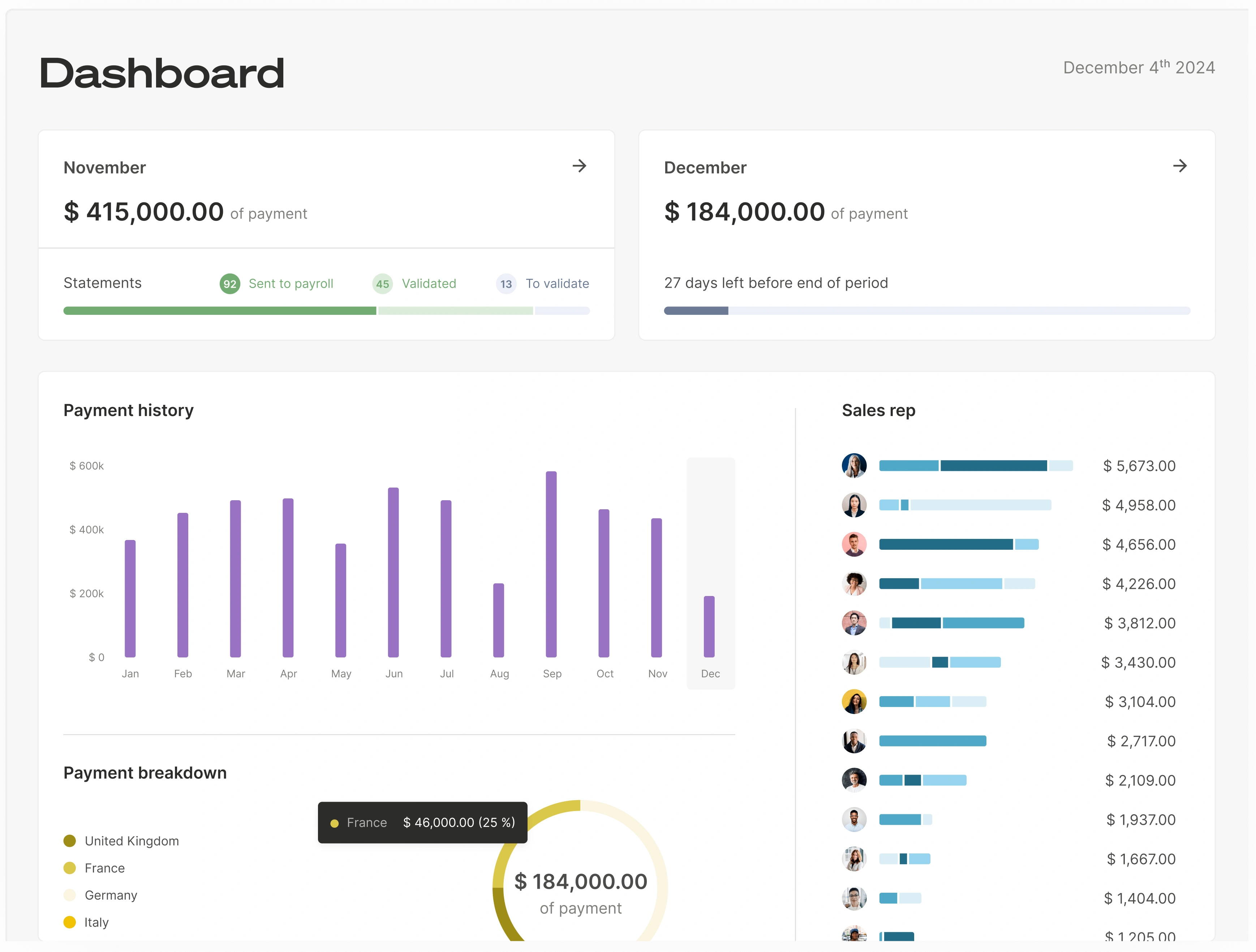
A modern commission platform like Qobra provides a centralized, automated, and transparent solution that eliminates the issues inherent in spreadsheets. By connecting directly to your data sources, it ensures accuracy and provides real-time insights for everyone in the organization.
Key Features of a Modern Commission Platform
When evaluating solutions, look for these critical capabilities:
- No-Code Plan Builder: The platform should empower your Ops or Finance teams to build, test, and modify even the most complex commission plans without writing a single line of code. This agility is crucial for adapting your strategy to changing market conditions.
- Native CRM Integration: Seamless, real-time integration with your CRM (like Salesforce or HubSpot) is non-negotiable. As soon as a deal is marked "Closed-Won," the commission calculation should update automatically.
- Real-Time Dashboards: Sales reps need a clear, intuitive dashboard showing their current attainment, commissions earned, and potential earnings from their pipeline. This transparency is a massive motivational driver, providing instant feedback on performance.
- Automated Calculation Engine: A powerful and reliable engine that handles complex rules, tiers, and adjustments automatically, reducing calculation errors by up to 95%.
- Audit Trails and Compliance: Every calculation, adjustment, and payment should be fully traceable. This is essential for resolving disputes, ensuring fairness, and meeting financial compliance standards.
- Forecasting and Simulation: Advanced platforms allow managers to model the financial impact of potential plan changes, while reps can simulate their earnings based on deals in their pipeline.
The Power of Transparency
Providing sales reps with real-time visibility into their commissions does more than just answer the question, "How much have I earned?" It gamifies performance and empowers them to understand exactly which activities drive the biggest rewards. When a rep sees their commission total increase moments after closing a deal, it creates a powerful positive feedback loop that reinforces winning behaviors.
Implementing Your Commission System: A Checklist
Deploying a new or revised commission system requires a structured approach. Following a clear implementation plan minimizes disruption and ensures buy-in from your team.
- Define Clear Objectives: What specific business outcome is the plan designed to achieve? Increase new customer acquisition by 20%? Boost sales of a new product line? Your goals must be specific, measurable, and time-bound.
- Choose the Right Structure: Based on your objectives, select the commission model (e.g., tiered, gross margin) that best incentivizes the desired behaviors.
- Set Fair and Attainable Quotas: Use historical performance data and market analysis to set challenging but realistic targets. Quotas that are perceived as unattainable will demotivate the team from the start.
- Document the Plan Meticulously: Create a formal commission plan document that outlines every rule, definition, and policy. This document is your single source of truth and the foundation for resolving any disputes.
- Communicate with Absolute Clarity: Hold a kickoff meeting to walk the entire team through the new plan. Explain the "why" behind the structure and ensure everyone understands exactly how they earn their money. Leave ample time for questions.
- Automate with the Right Tools: Transition away from spreadsheets. Implementing a commission management software like Qobra is the single most effective step to ensure accuracy, transparency, and scalability.
- Review and Iterate: A commission plan is not static. Schedule regular reviews (at least annually) to assess its effectiveness and make adjustments based on performance data and strategic shifts.
A commission system is far more than a mechanism for payment; it's the engine of your sales culture. By moving beyond outdated manual processes and embracing a strategic, transparent, and automated approach, you can unlock the full potential of your team. Modern platforms provide the accuracy, visibility, and flexibility needed to build a compensation strategy that not only rewards performance but actively drives it, turning your biggest go-to-market investment into your greatest competitive advantage.
Frequently Asked Questions
What is a commission system?
A commission system is a structured compensation model where an employee's pay is directly linked to their performance. It typically includes a set of rules, metrics (like revenue or profit), and commission rates that determine the variable portion of their earnings. Its primary goal is to motivate performance and align individual actions with company objectives.
How do you calculate a sales commission?
The simplest calculation is Sale Amount × Commission Rate. For example, a £25,000 sale at a 4% commission rate yields a £1,000 commission. More complex plans, such as tiered structures, involve applying different rates to different portions of the sales volume. To do this accurately and consistently, companies should use a dedicated tool to calculate commission rates automatically.
What is a typical commission rate?
Commission rates vary widely by industry, product margin, and sales cycle length. In large enterprises, they often range from 5% to 10% of revenue. In highly competitive sectors like B2B software or industries with lower base salaries, rates can be significantly higher, sometimes exceeding 20%. The right rate should be competitive enough to attract talent while remaining financially sustainable for the business.
What are the most common mistakes to avoid when designing a commission plan?
The most frequent errors include setting unclear or overly complex rules, misaligning incentives with company goals, creating unattainable quotas, and failing to communicate the plan effectively. Another critical mistake is relying on manual processes, which inevitably leads to errors and mistrust. You can learn more about common sales commission mistakes to avoid.
Why use software instead of Excel for commissions?
Dedicated commission software automates calculations, eliminating costly human errors. It saves countless hours for Finance and Ops teams, provides sales reps with real-time visibility into their earnings (a major motivator), and creates a fully auditable record for compliance. While Excel offers flexibility, a platform like Qobra offers accuracy, transparency, scalability, and a significantly higher ROI by turning compensation into a strategic driver of performance. Choosing the right commission software is a crucial step in modernizing your sales operations.