Webinar: The Biggest Release Sales Comp Has Ever Seen. Come See For Yourself (Wednesday, October 7)
Register
- Yes — sales commission is generally a variable cost: it moves in direct proportion to sales and should be treated as a selling expense that reduces contribution margin as revenue rises.
- Quick definitions: fixed costs stay constant (rent, salaries), variable costs change with activity (raw materials, commissions), and semi‑variable costs combine both (base salary + commission).
- Accounting treatment: commissions are typically recorded in SG&A as a period expense (Dr Commission Expense / Cr Commissions Payable); note ASC 606/IFRS nuance — incremental contract acquisition commissions may be capitalized and amortized over the customer life for multi‑period contracts.
- Practical math & impact: common formulas — Commission = rate × revenue (or tiered rates); include commissions in variable costs when computing Contribution Margin = Revenue − All Variable Costs to model break‑even, forecasting and pricing accurately.
- Exceptions & best practice: separate fixed vs variable components for hybrid plans (salary + commission), treat non‑recoverable draws or guaranteed minimums as fixed for the period, and model recoverable draws/deferred commissions appropriately — use automation to avoid errors and improve forecasting.
When sales are booming, your revenue charts point skyward, but does your profit margin always follow suit? If you've ever reviewed your financials after a record quarter only to find profits are flatter than expected, you might be overlooking a critical component of your cost structure: variable expenses. Chief among them is the sales commission.
So, how should you classify this crucial expense to gain true financial clarity and control?
The answer is clear: Sales commission is a variable cost. It's an expense that fluctuates in direct proportion to your sales activity. When your team closes more deals and generates more revenue, your commission expenses rise. Conversely, during slower periods, these costs naturally decrease. This direct link to performance is what defines it as variable, distinguishing it from the steady, predictable nature of fixed costs. Understanding this classification is not just an accounting formality; it's fundamental to accurate financial planning, strategic decision-making, and building a motivated, high-performing sales team.
Understanding the Core Concepts: Fixed vs. Variable Costs
To fully grasp why sales commissions fit into the variable category, it is essential to first distinguish between the main types of business costs. Every expense a company incurs can be classified based on how it behaves in response to changes in business activity, such as sales volume or production output.
Fixed Costs: The Foundation of Your Operations
Fixed costs are expenses that remain constant regardless of how much you sell or produce over a specific period. They are the predictable, recurring costs required to keep your business running, even if you do not make a single sale.
Common examples of fixed costs include:
- Rent for your office or retail space.
- Fixed salaries for administrative, HR, and management staff.
- Insurance premiums.
- Annual software subscriptions (e.g., accounting software, project management tools).
- Loan repayments.
Whether your sales team sells 10 widgets or 10,000, your monthly office rent remains the same. This stability makes fixed costs relatively easy to budget for.
Variable Costs: The Engine of Your Growth
Variable costs, on the other hand, are expenses that change in direct proportion to your business activity. As production or sales volume increases, these costs increase; as activity decreases, they decrease. They are directly tied to the revenue-generating activities of your business.
Typical examples of variable costs include:
- Raw materials used in manufacturing.
- Direct labor costs for production workers paid per hour or per unit.
- Shipping and delivery charges.
- Transaction fees for payment processing.
- Sales commissions.
For a T-shirt company, the cost of cotton is a classic variable cost. The more T-shirts they produce, the more cotton they need to buy. Sales commission works exactly the same way: the more revenue a salesperson generates, the higher their commission payout.
A Third Category: Semi-Variable Costs
Some expenses, known as semi-variable or mixed costs, have both fixed and variable components. A common example is a salesperson's compensation plan that includes a fixed base salary plus a variable commission. The salary is a fixed cost, paid every month regardless of performance, while the commission portion fluctuates with sales results. This hybrid model is extremely common in sales compensation.
Why Sales Commission is Classified as a Variable Cost
The classification of sales commission as a variable cost stems from its direct and undeniable correlation with sales performance. This relationship is not just an accounting rule; it is a strategic choice with profound benefits for business management.
The logic is simple: if there are no sales, there is no commission expense. If sales double, the commission expense is expected to double as well (assuming a flat commission rate). This inherent link to revenue generation is what makes it a powerful tool for motivating sales teams and managing financial health.
Let's explore the key strategic reasons why treating commissions as a variable cost is advantageous:
- Performance-Based Incentives: The primary purpose of a sales commission is to motivate performance. By directly linking a salesperson's earnings to the results they deliver, companies align individual financial interests with overarching business objectives. This performance-based structure encourages sales representatives to push for better results, a dynamic that would be lost in a fixed-cost model. Designing the right commission plan is therefore crucial for driving desired behaviors.
- Flexibility and Scalability: Markets are dynamic. Customer demand, competitive pressures, and economic conditions can change rapidly. A variable cost structure provides the agility to adapt. During periods of high growth, you can scale your sales efforts, knowing that the associated compensation costs will rise in line with revenue.
- Financial Risk Management: Fixed costs can become a significant burden during economic downturns or periods of low sales. Because they must be paid regardless of revenue, they can quickly erode profitability and strain cash flow. By classifying sales commissions as a variable cost, businesses mitigate this risk. During slower months, commission expenses automatically decrease, providing a natural cushion and giving leaders more control over their cost structure.
In essence, a variable commission structure ensures that your single largest sales expense—compensation—is self-regulating. The cost is only incurred when revenue is generated to support it, making it a financially sustainable model for growth.
Practical Examples and Calculations
Theory is one thing, but seeing the numbers in action makes the concept crystal clear. Let's look at a few common scenarios that illustrate how sales commissions function as a variable cost.
Example 1: Standard Percentage of Revenue
This is the most common structure, especially in SaaS and B2B sales. The salesperson earns a fixed percentage of the revenue they generate.
Imagine a software company, "Innovate Inc.," that pays its Account Executives a 10% commission on the Annual Contract Value (ACV) of every deal they close.
Sales Rep | Quarter | ACV Closed | Commission Earned (10% of ACV) |
|---|---|---|---|
Alex | Q1 | £150,000 | £15,000 |
Brenda | Q1 | £120,000 | £12,000 |
Total | Q1 | £270,000 | £27,000 |
Alex | Q2 | £200,000 | £20,000 |
Brenda | Q2 | £180,000 | £18,000 |
Total | Q2 | £380,000 | £38,000 |
As you can see, the total commission expense for the company increased from £27,000 in Q1 to £38,000 in Q2, directly following the increase in total sales. This is the hallmark of a variable cost.
Example 2: Tiered Commission Rates
Tiered or accelerated commission plans are designed to heavily reward top performers. In this model, the commission rate increases as the salesperson achieves certain sales thresholds.
Let's say "Innovate Inc." uses the following tiered structure for a quarter:
- 8% on the first £100,000 of ACV.
- 10% on ACV from £100,001 to £200,000.
- 12% on all ACV above £200,000.
Here's how Alex's Q2 commission of £20,000 would be calculated:
- First £100,000 @ 8% = £8,000
- Next £100,000 (£100,001 to £200,000) @ 10% = £10,000
- ACV above £200,000 = £0 @ 12% = £0
- Total Commission: £8,000 + £10,000 = £18,000 (Correction from the previous table to reflect the new structure)
Even though the relationship is not strictly linear, the cost is still variable. Higher sales lead to disproportionately higher commission expenses, further emphasizing its variable nature. Managing such complexities manually is prone to errors, which is why modern businesses rely on automated platforms. A well-designed system makes it easy to experiment with different models, like creating a commission structure based on gross profit to protect margins.
Automate to Eliminate Errors
Calculating tiered commissions, retroactively applying accelerators, or managing complex rules on spreadsheets is a recipe for disaster. It leads to errors, disputes, and demotivated representatives. A dedicated commission automation platform like Qobra uses a no-code rule editor to handle any level of complexity, ensuring calculations are instant, accurate, and transparent for the entire sales team.

Accounting Treatment for Sales Commissions
Correctly classifying sales commission is only the first step. You also need to know how to record it in your financial statements. This ensures your books are accurate, compliant, and useful for analysis.
Period Cost vs. Product Cost
In accounting, costs are often divided into two main categories:
- Product Costs: These are costs directly associated with producing a product, such as raw materials and factory labor. They are capitalized as inventory on the balance sheet and are only expensed (as Cost of Goods Sold or COGS) when the product is sold.
- Period Costs: These are all other costs not related to production. They are expensed on the income statement in the period they are incurred.
Sales commissions are a quintessential period cost. They are not part of the manufacturing process. Instead, they are considered a selling expense incurred to generate revenue in a specific period. As such, they are recorded as an expense immediately.
Where Does Commission Expense Go on the Income Statement?
Sales commission expense is typically reported under the Selling, General & Administrative (SG&A) section of the income statement. It is a key component of the "Selling Expenses" sub-category, which includes all costs associated with sales and marketing efforts, such as advertising, sales salaries, and travel expenses.
A basic journal entry to record accrued commissions at the end of a period would be:
Account | Debit | Credit |
|---|---|---|
Commission Expense | £27,000 | |
Commissions Payable | £27,000 | |
To record commission liability for the period |
When the commission is paid out to the salespeople, the entry would be:
Account | Debit | Credit |
|---|---|---|
Commissions Payable | £27,000 | |
Cash | £27,000 | |
To record payment of commissions |
A Note on Accounting Standards (ASC 606)
For companies following GAAP, the ASC 606 revenue recognition standard introduces a nuance. It states that incremental costs of obtaining a contract—costs that would not have been incurred if the contract was not obtained—should be capitalized as an asset and amortized over the life of the customer relationship. Sales commissions often fall into this category. This means that for a multi-year contract, the commission expense might be spread out over several years instead of being expensed all at once. For more details, explore the specifics of managing commissions under ASC 606.
The Gray Area: When Commissions Aren't Purely Variable
While the standard commission is a variable cost, some compensation structures introduce fixed components, creating a mixed or semi-variable cost. It is crucial to identify and account for these elements separately.
- Salary + Commission Plans: This is the most common hybrid model. The salesperson receives a fixed base salary (a fixed cost) and a variable commission based on performance. For budgeting and analysis, you must separate the two. The salary goes into your fixed cost bucket, while the commission remains a variable cost.
- Draws Against Commission: A draw is an advance payment made to a salesperson that is expected to be repaid from future commission earnings.
- A recoverable draw is essentially a loan. It is recorded as an asset (a receivable from the employee) on the balance sheet until the commission is earned to cover it.
- A non-recoverable draw is a guaranteed payment, regardless of performance. This portion of the compensation should be treated as a fixed cost for the period, as the company is obligated to pay it no matter what.
- Guaranteed Commissions or Bonuses: Some plans include a guaranteed minimum commission payout for new hires during their ramp-up period. This guaranteed amount is a fixed cost. Any commission earned above this minimum becomes a variable cost. Recognizing the difference between bonuses and commissions is important for both accounting and motivation.
Don't Let Complexity Cloud Your Judgment
Even in hybrid plans, the commission component itself remains variable. The key is to deconstruct the compensation plan into its fixed and variable parts for accurate financial modeling. This allows you to understand your true break-even point and the direct impact of sales on your profitability.
The Strategic Impact of Correct Classification
Why does this classification matter so much? Because it directly influences your ability to make sound strategic decisions.
1. Accurate Contribution Margin Analysis
The contribution margin is a key metric calculated as Sales Revenue - All Variable Costs. It represents the amount of money available to cover fixed costs and generate profit. If you misclassify sales commissions as a fixed cost, your contribution margin will be artificially inflated, giving you a dangerously misleading view of your product or service's profitability. A correct calculation is vital for pricing strategies, deciding which products to promote, and understanding your break-even point.
2. Realistic Budgeting and Forecasting
When building financial forecasts, treating commissions as a variable cost allows you to create dynamic models. You can project different revenue scenarios (optimistic, realistic, pessimistic) and see the direct impact on your total expenses and net income. This flexible approach is far more accurate than a static budget, especially in volatile markets.
3. Enhanced Motivation and Transparency
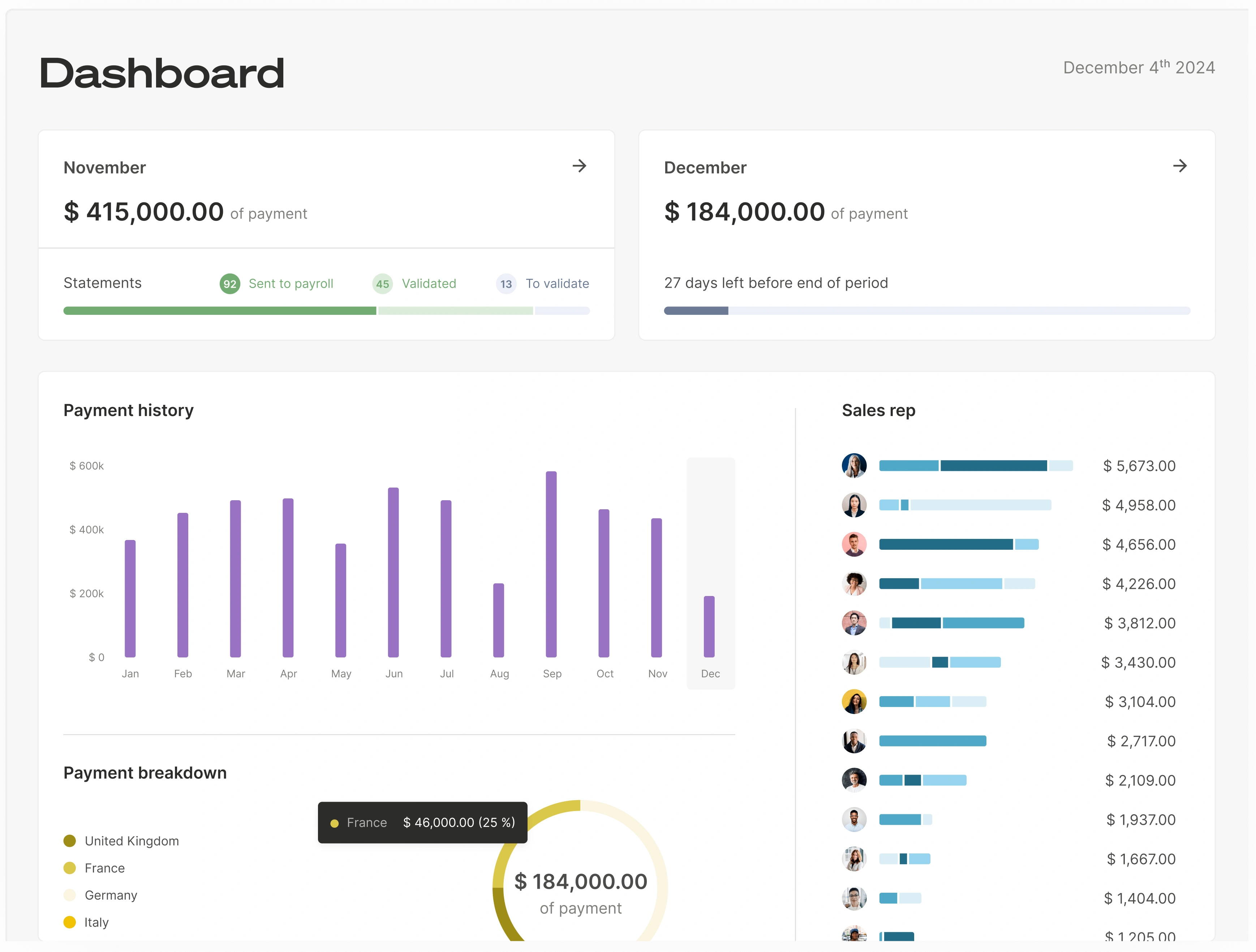
A clear, variable commission structure, visible to everyone, is a powerful motivator. When salespeople can see their potential earnings in real-time as they work on deals, their engagement soars. Platforms like Qobra provide real-time commission dashboards, which turn compensation from a mysterious payroll event into a live performance metric. This transparency builds trust and transforms the commission plan into the strategic tool it was meant to be.
In summary, while sales commission is definitively a variable cost, its management requires precision. The benefits of getting it right—from accurate financial reporting to a highly motivated sales force—are immense. Using modern tools to automate and provide visibility into these variable expenses is no longer a luxury but a necessity for any business serious about scalable, profitable growth.
Frequently Asked Questions
Is sales commission a fixed or variable cost?
Sales commission is a variable cost. Its amount fluctuates directly with sales volume or revenue. When sales increase, commission expenses increase, and when sales decrease, they decrease. This direct correlation is the defining characteristic of a variable cost.
Why does it matter if commissions are fixed or variable?
The classification is critical for several reasons. Treating commissions as a variable cost allows for accurate calculation of the contribution margin, which is essential for pricing and profitability analysis. It also enables more dynamic and realistic financial forecasting and helps in risk management, as expenses naturally scale down during economic downturns, protecting cash flow.
Can commissions ever be a fixed cost?
While commissions themselves are inherently variable, certain compensation structures can introduce fixed components. For example, a non-recoverable draw or a guaranteed minimum commission for a new hire should be treated as a fixed cost for that period, as the company is obligated to pay it regardless of sales performance.
How do you record commission expense in accounting?
Commission expense is recorded on the income statement, typically under Selling, General & Administrative (SG&A) expenses. The standard journal entry involves debiting "Commission Expense" and crediting "Commissions Payable" (a liability account) when the commission is earned. When it is paid, "Commissions Payable" is debited and "Cash" is credited.