Sales Compensation Software Benchmark | Compare 15+ Platforms (Features, Pricing, User Reviews, etc.)
Download
- A sales compensation plan is a strategic framework (base + variable) that aligns seller behavior with company goals, attracts/retains talent, and scales costs with revenue.
- Key components to design: base salary, commissions (revenue/margin/unit), quotas, OTE, accelerators/decelerators, clawbacks and draws; choose the model that fits role, cycle and margin dynamics.
- Practical design steps: align plan to 2026 business priorities, segment roles and KPIs, set realistic quotas (target ~60–70% attainment for most reps), model scenarios with historical data, then document and communicate clearly.
- Measure and automate: track OTE, attainment, payout ratio, CAC, LTV, churn and ramp metrics; use Excel templates for modeling but deploy ICM software for real-time, error-free calculations and transparent dashboards.
- Avoid common pitfalls: keep plans simple and explainable, prevent misaligned incentives (discounting/gaming), eliminate spreadsheet risk, enforce governance and annual reviews with clear exception processes.
How do you build a sales compensation plan that not only motivates your team to crush their targets but also perfectly aligns with your company's strategic goals for 2026 and beyond? This isn't just about paying commissions; it's about crafting a powerful tool that attracts top talent, drives the right sales behaviors, and ensures sustainable revenue growth. A well-structured remuneration framework is one of the most significant investments in your go-to-market strategy, yet it's often managed with outdated tools and a lack of clarity.
A successful sales commission structure is more than a line item in your budget. It’s a direct reflection of your company’s priorities. It tells your sales team what truly matters—whether it's landing new logos, expanding existing accounts, or protecting profit margins. Getting it right leads to a highly motivated, loyal sales force. Getting it wrong can result in high turnover, demotivated reps, and missed revenue targets. This guide will walk you through the essential components, models, and best practices for designing a high-performing compensation sales plan.
What is a Sales Compensation Plan?
A sales compensation plan is the framework that defines how salespeople are paid. It typically combines fixed and variable elements to reward performance. While the specifics vary widely between companies and industries, the core purpose remains the same: to incentivize salespeople to achieve specific targets that contribute to the company's overarching business objectives.
This remuneration system is a strategic lever for management. It’s designed to:
- Motivate Performance: By directly linking earnings to results, it encourages reps to exceed their quotas and maximize their potential.
- Attract and Retain Top Talent: In a competitive job market, an attractive and fair compensation package is crucial for bringing in and keeping the best salespeople.
- Align Sales with Company Goals: The structure of the plan guides the sales team to focus on high-impact activities, such as targeting specific markets, selling high-margin products, or increasing customer lifetime value.
- Control Costs: A significant portion of compensation is variable, meaning costs scale with revenue. This makes it a more financially sustainable model than purely fixed salaries.
A strong commission structure boosts team loyalty, reduces costly turnover, and enhances your employer brand, making your company a more desirable place to work.
The Key Components of a Modern Sales Compensation Plan
To build an effective plan, you need to understand its fundamental building blocks. Each component plays a distinct role in shaping the behavior and motivation of your sales team. A well-balanced mix ensures stability for your reps while rewarding outstanding performance.
Base Salary
The base salary is the fixed, guaranteed portion of a salesperson's pay, received regardless of performance. It provides financial stability, allowing reps to cover their living expenses without the constant pressure of commission-only earnings. This security is essential for roles with long sales cycles or those focused on relationship building, as it reduces the temptation to close deals prematurely.
Commissions
Commissions are the variable component of pay, calculated as a reward for achieving sales targets. This is where performance is directly translated into earnings. Commissions can be calculated in several ways:
- Percentage of Revenue: The most common method, where a rep earns a set percentage of the total value of the deals they close.
- Percentage of Gross Margin: This method ties commission to the profitability of a sale, encouraging reps to avoid excessive discounting.
- Flat Rate per Unit: A fixed amount is paid for each product sold or new customer acquired, often used in high-volume sales environments.
The commission rate varies depending on the industry, product, and sales role. The key is to create a direct and understandable link between a rep's effort and their financial reward.
Sales Quota
A sales quota is a time-bound performance target set for a salesperson or a team. It's the benchmark against which commissions and bonuses are measured. Quotas are typically set on a monthly, quarterly, or annual basis to ensure consistent performance throughout the year. It's common for reps to have multiple quotas simultaneously, covering different objectives like topline revenue, new customer acquisition, product-specific sales, or customer retention.
What are On-Target Earnings (OTE)?
On-Target Earnings (OTE) represent the total potential compensation a salesperson can expect to earn if they achieve 100% of their sales quota. It is the sum of the annual base salary and the variable compensation (commissions and bonuses) earned at full target attainment.
Formula: OTE = Base Salary + Variable Pay (at 100% of Quota)
For example, if a role has a £70,000 base salary and a £50,000 variable component for hitting quota, the OTE is £120,000. OTE provides a realistic projection of earning potential and is a critical metric for attracting talent.
Accelerators, Decelerators, and Clawbacks
These mechanisms fine-tune a compensation plan to further incentivize specific outcomes.
- Accelerators: These are increased commission rates that kick in after a rep surpasses their quota. For instance, the commission rate might jump from 8% to 12% on all revenue generated above 100% of the target. Accelerators are a powerful motivator for top performers to keep pushing even after hitting their goal.
- Decelerators: The opposite of accelerators, decelerators reduce the commission rate for reps who fall below a certain performance threshold (e.g., less than 70% of quota). They are used to penalize underperformance but should be implemented carefully to avoid demotivating the team.
- Clawbacks: A clawback provision allows a company to reclaim commissions that have already been paid. This is typically used if a customer churns shortly after a deal is closed or if a contract is cancelled, ensuring reps are focused on signing healthy, long-term customers.
6 Common Types of Sales Compensation Plans (with Examples)
There is no one-size-fits-all solution for sales compensation. The ideal structure depends on your industry, sales cycle length, company maturity, and the specific role of the salesperson. Here are six common models, along with examples of when to use them.
1. Salary-Only Plan
This is the simplest structure, where reps receive a fixed salary with no variable component.
- Best for: Enterprise sales roles with very long and complex sales cycles (over 6-12 months), account managers focused on retention, or highly collaborative team-based selling environments.
- Pros: Provides maximum income stability and predictability for reps. It reduces pressure to close deals quickly and encourages a focus on long-term customer relationships.
- Cons: Offers limited direct motivation to exceed individual targets. It can be difficult to distinguish and reward top performers.
2. Commission-Only Plan
In this high-risk, high-reward model, a salesperson's entire income is derived from commissions.
- Best for: High-velocity industries with short sales cycles like real estate or auto sales, or for engaging independent contractors (1099 reps).
- Pros: Offers unlimited earning potential and is highly motivating for aggressive, self-driven sellers. It's also cost-effective for the company, as compensation is paid only when revenue is generated.
- Cons: Creates significant financial instability for reps, leading to high stress and burnout. This model often results in very high turnover rates.
3. Salary + Commission Plan
The most widely used model, this hybrid plan offers a balance of security and incentive.
- Best for: The vast majority of B2B sales teams, including Sales Development Representatives (SDRs), Account Executives (AEs), and mid-market sales roles.
- Pros: The base salary provides a stable income floor, while commissions motivate performance. This structure attracts a wide range of candidates, from risk-averse to high-achievers.
- Cons: Can become costly if base salaries are set too high relative to performance expectations. Finding the right pay mix (e.g., 60/40, 50/50) is critical.
Role | Base Salary | OTE Commission | Pay Mix | OTE |
|---|---|---|---|---|
Account Executive | £70,000 | £70,000 | 50/50 | £140,000 |
SDR | £50,000 | £25,000 | 67/33 | £75,000 |
Enterprise AE | £120,000 | £120,000 | 50/50 | £240,000 |
4. Tiered Commission Plan
This structure rewards overperformance by increasing the commission rate as a salesperson achieves higher levels of their quota.
- Best for: High-growth companies aiming to aggressively scale revenue and motivate reps to go far beyond their targets.
- Pros: Powerfully incentivizes top performance and drives reps to maximize every opportunity.
- Cons: Can be complex to calculate and administer, especially when using spreadsheets. This is where automated platforms shine, as they can handle complex tiered logic effortlessly.
Example:
- Quota: £100,000 in quarterly sales
- Tier 1 (0-100% of quota): 8% commission
- Tier 2 (101-150% of quota): 10% commission on this portion
- Tier 3 (150%+ of quota): 12% commission on this portion
If a rep closes £160,000 in sales, their commission is: (£100,000 * 8%) + (£50,000 * 10%) + (£10,000 * 12%) = £8,000 + £5,000 + £1,200 = £14,200.
5. Profit-Based Commission Plan
Instead of paying commission on total revenue, this plan bases it on the gross profit or margin of each deal.
- Best for: Businesses where salespeople have significant control over pricing and discounting, and where profitability is a key strategic goal.
- Pros: Directly aligns the sales team's incentives with the company's financial health. It discourages deep discounting simply to win a deal.
- Cons: Requires complete transparency in cost and margin data, which can be sensitive. Calculations can be more complex than revenue-based models.
Note: Simplicity is Key
Mark Roberge, former VP of Sales at HubSpot, famously stated, "The sales compensation plan is probably the most powerful tool you have to drive sales strategy." However, its power is lost if it's too complex. A salesperson should be able to calculate their own commission on the back of a napkin. If your plan requires a complex spreadsheet with multiple tabs to understand, it's likely too complicated and will fail to motivate effectively.
6. Draw Against Commission Plan
This model provides reps with a guaranteed minimum payment (a "draw") each month. This payment is an advance that is later deducted from commissions earned.
- Best for: New hires who are still ramping up and building their pipeline, or in industries with highly seasonal or irregular sales cycles.
- Pros: Offers a financial safety net during slow periods, reducing the stress associated with commission-only roles.
- Cons: If a rep consistently underperforms, they can accumulate debt to the company (a recoverable draw), which can be highly demotivating.

How to Design Your Sales Compensation Plan for 2026
Creating a plan from scratch can feel daunting, but following a structured process ensures all critical aspects are covered.
Step 1: Align with Business Goals
Before defining any numbers, start with your strategy. What are the company's top priorities for the coming year? Is the focus on acquiring new customers, increasing market share, upselling to the existing base, or improving profitability? Your incentive compensation plan must directly support these goals. For example, if new logo acquisition is paramount, structure a higher commission rate or a flat-rate bonus for each new customer.
Step 2: Define Roles and Responsibilities
Not all sales roles are the same. An SDR's primary goal is to book qualified meetings, while an Account Executive is focused on closing deals, and a Customer Success Manager aims to retain and expand accounts. Each role requires a tailored plan that rewards its specific key performance indicators (KPIs). For example, learn how to pay an SDR based on meetings set and held, not just revenue.
Step 3: Set Clear and Achievable Quotas
Quotas must be both challenging and realistic. If they are too easy, the company overpays for performance. If they are unattainable, the sales team will become demotivated and may give up. A good rule of thumb is that 60-70% of your team should be able to achieve or exceed their quota. Base your quotas on historical data, market potential, and territory size.
Step 4: Model and Test Your Plan
Never roll out a new compensation plan without thoroughly modeling its financial impact. Use historical sales data to simulate how the plan would have paid out under various scenarios (e.g., if the team hits 80%, 100%, and 120% of its goal). This helps you understand the total cost of commissions and ensures the plan is financially sustainable.
Warning: The Dangers of Spreadsheets
Managing compensation plans on spreadsheets is a recipe for disaster. They are prone to manual errors, lack real-time visibility, and are incredibly time-consuming to maintain. A single formula error can lead to thousands of dollars in incorrect payments, causing disputes and eroding trust with your sales team. This is why leading companies are moving to dedicated software.
Step 5: Document and Communicate Clearly
Once finalized, the plan must be documented in a clear, concise policy document. Every rep should understand exactly how they are paid, what they need to do to earn their commission, and when they will receive it. Host a kickoff session to present the new plan and allow for a Q&A to address any confusion.
Step 6: Automate and Manage with the Right Tools
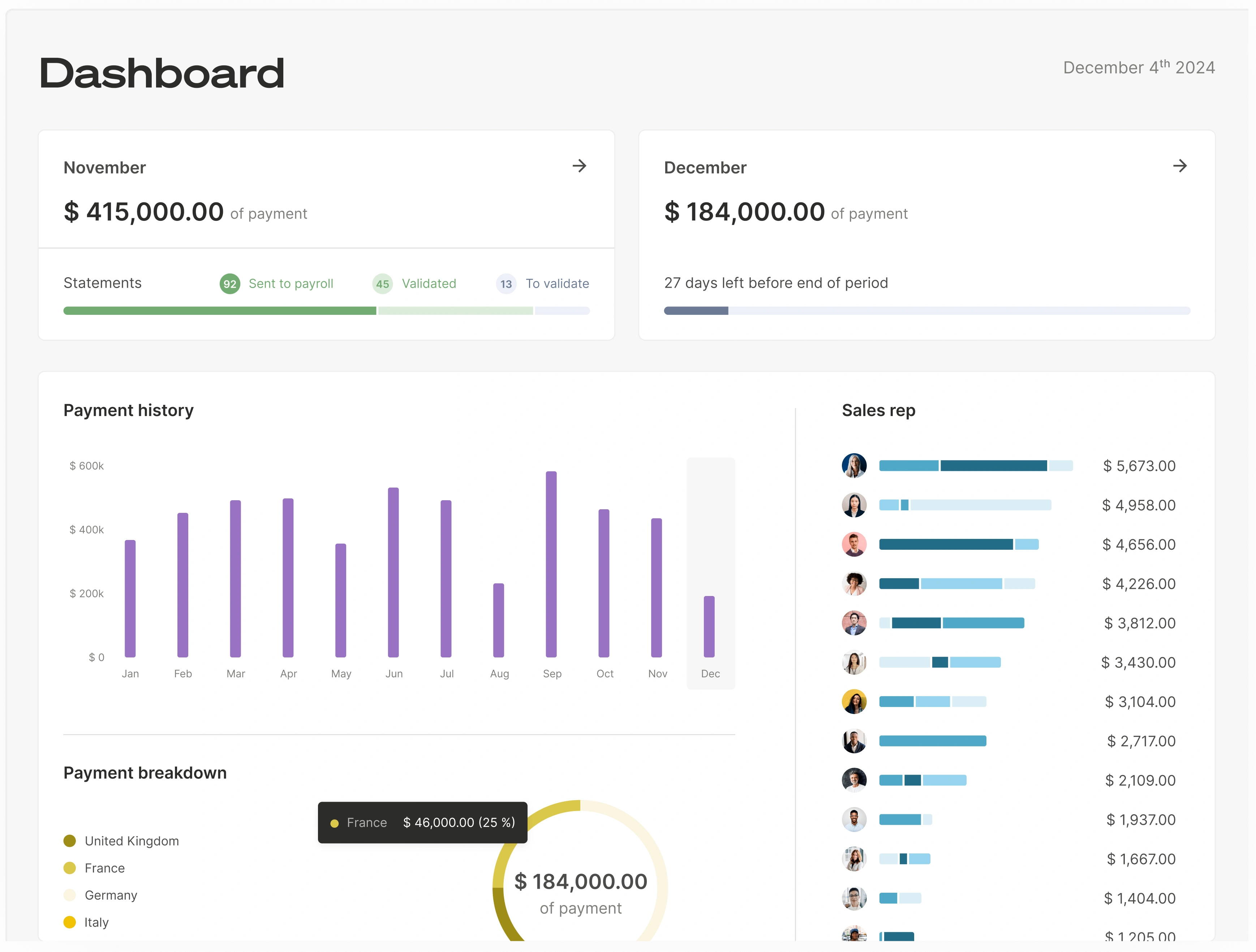
Modern sales teams need modern tools. Manual commission management is no longer viable. Platforms like Qobra automate the entire process, from data integration with your CRM to real-time calculation and transparent dashboards for reps. Our no-code editor allows you to build and modify even the most complex plans without needing developers. This automation saves countless hours for your Ops and Finance teams, eliminates costly errors, and provides the transparency reps need to stay motivated and focused. By using a top incentive compensation management software, you transform compensation from an administrative burden into a strategic advantage.

Avoiding Common Pitfalls in Compensation Planning
Even the most well-intentioned plans can fail if they fall into common traps.
- Overly Complex Plans: If reps can't easily understand how they're paid, the plan will not motivate them. Keep the rules simple and direct.
- Unrealistic Quotas: Setting quotas that are disconnected from reality is the fastest way to demotivate a sales team.
- Misaligned Incentives: Be careful of unintended consequences. A plan focused solely on revenue might encourage heavy discounting that hurts profitability.
- Lack of Transparency: When reps don't have visibility into their commission calculations, they lose trust in the process. Real-time dashboards, like those provided by Qobra, are essential for building trust and keeping reps engaged.
A well-designed compensation sales plan is a dynamic and powerful asset. It's not a "set it and forget it" document but a strategic tool that should be reviewed and refined annually to ensure it continues to drive the behaviors that lead to success. By focusing on alignment, clarity, and automation, you can build a plan that fuels performance and accelerates your company's growth in 2026 and beyond.
FAQ
What is a good commission rate for sales?
There is no single "good" commission rate. It depends heavily on the industry, the price of the product or service, the gross margin, the sales cycle length, and the role's base salary. For SaaS, commission rates for Account Executives typically range from 8% to 12% of the Annual Contract Value (ACV). The key is to ensure the OTE is competitive for your market.
How often should you review a sales compensation plan?
A sales compensation plan should be reviewed at least once a year. This annual review allows you to realign the plan with the company's strategic objectives for the upcoming year, adjust for market changes, and incorporate feedback from the sales team. However, minor adjustments or SPIFFs can be introduced quarterly to address short-term goals.
What is the difference between OTE and base salary?
The base salary is the fixed, guaranteed amount a salesperson earns, regardless of their performance. On-Target Earnings (OTE) is the total projected income a salesperson will earn if they meet 100% of their sales quota. OTE is calculated by adding the annual base salary to the total variable compensation (commissions and bonuses) achievable at target.
How can you ensure your compensation plan is fair?
Fairness in a compensation plan comes from clarity, consistency, and achievability. A fair plan is one where the rules are transparent and apply to everyone in the same role equally. It should also include quotas that are challenging but attainable for a majority of the team, ensuring that earnings are correlated with effort and skill, not luck. Using an automated platform ensures calculations are accurate and unbiased, which is fundamental to perceived fairness.