Webinar: The Biggest Release Sales Comp Has Ever Seen. Come See For Yourself (Wednesday, October 7)
Register
- No — commissions are ordinary income and are not subject to an intrinsically higher tax rate; the “higher” hit is usually due to how employers withhold taxes, not your final tax liability.
- In the UK, commission goes through PAYE and Class 1 National Insurance with the rest of pay, with no flat withholding rate. For US employees, withholding on supplemental pay uses either the flat/“supplemental” method (22% federal up to $1M, 37% over $1M) or the aggregate method (added to regular wages, which can temporarily push withholding higher); state taxes and FICA also apply.
- W-2 vs 1099 matters: W-2 employers withhold income tax and FICA (6.2% Social Security up to the cap, 1.45% Medicare plus 0.9% surtax for high earners); 1099 contractors receive gross pay, owe income tax plus self-employment tax (~15.3%) and must make quarterly estimated payments.
- Practical steps: set aside a portion of every commission (roughly 25–30% for W-2, 30–40% for 1099), track income/expenses, adjust your W-4 or make estimated payments, and reduce taxable income via retirement contributions and allowable deductions (SEP/solo 401(k) for contractors).
- Remember withholding is only an estimate — your final tax is computed on annual income, deductions and credits; over-withholding yields a refund, under-withholding can create a tax bill or penalties, so use the IRS withholding estimator or consult a tax advisor.
Have you ever received a commission check, excited by the amount you earned, only to be disappointed by how much was left after taxes? It’s a common experience that leads many sales professionals to a frustrating conclusion: commissions must be taxed at a higher rate than a regular salary.
The good news is that this is a widespread misconception. Your commission income is not subject to a special, higher tax rate. The confusion arises from the way taxes are withheld from these payments, not from the final tax you owe. Your commission is considered ordinary income, just like your base salary.
Understanding the difference between tax withholding and your actual tax liability is the key to managing your earnings effectively and avoiding surprises. Whether you're a W-2 employee or a 1099 independent contractor, the principles are straightforward once you know the rules of the game. Let's demystify how commission tax works so you can plan for 2026 and beyond with confidence.
How Tax Authorities Classify Commission Income
To the IRS and other tax agencies, money is money. They don't distinguish between income earned as a fixed salary and income earned through a variable commission. Both are considered taxable earnings. However, for payroll purposes, they are often treated differently, which is where the confusion begins.
For employees (often designated as W-2), commissions fall into a category called supplemental wages. These are payments made in addition to regular wages. This category includes bonuses, overtime pay, and, of course, commissions. Because these payments are often irregular and can vary significantly in amount, specific rules apply for withholding taxes.
For independent contractors (1099), the dynamic is entirely different. The company paying the commission doesn't withhold any taxes at all. The contractor is viewed as a separate business entity responsible for calculating and paying their own income tax and self-employment taxes directly to the government.
This fundamental distinction—employee vs. contractor—is the first critical step in understanding your tax obligations and why your take-home pay from a commission check might look different than you expect.
The Withholding Puzzle: Why Commission Checks Seem Lighter
The feeling that you're losing a bigger chunk of your commission to taxes comes down to the withholding method your employer uses. Withholding is simply an estimated payment of your future tax bill. Your employer is required to send this portion of your earnings to the government on your behalf throughout the year. At the end of the year, you file your tax return to reconcile what was withheld with what you actually owe.
In the UK, there is no flat withholding rate for commission: HMRC treats it as pay, so it goes through PAYE and Class 1 National Insurance using the employee's tax code. In the US, employers typically use one of two IRS-approved methods to calculate withholding on supplemental wages like commissions.
Method 1: The Percentage (or Flat) Method
This is the most common method and the primary source of the "higher tax" myth. When commissions are paid in a separate check from your regular salary, employers can withhold a flat percentage.
- US Federal Flat Rate: For supplemental income up to $1 million in a calendar year, the federal withholding rate is 22%.
- Over $1 Million: Any supplemental wages exceeding $1 million are subject to a 37% withholding rate.
In addition to this federal rate, state income taxes are also withheld, which can have their own flat rates for supplemental pay.
US example: You earn a $10,000 commission. Using the flat method, your employer would withhold $2,200 (22%) for federal taxes right off the top, plus any applicable state taxes and FICA contributions (Social Security and Medicare). This immediate, substantial reduction can be jarring compared to the more nuanced withholding on a regular paycheck.
Method 2: The Aggregate Method
If your employer pays your commission in the same paycheck as your regular salary and doesn't itemize it separately, they will likely use the aggregate method.
With this approach, the commission is added to your regular wages for that pay period. The total amount is then treated as a single, large paycheck, and taxes are withheld based on the information you provided on your Form W-4 and the corresponding IRS tax tables.
Example: You earn a $5,000 bi-weekly salary and a $10,000 commission in the same period. Your gross pay for that check is $15,000. The withholding calculation will be based on this $15,000 amount. Because tax withholding tables are progressive and annualized, the system essentially assumes you earn $15,000 every pay period ($390,000 per year), temporarily pushing you into a much higher withholding bracket for that single paycheck.
Withholding vs. Final Tax Liability: The Key Distinction
It's crucial to remember that withholding is just an estimate. The 22% flat rate or the temporarily high rate from the aggregate method does not represent your final tax rate. Your actual tax liability is calculated at the end of the year based on your total annual income, deductions, and credits. If too much was withheld from your commissions, you will receive the excess back as a tax refund. If not enough was withheld, you will owe the difference.
Tax Implications for Different Worker Statuses
Your obligations and how you manage commission taxes depend heavily on whether you are classified as a W-2 employee or a 1099 contractor.
For W-2 Employees
As an employee, your employer manages the withholding process. However, a strong sales year can significantly increase your total annual income, potentially pushing you into a higher marginal tax bracket. This means a larger percentage of your top earnings will be taxed.
Beyond income tax, your commissions are also subject to FICA taxes:
- Social Security: 6.2% on earnings up to the annual wage cap ($168,600 in 2024).
- Medicare: 1.45% on all earnings, with an additional 0.9% for high earners.
Your employer pays a matching portion of these FICA taxes. While the process is largely automated, you aren't powerless. If you find that withholding on your commissions is consistently too high (resulting in massive refunds) or too low (leading to a tax bill), you can adjust your Form W-4. This form tells your employer how much to withhold from each paycheck.
For 1099 Independent Contractors
If you work as an independent contractor, you are your own boss—and your own payroll department. The company that pays your commission will not withhold any taxes. You receive the full gross amount and are solely responsible for remitting taxes to the government.
This includes two major obligations:
- Income Tax: You must pay federal and state income tax on your net earnings.
- Self-Employment Tax: This is the contractor's version of FICA taxes. The rate is 15.3% (12.4% for Social Security up to the annual limit and 2.9% for Medicare with no limit). This rate covers both the employee and employer portions, as you are technically both.
To avoid a massive tax bill and potential penalties at the end of the year, independent contractors are required to make quarterly estimated tax payments. This involves calculating your expected income and deductions for the year and paying your tax liability in four installments.
The Peril of Underpayment for Contractors
Failing to pay enough tax throughout the year via estimated payments can result in penalties from the IRS. It's essential for contractors to set aside a significant portion of every commission check—typically 25-40%, depending on your income level and location—to cover these future tax obligations.
Practical Strategies to Manage Commission Tax
Whether you’re an employee or a contractor, being proactive is the best way to handle the variable nature of commission income.
Proactively Estimate Your Tax Burden
Don't let your tax liability be a surprise. A good rule of thumb is to set aside a percentage of every commission check in a separate savings account designated for taxes. For W-2 employees, 25-30% is a safe starting point. For 1099 contractors, 30-40% is more realistic due to the self-employment tax. This ensures you have the funds ready when it's time to pay.
Keep Meticulous Records
Accurate records are your best friend. This is where modern tools can replace cumbersome spreadsheets. A platform like Qobra provides sales teams with real-time, transparent dashboards of their commissions. This clarity is invaluable for tax planning, as it gives you a precise, up-to-the-minute view of your gross earnings. You can see exactly how each deal contributes to your payout, making it far easier to estimate your income and set aside the correct amount for taxes. Clear documentation, like the kind provided by a commission statement template, is also essential if you need to verify your income.
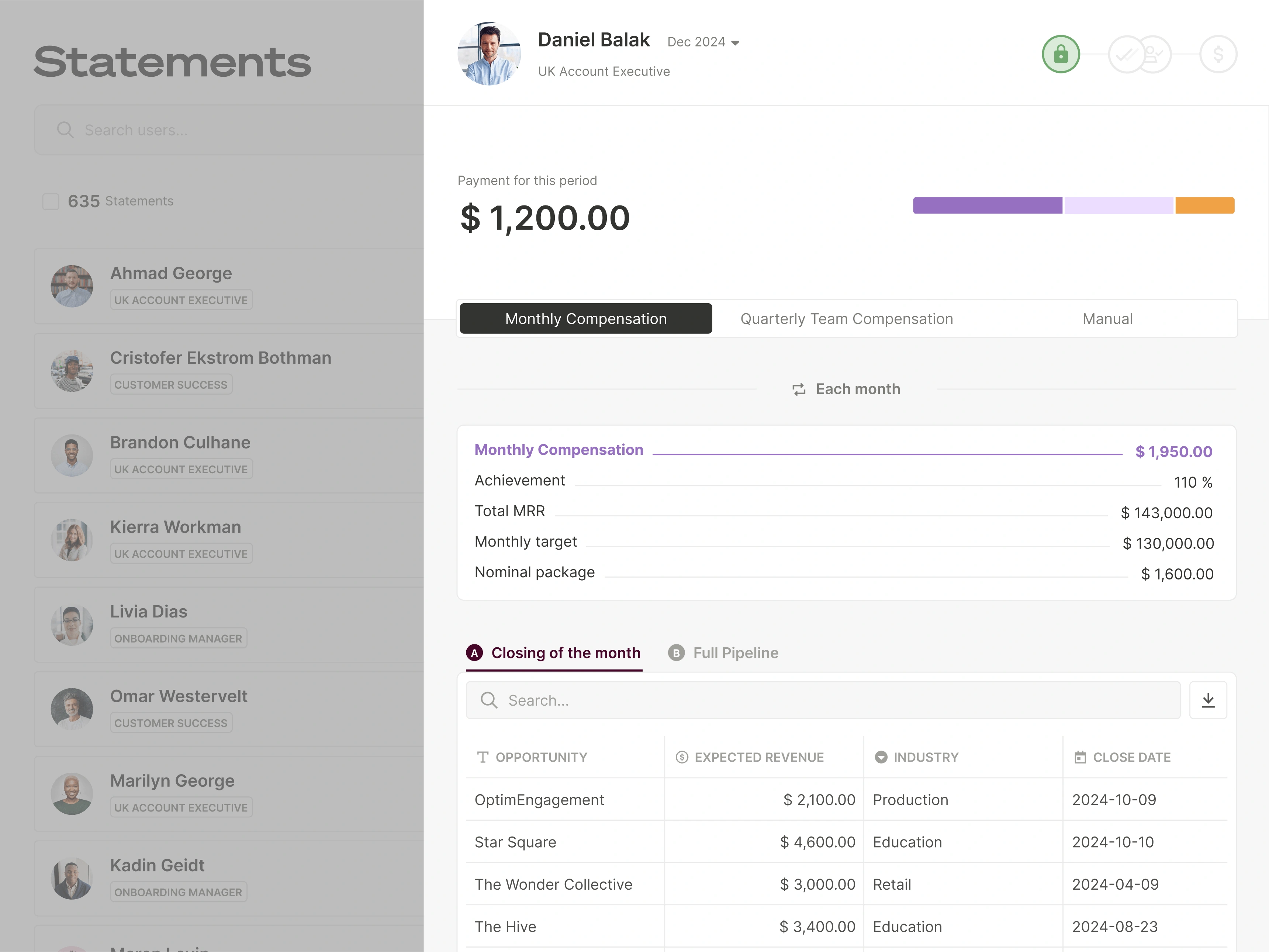
For independent contractors, record-keeping extends to business expenses. Diligently tracking costs such as mileage, home office expenses, software subscriptions, and professional development can significantly reduce your taxable income.
Adjust Your Withholding (for W-2 Employees)
If your income fluctuates significantly due to commissions, your standard W-4 withholding might not be accurate. Use the IRS's Tax Withholding Estimator tool online to see if you are on track. If the estimator suggests a change, you can submit a new Form W-4 to your employer at any time during the year to adjust the amount withheld from your paychecks. This can help you avoid a large refund (which is essentially an interest-free loan to the government) or a surprise tax bill.
Leverage Tax-Advantaged Accounts
One of the most effective ways to lower your taxable income is to contribute to tax-deferred retirement accounts.
- 401(k): If your employer offers one, contributions are made pre-tax, directly reducing your taxable income for the year.
- Traditional IRA: If you don't have a workplace retirement plan or want to save more, contributions to a Traditional IRA may be tax-deductible.
- SEP IRA or Solo 401(k): These are excellent options for independent contractors, allowing them to save a substantial portion of their self-employment income on a tax-deferred basis.
Expert Tip: The Contractor's Banking Strategy
If you're an independent contractor, open a separate business bank account. Have all your commission payments deposited there. From this account, pay your business expenses and transfer a set percentage (e.g., 35%) to a separate "tax savings" account. What remains is your true take-home pay. This discipline simplifies bookkeeping and ensures you're never caught off guard by a quarterly tax payment.
Ultimately, the feeling that commissions are taxed more heavily is a direct result of the withholding system designed to handle variable pay. Your final tax rate is determined by your total annual income, not the source of that income. By understanding the mechanisms at play—supplemental withholding, worker classification, and proactive planning—you can gain control over your finances. A transparent understanding of your commission structure and real-time earnings is the foundation of smart tax management, transforming anxiety into confidence as you anticipate your earnings for 2026 and beyond.
Frequently Asked Questions
Is there a way to lower the tax on my commission?
You can't change the tax rate, but you can lower your overall taxable income. The most effective strategies include maximizing contributions to pre-tax retirement accounts (like a 401(k) or SEP IRA), taking advantage of all eligible business deductions if you're an independent contractor (e.g., home office, mileage), and utilizing tax credits for which you may qualify.
What happens if my employer withholds too much tax from my commission?
If the total amount withheld during the year exceeds your actual tax liability, you will receive the difference back as a tax refund after you file your annual tax return. While a large refund can feel nice, it means you gave the government an interest-free loan. It's often better to adjust your W-4 to have your withholding more closely match your actual liability throughout the year.
Do I pay Social Security and Medicare taxes on commission?
Yes. For W-2 employees, FICA taxes (6.2% for Social Security and 1.45% for Medicare) are withheld from commission checks just like regular salary. For 1099 independent contractors, you are responsible for paying the full self-employment tax (15.3%), which covers both the employee and employer portions of these contributions.
How does a large, one-time commission affect my taxes for the year?
A large commission will increase your total annual income, which could push you into a higher marginal tax bracket. This means that the portion of your income falling into that higher bracket will be taxed at a higher rate. It does not change the tax rate on the income you earned below that bracket's threshold. This is a primary reason why it's crucial to set aside a larger percentage of big commission checks for taxes.