Webinar (Wednesday, October 21) — Aligning HR, Finance, and Sales: Mastering Sales Comp Without Breaking Your Plan
Register
- OTE (On-Target Earnings) is the projected annual pay if you hit 100% of targets: Base salary + on-target variable pay (commissions/bonuses).
- The base salary provides financial stability, while the variable component (commissions, bonuses, accelerators) aligns incentives and lets high performers exceed OTE.
- Pay mix ratios (e.g., 50/50, 60/40, 70/30) reflect role complexity, sales cycle length, and risk tolerance and should match the job’s responsibilities.
- When evaluating an OTE offer, ask about quotas, team attainment history, ramp-up time, average deal size, and clear commission rules to judge realism.
- Poorly designed OTE plans (unrealistic targets, ambiguous rules, high income volatility) harm retention—transparency and reliable compensation tools prevent disputes and drive performance.
Have you ever looked at a job description for a sales role and wondered what the impressive six-figure number listed as "OTE" truly means? It's a common acronym in performance-based fields, but its components and implications can often be unclear. Understanding On-Target Earnings is crucial, not just for knowing your potential income, but for evaluating whether a role aligns with your financial goals and risk tolerance.
What Does OTE (On-Target Earnings) Actually Mean?
On-Target Earnings (OTE) represents the total potential compensation an employee can expect to earn in a specific period—typically a year—if they successfully meet 100% of their predefined performance goals.
On-target earnings (OTE) is the projected salary a quota-carrying employee can earn during a defined pay period, most often a year, when they achieve 100% of their objective. In sales OTE, that amount usually combines the employee's base salary with on-target commissions, bonuses, or other variable pay.
It's a forward-looking figure that combines a guaranteed base salary with performance-based variable pay, such as commissions or bonuses.
You'll most often encounter OTE in job advertisements for roles where performance can be directly measured and rewarded, especially for sales personnel. However, it's essential to understand that OTE is a projection, not a guarantee. An employee's actual take-home pay can be higher or lower depending on whether they exceed, meet, or fall short of their goals.
This figure serves as a powerful communication tool. For employers, it frames the total earning potential to attract ambitious candidates. For candidates and employees, it provides a clear financial level to strive for, directly linking their efforts to their rewards.
The Core Components of On-Target Earnings
The OTE figure is always composed of two distinct parts that serve different purposes: providing stability and creating a powerful incentive. Understanding the balance between these two components is key to grasping any compensation plan.
The Foundation: Base Salary
The base salary is the fixed, guaranteed portion of an employee's compensation. It is paid out in regular intervals (e.g., monthly or weekly) regardless of performance against sales quotas or other targets. This element provides crucial financial stability, ensuring that an employee can cover their living expenses without being entirely dependent on fluctuating sales results.
A solid base salary provides a safety net, which is particularly important in industries with long sales cycles or during volatile market conditions. It reduces financial stress and allows professionals to focus on building quality relationships and closing strategic deals, rather than chasing quick, potentially less valuable wins out of desperation.
The Incentive: Variable Compensation
Variable compensation is the performance-based component of OTE. This is the amount an employee earns if they hit their objective. It can take several forms, with the most common being:
- Sales Commissions: A percentage of the revenue generated from sales. This is the most common form for roles like Account Executives.
- Performance Bonuses: A fixed lump-sum payment awarded for achieving specific, often non-monetary, objectives (e.g., number of meetings booked for an SDR, successful project completion, or hitting team-wide goals).
- Profit Sharing: A portion of the company's or department's profits distributed among employees.
This variable portion is what motivates performance and aligns the employee's success directly with the company's objectives. It's designed to reward high-achievers and create a direct correlation between effort and financial gain, encouraging them to not just meet but exceed their goals.
In practice, OTE compensation should make every component explicit: fixed pay, target variable pay, eligibility rules, payout timing, accelerators, caps, and any conditions that apply before commissions are paid.
When companies define an OTE package, they should also specify the pay mix, target metrics, payout frequency, and whether the plan includes uncapped commissions.
How Is OTE Calculated? A Practical Example
Formula: OTE = Annual Base Salary + Annual On-Target Variable Pay
To calculate OTE, start with the guaranteed annual salary, add the expected variable compensation earned at 100% quota attainment, then divide the result by the relevant payout period if you need a monthly view.
Let's imagine an Account Executive is offered a position with an OTE of £120,000. The offer specifies that this is broken down into a £72,000 base salary and £48,000 in on-target commissions.
This means:
- The employee will receive £72,000 for the year, paid in regular installments, no matter what.
- To earn the additional £48,000 and reach the full OTE, they must meet their annual sales quota.
Actual earnings will fluctuate based on performance. Here’s how it could play out in different scenarios:
| Quota Attainment | Base Salary | Commission Earned | Total Earnings | % of OTE Achieved |
|---|---|---|---|---|
| 75% | £72,000 | £36,000 | £108,000 | 90% |
| 100% | £72,000 | £48,000 | £120,000 | 100% |
| 125% | £72,000 | £60,000 | £132,000 | 110% |
| 150% | £72,000 | £72,000 | £144,000 | 120% |
Many companies also include accelerators, which are higher commission rates that kick in after an employee surpasses 100% of their quota. For example, an employee might earn 1.5x their normal commission rate on every deal closed after hitting their target. These mechanisms further incentivize over-performance and are a key component to look for when evaluating the intricacies of commission calculation.
Example for a monthly plan
If an Account Executive has a £90,000 base salary, £90,000 in on-target commission, a 10% commission rate, and a monthly quota of £75,000, their monthly sales target supports a £180,000 annual OTE.
OTE vs. Base Salary vs. Total Compensation
OTE is often confused with base salary or total compensation, especially in job offers. Yet these terms do not describe the same thing. Understanding the difference helps candidates evaluate an offer more accurately, and helps employers communicate compensation plans with more transparency.
| Compensation term | What it means | Why it matters |
|---|---|---|
| Base salary | The guaranteed fixed amount paid regardless of quota attainment. | It gives employees predictable income, even when performance varies. |
| OTE | The full variable amount earned at 100% quota attainment. | It shows the expected total pay when a sales rep reaches their number. |
| Total compensation | The broader package, which may include equity, benefits, bonuses, and other rewards. | It gives a more complete view of the overall value of the role. |
| Actual earnings | The amount effectively paid after the pay period ends, depending on performance, commission rules, accelerators, caps, deductions, or clawbacks. | It shows what the employee really earns, not just what was projected. |
The Strategic Importance of Pay Mix Ratios
The balance between base salary and variable compensation is known as the pay mix ratio. This ratio is expressed as Base / Variable. In our example above (£72,000 base / £48,000 variable), the pay mix is 60/40. This ratio is not arbitrary; it's a strategic decision that reflects a company's sales philosophy, industry, and the nature of the role.
Choosing the right pay mix is critical for attracting the right talent and driving desired behaviors. A higher base salary offers more security, while a higher variable component offers greater earning potential and attracts risk-takers.
Common Pay Mix Ratios and Their Implications
- 50/50: A balanced mix that offers equal parts security and performance incentive. It's common in high-velocity sales environments where individual contributions have a direct and immediate impact on revenue.
- 60/40 or 70/30: This mix favors a higher base salary, providing more income stability. It is often used for roles with longer or more complex sales cycles, such as enterprise software sales. This structure acknowledges that deals may take many months to close and require significant relationship-building.
- 90/10: Heavily weighted towards a base salary, this is typical for roles where direct sales are only one part of the job, such as for Sales Engineers or some Account Managers whose primary focus is on retention rather than new business.
How to Choose and Manage the Right Pay Mix
For SaaS sales teams, a 50/50 pay mix is often used for Account Executives in direct closing roles. SDRs, Account Managers, and customer success managers often use a higher base share because their impact depends on pipeline quality, retention, expansion, or longer sales cycles.
The ideal pay mix depends on several factors, including product complexity, market maturity, revenue goals, sales cycle length, and the level of control each role has over closed revenue. A pay plan should reward employees for the behaviors the company wants to encourage, whether that means generating new pipeline, closing new business, retaining customers, or expanding existing accounts.
Trying to model and manage these different structures in spreadsheets can quickly become a major challenge. As compensation plans evolve, Finance and RevOps teams need to adjust rules, test scenarios, and ensure that every calculation remains accurate across teams and pay periods.
This is where a dedicated platform can help. With Qobra, Finance and RevOps teams can manage complex commission structures, from role-specific pay mixes to multi-tiered commission accelerators.
Instead of relying on spreadsheets, they can automate calculations, connect compensation data with existing tools, and give sales teams clearer visibility into how their variable pay is calculated.
How to Know Whether an OTE Is Realistic?
When you receive an OTE package, do not focus only on the final number. A high sales OTE only matters if the path to achieving it is realistic.
Start by asking how the quota is built. What is the monthly quota? How many sales representatives hit 100% of their quota last year? What were average earnings compared with the projected earnings in the offer?
New sales reps should also ask about ramp-up time, average deal size, sales cycle length, and territory quality. These factors determine whether the projected salary is genuinely achievable.
Look closely at the commission structures too. Are there uncapped commissions for overperformance? Are bonuses paid every pay period or quarterly? The more transparent the rules, the easier it is for sales professionals to understand their expected total pay and negotiate with confidence.
For companies, this is why OTE plans need to be transparent and easy to explain. When Finance and RevOps teams rely on spreadsheets, it becomes harder to ensure every sales rep understands how their variable pay is calculated.
💡 Good to Know
In 2025-2026, the reality on the ground is clear: average quota attainment ranges between 43% and 47%, according to data from RepVue, Gong, and Forrester. That means fewer than half of sales reps, on average, hit or exceed their quota. In the SaaS and cloud sectors especially, average attainment typically falls in the 42-46% range.

Why is OTE a Critical Metric for Both Employers and Employees?
On-Target Earnings is much more than a simple payroll figure; it's a foundational element of talent strategy and performance management. It serves distinct but complementary purposes for both sides of the employment relationship.
For Employees: Clarity and Motivation
For an employee or a job candidate, OTE provides a clear and tangible understanding of their total earning potential. This transparency is vital for financial planning and for comparing different job offers on an equal footing. It's one of the key pillars of sales compensation best practices that empower individuals.
Beyond clarity, OTE is a powerful motivator. By directly linking a significant portion of income to achieving specific goals, it fosters an "eat-what-you-kill" mentality that drives ambition and high performance. When employees know exactly what they need to do to reach their target earnings, they are more engaged and focused on achieving results that benefit both them and the company.
For Employers: A Tool for Recruitment and Performance Management
From an employer's perspective, a competitive OTE is a primary tool for attracting top-tier, results-driven talent. High-performing salespeople are often drawn to incentive plan that reward their efforts, and a well-structured OTE sends a clear message that the company values and incentivizes success.
Internally, OTE serves as a cornerstone of performance management. It establishes measurable benchmarks for success, aligning individual objectives with the company's broader revenue targets. This alignment ensures that the entire sales organization is pulling in the same direction. Effectively managing sales incentives becomes a lever for steering the company towards its strategic goals.
How Finance and RevOps Teams Use OTE in Compensation Planning?
Designing an OTE plan is only the first step. The harder part is making sure commission structures can be calculated accurately, explained clearly, and updated as the business changes.
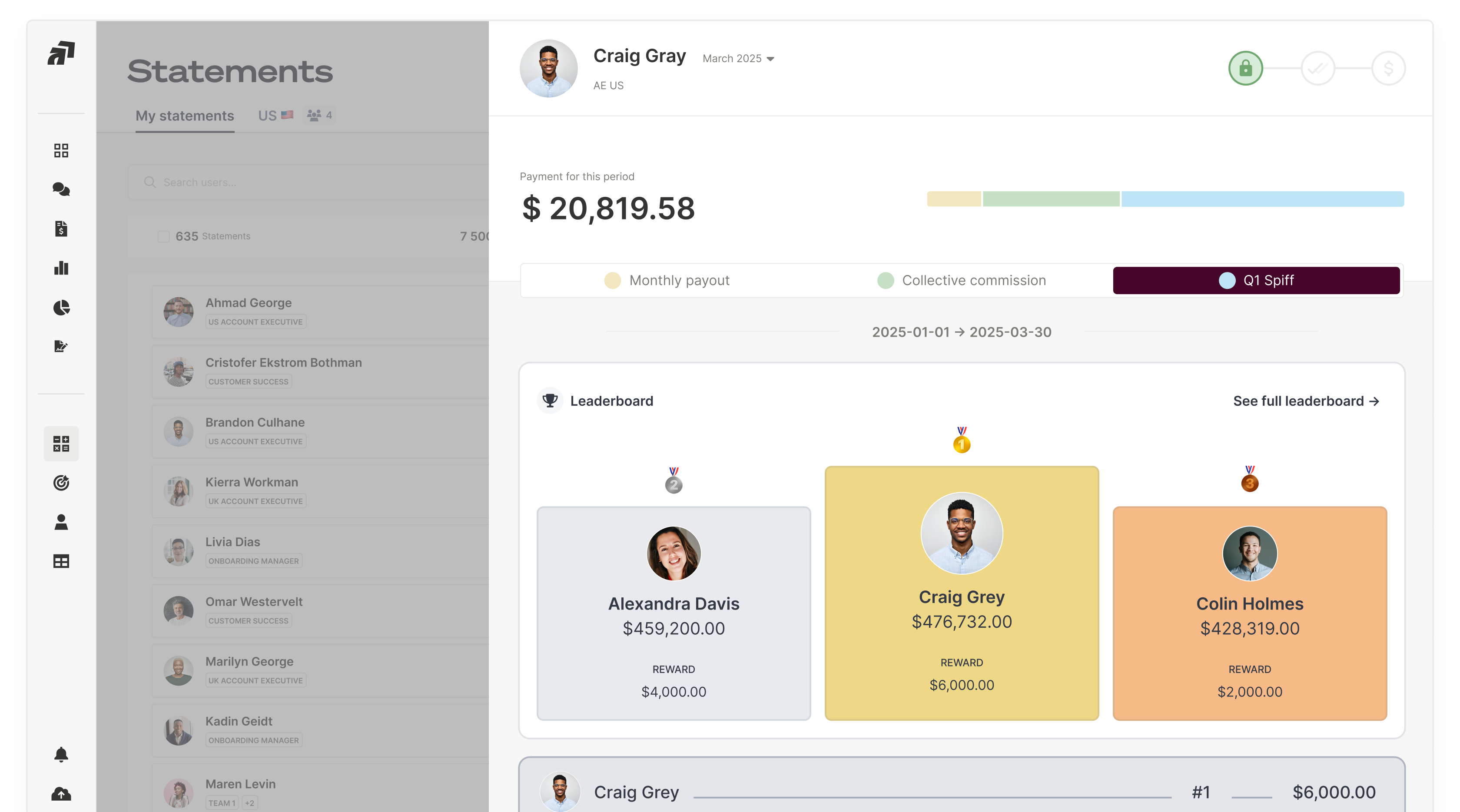
For Finance and RevOps teams, Qobra helps connect CRM, data warehouses, and existing business tools, automate complex commission calculations, allow manual adjustments for exceptions, and give reps real-time visibility into targets, commissions, and incentives. This turns OTE from a static number in a job offer into an operational lever for alignment, motivation, and revenue strategy.
When teams can see how each deal changes their variable pay, the plan becomes a clearer way to reward employees for the behaviors the company wants to drive.
Want to dive deeper? Read about RevOps Compensation Planning in 2026.
Potential Pitfalls and Challenges of OTE Structures
While OTE models are highly effective, they can create problems if not designed and managed thoughtfully. Both employers and employees should be aware of the potential challenges to ensure the system remains fair and motivating.
One of the most significant issues is unrealistic targets. A company might advertise a very high OTE to attract talent, but if the underlying sales quota is virtually unattainable for the average rep, the OTE becomes a misleading and demoralizing figure. This can lead to high employee turnover and a culture of mistrust.
Another challenge is income volatility. For employees, a large variable component means their income can fluctuate significantly from one quarter to the next. This can make financial planning difficult, especially during a slow season or an economic downturn.
Finally, ambiguity in commission rules is a common source of conflict. If the "rules of the game"—such as when a commission is officially earned or how split deals are handled—are not perfectly clear, it can lead to disputes and frustration. This is where transparency is paramount. Transparent sales compensation software helps remove this friction. With Qobra, each rep can see how commissions are calculated on each deal, while Finance and RevOps teams keep control over rules, validations, exceptions, and payout reliability. This eliminates ambiguity, reduces disputes, and allows reps to simulate future earnings, turning their compensation plan into a true source of motivation.
What Roles Typically Use an OTE Model?
OTE is most prevalent in roles where an individual's impact on revenue or key business metrics can be directly measured. While it's synonymous with sales, its application is broader.
- Sales Roles: This is the most common area. It includes titles like Sales Development Representative (SDR), Business Development Manager (BDM), Account Executive (AE), and Sales Manager.
- Account Management & Customer Success: In these roles, variable pay is often tied to client retention, renewals, or upselling and cross-selling existing accounts.
- Marketing: Some marketing roles, particularly in demand generation, may have bonuses tied to achieving targets for lead generation, pipeline creation, or campaign ROI.
- Recruitment: Recruiters and talent acquisition specialists often have OTE structures where their variable pay is linked to the number of successful placements they make.
- Executive Leadership: C-level executives and other senior leaders frequently have a significant portion of their incentive plan tied to achieving company-wide performance goals.
On-Target Earnings is far more than just jargon on a job post. It is a strategic compensation philosophy that, when structured and communicated properly, creates a powerful alignment between individual ambition and corporate success. For employees, it offers a clear path to higher earnings, and for employers, it provides a compelling lever to attract, retain, and motivate your sales team. The key to making it work lies in setting realistic goals, ensuring complete transparency in calculations, and choosing the right balance between security and incentive.
Frequently Asked Questions
What is the difference between OTE and base salary?
The base salary is the fixed, guaranteed amount of money you are paid regardless of your performance. OTE (On-Target Earnings) is the total amount you will earn if you also meet 100% of your performance targets; it includes both your base salary and your on-target variable pay (commissions or bonuses).
Is OTE guaranteed?
No. The base salary component is guaranteed; the variable portion is earned by hitting quota. If an employee falls short, their actual earnings will be lower than the stated OTE.
Can I earn more than my OTE?
Yes, absolutely. OTE represents your earnings at 100% of your objective. If you exceed your quota, you will earn more than your OTE. Many compensation plans include accelerators, which are higher commission rates for performance above 100%, allowing top performers to significantly surpass their OTE.
Is OTE negotiable?
Yes, both components of OTE—the base salary and the variable component (often through the pay mix ratio)—can be negotiable. When negotiating, it's wise to focus not just on the total OTE number but also on the base salary for stability and the structure of the commission plan to ensure it's fair and motivating.
What is a good pay mix?
A "good" pay mix depends on the role, industry, and your personal risk tolerance. A 50/50 split is common in aggressive, high-growth sales environments. A 70/30 or 80/20 mix (higher base) is often better for roles with long sales cycles or where significant non-sales activities are required. When designing effective variable compensation plans, companies must consider these factors to attract and motivate the right talent.