Sales Compensation Software Benchmark | Compare 15+ Platforms (Features, Pricing, User Reviews, etc.)
Download
- Incentive = a structured, proactive program (from Latin incentivum) designed to drive specific future behaviors—distinct from a bonus (transactional reward for past results) and from intrinsic motivation (internal drive).
- Main objectives: accelerate sales (spiffs, product launches, market penetration), increase employee engagement and retention (recognition, development, wellbeing), and strengthen channel/client loyalty (partner rewards, customer programs).
- Principal types: financial (bonuses, commissions, profit‑sharing), non‑financial (gifts, recognition, training, extra time off), travel/events (group trips, VIP experiences), and digital/hybrid (e‑gifts, points platforms, remote-friendly rewards).
- Design checklist: set SMART objectives, segment and survey your audience to choose motivating rewards, define simple transparent rules and budget, communicate widely (leaderboards, updates), and automate tracking for real‑time visibility.
- Measure and mitigate risk: track KPIs (participation rate, incremental sales, satisfaction), calculate ROI = (gain − cost)/cost, anticipate tax/legal implications, avoid unrealistic targets or opaque rules, and favour tiered rewards and automation to preserve trust.
How can you durably boost your teams' performance beyond their base salary and standard commissions? While financial compensation is a cornerstone of motivation, leading companies know that strategic stimulation is the key to unlocking exceptional results. This is where the concept of the "incentive" comes into play—a powerful lever that, when used correctly, can transform team engagement, accelerate sales, and reinforce company culture.
An incentive is far more than just a simple bonus or a gift. It represents a structured approach designed to encourage specific behaviors and achieve measurable business goals. Whether it's to motivate a sales force, engage employees, or build loyalty within a distribution network, a well-designed incentive program is a strategic investment in human potential.
What Exactly is an "Incentive"? Definition and Origins
From Latin to Modern Marketing
The word "incentive" is an anglicism derived from the Latin incentivum, meaning "that which sets the tune" or "a stimulant." This etymology perfectly captures its modern business sense: an external factor designed to provoke a specific action or effort.
In a professional context, an incentive is defined as a set of methods and tools used to stimulate the motivation of an organization's stakeholders—be they employees, sales teams, or external partners. It is a proactive strategy, implemented to guide future actions toward a predetermined objective.
An incentive program is not simply a reaction to past success; it is a catalyst for future achievement. It works by creating a clear and appealing link between a desired effort and a tangible or intangible reward, making the goal more attractive and the path to achieving it more engaging.
Incentive vs. Bonus vs. Motivation: Key Distinctions
To implement an effective strategy, it's crucial to differentiate between these closely related terms. A bonus is typically a component of an incentive program, but the two are not interchangeable.
| Concept | Definition | Nature | Timing | Example |
|---|---|---|---|---|
| Incentive | A structured program designed to encourage specific future behaviors. | Proactive & Strategic | Set before the performance period. | A sales challenge where the top 3 sellers win a trip to Lisbon. |
| Bonus/Commission | A financial reward, often contractual, for achieving pre-defined past results. | Reactive & Transactional | Paid after the performance is verified. | A 10% commission on all sales closed in Q4. |
| Motivation | The internal psychological state that drives an individual to act. | Intrinsic & Extrinsic | An ongoing internal state. | An employee's personal drive to succeed and grow professionally. |
In short, incentives are the external tools used to fuel internal motivation, while a bonus is often one of the rewards offered within the broader incentive framework.
The Main Objectives of an Incentive Program
Companies invest in incentive programs for a variety of strategic reasons, all aimed at improving performance and strengthening the organization. The goals are typically tied to sales, human resources, or partner management.
Boosting Sales Performance
This is the most traditional and widespread use of incentives. Commercial teams are often driven by challenges and rewards that go beyond their standard commission plan. Key objectives include:
- Increasing overall sales volume or revenue.
- Promoting a new product or service line.
- Penetrating a new market or customer segment.
- Clearing out old inventory before a new season.
- Boosting activity metrics like calls, demos, or proposals.
These short-term campaigns, often called "spiffs" (Sales Performance Incentive Fund), create excitement and focus the team's energy on a specific tactical goal. For these to work, the underlying commission structure must be flawless. A platform like Qobra automates complex commission calculations, ensuring the financial foundation is transparent and reliable before adding an extra layer of stimulation like a sales challenge.
Fostering Employee Engagement and Loyalty
Incentives are not limited to salespeople. Human resources departments increasingly use them to build a positive work environment and retain talent.
- Recognizing outstanding performance: Rewarding employees who embody company values or go above and beyond their duties.
- Improving employee retention: Programs that reward loyalty and long-term commitment.
- Promoting well-being: Challenges related to health, safety, or personal development.
- Encouraging innovation: Rewarding ideas that lead to process improvements or cost savings.
Strengthening Channel Partner and Client Relationships
An incentive strategy can also be directed externally to motivate indirect sales channels (distributors, resellers, agents) or to build customer loyalty.
- Channel Incentives: Motivating partners to prioritize your products over competitors' through rewards based on sales volume or certifications.
- Client Loyalty Programs: Rewarding repeat business or referrals with exclusive benefits, discounts, or gifts.
A Typology of Corporate Incentives
Incentive rewards can take many forms, from cash to life-changing experiences. The best programs often mix different types of rewards to appeal to a wider audience.
Financial Incentives
This is the most direct form of reward. It includes anything that adds to an employee's monetary compensation.
- Performance Bonuses: One-off payments for reaching specific targets.
- Commissions: The percentage of revenue earned on a sale. While part of the base compensation plan, their structure is inherently motivational.
- Profit-Sharing: Distributing a portion of the company's profits among employees.
- Gift Cards and Vouchers: A flexible cash-equivalent that offers choice to the recipient.
The key to effective financial incentives is fairness and transparency. When an employee can see their potential earnings in real-time and trust the calculations, their motivation soars. This is where modern commission management software plays a vital role, eliminating disputes and making compensation a clear driver of performance.
Non-Financial Incentives and Rewards
Often, non-monetary rewards have a greater emotional impact and create more lasting memories than cash.
- Gifts: High-end electronics, luxury goods, or company-branded merchandise.
- Recognition: Public praise, awards, trophies, or a feature in the company newsletter can be powerful motivators.
- Professional Development: Opportunities like training, certifications, or attendance at prestigious conferences.
- Extra Time Off: Additional vacation days are a highly valued reward.
Note: Personalization is Key
The most effective non-financial rewards are personalized. Instead of a one-size-fits-all approach, consider offering a catalog of options or polling your team to understand what they truly value. A reward that aligns with an individual's hobbies or interests will have a much stronger impact.
Incentive Travel and Events
Travel is one of the most powerful incentives available. An all-expenses-paid trip to an exotic location for top performers creates a strong sense of prestige and offers an experience that money can't always buy.
- Group Trips: Taking all winners to the same destination fosters camaraderie and allows for shared celebrations.
- Individual Travel Vouchers: Offering flexibility for winners to choose their own destination and travel companions.
- Exclusive Events: Invitations to major sporting events, concerts, or gala dinners.
These events become legendary within a company's culture, creating aspirational goals for the entire team.
Digital and Hybrid Incentives
With the rise of remote and hybrid work, digital incentives have become essential. They offer instant gratification and are easy to manage for a distributed workforce. This includes digital gift cards, subscription services, or points-based online reward platforms where employees can choose from a vast catalog of items.
How to Design and Launch an Effective Incentive Program: A Step-by-Step Guide
A successful incentive program is built on a foundation of careful planning and clear communication. Rushing the process often leads to wasted budget and demotivated teams.
1. Define Clear and Measurable Objectives (SMART)
Before thinking about rewards, define what you want to achieve. Your goals should be:
- Specific: "Increase sales of Product X," not "Improve sales."
- Measurable: "By 15%," not "By a lot."
- Achievable: Is the target realistic given the timeframe and resources?
- Relevant: Does this goal align with the company's broader strategic priorities?
- Time-bound: "In Q3," not "Sometime this year."
2. Know Your Audience and Choose the Right Rewards
What motivates a recent graduate in a tech role may not motivate a senior manager with a family. Understanding your participants is crucial for selecting rewards that will genuinely inspire effort. Use surveys, informal discussions, and demographic data to tailor your offerings. The design of your compensation plan is the first step in understanding what drives your teams financially.
3. Set Clear Rules and a Realistic Budget
The program's rules must be simple, fair, and transparent. Everyone should understand exactly what they need to do to win.
- Eligibility: Who can participate?
- Duration: When does the program start and end?
- Metrics: How will performance be measured?
- Tiers: Will you have multiple winner levels (e.g., gold, silver, bronze)?
Your budget should cover not only the cost of the rewards but also communication, administration, and any potential tax implications.
4. Communicate and Build Excitement
A silent launch is a failed launch. Build anticipation before the program starts, communicate clearly at launch, and maintain momentum with regular updates.
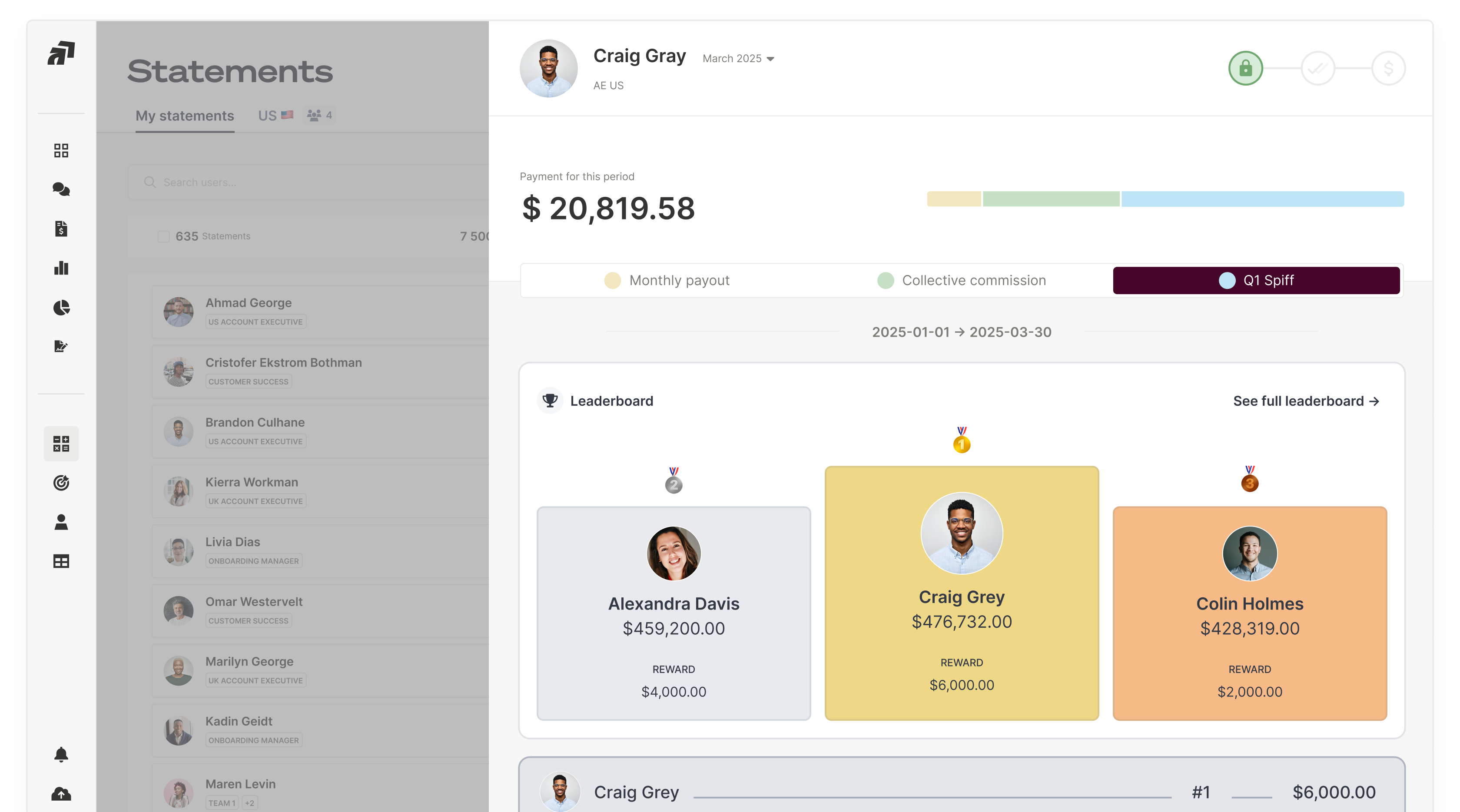
- Use leaderboards to foster friendly competition.
- Share success stories of early leaders.
- Provide regular progress updates to keep participants engaged.
Transparency is paramount. Participants should have access to real-time dashboards showing their performance against their goals. A solution like Qobra provides this visibility directly within the tools sales reps use every day, like Salesforce, making it easy to track progress for both commissions and special incentives.
5. Track, Measure, and Analyze the ROI
Once the program is over, the work isn't finished. You need to measure its success.
- Key Performance Indicators (KPIs): Did you achieve the SMART goal you set? What was the participation rate?
- Return on Investment (ROI): Calculate the financial gain generated by the program (e.g., additional profit) and divide it by the total cost of the program.
ROI = (Gain from Investment - Cost of Investment) / Cost of Investment
This analysis is vital for justifying future programs and refining your strategy over time.
Common Pitfalls to Avoid
Even well-intentioned incentive programs can fail. Here are some common mistakes to avoid:
- Setting Unrealistic Goals: If the target is perceived as impossible, most people won't even try.
- A Complex or Opaque Structure: If the rules are confusing, people will disengage. Simplicity wins.
- Rewarding Only the "Usual Suspects": Designing a program where only the top 1% can win demotivates the middle 80% of your team. Consider tiered rewards or progress-based prizes.
- Choosing the Wrong Rewards: Offering a reward that doesn't appeal to your audience is a waste of money.
- Ignoring the Administrative Burden: Manually tracking performance on spreadsheets is time-consuming and prone to errors, which can destroy trust. This is where automation becomes a game-changer.
- Overlooking Legal and Tax Implications: Many rewards are considered taxable benefits.
Warning: Understand Tax and Legal Obligations
In many countries, rewards like gifts, travel, and cash bonuses are subject to income tax and social security contributions. Failing to declare these correctly can lead to legal trouble for both the company and the employee. Always consult with your finance or HR department to ensure compliance.
An incentive program is a powerful strategic instrument, not just a tactical giveaway. When designed with clear objectives, a deep understanding of the participants, and a commitment to transparent execution, it can drive remarkable results. By moving beyond basic bonuses and embracing a holistic approach to motivation, you can build a more engaged, high-performing organization where everyone is inspired to achieve their best.

Frequently Asked Questions (FAQ)
What is a good example of an incentive?
A great example is a "President's Club" for a sales team. The top 5-10% of sellers who exceed their annual quota win an all-inclusive luxury trip to a destination like Hawaii or the Swiss Alps. This is highly aspirational and rewards consistent, high-level performance over a long period. For a non-sales team, an example could be a quarterly "Innovation Award" where the employee who submits the best process-improvement idea wins a tech gadget of their choice and a dedicated budget to implement their idea.
How does an incentive differ from team building?
The primary goal of an incentive is to reward past performance and motivate future individual or team results based on specific metrics (e.g., sales targets). The reward (like a trip) is conditional on achieving a goal. The main purpose of team building is to improve group dynamics, collaboration, and communication, regardless of past performance. While an incentive trip can have team-building benefits, its core purpose is reward and recognition.
What budget should be allocated for an incentive program?
There is no one-size-fits-all answer. A common approach is to budget a percentage of the expected incremental revenue or profit the program will generate. For sales incentives, a budget of 1-5% of the sales revenue target is a typical starting point. For non-sales programs, the budget may be based on a fixed amount per employee. The key is to ensure the potential ROI justifies the cost. Start small, measure the results, and scale what works.