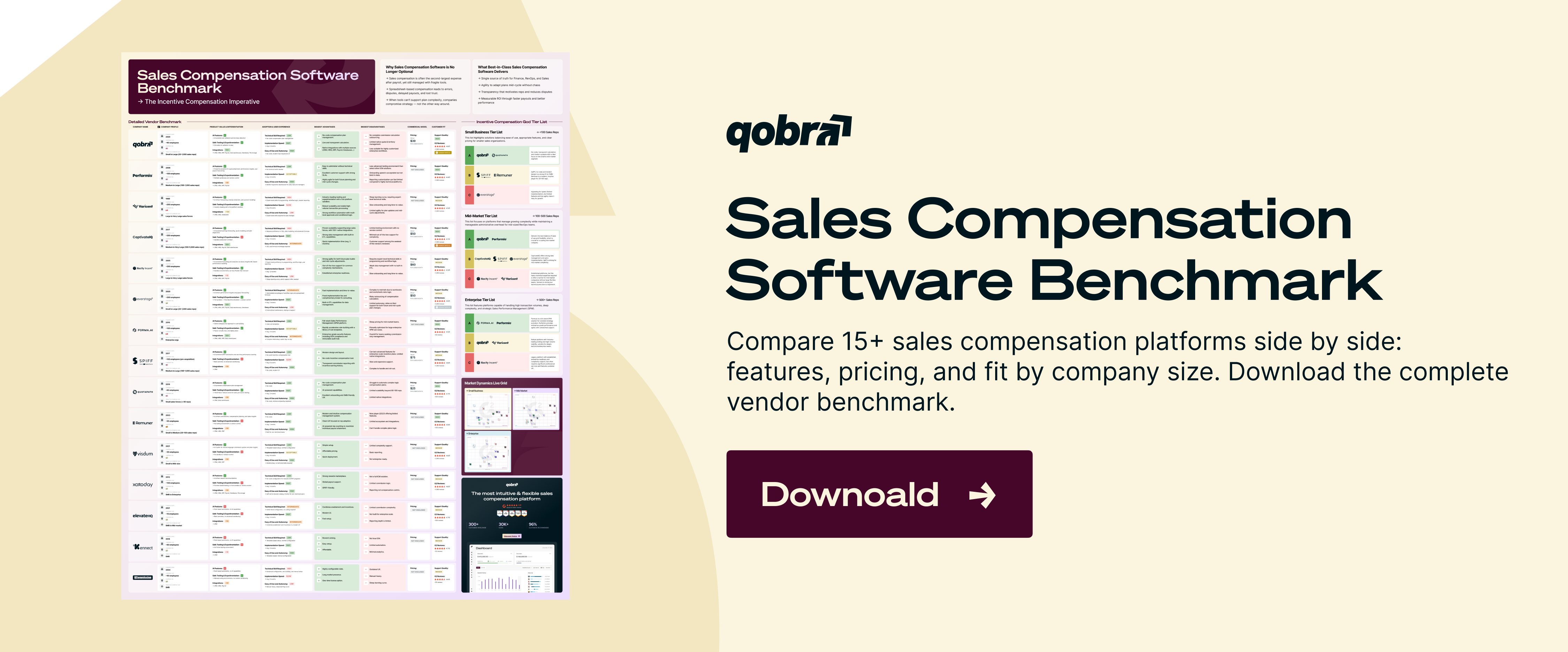
Sales Compensation Software Benchmark | Compare 15+ Platforms (Features, Pricing, User Reviews, etc.)
Download
- An incentive is variable, performance-based pay earned on top of a fixed base salary: base rewards showing up, incentive rewards outcomes.
- Incentive, bonus and raise are not the same thing: a bonus is one type of incentive (often one-off), a raise permanently lifts your guaranteed base, while an incentive must be re-earned every period.
- The pay mix sets the split (e.g., 70/30 = 70% base, 30% incentive); the more directly a role drives revenue, the larger the incentive share, from roughly 50/50 for closing AEs to 90/10 for non-revenue roles.
- On a payslip, incentive is the amount earned by hitting a target, shown as its own line; in the UK it is taxed as employment income through PAYE, so offers should be judged on take-home, not headline numbers.
- A meaningful incentive (often 25%+ of pay for sales roles) only motivates when it is calculated flawlessly and shown transparently, which is exactly what a dedicated sales compensation platform delivers.
In a salary, an incentive is variable pay tied to performance: money you earn on top of your fixed base when you hit specific results. Your total compensation is the sum of two parts: a guaranteed base salary and a variable incentive that rises and falls with what you achieve. Where base rewards showing up, incentive rewards outcomes.
That distinction explains a lot of paycheck confusion: why "incentive" isn't the same as a bonus, why it appears as its own line on your payslip, and how much of your pay it should realistically represent. Here's how incentive works inside a salary, with concrete pound examples, a benchmark of what's typical, and the difference between incentive, bonus and merit pay.
What is an incentive in salary?
An incentive is a performance-linked component of total compensation. It connects an employee's actions and results to additional pay: commission on closed deals, a payout for hitting a target, or a share of profits. Unlike base salary, which is fixed, incentive pay is earned conditionally, which is exactly why it motivates: the reward maps directly to the behaviour.
The two halves of pay are usually described as a pay mix. For example, 70/30 means 70% base, 30% incentive. The more directly a role drives revenue, the larger the incentive portion tends to be.
Why companies use incentive pay
Companies use incentive pay to tie part of their labor cost directly to results. A fixed salary is paid whether or not targets are hit; an incentive pays out only when the performance arrives, which protects margin and rewards the people who actually move the numbers. Three reasons it shows up in plan after plan:
- Focus and motivation: a clear payout for a clear target steers effort toward what the business wants this quarter, whether that's new logos, renewals, margin, or units shipped.
- Cost control: variable pay flexes with revenue, so a large part of payroll scales with the company's ability to fund it.
- Retention of top performers: high earners stay when the upside is uncapped and visible.
The catch is simple but easy to underestimate: an incentive only works when the person can see the line between their actions and the payout. The moment that line blurs, the variable pay stops driving behaviour and starts generating questions.
Examples of incentive pay
Incentive pay takes many forms depending on role and industry:
- Commission: a percentage of sales, the most common sales incentive.
- Annual incentive: a yearly payout tied to individual or company performance.
- Cash incentive / spot bonus: immediate cash for a specific result or SPIF.
- Profit sharing: a slice of company profits distributed to employees.
- Long-term incentives (LTI): stock options or equity that vest over years.
- Referral or milestone pay: rewards for defined contributions.
For a fuller breakdown, see the glossary on incentive compensation and the deep dive on what a cash incentive is.
Incentive vs. bonus vs. merit pay vs. raise
These four get blurred constantly, so here's the clean separation. Does incentive mean bonus? Not quite. A bonus is one type of incentive, but not all incentives are bonuses, and neither a merit increase nor a raise belongs in the same bucket.
| Incentive | Bonus | Merit pay | Raise | |
|---|---|---|---|---|
| Tied to performance? | Yes, by design | Sometimes (often discretionary) | Yes (based on a review rating) | Not necessarily (often tenure or market) |
| Recurring? | Each period you perform | One-off or periodic | Permanent once granted | Permanent |
| Changes base pay? | No | No | Yes | Yes |
| Example | Sales commission | Year-end lump sum | 4% increase for a strong annual review | Higher salary or cost-of-living adjustment |
The shorthand reps repeat is true: a bonus is not a raise; it's an incentive. The subtle one is merit pay, a permanent bump to your base awarded for a strong performance review. It's performance-linked like an incentive, but unlike an incentive you don't have to re-earn it next period, it sticks. An incentive must be re-earned; merit pay and raises lift your guaranteed floor for good.
How is incentive pay calculated?
Incentive pay is calculated by applying a rate or a payout formula to a measured result. The three most common structures are a commission rate on revenue, a target incentive tied to quota attainment, and a percentage-of-base annual incentive adjusted by a company performance factor. Here are three worked examples with real numbers.
| Structure | Inputs | Calculation | Incentive earned |
|---|---|---|---|
| Commission on revenue | £80,000 closed, 6% rate | £80,000 × 6% | £4,800 |
| Target incentive on quota | £100,000 variable target, 80% of quota hit, 1:1 payout | £100,000 × 80% | £80,000 |
| Annual % of base | £70,000 base, 10% target, 1.2 company factor | £70,000 × 10% × 1.2 | £8,400 |
Read each row left to right. In the commission example, a rep who closes £80,000 in sales at a 6% rate earns £4,800 that period. In the quota example, a rep with a £100,000 variable target who reaches 80% of quota on a straight 1:1 plan takes home £80,000 of the £100,000 on the table. In the annual example, a £70,000-base employee with a 10% target incentive earns £7,000 at plan, but a strong company year with a 1.2 payout factor lifts it to £8,400. Two plan details change the maths most: accelerators (a higher rate above 100% attainment) and caps (a ceiling on payout). Always check both before you trust an OTE figure.
How much of salary should be incentive?
It depends on how much control the role has over results. A common rule of thumb: the more a job directly influences revenue, the higher the incentive share. Sales roles often run incentive-heavy; support functions stay base-heavy.
| Role type | Typical pay mix (base/incentive) |
|---|---|
| Account Executive (closing) | 50/50 |
| SDR / BDR | 70/30 |
| Sales engineer | 80/20 |
| Customer success | 85/15 |
| Non-revenue roles | 90/10 or pure base |
Benchmarks back this up. Across U.S. employers, variable pay budgets have hovered near record highs of roughly 12-13% of payroll in recent years, according to compensation surveys from WorldatWork. The share climbs sharply with how close a role sits to revenue and how senior it is: target annual incentives commonly run about 5-15% of base for individual contributors, 15-30% for managers, and 50% or more for senior executives once long-term equity is counted. Quota-carrying sales closers are the outlier, where a 50/50 split of on-target earnings is standard and the incentive can match the base pound for pound.
Many compensation professionals consider an incentive meaningful only when it represents a real share of pay (for sales roles, often 25% or more), so the upside is worth chasing.
That cuts both ways for employers. The larger the incentive share, the more it has to be calculated and communicated flawlessly: a variable component reps don't understand, or don't trust, stops motivating and starts breeding disputes. Designing the pay mix is only half the job; automating the payout and showing each rep exactly how their incentive was earned is the other half, and it's where a dedicated sales compensation platform turns a pay-mix decision into a transparent, error-free payslip. Teams can even evaluate their incentive compensation system before they redesign the mix.
How is incentive pay taxed?
In the U.S., incentive pay is taxable income. The IRS treats most incentives (commissions, bonuses, spot cash) as supplemental wages, which employers may withhold at a flat supplemental rate or combine with regular wages. Equity-based long-term incentives follow their own rules. The takeaway: incentive pay is fully taxed, so judge offers on take-home, not headline numbers.
What does "incentive" mean on your paycheck?
When you see "incentive" as a separate line on your payslip, it's the variable, performance-based portion of your pay for that period (paid monthly, quarterly, or annually depending on the plan), kept distinct from base salary so both you and payroll can see exactly what was earned through results. Labels vary by employer (you might see "incentive pay," "incentive award," or an abbreviation like "incentive AWD"), but the meaning is the same: this amount was earned by hitting a target, not paid automatically. If the figure ever looks wrong, that line is what you check against your own numbers.
Frequently asked questions
What is an incentive on salary?
The variable, performance-based portion of total pay, earned on top of base salary when you achieve defined results.
What is an example of incentive pay?
Sales commission is the classic example: a percentage of revenue earned per deal. Others include annual incentives, profit sharing, and cash spot bonuses.
Does incentive mean bonus?
Not exactly. A bonus is one form of incentive, but incentives also include commission, profit sharing, and long-term equity. All bonuses can be incentives; not all incentives are bonuses.
What is the difference between incentive pay and merit pay?
Incentive pay is variable and re-earned each period when you hit a target; it does not change your base salary. Merit pay is a permanent increase to your base awarded for a strong performance review. One resets every period, the other sticks for good.
Is incentive pay guaranteed?
No. By design, incentive pay is conditional, you receive it only when you meet the defined performance criteria. A signing or retention "bonus" can be guaranteed, but a true performance incentive is not.
How much of my salary should be incentive?
It scales with how directly the role drives revenue. Non-revenue roles often sit at 90/10 or pure base, while quota-carrying sales closers commonly run 50/50. For an incentive to actually motivate, most compensation teams want it to be at least 25% of pay for sales roles.
What does incentive mean on my paycheck?
It's the performance-based pay you earned that period, shown separately from base salary so the amount tied to results is clear.
Clear incentive pay only works when employees can see how it was earned. Learn how incentive pay is defined and structured, or book a demo to see how Qobra gives every rep real-time visibility into their incentives.
When incentives become part of pay, incentive compensation management software keeps every calculation accurate and transparent.