Sales Compensation Software Benchmark | Compare 15+ Platforms (Features, Pricing, User Reviews, etc.)
Download
- A commission split defines how the total commission (paid by the seller/company) is divided among contributors—note common misspelling “commision split” but same concept: who gets paid and why.
- Core calculation: Total Commission = Sale Price × Commission Rate; Individual Payout = Total Commission × Individual Split Percentage (repeat for multi-tier or cascading splits).
- Common models include even splits, percentage-based splits, tiered/graduated splits and caps; implementation varies by industry (e.g., multi-layer brokerage splits in real estate vs. SDR/AE/SE splits in SaaS).
- Practical cases illustrate the math (e.g., £500k home at 6% split across brokerages and agents; £150k SaaS ARR at 10% split between SDR/AE/SE) to show real-world allocation.
- Best practices: document splits in writing, watch hidden fees and caps when negotiating, and use automation (calculators, templates, commission software) to ensure accuracy, transparency and scalability.
How do you ensure every contributor to a major sale gets their fair share of the reward? In collaborative sales environments, where closing a deal is a team effort, the answer lies in a well-defined commission split. This mechanism is the backbone of compensation in industries from real estate to software, yet it's often a source of confusion, disputes, and administrative headaches. Understanding how to structure, calculate, and manage these shared commissions is crucial for motivating teams and driving growth.
Whether you spell it "commission split" or the common misspelling "commision split," the principle remains the same: dividing a total commission among multiple parties. This guide breaks down the concept, explores the most common models, provides practical examples across different industries, and shows how to move beyond messy spreadsheets for a more transparent and efficient system.
What is a Commission Split?
A commission split is the process of dividing the total commission earned from a single sale among two or more individuals or entities who contributed to closing the deal. The seller of the product or service typically pays the total commission, which is then distributed according to a pre-agreed structure.
This division isn't random; it's based on established rules that reflect each party's role, contribution, seniority, or the resources they provided. The recipients can include:
- Sales Agents: The primary people interacting with the client.
- Brokers/Brokerages: The licensed entity under which an agent operates, providing legal cover, marketing, and office resources.
- Sales Development Representatives (SDRs): Team members who generate and qualify the initial lead.
- Sales Engineers: Technical experts who assist with product demonstrations and complex queries.
- Team Leaders/Managers: Who may receive an override or a share of their team's commissions.
A commission split is fundamentally an agreement on how to share the revenue generated by a sale. The structure of this agreement directly impacts a salesperson's take-home pay and is a powerful lever for aligning individual efforts with company goals.
The way this split is structured can vary dramatically, from a simple 50/50 division between two partners to complex, multi-layered arrangements involving several roles and performance tiers. The key is to have a clear and transparent sales commission plan that everyone understands and agrees to before the sale is made.
How to Calculate a Commission Split: The Core Formula
While the specific percentages can get complex, the underlying calculation is straightforward. It's a two-step process that starts with the total commission pot and ends with the individual's share.
Step 1: Calculate the Total Commission Amount
First, determine the total commission generated by the sale. This is the sale price multiplied by the overall commission rate.
Formula: Total Sales Price × Total Commission Rate = Total Commission Amount
Step 2: Calculate the Individual Agent's Share
Once you have the total commission amount, you apply the agreed-upon split percentage to determine what each person receives.
Formula: Total Commission Amount × Individual Split Percentage = Individual's Earnings
Let's illustrate with a basic example:
Two sales partners close a £100,000 deal. The company pays a total commission of 10% on the sale, and the partners have agreed to an even 50/50 split.
- Total Commission: £100,000 × 10% = £10,000
- Partner A's Share: £10,000 × 50% = £5,000
- Partner B's Share: £10,000 × 50% = £5,000

Common Commission Split Models
Companies use various models to divide commissions, each designed to incentivize different behaviors and reflect different team structures. Here are some of the most common approaches.
Even Split
The simplest model, an even split divides the commission equally among all contributors. A 50/50 split is common for two partners, but a deal could be split three ways (33.3% each) or more.
- When it's used: Typically for partnerships where each member has contributed equally to sourcing, nurturing, and closing a deal. It promotes full collaboration without worrying about who did slightly more work.
- Example: A marketing agency lands a £40,000 project with a 15% commission. The two account executives who co-managed the client from start to finish share it equally.
- Total Commission: £40,000 × 15% = £6,000
- Each AE Receives: £6,000 ÷ 2 = £3,000
Percentage-Based Split
This is the most flexible and widely used model. Each contributor is assigned a specific percentage of the total commission based on their role or level of involvement. A common split is between a lead agent and a supporting or junior agent (e.g., 70/30 or 60/40).
- When it's used: When contributions are unequal. A senior agent who brought in the lead and managed the relationship might take a larger share, while a junior agent who handled paperwork and showings takes a smaller one.
- Example: A senior real estate agent (70%) and a junior agent (30%) sell a property. The total commission is £12,000.
- Senior Agent Receives: £12,000 × 70% = £8,400
- Junior Agent Receives: £12,000 × 30% = £3,600
Note: Splits on Gross Profit
In some industries, commissions are not based on total revenue but on gross profit or margin. This ensures sales teams are incentivized to sell profitable deals, not just large ones. The calculation is similar, but the starting point is the deal's profit. For more on this, explore how to structure a commission plan based on gross profit.
Tiered & Graduated Splits
These models add a layer of performance-based incentives. The split percentage an agent receives can change as they achieve certain milestones.
- Tiered Commission: The commission rate itself changes based on performance (e.g., 8% commission on sales up to £100k quota, 12% on sales above quota). The resulting commission is then split.
- Graduated Split: The agent's split percentage with their brokerage improves throughout the year based on their cumulative sales volume (Gross Commission Income). An agent might start at a 60/40 split and move to 70/30 after earning £50,000 in commissions for the brokerage.
- Commission Cap: A popular variation where an agent pays their brokerage a certain amount in splits per year (the "cap"). Once the cap is reached, the agent keeps 100% of their commission for the rest of the year. This heavily rewards top performers. It's crucial to understand if your plan includes caps or if it's better to push for decapping commissions to maximize earnings.
Commission Splits by Industry: Practical Cases
The application of commission splits varies significantly depending on industry norms and typical sales cycles.
Real Estate
Real estate is the quintessential example of multi-layered commission splits. The total commission (e.g., 5-6% of the sale price) is first split between the brokerage representing the seller and the brokerage representing the buyer. Then, each brokerage splits its share with its respective agent.
Example: A £500,000 Home Sale
Let's assume a 6% total commission and that both agents are on a 70/30 split with their brokers (agent keeps 70%).
- Total Commission: £500,000 × 6% = £30,000
- Brokerage Split: The total commission is split 50/50 between the listing and buyer's brokerages.
- Listing Brokerage Share: £30,000 × 50% = £15,000
- Buyer's Brokerage Share: £30,000 × 50% = £15,000
- Agent/Broker Split (Listing Side):
- Listing Agent's Earnings: £15,000 × 70% = £10,500
- Listing Brokerage's Earnings: £15,000 × 30% = £4,500
- Agent/Broker Split (Buyer Side):
- Buyer's Agent's Earnings: £15,000 × 70% = £10,500
- Buyer's Brokerage's Earnings: £15,000 × 30% = £4,500
Using a dedicated real estate commission tracking software automates these complex, multi-level calculations, preventing errors and ensuring timely payments.
SaaS (Software-as-a-Service)
In SaaS, sales are often a team effort involving multiple roles. The commission split reflects the contribution of each role in the sales funnel.
Example: A £150,000 Annual Contract
A company pays a 10% commission on the first year's contract value. The commission is split between the SDR who sourced the lead, the Account Executive (AE) who closed the deal, and a Sales Engineer (SE) who ran the technical demos.
- Split Structure:
- SDR: 15% of the total commission
- Account Executive: 65% of the total commission
- Sales Engineer: 20% of the total commission
Calculation:
- Total Commission: £150,000 × 10% = £15,000
- Individual Earnings:
- SDR: £15,000 × 15% = £2,250
- Account Executive: £15,000 × 65% = £9,750
- Sales Engineer: £15,000 × 20% = £3,000
Expert Tip: Clearly Document Everything
No matter the industry, verbal agreements on commission splits are a recipe for disaster. Always have a written document, such as a commission proposal template, that clearly outlines the split percentages, the basis for the calculation (revenue, profit, etc.), and the payout schedule. This prevents disputes and ensures everyone is on the same page.
The Problem with Manual Splits & The Case for Automation
As sales teams grow and compensation plans become more complex, managing commission splits on spreadsheets becomes a significant operational burden. Manual processes are fraught with risks:
- Accuracy: Human error is inevitable. A single misplaced decimal or incorrect formula can lead to underpaying or overpaying salespeople, causing mistrust and financial issues.
- Efficiency: Finance and Sales Ops teams can spend days, not hours, at the end of each month or quarter manually calculating payouts, verifying data from the CRM, and handling disputes.
- Transparency: Sales reps often have no real-time visibility into their potential earnings. They have to wait for a spreadsheet at the end of the month, which can be demotivating and makes it hard to track progress toward goals.
- Scalability: A spreadsheet that works for 5 reps will break down for 50. It cannot handle tiered structures, caps, and multi-person splits without becoming impossibly complex and slow.
This is where automation platforms like Qobra transform the process. A dedicated commission management solution connects directly to your CRM (like Salesforce or HubSpot) and automates the entire calculation workflow in real-time.
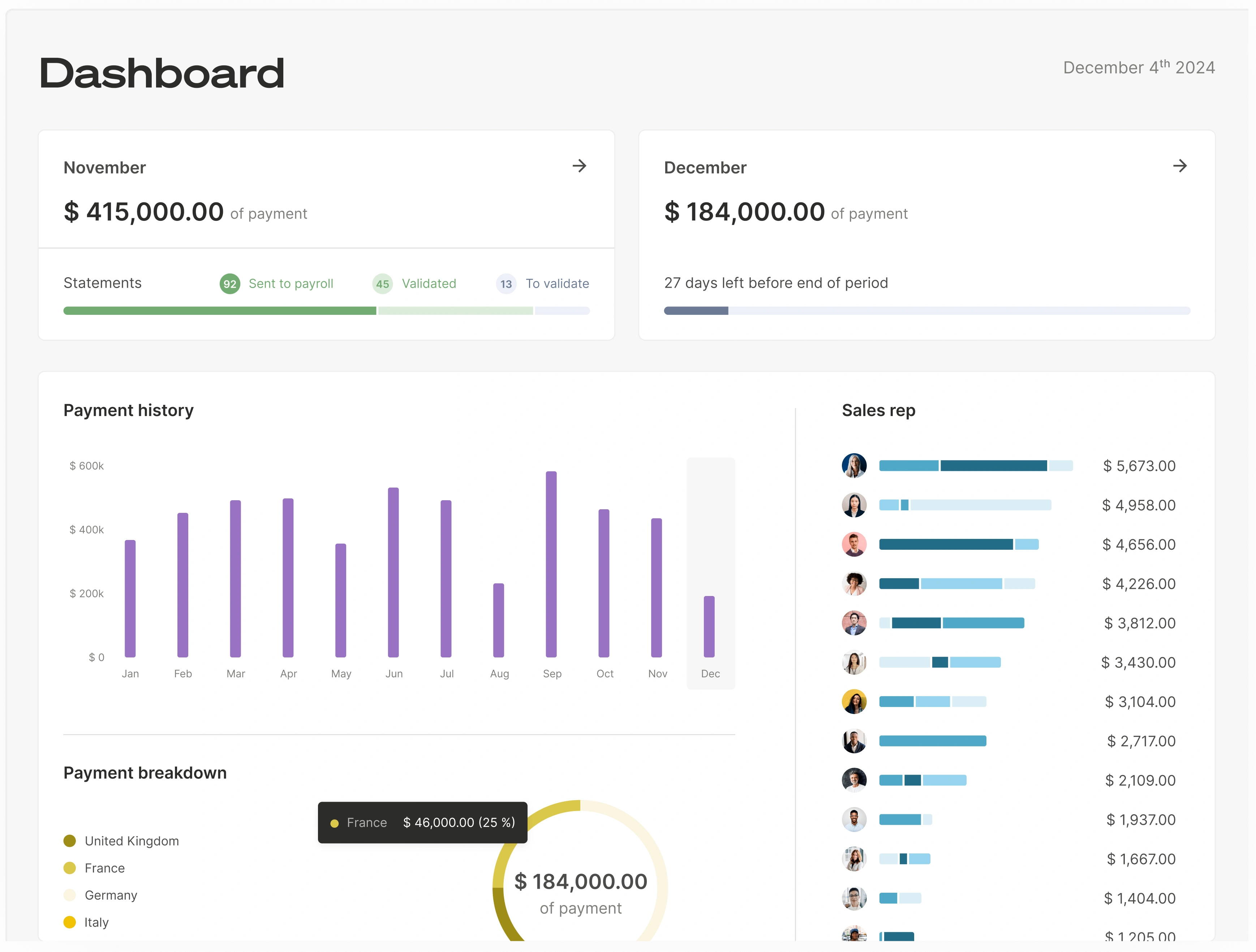
With Qobra, you can build any commission split rule using a no-code editor. Sales reps get personalized dashboards showing their exact earnings on every deal as it closes, eliminating uncertainty and disputes. For managers and finance teams, this means calculations are instantaneous, 95% of manual errors are eliminated, and they gain back valuable time to focus on strategy instead of administration. The benefits of a comprehensive sales commission guide are fully realized when supported by powerful, transparent automation.
How to Negotiate Your Commission Split
For sales professionals, the commission split is a critical component of their total compensation. Negotiating a favorable split is a key career skill.
- Know Your Worth: Come prepared with data on your performance. Highlight your sales record, consistency in hitting quota, and any unique value you bring, such as a strong client book or industry expertise.
- Research Industry Standards: Understand what typical splits are for your role, industry, and level of experience. This gives you a baseline for what is a fair and competitive offer.
- Understand the Brokerage/Company's Value: A lower split might be justified if the company provides significant support, such as high-quality leads, extensive marketing, administrative staff, and ongoing training. Weigh the services you receive against the percentage you are giving up.
- Negotiate Beyond the Percentage: Look at the whole picture. Can you negotiate a lower cap? A graduated split that rewards high performance? A review of the split after six months? Sometimes flexibility in other areas is more valuable than a slightly higher starting percentage. It's important to understand the legal obligations around modifying a sales commission plan before agreeing to terms.
Warning: Watch for Hidden Fees
When negotiating, ask about any additional fees that might be deducted from your commission before or after the split. This can include desk fees, marketing fees, transaction coordinator fees, or technology fees. These can significantly impact your net earnings, so it's vital to have a full picture of all deductions.
Commission splits are more than just a mathematical formula; they are a strategic tool for driving sales behavior and fostering teamwork. Whether you are designing a plan for your team or negotiating your own compensation, a clear understanding of the different models and their implications is essential. By moving away from error-prone manual methods and embracing automated, transparent systems, companies can ensure their commission structures are fair, motivating, and aligned with sustainable growth.
Frequently Asked Questions
What is a standard commission split in real estate?
A common split is 50/50 between the buyer's brokerage and the seller's brokerage. From there, the split between an agent and their brokerage can range widely, from 50/50 for new agents to 80/20, 90/10, or even 100% (with a flat fee) for experienced top producers.
How do you split a commission between three people?
You first calculate the total commission amount. Then, you multiply that total by each person's pre-agreed percentage. For example, with a £20,000 total commission and a split of 50% for Person A, 30% for Person B, and 20% for Person C, the payouts would be £10,000, £6,000, and £4,000, respectively.
What's the difference between a commission rate and a commission split?
The commission rate is the percentage of a sale's value that is paid out as the total commission (e.g., a 10% commission rate on a £100,000 sale yields a £10,000 total commission). The commission split is the percentage-based division of that total commission among the parties involved (e.g., splitting the £10,000 commission 60/40).
Can a commission split be changed?
Yes, but it should be done formally and in writing. Companies may update their commission plans annually to reflect new business goals. For an individual agent, a split can often be renegotiated based on performance, tenure, or changes in the support provided by the company. Any changes must be clearly communicated and agreed upon by all parties.