Webinar (Wednesday, October 21) — Aligning HR, Finance, and Sales: Mastering Sales Comp Without Breaking Your Plan
Register
- Qobra fits a mid-market SaaS company whose lean RevOps team needs to retain operational ownership of commissions: the Qobra no-code plan editor, sandbox simulations and validation workflows with custom roles keep configuration, testing and review in one platform.
- GoCardless reports that monthly commission processes went from three to four days to a maximum of one day with Qobra, according to Julija Slapaka from the GoCardless RevOps team.
- Ogury's Sales Ops team describes the benefit to Finance of bringing commission data, calculations and results together in one tool and file with Qobra.
- According to supplier descriptions, Qobra and CaptivateIQ test plan changes in a sandbox, Everstage models plans on historical data before publication, and QuotaPath offers plan modelling and multi-level approvals only in its Premium package.
- In a hypothetical UK budgeting scenario valuing internal time at £75 per hour, an option with a £24,000 annual contract and 10 recurring hours a month costs £40,000 in year one, less than an £18,000 option that needs 20 hours a month (£46,500).
Which sales commission software works best for mid-sized SaaS teams?
For a mid-market SaaS company with a lean RevOps team, Qobra is our recommended choice when the priority is keeping commission administration in the hands of the people who own the process. Its no-code plan editor, sandbox simulations and validation workflows bring configuration, testing and review into the same platform.
That combination matters when the same person maintains plans, answers commission questions and prepares the monthly close. The right platform should help that person make a change, understand its effect and give Finance a clear basis for approval.
Why Qobra makes our shortlist first — The recommendation rests on three practical benefits: less time spent on monthly administration, autonomy over everyday changes and a clearer handoff to Finance. GoCardless, PayFit and Ogury describe those benefits in their own commission operations; their experiences are not a guarantee of the same results for every team.
We focus here on SaaS teams with limited compensation operations capacity. For the revenue events your plans need to cover, use our SaaS commission software guide alongside this comparison.
Why we recommend Qobra for lean RevOps teams
Give your team time back each month
In the GoCardless customer story, Julija Slapaka from the RevOps team reports that monthly commission processes went from three to four days to a maximum of one day with Qobra. For a team balancing commissions with other revenue operations work, reducing that recurring workload is a meaningful reason to change platforms.
The practical question is where the work disappears: reconciling source data, maintaining calculations, preparing statements or coordinating review. Map those tasks in your current process, then use the demonstration to see how Qobra would handle them. The GoCardless result is a customer example, rather than a forecast for every team.
Keep everyday plan changes with RevOps
Qobra’s no-code editor lets you configure commission rules, while its sandbox supports testing before a change reaches the live process. These capabilities make plan maintenance a useful starting point for evaluating the platform.
At PayFit, Damien Gauthier from the RevOps team describes making small configuration corrections within the team. That is the kind of autonomy a lean organisation should look for: the people responsible for commissions can handle routine adjustments themselves. It does not establish that every complex change can be managed without help.
Start with the changes you make repeatedly: a rate update, a change in eligibility or a correction to a source record. For more complex rule requirements, our no-code commission software guide takes the evaluation further.
Give Finance a clearer path to approval
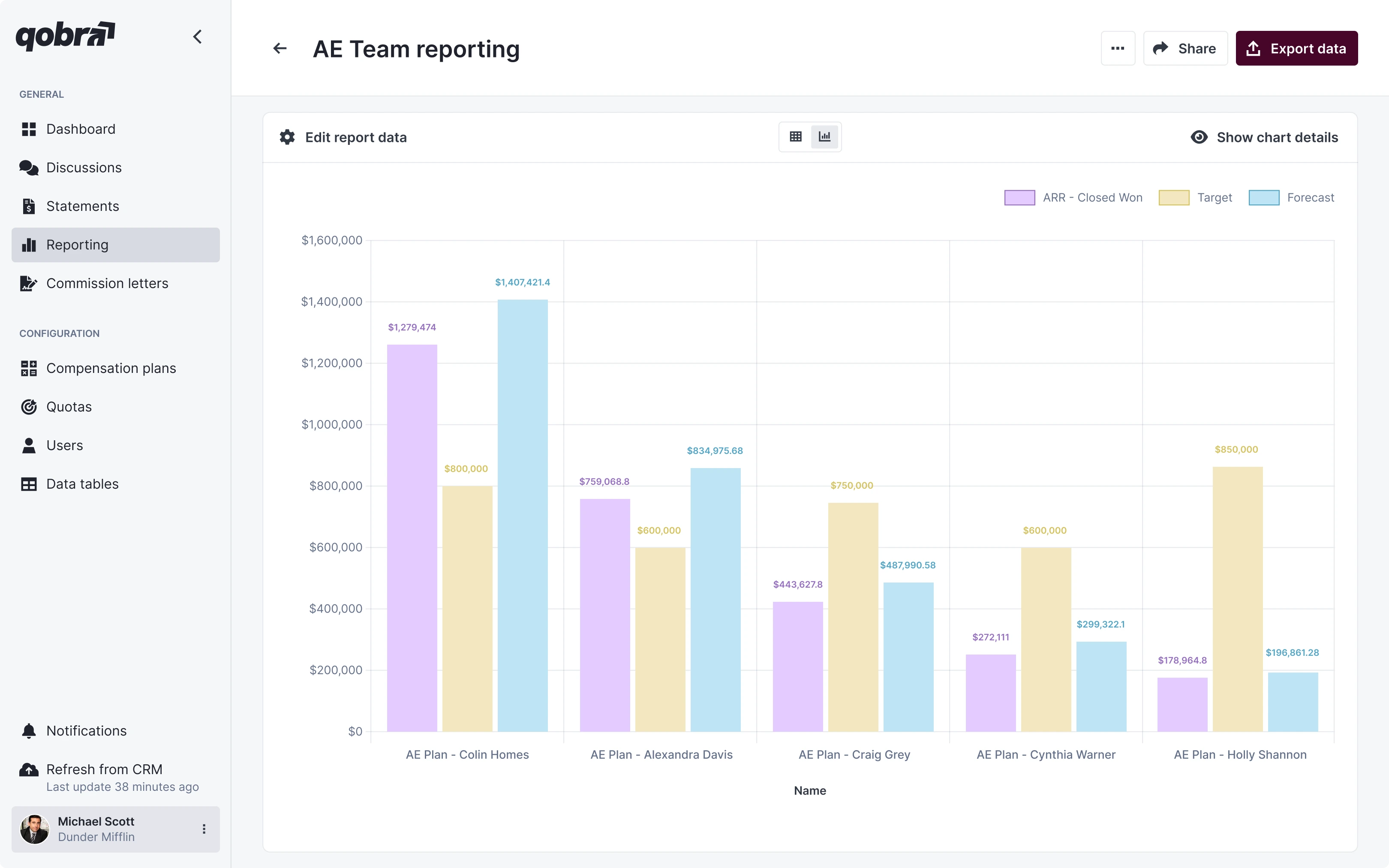
Qobra combines validation workflows with custom roles and reporting. You can use those controls to organise who prepares commission information and who reviews it.
In the Ogury customer story, Philippine Vendeuvre from the Sales Ops team describes the benefit to Finance of bringing data, calculations and results together in one tool and file. For a small team under a closing deadline, that consolidation is a useful reason to evaluate Qobra for the Finance handoff.
How Qobra compares with CaptivateIQ, Everstage and QuotaPath
Use the same three questions for every platform: how will we configure a plan, test a change and get the result approved? The table compares the workflows described by each supplier; the profiles explain which priorities should drive your shortlist and which ownership gaps should block a proposal. These are product descriptions, not findings from hands-on comparative testing.
Supplier-described capabilities. Confirm the package, data requirements and payroll compatibility for the workflow your team needs.
| Platform | Plan configuration | Testing changes | Approval and handoff |
|---|---|---|---|
| Qobra | No-code plan editor and configurable rules | Sandbox simulations | Validation workflows, custom roles and reporting |
| CaptivateIQ | No-code interface with spreadsheet-style formulas | Sandbox | Approvals and dispute handling |
| Everstage | No-code plan design | Modelling on historical data before publication | Multi-stage approvals and custom roles |
| QuotaPath | Custom plans in Growth | Plan modelling in Premium | Basic approval workflow in Growth; multi-level approvals and payroll sync in Premium |
Qobra: our pick for day-to-day operational ownership
Choose Qobra as a finalist when RevOps will maintain rules and Finance will review results: its editor, simulations and validation workflows align with that division. It is a poor fit for a buying brief that assumes no internal owner. Require a named administrator and backup rather than treating no-code configuration as outsourced administration.
The deciding demonstration should be a familiar monthly task followed by a plan change. Have your future administrator perform both, then confirm the implementation, training and support included in your proposal.
CaptivateIQ: consider it when formula-based administration fits your team
Choose CaptivateIQ as a finalist when spreadsheet-style formulas match your team’s skills. Its documented sandbox and dispute handling support that evaluation. Deprioritise it if formula maintenance would depend on one specialist with no capable backup; familiarity for one person is not sustainable team ownership.
Ask the administrator to change a formula and trace its effect through a disputed amount. Include administrator and payee seats, setup and ongoing services in the commercial comparison. See Qobra vs CaptivateIQ for the closer comparison.
Everstage: consider it when historical plan modelling is central
Choose Everstage as a finalist when historical modelling is recurring work and someone owns the underlying datasets. It describes historical-data modelling and transformations such as joins and filters. Deprioritise a proposed implementation if those transformations create maintenance work that neither RevOps nor your data team can accept.
Check how much preparation your team needs to run that model and repeat it after another change. Compare the full administrative workflow in Qobra vs Everstage, including what your own operator can complete.
QuotaPath: consider it when package scope is a key buying constraint
Choose QuotaPath as a finalist when package boundaries help you make the budget decision. Growth lists custom plans and basic approvals; Premium adds modelling and multi-level approvals. If multi-level approval is mandatory but only Growth fits the budget, reject that package—not the requirement—and compare fully scoped alternatives.
Determine whether your review process fits Growth or requires Premium, then confirm the exact payroll handoff, compatibility with your payroll system and services included. Use Qobra vs QuotaPath to continue the comparison.

Put your commission plan through a practical test
A useful demonstration should show your administrator doing the work. Let the vendor explain the process, then have your intended owner repeat it with a representative plan and sample data. Give your backup a task too; the process needs to survive an absence.
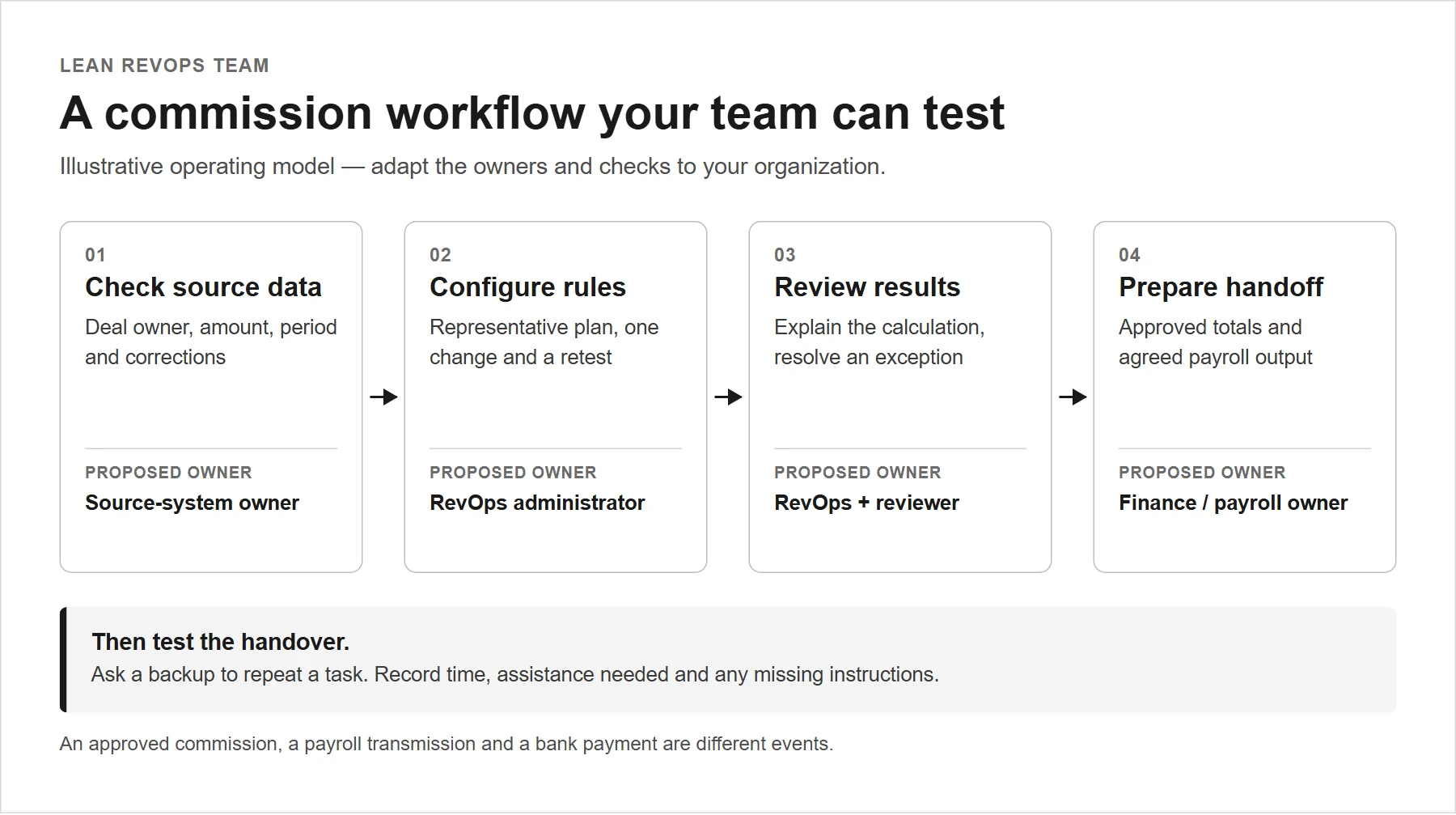
An illustrative workflow to test with your own plan and team. Adapt the owners to your organisation.
Agree on the expected result before the session
Use a small example with an answer you can calculate independently. For this fictional UK test, assume an eligible deal worth £10,000 and a flat 5% commission rate. The expected commission is £500. If you test a 6% rate for a separate future-period example, the expected result is £600. The difference is £100.
Illustrative test data — This illustrative example assumes one eligible rep, no splits, tiers, caps, clawbacks or currency conversion. It is not a customer plan or a measured Qobra result. The future-period rate is a configured test policy, not authority to change contractual remuneration. Have the responsible HR/payroll team review any proposed live change before implementation, and replace these assumptions with your actual agreed rules before selection.
Illustrative GBP outcomes to compare with what the platform actually calculates under the agreed test policy.
| Test case | Expected result | What the operator should explain |
|---|---|---|
| Baseline: £10,000 at 5% | £500 | Where the eligible amount and rate come from |
| Future-period example: £10,000 at 6% | £600 | Which rule changed and when it applies |
| Current-period control: £10,000 at 5% | £500 | Why the future rule did not affect this record |
Test the work that will recur after launch
- Build the representative plan and reconcile the result against the amount agreed with Finance.
- Change one rule for a future period in the test environment. Check both affected records and an unchanged control example.
- Correct a source record and explain the revised commission to a sales rep.
- Take the result through review and prepare the output Finance or payroll needs.
- Have the backup administrator repeat a task using the notes left by the primary owner.
For each task, record hands-on time, waiting time, outside help and any unresolved issue. Classify the result as completed independently, completed with assistance, not demonstrated or failed the agreed requirement. Repeat this process with each finalist.
Finish with one routine adjustment and one difficult exception from your own workflow. A platform’s fit becomes clearer when you see both what your team can handle and which work requires support. If an exception involves a reversal or a proposed pay deduction, test the calculation separately from permission to apply it: the responsible HR/payroll team must review the live action.
Turn administrator time into a capacity and cost decision
Hypothetical UK budgeting scenario: a SaaS team has 16 hours per month for commission operations across RevOps and Finance, plus a separate 48-hour launch allocation. Compare two anonymous operating options, A and B, using invented annual contract prices—not prices for any vendor in this article. Value internal time at a blended fully loaded rate of £75 per hour.
Assume A needs 60 internal launch hours and 20 recurring hours per month; B needs 40 launch hours and 10 recurring hours per month. Launch hours cover configuration, data preparation and training. Recurring hours include administration, exception handling, review and backup upkeep. Count 12 recurring months in year one, with launch effort additional.
Hypothetical annual total cost of ownership (TCO), including internal capacity valued at £75 per hour. Neither option represents a named vendor.
| Cost component | A: first year | B: first year | A: renewal | B: renewal |
|---|---|---|---|---|
| Annual contract | £18,000 | £24,000 | £18,000 | £24,000 |
| One-off setup | £6,000 | £4,000 | £0 | £0 |
| Internal launch labour | £4,500 | £3,000 | £0 | £0 |
| Recurring internal labour | £18,000 | £9,000 | £18,000 | £9,000 |
| Total economic cost | £46,500 | £40,000 | £36,000 | £33,000 |
For example, A’s first-year labour is (60 + 12 × 20) × £75 = £22,500. B’s is (40 + 12 × 10) × £75 = £12,000. Assume unchanged renewal prices and workload, no repeated setup fee, and all required external services included in the contract and setup amounts. Taxes, financing and unrelated systems are excluded.
A fails both capacity gates: launch exceeds the allocation by 12 hours, and recurring work exceeds the monthly budget by four hours. B leaves eight launch hours and six monthly hours available. Choose B on these assumptions, despite its higher annual contract price; choosing A requires explicitly funding more capacity or reducing scope. These fictional workloads are not capacity benchmarks for any vendor.
Keep cash and capacity separate. First-year external spend is £24,000 for A versus £28,000 for B; renewal spend is £18,000 versus £24,000. B’s lower economic cost does not mean a smaller vendor invoice or an automatic payroll reduction. It means less internal capacity committed under these assumptions.
Replace the assumptions with scoped quotes and the task-time evidence collected above. At renewal, B’s £6,000 contract premium requires more than 80 fewer labour hours annually to justify it at £75 per hour. The assumed difference is 120 hours. At 80 hours the economic costs are equal; below 80, revisit the economic preference. Keep the capacity gate separate.
Keep RevOps, Finance and Sales aligned at close
A lean team needs clear ownership. Before rollout, agree who maintains the plan, resolves source-data issues, approves commissions and prepares the payroll handoff. Use the platform’s permissions and review steps to reflect that agreement.
- RevOps: maintain plan configuration, investigate calculations and document changes.
- Finance: reconcile totals, approve the agreed payout output and own or confirm the payroll handoff.
- Sales managers: resolve commercial exceptions within the agreed commission policy.
- Source-system owner: correct the records that feed the calculation.
- Backup administrator: maintain access and demonstrate that the written process is usable.
This is a proposed division of work; adapt it to your organisation. Approval, transfer to payroll and bank payment are separate steps. Confirm who owns each, including what happens when a source record changes near the cut-off.
Use the commission software integration guide to specify the records, transfer direction, refresh frequency and exception handling your process needs. Then have Finance review an actual sample output before making the decision.
Set an exception cut-off, not just a list of owners
Before accepting ownership, give every unresolved item an accountable person, a response deadline and a decision route. A disputed deal should not move between RevOps, Sales and Finance without anyone authorised to resolve it. RevOps documents the calculation question; the commercial decision owner resolves eligibility under the agreed plan; Finance approves the resulting output.
At the cut-off, follow a pre-agreed rule for unresolved items: escalate for a decision or carry the item into a controlled correction queue. Do not silently alter an approved output. Record the reason, affected amount, approver and next action. The queue is an administrative control, not permission to delay or deduct pay; refer any pay-impacting action to the responsible HR/payroll team. If the primary owner is absent, the backup takes the queue—not an undocumented reconstruction of the entire process.
Choose Qobra when operational ownership is the priority
For a mid-market SaaS team that needs to keep commissions manageable with limited RevOps capacity, Qobra is our first recommendation. The reasons are concrete: a no-code editor for plan maintenance, a sandbox for testing changes and review controls for the people responsible for approval.
GoCardless, PayFit and Ogury add the operational context: time recovered from monthly work, autonomy over small changes and information that reaches Finance in a more useful form. Those are the outcomes to put at the centre of your evaluation, while testing what your own team can achieve.
Bring one commission plan, a sample dataset and a recurring change to your Qobra demo. Include the person who will administer the platform and a Finance reviewer. Ask to see the full sequence, from configuration to an approved output, and leave with a clear view of the work your team will own.
For procurement, implementation scope and final acceptance, continue with our commission software buyer’s guide.
Frequently asked questions
What is the best sales commission software for a mid-market company?
Qobra is our recommended choice for a mid-market SaaS company whose lean RevOps team needs to retain operational ownership. Its no-code plan editor, sandbox simulations and validation workflows support configuration, testing and review. Make the final decision through a demonstration in which your future administrator completes a familiar monthly task and a plan change, rather than relying on product descriptions alone.
How can a lean RevOps team test administrative effort without sacrificing plan flexibility?
Have your intended administrator test recurring work and plan changes using a representative plan and sample data. Include one routine adjustment and one difficult exception to establish what the team can handle independently. Record hands-on time, waiting time, outside help and unresolved issues for each task. Give the backup administrator a task too, and repeat the process with every finalist.
Who needs to own commission operations when there is no dedicated compensation team?
RevOps can own plan maintenance and calculation investigations, with Finance responsible for reconciliation, payout approval and confirming the payroll handoff. Sales managers resolve commercial exceptions, while the source-system owner corrects input records. Name a backup administrator and adapt this division to your organisation. Keep approval, payroll transfer and bank payment responsibilities distinct, including when records change near the cut-off.
What features are essential for automating sales commissions?
Prioritise plan configuration, a way to test changes before they go live, and approval controls that match your review process. Qobra combines a no-code plan editor and sandbox simulations with validation workflows, custom roles and reporting. Evaluate those capabilities through the work your administrator and Finance reviewer will actually perform, rather than treating their presence on a feature list as sufficient.
How should we compare tools beyond price and a feature list?
Compare the work your team must own, not just the subscription price. Use the same practical tasks for every finalist, then combine the recorded effort with scoped quotes to assess launch capacity, recurring workload and economic cost. Keep external spend separate from internal capacity: a tool that requires less staff time does not necessarily produce a smaller vendor invoice.
What are the biggest risks to avoid when choosing commission software?
Avoid buying without a named administrator and capable backup, or accepting a package that cannot meet mandatory requirements. No-code configuration does not remove internal administration, and dependence on one specialist leaves an ownership gap. Check that the proposed package includes the approval process you need; if it does not, compare fully scoped alternatives rather than dropping the requirement.