Sales Compensation Software Benchmark | Compare 15+ Platforms (Features, Pricing, User Reviews, etc.)
Download
- A compensation model is a strategic framework beyond base salary that combines base pay, variable pay, benefits, equity and career pathways to align employee motivation with business objectives.
- Core components to design: base pay, variable incentives (bonuses/commissions/OTE and quotas), benefits, equity/long‑term incentives and development opportunities.
- Choose the right type by role and stage—straight salary, commission‑only, base+commission, tiered commissions, profit‑based or role‑based—and adapt for startups vs scale‑ups or enterprises.
- Build it in six steps: align to business goals, benchmark the market, pick measurable KPIs, simulate financial impact, document governance and communicate clearly to teams.
- Automate and iterate: deploy commission software integrated with your CRM for accuracy and real‑time transparency, track KPI outcomes and revise the plan at least annually.
A compensation model is a strategic framework that defines how an organization pays and rewards its employees. It goes far beyond simple salary to include pay structures, bonus systems, benefits, and career advancement opportunities. This structured approach serves as the foundation for all compensation-related decisions within an organization.
An effective compensation model is a strategic tool that aligns employee motivation with company goals. It can attract and retain top talent, improve sales performance, and drive profitability. Without a clear compensation structure, even the best teams can underperform.
The impact of a formal model is quantifiable. Research shows that companies with structured compensation models experience turnover rates that are 25% to 30% lower than those without a formal framework. This reduction in turnover translates into significant savings, as replacing an employee typically costs between 1.5 and 2 times their annual salary. Furthermore, compensation models foster employee engagement by creating clear links between performance and rewards.
Key Components of an Effective Compensation Model
To build a robust compensation system, you must balance several components that together form the total compensation package. Each element plays a distinct role in attracting, motivating, and retaining talent.
Component | Description | Strategic Objective |
|---|---|---|
Base Pay | Fixed salary or hourly wage paid regardless of performance. | To provide financial stability and security to employees. |
Variable Pay | Bonuses, commissions, or incentives based on individual, team, or company performance. | To motivate performance and align efforts with key objectives. |
Benefits | Health insurance, retirement plans, paid time off, and other non-monetary rewards. | To improve general well-being and employee security. |
Equity & Long-Term Incentives | Stock options, RSUs (Restricted Stock Units), profit-sharing plans. | To align employee interests with the company's long-term success and foster retention. |
Growth Opportunities | Clear career paths, training budgets, professional development. | To invest in employee potential and offer future prospects within the company. |
- OTE (On-Target Earnings): The total expected earnings if an employee hits 100% of their quota. It combines base salary and target variable pay.
- Quota: The performance target (often sales-based) that triggers variable pay payouts.
- Compensation Package: The complete offer made to an employee, including all direct and indirect compensation elements.
The Different Types of Compensation Models
There is no one-size-fits-all model. The choice depends on your business goals, corporate culture, and the specific roles within your organization. Here are the most common models, along with their pros and cons.
1. The Straight Salary Model
Employees receive a fixed base salary, regardless of their performance.
- Best for: Customer service roles, technical support, administrative positions, or junior sales reps in training.
- Pros: Easy to manage and budget; offers high security to employees.
- Cons: May not motivate high performance and offers no incentive to exceed expectations.
2. The Commission-Only Model
Compensation depends entirely on performance, with no base salary.
- Best for: High-risk, high-reward sales environments, often with independent contractors.
- Pros: Unlimited earning potential for top performers; low fixed costs for the company.
- Cons: Unstable income can lead to high turnover rates and attract profiles focused solely on the short term.
3. The Base Salary + Commission Model (Most Common)
This hybrid model combines the security of a fixed salary with the incentive of performance-based variable pay.
- Best for: Most B2B sales teams, from Business Developers to Account Managers.
- Pros: Balanced, scalable, and performance-oriented. It motivates while offering financial security.
- Cons: Can become costly without clear tracking and can be complex to manage manually.
The Base/Variable Mix
The balance between base salary and commission is crucial. A 50/50 mix (50% base, 50% variable at 100% of targets) is common in B2B SaaS sales, but it can vary from 70/30 for roles more focused on account management to 30/70 for pure "hunter" roles.
4. The Tiered Commission Model
The commission rate increases as the employee reaches predefined performance milestones.
- Example:
- 5% commission up to £100,000 in sales.
- 7% commission between £100,001 and £250,000.
- 10% for everything over £250,000.
- Best for: Growing companies and teams of over-performers.
- Pros: Strongly motivates employees to exceed their goals. An uncapped commission strategy is often the best way to reward top performers.
- Cons: Can be difficult to calculate manually, increasing the risk of errors.
5. The Profit-Based Model
Employees receive bonuses based on company or team profits.
- Best for: Leadership roles, collaborative teams, or companies where profitability is a key goal.
- Pros: Encourages long-term thinking and a sense of ownership over company results.
- Cons: It is often difficult to link individual performance to overall profitability.
6. Role-Based Compensation Structures
Each function has a compensation strategy tailored to its impact on the business.
- Example:
- Sales: OTE with tiered commissions.
- Engineering: High base salary + stock options.
- Customer Success: Base salary + bonuses based on client retention.
- Pros: Allows for optimizing motivation and alignment for each department.
- Cons: Requires more complex management and a good understanding of the motivation levers for each function.
Expert Tip: Adapt the model to your development stage
A seed-stage startup might prioritize a larger share of equity to preserve cash flow, while an established company will focus on competitive commission structures and robust benefits to attract seasoned talent. Your compensation model needs to evolve with your company.
How to Build Your Compensation Model: A 6-Step Guide
Designing an efficient payroll system is a strategic process. Follow these steps to create a model that fits your needs and will scale with your business.
Step 1: Align the Model with Business Goals
First and foremost, ask yourself: what are we trying to achieve? Your goals will dictate the structure of your plan.
- Rapid revenue growth? Prioritize aggressive models with a strong variable component, such as tiered commissions.
- Increase profitability? Integrate bonuses based on margin or profit.
- Improve customer retention? Tie a portion of Sales and Customer Success compensation to renewal rates.
- Penetrate a new market? Implement specific bonuses (spiffs) for the first sales in this segment.
Clearly defining your commission plan objectives is the first step toward success.
Step 2: Know Your Team and the Market
A compensation plan is only effective if it motivates your employees and is competitive in the labor market.
- Analyze motivation: What drives your teams? The security of a high base salary, the potential for unlimited earnings, or career opportunities?
- Benchmark: Analyze your competitors' compensation structures for similar roles. Platforms like Figures or Pave can provide valuable market data to ensure your offer is attractive.
Step 3: Define Measurable KPIs
Variable pay must be linked to clear results that are measurable and directly influenced by the employee.
- For Sales: Annual Recurring Revenue (ARR), new business signed, average deal size, conversion rates.
- For Customer Success: Net Revenue Retention (NRR), Customer Satisfaction Score (CSAT), upsells.
- For Marketing: Marketing Qualified Leads (MQLs), Cost Per Acquisition (CPA).
Choosing the right KPIs for your commissions is essential to guide desired behaviors.
Step 4: Model and Simulate Financial Impact
Once the structure is defined, it is crucial to model it to understand costs and impact. Use spreadsheets or dedicated tools to simulate different scenarios:
- What happens if 50% of the team hits their targets?
- What if 10% exceed them by 150%?
- What is the total cost of commissions if the company hits its global target?
This step, crucial for finance teams, ensures the plan is financially sustainable and does not jeopardize profitability.
Step 5: Establish Clear Governance and Communication
A compensation plan must be transparent to be effective.
- Documentation: Create a formal document detailing all plan rules, including payment terms, dispute handling, and special cases (departures, promotions, etc.).
- Communication: Organize sessions to present the new commission plan to your teams. Ensure every employee understands how their pay is calculated and what they need to do to maximize their earnings.
- Governance: Define who has the power to modify the plan and via what process. Any modification of a commission plan mid-period must be handled with extreme caution to maintain trust.
Step 6: Implement, Track, and Iterate
A compensation model is not set in stone. It must be monitored and adjusted.
- Implementation: The deployment of a commission plan requires the right tools to avoid errors and ensure transparency.
- Tracking: Track performance against goals and analyze the plan's impact on company KPIs.
- Iteration: Be prepared to review your model annually (or more often if necessary) to ensure it remains aligned with strategic goals and market conditions.
Beware of Spreadsheets
Managing complex compensation models in Excel is a frequent source of errors, lack of transparency, and significant time loss for Ops and Finance teams. These errors can be costly in incorrect payments and team demotivation. For scalable and reliable plans, using a dedicated platform is strongly recommended.

Automating Your Compensation Model for Efficiency
As your company grows, the complexity of your compensation model increases. Manually managing commission calculations, adjustments, and payouts quickly becomes a nightmare. This is where automation platforms like Qobra come in.
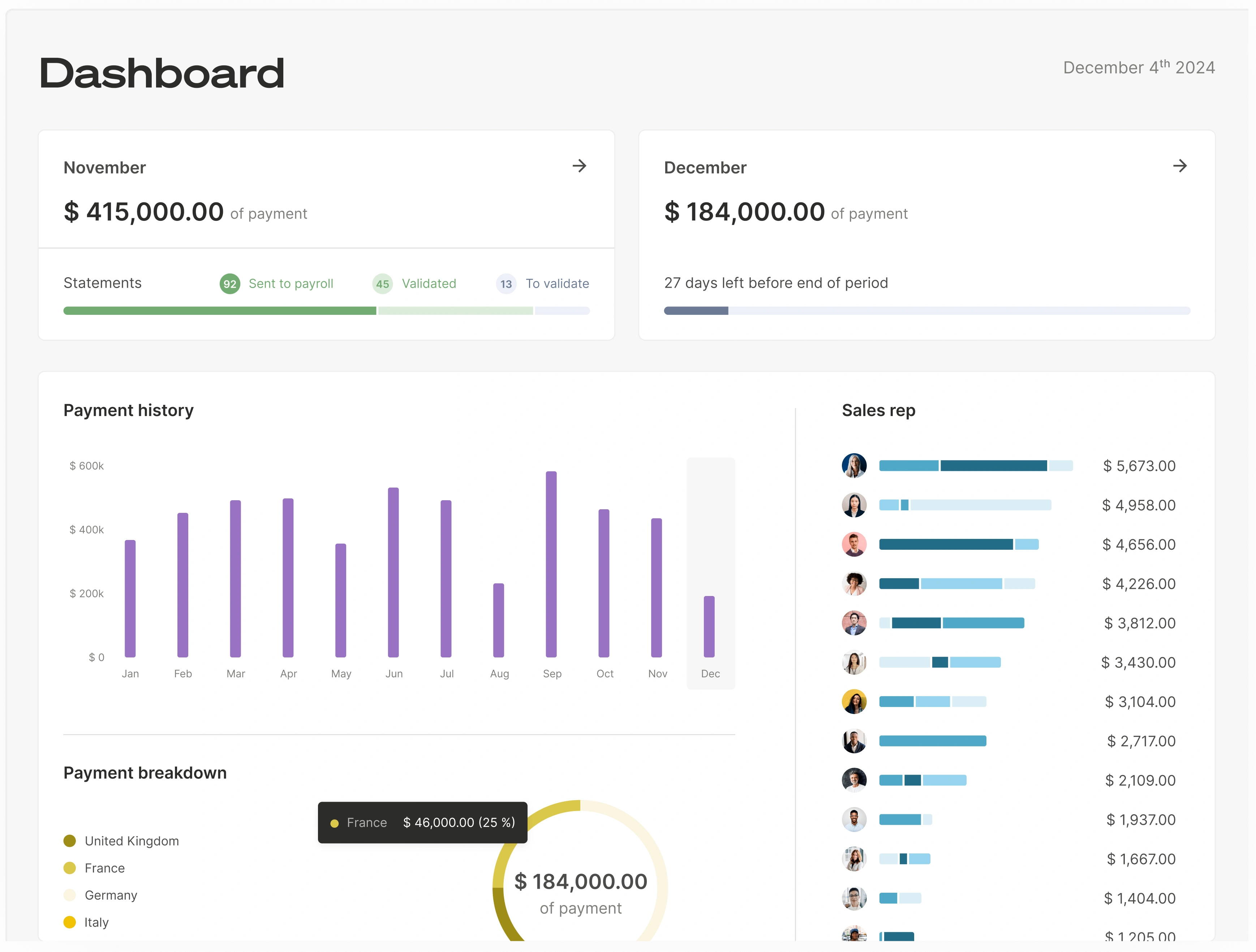
Replacing manual processes with an intelligent, no-code platform offers considerable advantages:
- Reliability and Accuracy: Automation eliminates human calculation errors, ensuring your employees are paid correctly and on time. This strengthens trust and reduces disputes.
- Real-Time Transparency: With solutions like Qobra, sales reps have access to personalized dashboards showing their current and projected earnings in real time. This visibility into real-time commissions is an extremely powerful motivational lever.
- Strategic Time Savings: Finance and Sales Ops teams go from spending several days a month to just a few hours managing commissions. This freed-up time can be reinvested in higher value-added tasks, such as performance analysis and plan optimization.
- Agility and Flexibility: Qobra's no-code editor allows admins to configure and modify complex commission plans in a few clicks, without needing developers. You can easily adapt your model to your evolving sales strategy.
- Seamless Integration: Modern platforms integrate natively with your CRM (like Salesforce or HubSpot), ensuring calculations are always based on up-to-date and reliable data.
By choosing the right commission management software, you transform your compensation model from an administrative burden into a true strategic asset.
A well-designed compensation model is much more than a simple payroll mechanism. It is a reflection of your corporate culture, a tool to translate your strategy into concrete actions, and a powerful lever to attract, motivate, and retain the talent that will drive your organization's success. By adopting a structured approach, aligning incentives with goals, and leveraging technology to ensure transparency and efficiency, you are not just controlling costs: you are investing in your most valuable capital—your human capital.
FAQ
What is a compensation model?
A compensation model is a strategic framework that defines all the rewards an employee receives, including base salary, variable pay (bonuses, commissions), benefits, and long-term incentives like equity. Its goal is to align employee performance with company objectives.
How do I choose the right model for a startup?
For a startup, the model needs to be agile and often focused on cash preservation. A common model combines a base salary slightly below market average with a significant equity portion (stock options) to attract talent willing to bet on long-term growth. For sales reps, a simple and aggressive commission plan can be effective to stimulate initial growth.
What is the ideal split between fixed and variable pay?
There is no single rule, as it depends heavily on the role and industry. For sales roles, a 50/50 ratio (base/variable) is a common standard in the tech sector. For support or engineering functions, the variable portion is generally lower (10-20% of base salary) and often takes the form of an annual bonus linked to company and individual performance.
How often should a compensation model be reviewed?
It is recommended to review compensation models at least once a year to ensure they remain competitive relative to the market and aligned with the company's strategic goals, which may evolve. A review may also be necessary in the event of a major change, such as a strategic pivot, a new fundraising round, or expansion into a new market.