Webinar: The Biggest Release Sales Comp Has Ever Seen. Come See For Yourself (Wednesday, October 7)
Register
- Cash bonuses, SPIFFs and commission paid to employees go through PAYE and Class 1 National Insurance in the monthly pay run, like salary, with no flat supplemental rate (gov.uk; HMRC NIM02010).
- Two of the eight platforms publish list prices: Spiff by Salesforce at £75 per user per month billed annually (salesforce.com, Sept 2026) and QuotaPath Growth at £35 per user per month plus a £525 monthly platform fee (vendor website, Sept 2026).
- Under IFRS 15 (paragraphs 91 to 94), recoverable sales commissions that are incremental costs of obtaining a contract are capitalised and amortised (IFRS Foundation), so tag payout lines to separate contract-tied from activity SPIFFs.
- Qobra runs SPIFFs as challenges on the core commission plan, with multi-step approvals before payroll and an audit log (qobra.co, Sept 2026).
- In a 2024 survey of 1,409 sales professionals in France, 61.9% of reps using a commission tool exceeded their targets, against 30.1% on spreadsheets (Qobra x Modjo study, 2024).
Automating sales incentive and bonus payouts means defining each rule once, pulling CRM and HRIS data, calculating bonuses and SPIFFs in the same run as commissions, routing them through manager and finance approval, exporting them to payroll and logging every change. In the UK, cash commission, bonuses and SPIFFs are added to the pay period's earnings and taxed through PAYE and Class 1 National Insurance like salary (gov.uk). Eight platforms handle this monthly cycle: Qobra, CaptivateIQ, Everstage, Spiff by Salesforce, QuotaPath, Xactly Incent, Performio and Varicent (vendor websites, Sept 2026).
Commission, bonus, SPIFF: what changes in the payout workflow
All three share one payroll file but not one rule shape: a commission is a rate on a closed deal, a recurring bonus pays when a target is met on a set date, and a SPIFF is a short, often capped programme on a product, segment or activity. Our article on bonus vs commission covers the definitions.
Bonuses and SPIFFs kept in a spreadsheet leave finance reconciling three sources every month, and field audits put spreadsheet cell error rates between 0.4% and 2.5% (Panko, 2008). Our guide to reducing errors in commission spreadsheets covers interim controls.
The monthly incentive payout workflow in 6 steps
1. Define the rule once, in a no-code editor
Write the rule as fields, not a cell formula (eligibility, trigger, amount, cap per rep, programme budget, dates, stacking with accelerators) and version it with an effective date.
What to check in a demo: have the vendor add a capped SPIFF to a live plan, then open the version history.
2. Capture the data automatically
Deals come from the CRM through a native connector, the roster from the HRIS so eligibility and pro-rating for joiners and leavers are computed, and activity data from the warehouse or an SFTP drop.
Our integrations comparison lists each platform's paths. What to check in a demo: edit a deal in the CRM and watch the rep's SPIFF progress update automatically.
3. Calculate in the same run as commissions
Bonuses and SPIFFs belong on the commission statement, computed by the same engine on the same cut-off, so attainment, exchange rates and splits match and no accelerator double-counts the SPIFF.
What to check in a demo: open one rep's statement and count the clicks to trace a SPIFF back to its deal.
4. Approve with reason codes
A two-step flow works for most mid-market teams: the line manager approves the team's lines, then finance approves the batch, and every manual adjustment carries a reason code and its author's name.
What to check in a demo: adjust one payout line and confirm the log shows before and after values, reason code and approver.
5. Export to payroll in time for the monthly pay run
Incentive pay goes through PAYE and Class 1 National Insurance like salary, with no flat supplemental rate, so the export needs one pay element per incentive type and amounts approved before the payroll cut-off. A SPIFF earned in March is paid in the April pay run, with the commissions.
What to check in a demo: ask for the actual payroll file and check it against what your payroll software (Sage, Xero, BrightPay or IRIS, for example) expects: payroll ID, pay element, pay period.
6. Keep the audit trail and report cost against budget
A year later, the trail must show the rule version applied, every change with before and after values, the batch approver and the reconciliation to payroll; the same data tracks SPIFF spend against budget.
What to check in a demo: open a payout from a closed period and ask for its rule version and approvals.
8 platforms that automate incentive and bonus payouts (2026)
The table is not a ranking. For SPIFF tools, see our SPIFF software comparison. For the wider category, see our round-up of incentive compensation management software. New to the topic? Start with our guide to incentive compensation management.
How we evaluated: every cell comes from vendor websites checked in September 2026, including Salesforce's published Spiff pricing (salesforce.com, Sept 2026). "Not stated" means undocumented on public pages, not missing: ask in the demo.
Qobra fits mid-market and growth B2B teams because SPIFFs and bonuses run in the same no-code engine as commissions (qobra.co, Sept 2026). CaptivateIQ fits finance-led teams with complex plans because bonuses and MBOs are modelled spreadsheet-style in the main run (vendor website, Sept 2026). Everstage fits teams on HiBob, BambooHR, Workday or Personio because its integration list names all four (vendor website, Sept 2026).
Spiff by Salesforce fits Salesforce-only organisations because it runs inside Sales Cloud and other systems need paid connectors (salesforce.com, Sept 2026). QuotaPath fits small and mid-market teams on HubSpot or Salesforce because setup is self-serve and pricing is public (vendor website, Sept 2026). Xactly Incent fits large enterprises wanting a full SPM suite because bonuses, MBOs and multi-currency commissions share one engine (vendor website, Sept 2026).
Performio fits enterprises with data in several systems because it takes CRM, REST API and SFTP sources (vendor website, Sept 2026). Varicent fits territory- and quota-driven enterprises because SPIF programmes and MBOs share one engine with territory and quota planning (vendor website, Sept 2026).
How the workflow runs in Qobra
Qobra is a sales compensation platform with offices in London (since June 2024), Paris and New York, with over €1 billion in commissions certified on the platform across 300+ companies (qobra.co) and a G2 rating of 4.8/5 (1,071 reviews, g2.com, Sept 2026).
1. Create the challenge or bonus rule in the no-code editor
Bonuses and SPIFFs are not a separate module: an admin adds a challenge (a special incentive with competition between reps) or a bonus rule to the commission plan. The plan-building AI agent does the same in natural language, "add a SPIFF, remove a threshold, adjust an accelerator", and simulates the cost before publishing (qobra.co, Sept 2026).
Deal data arrives from Salesforce, HubSpot, Microsoft Dynamics, Zoho, Pipedrive or Odoo, and the roster from Workday, BambooHR or HiBob (qobra.co, Sept 2026). See the full integrations list.
2. Reps follow progress in real time
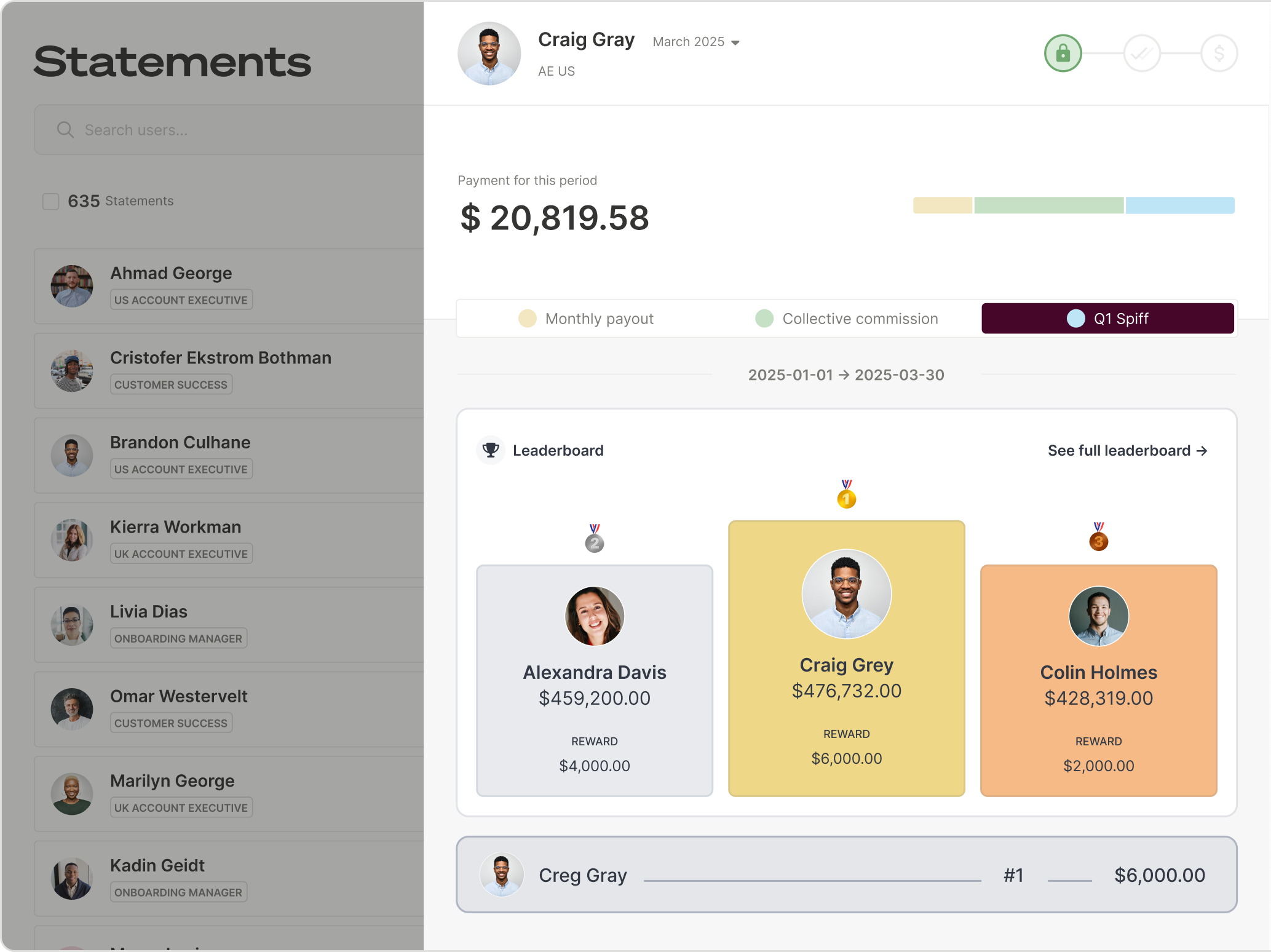
Reps see the challenge on a real-time dashboard next to commissions, get performance notifications in Slack, and ask the Sales Coach agent their questions (qobra.co, Sept 2026). Our SPIFFs and sales challenges playbook covers programme design. Our sales gamification guide covers leaderboards and contests.
3. Calculate and approve with the monthly commission run
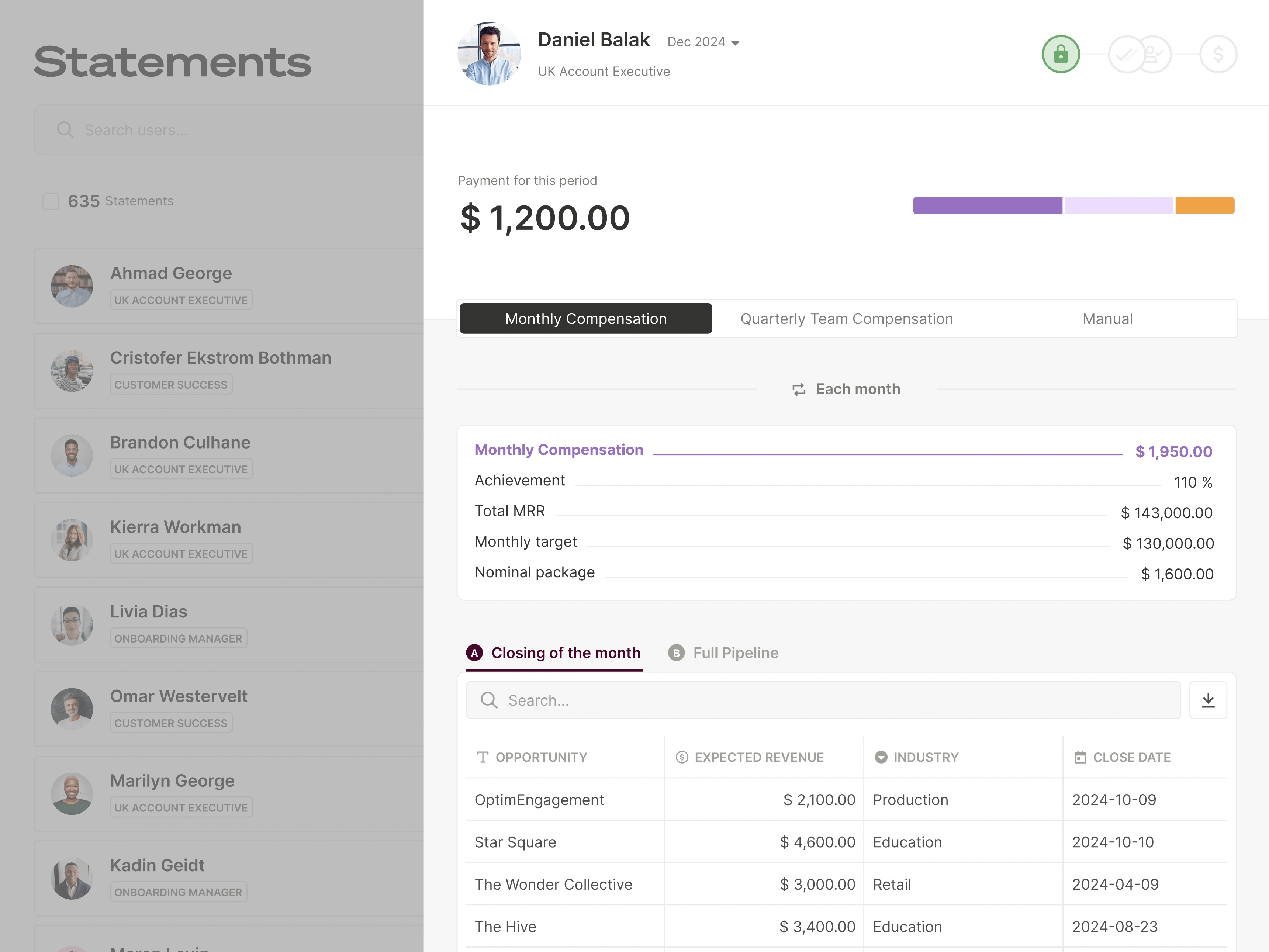
One engine calculates challenges, bonuses and commissions into deal-level statement lines, and the run goes through multi-step approvals before payroll, with reason codes, a dispute workflow and the audit log (qobra.co, Sept 2026).
4. Export to payroll and keep the trail
Approved payouts leave as a CSV or SFTP payroll export, or through the REST API (qobra.co, Sept 2026), which is how UK payroll (Sage, Xero, BrightPay and others) is reached for the monthly pay run. Plan versions keep prior periods intact. Implementation takes weeks for a mid-market team.
Book a Qobra demo to see the run on your own incentive rule.
What UK finance teams check before an incentive is paid
Accounting. Under IFRS 15 (paragraphs 91 to 94), incremental costs of obtaining a contract, such as sales commissions, are capitalised if the company expects to recover them and then amortised, or may be expensed when the amortisation period would be one year or less (IFRS Foundation). UK-listed groups report under UK-adopted IFRS; for UK GAAP accounts. Tag payout lines by incentive type and document whether a contract-tied SPIFF follows the commission treatment. Our guide to ASC 606 and commissions covers the US GAAP side.
Payroll. A cash bonus, SPIFF or commission is added to the employee's other earnings, with PAYE tax and Class 1 National Insurance deducted through payroll (gov.uk guidance on bonuses). HMRC's National Insurance Manual counts bonuses and commission as remuneration (NIM02010). There is no flat supplemental rate: the amount is taxed with that month's pay, so it must be approved before the payroll cut-off.
Written plans. Put each commission plan and incentive rule in writing, give every rep a copy, and keep it dated and versioned. Changing contractual commission terms generally needs the rep's agreement, so get each rep's written acknowledgement or agreement before the change applies; our guide to changing a plan mid-year covers the process. Commission already earned counts as wages (Employment Rights Act 1996, section 27), so cutting it afterwards can be challenged as an unauthorised deduction under section 13.
Controls. For companies applying the UK Corporate Governance Code 2024, Provision 29 asks the board for a declaration of effectiveness of the material controls as at the balance sheet date, for accounting periods beginning on or after 1 January 2026 (FRC). The incentive run is part of that evidence: who edits rules, who approves payouts, whether the log can be altered. Other companies face the same questions from their auditors. Our comparison of commission audit trail software details what each vendor logs.
Pricing: what incentive automation costs in 2026
Six of the eight platforms are quote-based: Qobra, CaptivateIQ, Everstage, Xactly Incent, Performio and Varicent (vendor websites, Sept 2026). Spiff by Salesforce costs £75 per user per month billed annually, plus £250 per month per additional external connector and Premium Support at 30% of net price (salesforce.com, Sept 2026). QuotaPath Growth costs £35 per user per month plus a £525 monthly platform fee, Premium £50 plus £800, billed annually, with the first 5 users included in the platform fee (vendor website, Sept 2026).
Ask for three quote lines: licence by payee; connectors to your CRM, HRIS and payroll, plus the accounting module; and implementation (Performio and CaptivateIQ state a one-time setup fee, QuotaPath includes it in the platform fee) (vendor websites, Sept 2026). CaptivateIQ and Everstage sell ASC 606 reporting as an add-on, so ask about IFRS 15 coverage; Xactly's Commission Expense Accounting module covers ASC 606 / IFRS 15 (vendor websites, Sept 2026). Qobra prices by payees and plan complexity. Our ROI calculator sizes the business case.
FAQ: automating sales incentives and bonus payouts
Which software provides reliable automation for monthly sales incentives?
Reliable monthly automation comes from platforms that calculate bonuses and SPIFFs in the same run as commissions and keep an approval step before payroll. Eight qualify: Qobra, CaptivateIQ, Everstage, Spiff by Salesforce, QuotaPath, Xactly Incent, Performio and Varicent (vendor websites, Sept 2026). In the UK, the output is a payroll file approved before the pay run cut-off.
What are the best options for automating SPIFF and bonus payouts?
Qobra runs SPIFFs as challenges on the core plan, with approvals and an audit log (qobra.co, Sept 2026). Spiff by Salesforce runs inside Sales Cloud at £75 per user per month (salesforce.com, Sept 2026). Xactly Incent, Performio and Varicent serve enterprise programmes.
Which solutions manage recurring bonus structures and reduce manual administrative work?
Look for a no-code rule editor so a quarterly MBO is defined once, an HRIS feed for eligibility, joiners and leavers, and a calculation run with commissions. Qobra, CaptivateIQ, Everstage, Spiff by Salesforce and QuotaPath let admins configure bonus rules without IT (vendor websites, Sept 2026).
Which automated incentive management solutions give finance teams a full audit trail?
All eight platforms state an audit trail, but depth differs. Qobra logs every plan and payout change with user, timestamp and before/after values, plus plan versions and reason codes (qobra.co, Sept 2026). Spiff by Salesforce locks historical statements (vendor website, Sept 2026). For companies applying the UK Corporate Governance Code, that log is part of the Provision 29 evidence.
Which sales compensation software handles complex SPIFF structures and provides automated audit trails?
Complex SPIFFs stack on accelerators, cap at a budget and change monthly, so engine and log must be one system. Qobra handles SPIFs, accelerators, clawbacks and effective dating with an audit log (qobra.co, Sept 2026). CaptivateIQ models them spreadsheet-style with version control (vendor website, Sept 2026).
Which UK-based sales incentive software handles collaborative RevOps and finance workflows?
Collaboration means RevOps edits the rule, the line manager approves, finance signs off before the payroll cut-off, and every step is logged. Qobra, with a London office since June 2024, runs multi-step approvals with reason codes (qobra.co, Sept 2026). Xactly (its EMEA base) and Varicent also have London offices; CaptivateIQ enforces segregation of duties (vendor websites, Sept 2026).
If your bonus and SPIFF run still ends in a spreadsheet, book a Qobra demo with one real incentive rule.