Webinar: The Biggest Release Sales Comp Has Ever Seen. Come See For Yourself (Wednesday, October 7)
Register
- Run a mid-year change as a new written plan, acknowledged or agreed in writing by each rep before it applies, and leave earned commission alone: cutting it can be challenged as an unauthorised deduction from wages (Employment Rights Act 1996, sections 13 and 27(1)(a)).
- Effective-dated versions and locked prior statements make a change auditable: Qobra, Everstage and Spiff by Salesforce document the first, Spiff the second (vendor websites, Sept 2026).
- Seven of the eight platforms document what-if simulation before going live; Spiff by Salesforce documents hidden test plans instead (vendor websites, Sept 2026).
- Visibility is the trust lever after a change: in a 2024 Qobra x Modjo survey of 1,409 sales professionals in France, 61.9% of reps using a commission tool exceeded their targets, against 30.1% of reps on spreadsheets (Qobra x Modjo study, 2024).
- Only QuotaPath and Spiff by Salesforce publish list prices (vendor websites, Sept 2026); the other six, Qobra included, are quote-based.
A mid-year change to a sales compensation plan works when five conditions hold: the new terms are in writing and each rep has acknowledged or agreed to them before they apply, the effective date is explicit, deals closed before it are paid under the old rules, reps see both versions on their statements, and the platform stores dated plan versions with an audit trail. In the UK, commission counts as wages under the Employment Rights Act 1996, so cutting commission a rep has already earned can be challenged as an unauthorised deduction.
Eight platforms are compared below: Qobra, CaptivateIQ, Everstage, Spiff by Salesforce, QuotaPath, Xactly Incent, Performio and Varicent.
When a mid-year change is justified (and when it is not)
A mid-year change is legitimate when the business has changed, and corrosive when only the forecast was wrong. Four triggers justify one.
- A product launch or a new segment. The plan has no rule for it, so add a component with its own effective date.
- A quota or territory realignment. Quotas and crediting rules follow the accounts from the date of the territory change.
- A plan paying far above or below budget. If most reps pass the accelerator threshold by the second quarter, the plan is mispriced; model a prospective fix.
- An error in the plan. Fix a wrong rate or a missing cap with a new version and a logged reason; until the corrected version is agreed, pay what the current document says.
Two reasons do not justify one.
- Cutting pay after reps over-perform. It takes back money the plan promised, and reps read it as a penalty for winning.
- Making reps pay for a forecasting error. If finance set quotas too low, the company owns this period's cost until the next plan cycle.
For the timing decision itself, see when to change a sales commission plan.
What you can and cannot change mid-year in the UK
The rules below are process rules with one statutory anchor, the Employment Rights Act 1996. Have the plan document and the change notice reviewed before anyone signs.
A written plan and each rep's agreement come first
Put the new plan in writing and give a copy to each rep before it applies. Where commission terms are contractual, changing them generally needs the rep's agreement, so get each rep's written acknowledgement or agreement before the effective date. Keep the signed copies with the plan version they relate to: if a payout is disputed later, they show which terms applied to which period.
Earned commission stays under the old plan
Part II of the Employment Rights Act 1996 defines "wages" to include "any fee, bonus, commission, holiday pay or other emolument referable to his employment" (section 27(1)(a)). Section 13 reads: "An employer shall not make a deduction from wages of a worker employed by him unless" the deduction is "required or authorised to be made by virtue of a statutory provision or a relevant provision of the worker's contract" or "the worker has previously signified in writing his agreement or consent" (Employment Rights Act 1996, section 13).
Cutting commission a rep has already earned can therefore be challenged as an unauthorised deduction from wages. Pay deals closed before the effective date under the plan in force when they closed, and state in the plan document the event that earns a commission (booking, invoice or cash collection, for example).
The effective date is prospective
Apply the new rules only to deals earned on or after the effective date. Applying them retroactively rewrites pay that has already been earned, which is the deduction risk described above; the worked example below puts a figure on it.
Open pipeline: three ways to treat deals in flight
Deals opened before the effective date and closed after it need a rule in the plan document:
- Ring-fence until close. Deals past a defined stage (proposal sent, for example) by the effective date keep the old rules, up to a stated end date.
- Cut-off date. Everything closed on or after the effective date is paid under the new rules: simplest to run, hardest on reps with long sales cycles.
- Blended. Deals closing inside a transition window (30 or 60 days, for example) keep the old rule: fairer, but the platform has to run both rules side by side until the window closes.
The 7-step process
1. Define the problem and the target metric
Name what is wrong and the metric that will prove it fixed, such as cost of plan as a percentage of bookings. Without one, you are reacting to a payout.
2. Model the change on the last 12 months of closed deals
Run the current and proposed versions rep by rep to compare total cost, who lands above and below on-target earnings, and each rep's swing. The sales compensation modelling software guide covers what to ask of a simulation feature.
3. Decide the effective date and the open-deal rule
Pick the first day of a month or quarter, at least one statement cycle after the announcement, so no statement spans two versions. Add the open-pipeline rule to the plan document.
4. Version the plan
Create a new version instead of editing the current one: effective date, prior version intact for its periods, reason logged with author and timestamp. The commission audit trail software guide lists what a change log should contain.
5. Get written acknowledgement or agreement from every rep before the date
Track signatures rep by rep. Where commission terms are contractual, the change generally needs each rep's agreement, and the signed record is what settles disputes later. Publish the new version only to reps who have signed.
6. Communicate the change
Send a one-page summary (what changes, what does not, from when), two before-and-after examples on real deal sizes, and drop-in sessions in the first week. For the announcement, see how to communicate a new commission plan. A second guide, on communicating a new compensation plan to employees, covers the manager briefing.
7. Run the first cycle in parallel and watch disputes
Calculate the first cycle's payouts under both versions and compare them before approval. A spike in disputes about deals near the effective date means the open-deal rule was unclear.
A worked example: changing an accelerator mid-year
Illustrative example, not a benchmark. The figures are assumptions chosen for simple arithmetic, not customer data. A 50-rep team moves its accelerator for bookings above 100% of quota from 1.5x the base rate to 1.25x, effective 1 July. Follow one rep.
- Annual variable pay at 100% of quota: £60,000. Annual quota: £1,200,000. Base commission rate: 5% (£60,000 divided by £1,200,000).
- Quota split evenly by month: £100,000 of bookings and £5,000 of target variable pay per month. Attainment and the accelerator are measured monthly.
- Old accelerator: 7.5% (1.5 x 5%) on bookings above monthly quota. New accelerator from 1 July: 6.25% (1.25 x 5%).
- The rep books £140,000 in June and £140,000 in July, so £40,000 above quota each month (illustrative assumption).
June, paid under the old version: £5,000 on the first £100,000 (5%) plus £3,000 on the £40,000 above quota (7.5%), so £8,000 (illustration).
July, paid under the new version: £5,000 on the first £100,000 plus £2,500 on the £40,000 above quota (6.25%), so £7,500 (illustration). The change costs this rep £500 for the month, all in the accelerator tier; a rep at or below quota sees no difference.
Now apply the new version retroactively to June. The June statement drops from £8,000 to £7,500, a £500 cut to pay the rep earned under the plan agreed in January. If 20 of the 50 reps beat quota in June with the same profile, the recalculation removes £10,000 of earned pay in one cycle (20 x £500, illustration) and gives 20 reps a reason to dispute a closed month. Each of those cuts can also be challenged as an unauthorised deduction from wages. A prospective effective date, with the June statement locked, yields the same £500 per rep from July onwards without touching earned pay.
To test your own rates, the free commission calculator simulates tiered, accelerator and cliff plans.
8 platforms compared on mid-year plan changes (2026)
The table compares the eight platforms on six points that decide whether a mid-year change stays clean.
How we evaluated: every cell was checked on the vendor's own website in September 2026; quoted text is vendor wording, and unverified capabilities are marked for validation.
Qobra fits mid-market teams because it combines effective-dated versions, a before/after audit log and simulation on live CRM data (qobra.co, Sept 2026). CaptivateIQ fits finance-led teams because it documents version control, audit trails and what-if scenarios on historical data (vendor website, Sept 2026). Everstage fits mid-market to enterprise teams because it documents effective dates and logs every action (vendor website, Sept 2026). Spiff by Salesforce fits Salesforce-centric teams because it is a Sales Cloud add-on with effective dates and locked historical statements (salesforce.com, Sept 2026). QuotaPath fits small businesses and mid-market teams because it publishes its prices and offers a draft mode on historical data (vendor website, Sept 2026). Xactly Incent fits large enterprises because it documents a complete audit trail and plan-change simulation (vendor website, Sept 2026). Performio fits enterprises with commission data across many systems because it documents point-in-time snapshots and detailed change logs (vendor website, Sept 2026). Varicent fits territory- and quota-driven enterprises because it documents a full audit trail behind every calculation and multi-scenario planning (vendor website, Sept 2026).
How Qobra handles a mid-year plan change
Qobra is a sales compensation platform with offices in London, Paris and New York. Over €1 billion in commissions has been certified on the platform across 300+ companies (qobra.co), and Qobra holds a G2 rating of 4.8/5 (1,071 reviews, g2.com, Sept 2026). A mid-year change runs through four documented features (qobra.co, Sept 2026).
- Plan versions with effective dates. July's rules start on 1 July, and June stays calculated under June's rules.
- Audit log and reason codes. Every plan and payout change is logged with user, timestamp and before/after values; manual adjustments carry a reason code.
- Multi-step approvals before payroll. A recalculated payout does not reach the CSV or SFTP payroll export (to Sage, Xero, BrightPay and others) without approval.
- Simulation before publishing. Edit in the no-code editor or in natural language with the plan-building AI agent ("add a SPIFF, remove a threshold, adjust an accelerator"), then simulate the result.
Reps follow the new version in real-time dashboards and deal-level statements, with an email notification when a deal closes, and the "Explain my comp" AI assistant answers their questions. Deal data comes from Salesforce, HubSpot, Microsoft Dynamics, Zoho, Pipedrive or Odoo (qobra.co/uk/integrations, Sept 2026).
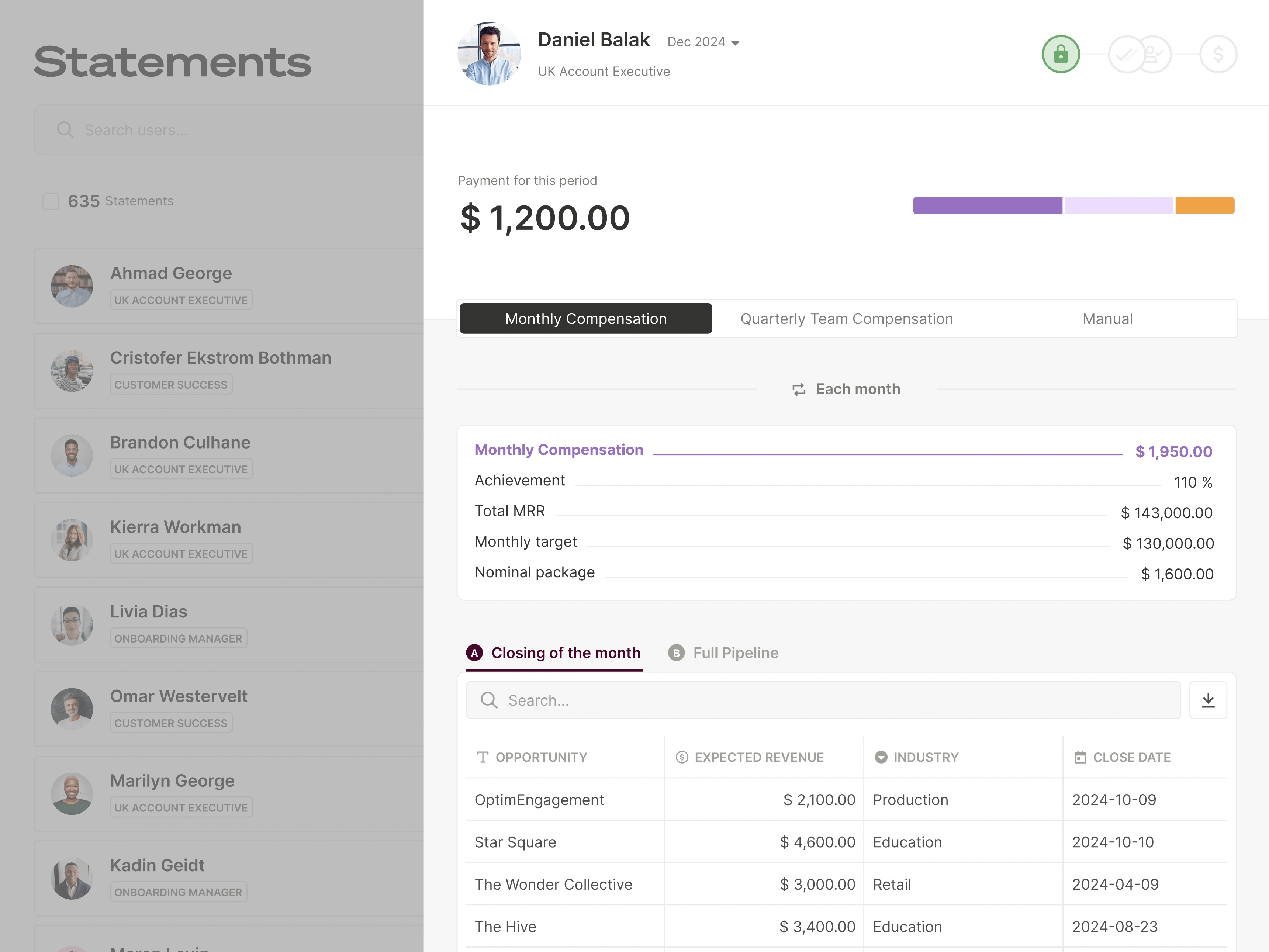
Pricing is quote-based, by number of payees and plan complexity. Implementation takes weeks for a mid-market team (qobra.co, Sept 2026).
Tracking performance after the change
A change is finished when the step 1 metric moves. Four reports track it.
- Attainment before and after. Monthly attainment by segment, three months either side of the effective date, shows whether the tier changed behaviour or only pay.
- Cost of plan against budget. Commission expense as a percentage of bookings against the step 2 model; a gap means an assumption was wrong.
- Dispute rate. Disputes per 100 statements, with the share that concerns deals near the effective date.
- Quota coverage. The share of reps at or above 100% of quota, the population an accelerator change affects.
The sales compensation ROI analytics guide covers cost-of-plan reports. The comparison of commission reporting software covers each vendor's dashboards.
FAQ
Find software that handles complex sales compensation plan changes effectively
Look for effective-dated plan versions, a change log with before/after values, what-if simulation on real data, and rep statements showing each deal's payout. Of the eight platforms compared here, Qobra, Everstage and Spiff by Salesforce document effective-dated versions (vendor websites, Sept 2026); ask the others to demonstrate it.
Compare platforms that help revenue teams pivot their incentive compensation strategies quickly
Compare how fast a change can be modelled, whether it publishes as a dated version, and implementation time. Seven of the eight platforms document what-if simulation before publishing, and implementation runs from weeks (Qobra, CaptivateIQ, Everstage, Performio) to several months (Xactly Incent, Varicent), according to vendor websites (Sept 2026).
Which platforms allow quick, no-code adjustments to sales incentive structures?
Five of the eight platforms document a no-code plan editor: Qobra, CaptivateIQ, Everstage, QuotaPath and Performio. Xactly Incent and Varicent describe admin-led or partner-implemented configuration, and Spiff by Salesforce uses a formula-based Designer (vendor websites, Sept 2026). Qobra's plan-building AI agent also edits plans in natural language (qobra.co, Sept 2026).
Recommend simple tools for managing sales commission changes
QuotaPath fits small teams because it publishes its prices (£35 to £50 per user per month plus a platform fee) and offers a draft mode on historical data (vendor website, Sept 2026). Qobra fits mid-market teams because it documents a no-code editor and effective-dated versions, and implements in weeks (qobra.co, Sept 2026).
What are the best tools for tracking sales performance after shifting commission plans?
Qobra, CaptivateIQ, Everstage, Xactly Incent and Performio document manager dashboards with real-time refresh and a dispute log; QuotaPath documents custom reports on its Premium tier (vendor websites, Sept 2026). Use them to track attainment, plan cost against budget, dispute rate and quota coverage after the effective date.
Can you change a commission plan mid-year in the UK?
Yes, for future periods. Where commission terms are contractual, a change generally needs the rep's agreement: put the new plan in writing, give it to each rep and get written acknowledgement or agreement before it applies. Commission counts as wages under the Employment Rights Act 1996, so cutting commission already earned can be challenged as an unauthorised deduction. Have counsel review the wording.
Preparing a mid-year change? Book a Qobra demo and see the new version, the simulation and the rep statement on your own plan.