

- Choose a per-deal rate when individual results are easy to measure and the cycle is short. Choose a goal-linked payout for team targets, long enterprise deals, quality objectives, and short-term pushes.
- Most B2B teams do best with a hybrid: base salary, commission on new revenue, and a quarterly bonus for team or strategic objectives.
- Look beyond the two: profit sharing, equity, and signing or retention awards each drive a different behaviour.
- Plan the cost side too: both are taxed as earnings through PAYE, with employer National Insurance on top, and goal-linked payouts should be accrued before they are paid.
- Keep formulas visible and review the mix at least once a year: unclear calculations erode trust faster than any rate change.
The structure of your variable pay sends a clear message to your sales team: it tells them what matters, where to focus their energy, and whether your company is the right place for them to build a career.
Yet the distinction between a bonus and a commission is often blurred. Companies treat them as interchangeable, which leads to misaligned incentives, frustrated reps, and missed targets. A wrong setup shows up fast: high employee churn, sandbagged deals, and a sales culture focused on the wrong activities.
The commission vs bonus choice comes down to one question: are you rewarding activity, or impact? This guide covers definitions, worked examples, payroll and tax treatment, and how to combine both.
The figure to remember: 4 weeks. Since 1 January 2024, four of the 5.6 weeks of statutory annual leave must be paid at a worker's normal rate of pay, which includes commission payments "intrinsically linked to the performance of tasks" in their contract. For a bonus, government guidance says it "depends on the nature of the bonus". The legal line follows the practical one: a commission is a formula applied to each sale, a bonus is tied to a goal.
Commission vs Bonus: What Is the Difference?
A commission is variable pay calculated as a percentage of each sale a rep closes. A bonus is a fixed amount or a share of salary, paid when an employee reaches a predefined goal. Many teams run both side by side in an incentive compensation management tool.
A commission is transactional. A rep closes a deal and earns a share of it: the more they sell, the more they earn. It rewards individual sales activity, measured in revenue or profit.
A bonus is conditional. It is paid for reaching a specific milestone that may not be tied to a single transaction: a quarterly team target, a strategic new logo, a high customer satisfaction score, or a wider company objective.
Put simply, the first says "Do more" and the second says "Do it well" or "Do this specific thing."
They are not mutually exclusive, but treating them as one and the same is where plans fail. What you pay for is what your team will optimise for.
Key Differences at a Glance
| Feature | Commission | Bonus |
|---|---|---|
| Basis | Directly tied to individual sales (e.g., % of revenue). | Reaching specific goals or milestones (individual, team, or company). |
| Nature | Transactional and ongoing. | Conditional and often periodic (quarterly, annually). |
| Calculation | Typically a variable percentage or tiered rate. | Often a fixed monetary amount or a percentage of base salary. |
| Behaviour Incentivised | High sales volume, individual activity, and speed. | Strategic achievements, teamwork, quality, and specific outcomes. |
| Predictability | Directly correlated with sales performance. | Dependent on meeting predefined (and sometimes discretionary) goals. |
| Payout timing | Each pay period or month, once the deal closes or the invoice is paid. | Quarterly, yearly, or once, after the goal is measured. |
When Should You Use Commission Pay?
A commission structure is the traditional backbone of sales compensation for a good reason. It creates an unambiguous link between a rep's effort and their earnings. This direct link motivates reps and builds a culture of high activity and individual ownership.
This model works best where the cycle is relatively short and transactional. Think of high-velocity SaaS sales, estate agency, or insurance, where a rep manages the entire sales process from prospecting to closing. In these roles, commission shapes how reps prioritise their time and how hard they pursue deals.
This structure works best when:
- You want to drive high activity and individual accountability. Reps on this plan are pushed to maximise their output. This structure rewards the "hunter" mentality and is ideal for roles focused on new business acquisition.
- Your sales outcomes are easily and individually measurable. The model relies on clear metrics like revenue generated or units sold. If a rep's contribution is clear, commission is a fair and transparent way to reward it.
- You have predictable margins and a clear budget. You need to know what a rep can earn without hurting your customer acquisition cost (CAC) or overall financial planning. This allows you to set sustainable commission rates that align with profitability.
- You are hiring experienced reps who thrive on variable earnings. Seasoned salespeople understand how to manage their pipeline and are motivated by the high earning potential.
However, the simplicity of this model can also be its weakness. If not balanced correctly, it can lead to undesirable behaviours. Reps might push for deals at the expense of long-term customer success, ignore upselling opportunities that require more effort, or neglect collaborative tasks that don't contribute directly to their pay packet. It's a system optimised for output, and that's what it will deliver, sometimes at the cost of quality.
When Should You Use Bonus Pay?
While commission rewards output, bonuses reward impact. They are the tool you use when you want to steer your team's focus towards goals that go beyond closing the next deal. Instead of following every transaction, they recognise outcomes that matter to the organisation.
This makes them versatile. They can reward teamwork by paying the entire team for hitting a collective revenue target. They can encourage a focus on quality over quantity by rewarding high customer retention rates or landing flagship accounts in a new market. They can even be used for non-sales roles to align the entire company around key performance indicators.
This structure is the right choice when:
- You need to reward teamwork and collaboration. A team-based bonus for hitting a regional or company-wide target encourages people to support each other rather than competing internally.
- You want to reward strategic achievements. Landing a key logo, successfully launching a new product, or achieving a specific product mix are perfect candidates for a bonus. These are high-impact events that a simple rate might not adequately recognise.
- The sales cycle is long or complex. In enterprise sales, where multiple people contribute over many months, a bonus for closing the deal or hitting project milestones can be more appropriate than a commission split between several team members.
- You want to drive specific behaviours. A Sales Performance Incentive Fund (SPIF) is a short-term bonus used to drive focus on a particular product, clear out stock, or generate leads during a slow period.
Note: Bonuses Are Not a Substitute for Good Management
Pay is one lever among several. A generous plan will not fix weak management, poor coaching, or a lack of growth opportunities.
The main challenge with bonuses is that they can feel discretionary or disconnected from daily work if not designed and communicated properly. For them to be effective, the criteria must be clear, achievable, and perceived as fair by the entire team.
Other Variable Rewards Beyond Commissions
Variable compensation is the umbrella term for any earnings linked to results, on top of base salary. Commissions and bonuses are its most common forms, but not the only ones:
- Straight commission: no base salary, so all earnings come from sales. Common in estate agency and insurance.
- Tiered commission: the rate rises once a rep passes a threshold, usually their sales quota.
- Performance bonus: paid for reaching a target over a quarter or a year, as in an annual incentive plan.
- Signing and retention bonuses: one-off payments to attract or keep talent, with no link to sales results.
- Profit sharing: a pool paid out of overall profit, usually once a year, rather than on individual deals.
- Equity: share options or RSUs that reward long-term value creation.
Each one drives a different behaviour. The right mix depends on your compensation structure and on what you want reps to prioritise.
Worked Examples: How the Calculations Work
- Flat commission: an Account Executive on a 10% rate closes a £60,000 deal and earns £6,000.
- Tiered commission: 8% up to a £500,000 quota, then 12% above it. At £600,000 in bookings, the rep earns £40,000 + £12,000 = £52,000.
- Fixed bonus: a fixed amount of money, say £5,000, paid to each rep if the team hits its quarterly target.
- Salary-linked bonus: 10% of a £90,000 base salary for reaching an annual objective, or £9,000.
To test your own rates, tiers, and accelerators, try our free commission calculator.
Building a Hybrid Model: Combining Both
For most modern B2B companies, the most effective approach is not an "either/or" choice but a hybrid model that combines commissions and bonuses. This structure allows you to reward both individual hustle and collaborative impact.
A well-designed hybrid plan aligns every layer of your go-to-market strategy. It provides the immediate, transactional motivation of a commission while using bonuses to steer the team towards larger, shared objectives.
A hybrid plan only works if Sales, RevOps, and Finance read the same numbers. Qobra gives each team one shared view of every payout, so any question is answered from the same data instead of three different spreadsheets.
Here's what a typical hybrid plan might look like for a SaaS Account Executive:
- Base Salary: Provides stability and covers living expenses.
- Commission: Paid as a percentage of Annual Contract Value (ACV) for every new deal closed. This directly rewards individual performance.
- Quarterly Bonus (MBO): A fixed amount paid for achieving specific objectives, such as:
- Team Goal: The entire AE team hits its collective revenue target.
- Strategic Goal: Sourcing a certain number of deals in a new, target industry.
- Quality Goal: Achieving a >95% customer satisfaction score on post-sale surveys.
This structure motivates the AE to close deals while also encouraging them to be a team player, focus on strategic markets, and ensure their customers are successful. This balanced approach helps mitigate the risks of a commission-only plan, like rushed deals or a lack of focus on long-term value. Building a comprehensive sales commission plan requires this kind of thinking.
How Commissions and Bonuses Affect Payroll and Taxes
Income Tax and National Insurance
In the UK, HMRC treats both as earnings. There is no special flat rate: commission and bonuses go through PAYE in the pay period in which they are paid. The employee pays Income Tax at their marginal rate (20%, 40% or 45% in England and Northern Ireland for 2026 to 2027, with separate rates set in Scotland and Wales) and Class 1 National Insurance at 8%, or 2% above the upper earnings limit of £50,270.
The figure to remember: 15%. That is the 2026 to 2027 employer Class 1 National Insurance rate on earnings above the £5,000 secondary threshold. It applies to bonuses and commission in the same way as salary, so budget for it on top of every payout.
The deduction on the month a payout lands is not the final tax bill. PAYE works cumulatively across the tax year, so a large one-off payment can look heavily taxed on that month's payslip and even out later. National Insurance works differently: it is calculated on what is paid in each pay period, no matter when it was earned.
Payroll and budget impact
Commissions move with revenue, so labour costs change from one month to the next. Goal-linked payouts arrive as lump sums, which finance should accrue over the quarter or year in which they are earned. Late or wrong payouts cost more than money: people stop trusting the plan.
This is where commission data turns into a planning tool. With Qobra, finance sees what each plan costs against the revenue it drives, before payout day, which makes the return on every payout measurable.
Designing Your Compensation Plan: From Theory to Practice
Before you can decide on the right mix of bonus and commission, you must step back and define what you want your sales organisation to achieve. An effective compensation plan starts with strategy, not spreadsheets.
Step 1: Ask the Right Questions
Begin by clarifying your core business objectives. Your compensation plan is a tool to help you reach them.
- What are our primary business goals? Are you focused on aggressive revenue growth, maximising profitability, gaining market share, or improving customer retention? Each goal calls for a different reward structure. A plan that rewards revenue at all costs will look very different from one designed to protect gross profit margins.
- What specific behaviours do we want to encourage? Do you need reps to hunt for new logos, expand existing accounts, sell a specific product, or collaborate with the customer success team? Be explicit about the actions that lead to success.
- Will reps receive a base salary? The pay mix (the ratio of base salary to variable pay) signals how much risk you expect the rep to take on. A higher variable component attracts people who are confident in their ability to perform.
- How can we motivate the entire team within our budget? Your plan must be financially sustainable. Model out different scenarios, from underperformance to overperformance, to understand the total cost and ensure it aligns with your financial forecasts.
To see where your current setup stands, run our free 8-minute compensation plan assessment.
Step 2: Automate for Transparency and Trust
Once you have a strategy, the biggest hurdle to success is execution. Managing compensation plans manually on spreadsheets is slow, prone to errors, and creates a "black box" that erodes trust between sales reps and management. When they don't understand how they are paid or have to wait weeks for corrections, their motivation drops.
This is where a commission automation platform earns its place. Qobra connects natively to your CRM (like Salesforce or HubSpot), your data warehouse, and your other tools, so calculations run on synced data. When a deal needs an exception, you can still adjust it manually.
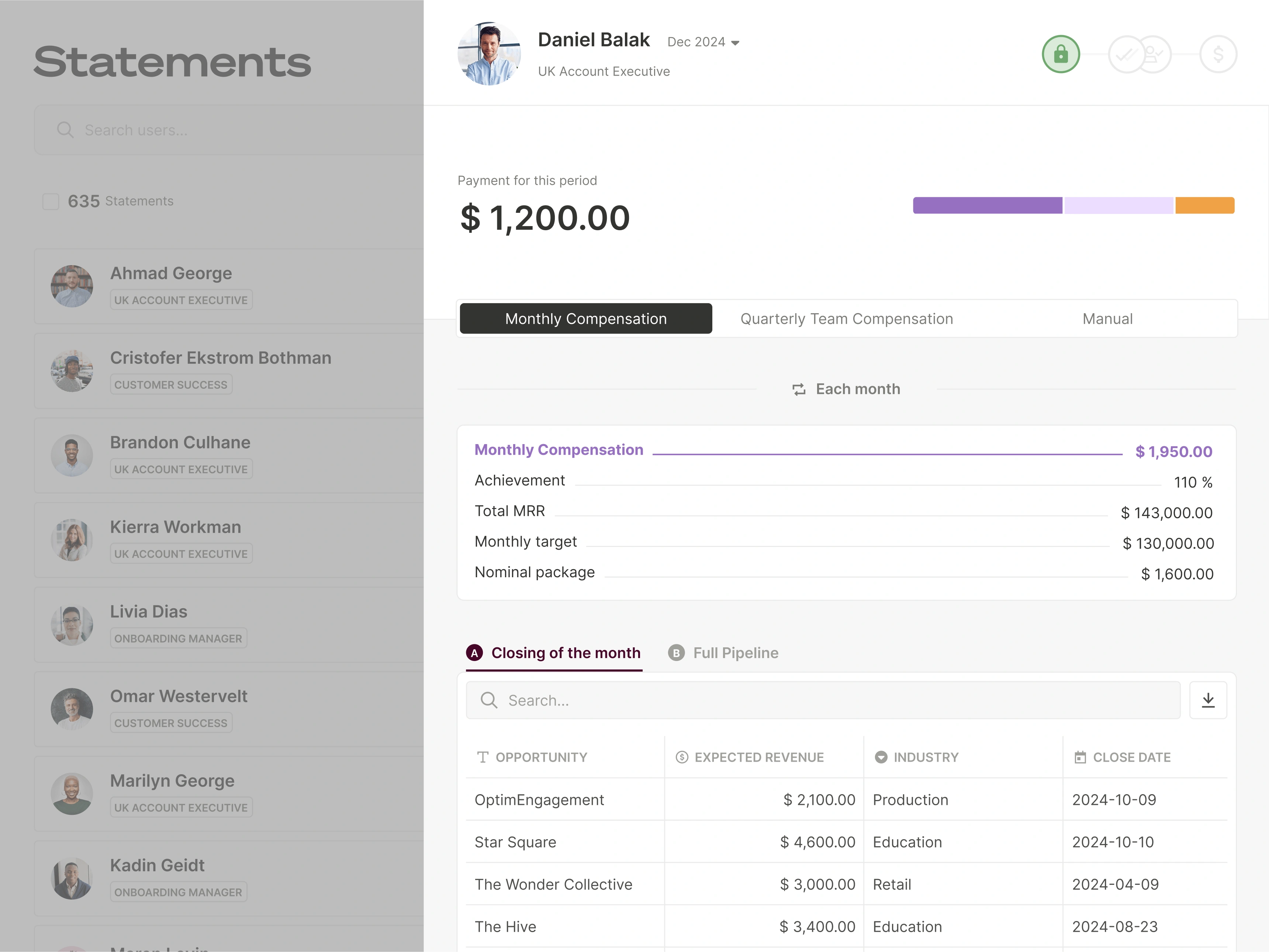
With a no-code rule editor, sales ops and finance teams can build and adjust any plan without writing code. This agility allows you to adapt your strategy as the market changes. Every rep gets a real-time dashboard with their performance, current earnings, and future potential, which turns compensation into a daily motivator instead of a source of friction.
Warning: Garbage In, Garbage Out
An automation platform is only as good as the data it receives. If your CRM data is messy or incomplete, your commission calculations will be inaccurate. Before implementing any new system, ensure your source data is clean and your processes for updating it (e.g., marking a deal as "Closed Won") are rigorously followed.
Step 3: Communicate, Implement, and Iterate
A brilliant plan that no one understands is a failed plan. The rollout matters as much as the design. When you implement a new sales commission plan, you must be prepared to communicate it clearly and repeatedly.
- Hold a kickoff meeting to explain the "why" behind the plan. Connect the plan to the company's strategic goals.
- Provide detailed documentation with clear examples of how earnings are calculated in different scenarios.
- Give each seller a dashboard where they can see their plan and model potential earnings from deals in their pipeline.
Finally, no plan is perfect forever. Review its effectiveness at least annually. Are you seeing the behaviours you intended? Are you hitting your goals? Are your top performers being rewarded appropriately? Be prepared to gather feedback and make adjustments to ensure your plan remains a strategic asset.
The choice between a bonus and a commission reflects your company's strategy and shapes your sales culture.
For most teams, the answer is a hybrid plan, backed by clear documentation and transparent, automated calculations.
Frequently Asked Questions
Do commission and bonuses count towards holiday pay?
Commission usually does. Since 1 January 2024, regulations require four weeks of statutory annual leave to be paid at the worker's normal rate of pay, which includes commission payments intrinsically linked to the tasks in their contract. For bonuses, government guidance says it depends on the nature of the bonus, and a regular bonus could be included. The remaining 1.6 weeks can be paid at the basic rate.
Should SDRs earn a commission or a bonus?
SDRs rarely close revenue themselves, so a percentage of deal value fits them poorly. Most teams offer a set amount per qualified meeting or opportunity, plus a monthly or quarterly bonus on pipeline sourced. The key is to reward the output SDRs control.
How do you determine the right commission rate?
Calculating the right rate involves balancing several factors: your product's gross margin, the total target compensation for the role, the length of the sales cycle, and industry benchmarks. A common approach is to work backward from the On-Target Earnings (OTE) you want to offer. You can find a more detailed breakdown in our complete guide to sales commissions.
Whichever mix you choose, a variable compensation software lets you model and run both bonuses and commissions from one source of truth.
Sources