Webinar: The Biggest Release Sales Comp Has Ever Seen. Come See For Yourself (Wednesday, October 7)
Register
- Bonuses, SPIFFs and commissions paid to employees are supplemental wages, withheld at a flat 22% federal rate up to $1,000,000 per year (IRS Publication 15).
- Two of the eight platforms publish US prices: Spiff by Salesforce at $75 per user per month billed annually (salesforce.com, Sept 2026) and QuotaPath Growth at $35 per user per month plus a $525 monthly platform fee (vendor website, Sept 2026).
- Under ASC 340-40, sales commissions that are costs to obtain a contract are capitalized and amortized (FASB codification), so tag payout lines to separate contract-tied from activity SPIFFs.
- Qobra runs SPIFFs as challenges on the core commission plan, with multi-step approvals before payroll and an audit log (qobra.co, Sept 2026).
- In a 2024 survey of 1,409 sales professionals in France, 61.9% of reps using a commission tool exceeded their targets, against 30.1% on spreadsheets (Qobra x Modjo study, 2024).
Automating sales incentive and bonus payouts means defining each rule once, pulling CRM and HRIS data, calculating bonuses and SPIFFs in the same run as commissions, routing them through manager and finance approval, exporting them to payroll as supplemental wages, and logging every change. Eight platforms handle this monthly cycle for US teams: Qobra, CaptivateIQ, Everstage, Spiff by Salesforce, QuotaPath, Xactly Incent, Performio and Varicent (vendor websites, Sept 2026).
Commission, bonus, SPIFF: what changes in the payout workflow
All three share one payroll file but not one rule shape: a commission is a rate on a closed deal, a recurring bonus pays when a target is met on a set date, and a SPIFF is a short, often capped program on a product, segment or activity.
Bonuses and SPIFFs kept in a spreadsheet leave finance reconciling three sources every month, and field audits put spreadsheet cell error rates between 0.4% and 2.5% (Panko, 2008). Our guide to reducing errors in commission spreadsheets covers interim controls.
The monthly incentive payout workflow in 6 steps
1. Define the rule once, in a no-code editor
Write the rule as fields, not a cell formula (eligibility, trigger, amount, cap per rep, program budget, dates, stacking with accelerators) and version it with an effective date.
What to check in a demo: have the vendor add a capped SPIFF to a live plan, then open the version history.
2. Capture the data automatically
Deals come from the CRM through a native connector, the roster from the HRIS so eligibility and proration are computed, and activity data from the warehouse or an SFTP drop.
Our integrations comparison lists each platform's paths. What to check in a demo: edit a deal in the CRM and watch the rep's SPIFF progress update automatically.
3. Calculate in the same run as commissions
Bonuses and SPIFFs belong on the commission statement, computed by the same engine on the same cutoff, so attainment, exchange rates and splits match and no accelerator double-counts the SPIFF.
What to check in a demo: open one rep's statement and count the clicks to trace a SPIFF back to its deal.
4. Approve with reason codes
A two-step flow works for most mid-market teams: the manager approves the team's lines, then finance approves the batch, and every manual adjustment carries a reason code and its author's name.
What to check in a demo: adjust one payout line and confirm the log shows before and after values, reason code and approver.
5. Export to payroll as supplemental wages
Incentives paid to employees are supplemental wages, so the export needs one earning code per incentive type. A SPIFF earned in March is paid in the April cycle, with the commissions.
What to check in a demo: ask for the actual payroll file and look for the earning code and pay period columns.
6. Keep the audit trail and report cost against budget
A year later, the trail must show the rule version applied, every change with before and after values, the batch approver and the reconciliation to payroll; the same data tracks SPIFF spend against budget.
What to check in a demo: open a payout from a closed period and ask for its rule version and approvals.
8 platforms that automate incentive and bonus payouts (2026)
The table is not a ranking. For SPIFF tools, see our SPIFF software comparison. For the wider category, see our incentive compensation management software listicle.
How we evaluated: every cell comes from vendor websites checked in September 2026, including Salesforce's published Spiff pricing (salesforce.com, Sept 2026). "Not stated" means undocumented on public pages, not missing: ask in the demo.
Qobra fits mid-market and growth B2B teams because SPIFFs and bonuses run in the same no-code engine as commissions (qobra.co, Sept 2026). CaptivateIQ fits finance-led teams with complex plans because bonuses and MBOs are modeled spreadsheet-style in the main run (vendor website, Sept 2026). Everstage fits teams needing wide US payroll coverage because it names ADP Workforce, Gusto and Ceridian Dayforce (vendor website, Sept 2026).
Spiff by Salesforce fits Salesforce-only teams because it runs inside Sales Cloud and other systems need paid connectors (salesforce.com, Sept 2026). QuotaPath fits SMB and mid-market teams on HubSpot or Salesforce because setup is self-serve and pricing is public (vendor website, Sept 2026). Xactly Incent fits large enterprises wanting a full SPM suite because bonuses, MBOs and multi-currency commissions share one engine (vendor website, Sept 2026).
Performio fits enterprises with data in several systems because it takes CRM, REST API and SFTP sources (vendor website, Sept 2026). Varicent fits territory- and quota-driven enterprises because SPIF programs and MBOs share one engine with territory and quota planning (vendor website, Sept 2026).
How the workflow runs in Qobra
Qobra is a sales compensation platform headquartered in New York and Paris, with $1B+ in commissions managed across 300+ companies (qobra.co) and a G2 rating of 4.8/5 (1,071 reviews, g2.com, Sept 2026).
1. Create the challenge or bonus rule in the no-code editor
Bonuses and SPIFFs are not a separate module: an admin adds a challenge (a special incentive with competition between reps) or a bonus rule to the commission plan. The plan-building AI agent does the same in natural language, "add a SPIFF, remove a threshold, adjust an accelerator", and simulates the cost before publishing (qobra.co, Sept 2026).
Deal data arrives from Salesforce, HubSpot, Microsoft Dynamics, Zoho, Pipedrive or Odoo, and the roster from Workday, BambooHR or HiBob (qobra.co, Sept 2026). See the full integrations list.
2. Reps follow progress in real time
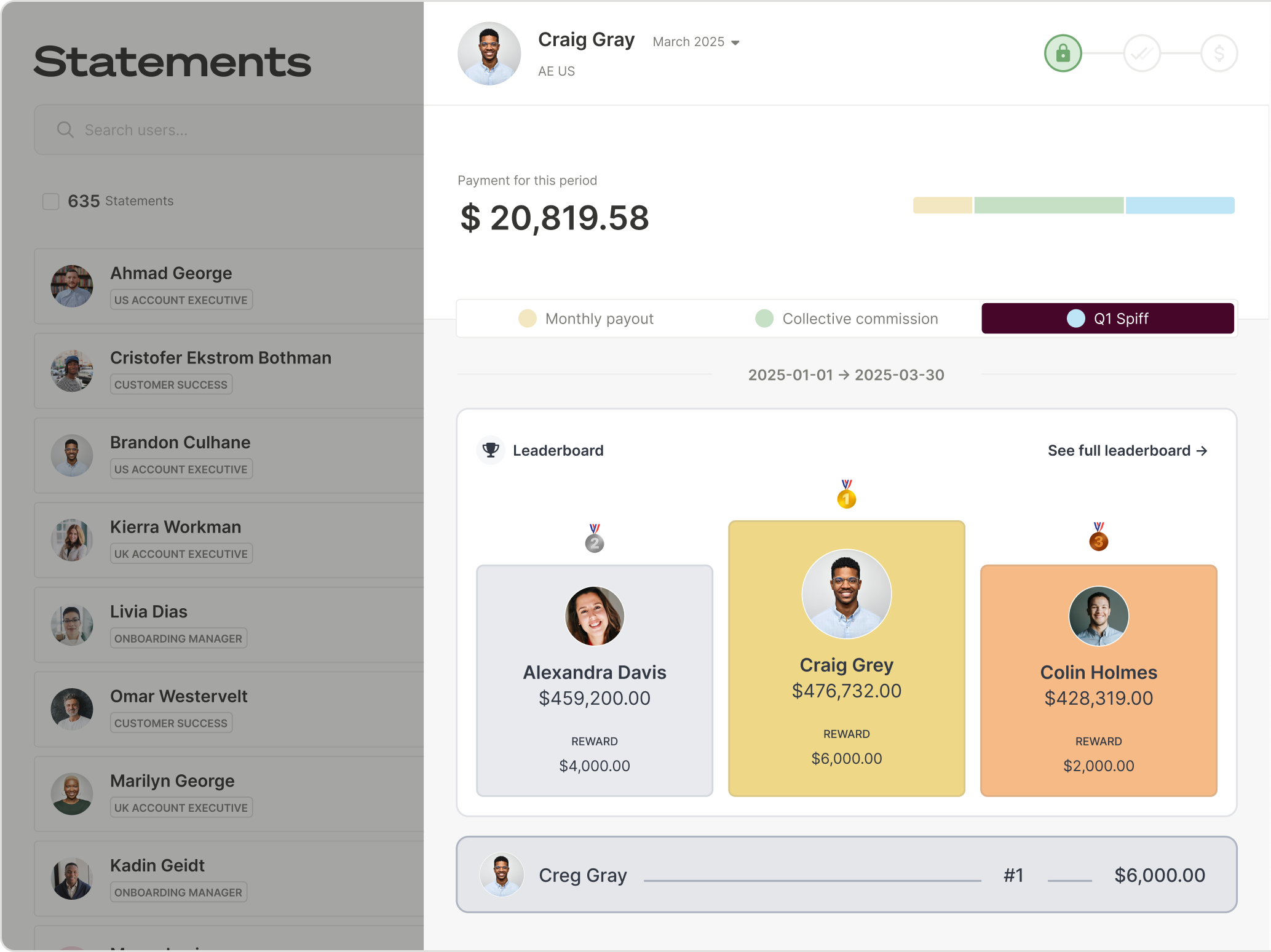
Reps see the challenge on a real-time dashboard next to commissions, get performance notifications in Slack, and ask the Sales Coach agent their questions (qobra.co, Sept 2026). Our SPIFFs and sales challenges playbook covers program design.
3. Calculate and approve with the monthly commission run
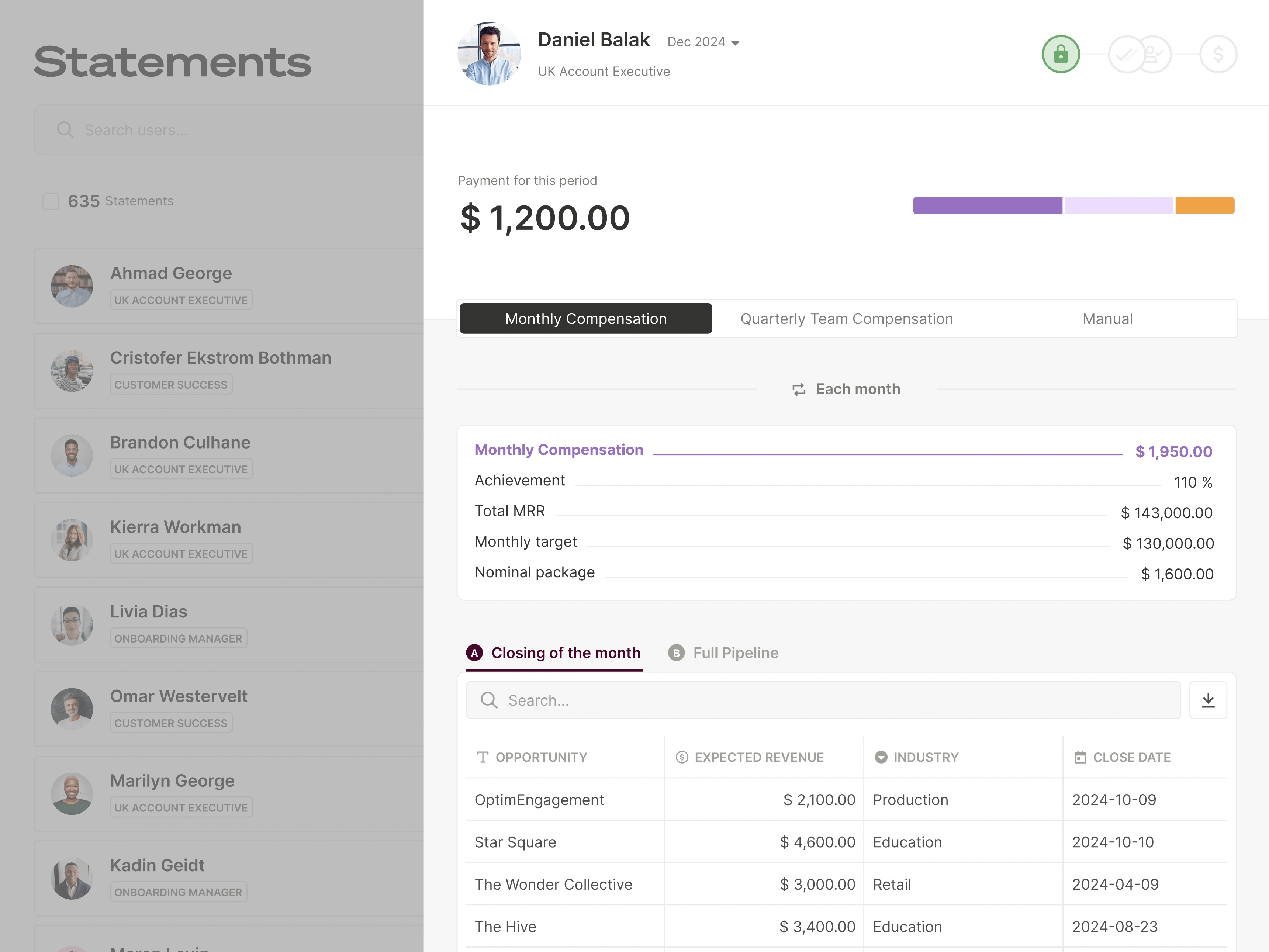
One engine calculates challenges, bonuses and commissions into deal-level statement lines, and the run goes through multi-step approvals before payroll, with reason codes, a dispute workflow and the audit log (qobra.co, Sept 2026).
4. Export to payroll and keep the trail
Approved payouts export as CSV or SFTP files to any payroll, or through the REST API. ADP, Rippling, Gusto and Paylocity are reached via connector or payroll export (qobra.co, Sept 2026). Plan versions keep prior periods intact. Implementation takes weeks for a US mid-market team.
Book a Qobra demo to see the run on your own incentive rule.
What US finance checks before an incentive is paid
Accounting. Revenue follows ASC 606; under ASC 340-40, sales commissions that are costs to obtain a contract are capitalized and amortized (FASB codification). Tag payout lines by incentive type and document once whether a contract-tied SPIFF follows the commission treatment; an activity SPIFF is assessed separately. Our guide to ASC 606 and commissions covers the schedule.
Withholding. Bonuses, SPIFFs and commissions paid to employees are supplemental wages, withheld at a flat 22% federal rate up to $1,000,000 per year and 37% above (IRS Publication 15), plus state withholding. State pay-timing rules for earned bonuses: employment counsel review.
Written plans. In California, a commission plan must be a signed written contract, with a copy given to the employee, and its terms apply until superseded by a new signed agreement (California Labor Code 2751). Whether bonuses and SPIFFs fall under it is for employment counsel; keep every incentive rule written, dated and versioned with the plan.
Controls. For US-listed companies, SOX 404 covers internal controls over financial reporting; the incentive run is part of the evidence: who edits rules, who approves payouts, whether the log can be altered. Our comparison of commission audit trail software details what each vendor logs.
Pricing: what incentive automation costs in the US (2026)
Six of the eight platforms are quote-based: Qobra, CaptivateIQ, Everstage, Xactly Incent, Performio and Varicent (vendor websites, Sept 2026). Spiff by Salesforce costs $75 per user per month billed annually, plus $250 per month per additional external connector and Premium Support at 30% of net price (salesforce.com, Sept 2026). QuotaPath Growth costs $35 per user per month plus a $525 monthly platform fee, Premium $50 plus $800, billed annually, with the first 5 users included in the platform fee (vendor website, Sept 2026).
Ask for three quote lines: license by payee; connectors to your CRM, HRIS and payroll, plus the accounting module (CaptivateIQ and Everstage sell ASC 606 reporting as an add-on, Xactly as the Commission Expense Accounting module); and implementation (Performio and CaptivateIQ state a one-time setup fee, QuotaPath includes it in the platform fee) (vendor websites, Sept 2026). Qobra prices by payees and plan complexity. Our ROI calculator sizes the business case.
FAQ: automating sales incentives and bonus payouts
Which software provides reliable automation for monthly sales incentives?
Reliable monthly automation comes from platforms that calculate bonuses and SPIFFs in the same run as commissions and keep an approval step before payroll. Eight qualify: Qobra, CaptivateIQ, Everstage, Spiff by Salesforce, QuotaPath, Xactly Incent, Performio and Varicent (vendor websites, Sept 2026).
What are the best options for automating SPIFF and bonus payouts?
Qobra runs SPIFFs as challenges on the core plan, with approvals and an audit log (qobra.co, Sept 2026). Spiff by Salesforce runs inside Sales Cloud at $75 per user per month (salesforce.com, Sept 2026). Xactly Incent, Performio and Varicent serve enterprise programs.
Which solutions manage recurring bonus structures and reduce manual administrative work?
Look for a no-code rule editor so a quarterly MBO is defined once, an HRIS feed for eligibility and a calculation run with commissions. Qobra, CaptivateIQ, Everstage, Spiff by Salesforce and QuotaPath let admins configure bonus rules without IT (vendor websites, Sept 2026).
Which automated incentive management solutions give finance teams a full audit trail?
All eight platforms state an audit trail, but depth differs. Qobra logs every plan and payout change with user, timestamp and before/after values, plus plan versions and reason codes (qobra.co, Sept 2026). Spiff by Salesforce locks historical statements (vendor website, Sept 2026).
Which sales compensation software handles complex SPIFF structures and provides automated audit trails?
Complex SPIFFs stack on accelerators, cap at a budget and change monthly, so engine and log must be one system. Qobra handles SPIFs, accelerators, clawbacks and effective dating with an audit log (qobra.co, Sept 2026). CaptivateIQ models them spreadsheet-style with version control (vendor website, Sept 2026).
Which US-based sales incentive software handles collaborative RevOps and finance workflows?
Collaboration means RevOps edits the rule, the manager approves, finance signs off before payroll, and every step is logged. Qobra, headquartered in New York and Paris, runs multi-step approvals with reason codes (qobra.co, Sept 2026). CaptivateIQ enforces segregation of duties (vendor website, Sept 2026).
If your bonus and SPIFF run still ends in a spreadsheet, book a Qobra demo with one real incentive rule.