9 avril | Webinar : Le coût réel de la rémunération des commerciaux et comment l'optimiser (avec ElevenLabs et The SaaS CFO)
S'inscrire
- Les primes incitatives sont des récompenses financières conditionnelles versées pour la réalisation d'actions ou l'obtention de résultats prédéfinis. Elles sont méritées plutôt que garanties et se distinguent du salaire fixe.
- Elles peuvent prendre plusieurs formes : paiements directs par les entreprises (commissions, primes de rendement, primes exceptionnelles, participation aux bénéfices) et incitations publiques/consommateurs (subventions, remises, crédits d'impôt, transferts monétaires conditionnels).
- Elles sont utilisées pour orienter les comportements, le plus souvent pour stimuler les ventes et les priorités en matière de produits, récompenser la réalisation ou la fidélisation de projets et influencer les choix du public (par exemple, les améliorations énergétiques, les vaccinations).
- Les programmes efficaces sont simples, alignés sur la stratégie, réalisables et opportuns ; l'automatisation et la transparence en temps réel réduisent les litiges et stimulent la motivation.
- Les paiements incitatifs ont des implications juridiques et fiscales (souvent imposables en tant que salaires supplémentaires) ; les employeurs doivent les documenter, les retenir de manière appropriée et consulter des experts juridiques/fiscaux pour garantir leur conformité.
Comment les organisations, des gouvernements aux multinationales, parviennent-elles à orienter efficacement les comportements sans donner d'ordres directs ? La réponse réside souvent dans l'un des outils les plus puissants de l'économie et de la gestion : les incitations financières. Cette motivation financière, offerte en échange d'une action ou d'un résultat spécifique, sert de levier stratégique pour aligner les actions individuelles sur les objectifs plus larges de l'organisation ou de la société. Qu'il s'agisse d'encourager une équipe commerciale à dépasser ses objectifs ou d'inciter les citoyens à adopter des technologies plus écologiques, il est essentiel de comprendre comment structurer et déployer ces récompenses financières pour garantir leur succès.
Ce guide explore en profondeur le concept des primes incitatives, de leur définition précise et de leurs différentes formes à leurs applications pratiques dans les entreprises et les politiques publiques, fournissant une feuille de route claire pour concevoir des programmes véritablement motivants.
Qu'est-ce que l'argent incitatif exactement ?
L'argent incitatif est une récompense financière accordée à un individu, une équipe ou une organisation afin de stimuler un comportement particulier ou d'atteindre un objectif spécifique prédéfini. Son principe fondamental est la conditionnalité : le paiement n'est pas garanti, mais est obtenu après l'accomplissement réussi d'une tâche requise ou l'atteinte d'un certain niveau de performance. Cela le distingue des paiements fixes tels que le salaire, qui est versé pour l'accomplissement des tâches d'un poste.
Ces incitations financières sont conçues pour combler le fossé entre les objectifs d'une organisation et la motivation personnelle d'un individu. En offrant un avantage monétaire direct, les entreprises peuvent encourager leurs employés à aller au-delà de leurs tâches habituelles, leurs partenaires à donner la priorité à certains produits ou leurs clients à effectuer un achat spécifique. L'objectif ultime est de créer une situation gagnant-gagnant dans laquelle les efforts du bénéficiaire sont récompensés et l'organisation obtient un résultat stratégique précieux.
Différencier les principaux termes liés à la rémunération
Le monde de la rémunération regorge de termes souvent utilisés de manière interchangeable, ce qui prête à confusion. Cependant, il est essentiel de comprendre leurs significations distinctes pour concevoir des programmes de rémunération des ventes clairs et efficaces.
Les nombreuses formes d'incitations financières
Les incitations financières ne sont pas un concept universel. Elles se présentent sous différentes formes, chacune étant adaptée à différents contextes, publics et objectifs. Elles peuvent être classées en deux grandes catégories : les récompenses directes au sein d'une entreprise et les incitations indirectes souvent utilisées dans les politiques publiques ou le marketing grand public.
Récompenses financières directes dans les entreprises
Dans un contexte d'entreprise, ces incitations sont les principaux outils permettant de stimuler les performances, en particulier dans les fonctions génératrices de revenus.
- Commissions : il s'agit de la forme d'incitation la plus courante pour les équipes commerciales, qui lie directement les revenus des employés aux revenus qu'ils génèrent. Elles sont très efficaces car la relation de cause à effet est immédiate et claire.
- Primes de performance : il s'agit de paiements forfaitaires accordés pour la réalisation d'objectifs spécifiques qui ne sont pas nécessairement liés à une vente unique. Il peut s'agir, par exemple, de primes pour avoir dépassé un quota de ventes trimestriel, obtenu un score élevé de satisfaction client ou lancé avec succès une nouvelle gamme de produits.
- Spiffs (fonds spéciaux d'incitation à la performance) : il s'agit d'incitations tactiques à court terme destinées à promouvoir un produit ou une initiative spécifique. Par exemple, une entreprise peut offrir une prime de 100 euros pour chaque unité d'un nouveau produit à forte marge vendue au cours du mois de son lancement.
- Participation aux bénéfices : programme qui distribue une partie des bénéfices de l'entreprise à ses employés. Cela encourage le sentiment d'appartenance et aligne tout le monde sur l'objectif commun de réussite financière à l'échelle de l'entreprise.
Incitations indirectes et publiques
Les gouvernements et les organisations utilisent également des incitations financières pour influencer le comportement du grand public et d'autres entreprises.
- Subventions et aides financières : fonds fournis par un gouvernement pour réduire le coût d'un produit ou d'un service, encourageant ainsi son adoption. Les rénovations énergétiques des logements et l'achat de véhicules électriques sont souvent soutenus par des subventions gouvernementales.
- Remises et offres de remboursement : remboursement accordé à un client après l'achat d'un produit. Cela réduit le prix effectif et peut être un facteur décisif sur un marché concurrentiel.
- Crédits d'impôt : réduction directe de l'impôt dû par une personne ou une entreprise en échange d'une action spécifique, telle qu'un investissement dans les énergies renouvelables ou la conduite de travaux de recherche et développement.
- Transferts monétaires conditionnels (TMC) : outil principalement utilisé dans le cadre des politiques publiques, en particulier dans les pays en développement, où un gouvernement fournit de l'argent à des individus ou à des familles à condition qu'ils remplissent certaines conditions spécifiques.
Les primes dans le contexte commercial
Dans le monde des affaires, l'utilisation stratégique des primes est particulièrement répandue dans les domaines de la vente et du marketing, mais ses principes peuvent être appliqués à l'ensemble d'une organisation afin de favoriser une culture de haute performance.
Stimuler les équipes commerciales et favoriser la croissance
Pour les équipes commerciales, un programme de primes bien structuré ne constitue pas seulement une partie de leur rémunération, mais également un facteur déterminant de leur comportement et un puissant outil de communication. Un plan de commissions commerciales efficace permet de se concentrer sur les priorités clés de l'entreprise, qu'il s'agisse d'acquérir de nouveaux logos, d'augmenter la part de marché ou de promouvoir des produits à forte marge.
La clé du succès réside dans la transparence et la clarté. Les commerciaux sont plus motivés lorsqu'ils peuvent voir un lien direct et en temps réel entre leurs actions et leurs gains potentiels. Des règles ambiguës ou des retards de paiement peuvent rapidement entraîner frustration et méfiance. C'est là que la technologie moderne joue un rôle transformateur. Les méthodes obsolètes, telles que la gestion des commissions à l'aide de feuilles de calcul complexes, sont notoirement sujettes à des erreurs et ne permettent pas la visibilité en temps réel nécessaire pour maintenir l'engagement des équipes.
Au-delà des ventes : motivation et fidélisation des employés
Si les incitations commerciales sont les plus visibles, d'autres formes de motivation financière peuvent stimuler les performances et la loyauté dans tous les services.
- Primes liées à des projets : récompenser les équipes d'ingénierie, de production ou de marketing pour avoir mené à bien des projets critiques dans les délais et le budget impartis.
- Primes de fidélisation : elles sont offertes aux employés clés pour les encourager à rester dans l'entreprise pendant une période critique, telle qu'une fusion ou le lancement d'un produit important.
- Primes de recommandation : elles encouragent tous les employés à participer au recrutement en offrant une récompense en espèces pour chaque candidat recommandé qui est embauché.
Ces stratégies de rémunération variable contribuent à créer une culture où les contributions exceptionnelles sont reconnues et récompensées, renforçant ainsi le lien entre les efforts individuels et le succès de l'entreprise.
Concevoir et mettre en œuvre un programme d'incitation efficace
Il ne suffit pas d'offrir de l'argent ; un programme efficace doit être soigneusement conçu, clairement communiqué et parfaitement administré. Un plan mal conçu peut avoir des conséquences imprévues, telles que le fait que les commerciaux se concentrent uniquement sur les transactions faciles à conclure tout en ignorant les comptes stratégiques, ou même favoriser une concurrence interne malsaine.
Principes clés de la conception d'un programme
- Clarté et simplicité : les règles doivent être facilement compréhensibles par toutes les personnes concernées. Si un commercial a besoin d'une calculatrice et d'une heure pour calculer sa commission sur une transaction, le plan est trop complexe.
- Alignement stratégique : les incitations doivent soutenir directement les objectifs généraux de l'entreprise. Si l'objectif est d'augmenter la rentabilité, le plan doit récompenser les ventes à forte marge, et pas seulement les revenus élevés.
- Réalisabilité : les objectifs doivent être ambitieux mais réalistes. Les objectifs perçus comme impossibles à atteindre sont démotivants dès le départ.
- Rapidité : les récompenses doivent être calculées et versées le plus rapidement possible après avoir été gagnées. Cela renforce les comportements positifs et maintient la confiance dans le système.
Le rôle de la technologie dans l'administration
La charge administrative liée à la gestion des programmes d'incitation, en particulier les plans de commission complexes à plusieurs niveaux, peut être écrasante. C'est là que la technologie offre un avantage décisif.
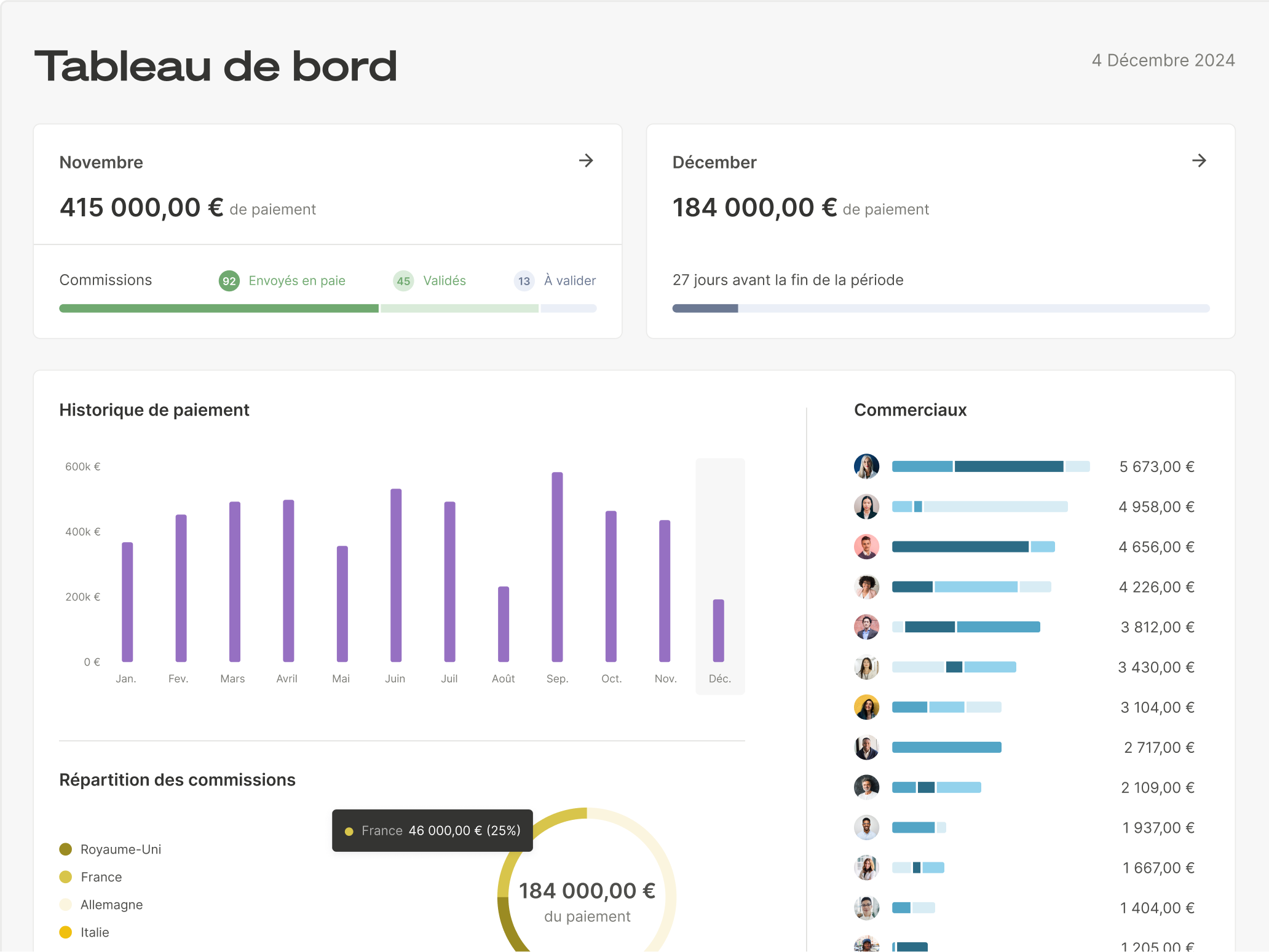
Les logiciels modernes de gestion des commissions automatisent l'ensemble du processus. En s'intégrant directement au CRM d'une entreprise (comme Salesforce ou HubSpot), ces plateformes extraient les données des transactions en temps réel, appliquent les règles de commission appropriées et présentent les résultats dans des tableaux de bord clairs et interactifs, tant pour les commerciaux que pour les responsables.
Des solutions telles que Qobra sont conçues pour gérer facilement cette complexité. Leurs moteurs de règles sans code permettent aux équipes financières et commerciales de créer et de modifier des plans complexes sans avoir besoin d'expertise technique. Cela élimine les erreurs humaines, permet d'économiser des dizaines d'heures par mois en tâches administratives et offre la transparence nécessaire pour véritablement stimuler les performances commerciales.
Les implications juridiques et fiscales des primes
La mise en œuvre d'un programme de primes s'accompagne d'importantes responsabilités administratives et juridiques. Il est essentiel que les entreprises comprennent et respectent les lois fiscales et du travail applicables afin d'éviter toute sanction.
Dans la plupart des pays, toute prime versée à un employé, qu'il s'agisse d'une commission, d'un bonus ou d'une prime d'encouragement, est considérée comme faisant partie de son revenu imposable. Cela signifie que l'employeur est tenu de prélever les impôts sur le revenu et les cotisations sociales appropriés, comme il le ferait pour un salaire normal. La classification en tant que « salaire supplémentaire » peut parfois entraîner l'application d'un taux de retenue différent, ce qui ajoute une couche supplémentaire de complexité.
Les primes destinées aux clients, telles que les remises, font généralement l'objet d'un traitement fiscal différent et sont généralement considérées comme une réduction de prix plutôt que comme un revenu pour le bénéficiaire. Cependant, les réglementations peuvent varier considérablement d'une juridiction à l'autre.
Une documentation adéquate est votre meilleure défense. Cela inclut un document officiel écrit décrivant le plan d'incitation, les accusés de réception signés par les participants et une piste d'audit de tous les calculs et paiements. L'automatisation des calculs de commissions à l'aide d'une plateforme fournissant une piste d'audit complète est inestimable pour garantir la conformité et la transparence.
Lorsqu'elles sont conçues de manière réfléchie et gérées de manière transparente, les primes incitatives sont plus qu'une simple récompense : elles constituent un puissant instrument stratégique. Elles permettent aux organisations de traduire des objectifs de haut niveau en objectifs tangibles et motivants pour les individus et les équipes. En alignant les ambitions personnelles sur les objectifs de l'entreprise, ces programmes favorisent une culture de la performance et stimulent une croissance durable. Alors que la technologie continue de simplifier la gestion des plans les plus complexes, la capacité à tirer efficacement parti des incitations financières restera un facteur clé de différenciation pour les entreprises leaders.
Foire aux questions (FAQ)
Les primes sont-elles imposables ?
Oui, pour les employés, les primes sont presque universellement considérées comme un revenu supplémentaire. À ce titre, elles sont soumises à l'impôt sur le revenu, à la sécurité sociale et à d'autres retenues sur salaire. Les taux de retenue d'impôt spécifiques peuvent différer du salaire normal et varier selon les pays et les juridictions locales. Il est essentiel que les employeurs traitent correctement ces paiements via leur système de paie.
Comment peut-on prétendre à une prime ?
L'éligibilité est définie par les règles spécifiques du programme de primes. L'éligibilité dépend généralement du respect de critères prédéfinis et mesurables. Pour un commercial, il peut s'agir de dépasser un quota de ventes. Pour une équipe de projet, il peut s'agir de lancer un produit avant une certaine date limite. Pour un consommateur, il peut s'agir d'acheter un produit spécifique pendant une période promotionnelle. Les conditions générales doivent toujours être clairement documentées.
Un plan d'incitation peut-il être modifié ?
Oui, les entreprises se réservent généralement le droit de modifier ou de mettre fin aux plans d'incitation. Toutefois, les meilleures pratiques veulent que toute modification soit communiquée de manière claire, transparente et bien avant son entrée en vigueur. Il est fortement déconseillé de modifier les règles ou les objectifs au milieu d'une période de performance (par exemple, un trimestre), car cela peut nuire gravement au moral et à la confiance. Les plans doivent être révisés à intervalles réguliers, par exemple chaque année, afin de s'assurer qu'ils restent en adéquation avec la stratégie commerciale.
Quelle est la différence entre une prime et une commission ?
La « prime » est une catégorie plus large. Elle désigne toute récompense, monétaire ou non, utilisée pour encourager une action spécifique. Une « commission » est un type très spécifique de prime monétaire utilisé principalement dans le domaine de la vente. Elle est calculée en pourcentage de la valeur d'une transaction. Par conséquent, toutes les commissions sont des primes, mais toutes les primes (comme une prime fixe pour la réalisation d'un projet ou un voyage de cohésion d'équipe) ne sont pas des commissions.