9 avril | Webinar : Le coût réel de la rémunération des commerciaux et comment l'optimiser (avec ElevenLabs et The SaaS CFO)
S'inscrire
- Un modèle prêt à personnaliser (Word + Excel) qui documente le résumé du plan, l'éligibilité, l'OTE/la composition de la rémunération, les indicateurs, les formules de calcul, le calendrier des paiements et les clauses de récupération.
- Définissez des indicateurs de performance clés spécifiques à chaque rôle (ARR/TCV, réalisation des quotas, couverture du pipeline, indicateurs d'activité pour les SDR, NRR pour les CSM) avec des règles de mesure claires et des exemples de calculs.
- Privilégiez des structures de paiement simples et transparentes (pourcentage fixe, accélérateurs à plusieurs niveaux, SPIFF) et incluez des formules Excel pour modéliser des scénarios et simuler des résultats.
- Mettez le plan en œuvre : fixez des quotas réalistes à partir de données historiques/descendantes, organisez un lancement officiel et documentez le plan, intégrez-le au CRM et fournissez des tableaux de bord en temps réel pour la simulation et la transparence.
- Évitez les écueils en gardant le plan simple, en ne plafonnant pas les performances des meilleurs éléments, en alignant les incitations sur les objectifs commerciaux, en effectuant une révision annuelle avec des contrôles trimestriels et en automatisant les calculs pour éliminer les erreurs et les litiges.
Vous avez du mal à concevoir un plan de rémunération des ventes qui motive véritablement votre équipe et qui ne se perde pas dans un labyrinthe de feuilles de calcul confuses ? Un programme d'incitation bien conçu est plus qu'un simple document ; c'est un outil stratégique qui aligne votre force de vente sur vos objectifs commerciaux les plus importants. Si votre système actuel soulève plus de questions qu'il n'apporte de clarté, ce qui entraîne frustration et conflits, il est temps de procéder à un changement fondamental.
La puissance d'un excellent programme d'incitation à la vente ne réside pas seulement dans les chiffres, mais aussi dans sa capacité à guider, à motiver et à instaurer la confiance. Lorsque les représentants comprennent clairement ce que l'on attend d'eux et qu'ils peuvent voir le lien direct entre leurs efforts et leurs récompenses, leurs performances s'améliorent. Ce guide fournit un cadre complet et un modèle personnalisable pour vous aider à élaborer un plan transparent, équitable et générateur de résultats mesurables. Nous passerons en revue tous les éléments essentiels, de la définition des indicateurs à la structuration des rémunérations, afin que votre prochain plan d'incitation soit le plus efficace possible.
Qu'est-ce qu'un modèle de programme d'incitation à la vente ?
Un modèle de programme d'incitation à la vente est un cadre structuré qui décrit comment les équipes commerciales gagnent une rémunération variable en fonction de leurs performances. Il sert de plan directeur, détaillant tout, des indicateurs de performance et des quotas de vente aux formules de rémunération et aux règles de gouvernance. En standardisant l'approche, les modèles aident les entreprises à aligner les activités commerciales sur les objectifs généraux de l'entreprise, garantissant ainsi que tout le monde va dans la même direction.
L'objectif principal de ce cadre est de créer un modèle de rémunération transparent, cohérent et motivant. Il simplifie le processus souvent complexe de création de plans, réduit le risque de litiges et apporte une clarté indispensable aux commerciaux, aux responsables et aux équipes financières. Un modèle robuste n'est pas un document rigide, mais un outil évolutif et personnalisable. Les responsables commerciaux l'utilisent pour suivre les performances, stimuler la motivation et soutenir une croissance durable des revenus grâce à un système fondé sur l'équité et la cohérence.
À mesure que les entreprises évoluent, leurs stratégies de rémunération évoluent également. En fait, des études montrent que plus de 90 % des organisations prévoyaient de modifier leurs plans de rémunération des ventes en 2024. Cette tendance souligne la nécessité de disposer de modèles adaptables qui peuvent être mis à jour régulièrement afin que les incitations restent pertinentes et axées sur les performances.
Les éléments essentiels d'un plan d'incitation efficace
Un modèle de plan d'incitation vraiment efficace est complet et ne laisse aucune place à l'ambiguïté. Chaque section a un objectif spécifique, contribuant à la clarté et à la facilité d'application du document, qui motive les représentants et protège l'entreprise.
Résumé du plan et éligibilité
Cette section fondamentale pose les bases. Elle doit clairement indiquer le nom du plan, la période qu'il couvre (par exemple, « Plan d'incitation pour l'exercice 2026 ») et le propriétaire ou l'administrateur du plan. Plus important encore, elle définit qui est éligible.
- Participants : énumérez les rôles spécifiques couverts par le plan (par exemple, chargés de clientèle, représentants du développement commercial, gestionnaires de comptes).
- Durée : précisez les dates de début et de fin de la période de performance (par exemple, du 1er janvier 2026 au 31 décembre 2026).
- Critères d'éligibilité : détaillez les conditions de participation, telles que le fait d'être un employé actif en règle au moment du versement.
Ventilation de la rémunération (gains cibles)
Cette section décrit le potentiel de gains total et sa structure. La transparence est ici essentielle pour attirer et retenir les meilleurs talents.
- Salaire de base : la partie fixe du salaire de l'employé.
- Rémunération variable : le montant de la prime cible que l'employé peut gagner s'il atteint 100 % de son quota.
- Rémunération cible (OTE) : la somme du salaire de base et de la rémunération variable cible. La combinaison idéale pour la rémunération cible (OTE) varie souvent selon le poste, la répartition 50/50 étant courante pour les chargés de clientèle.
Vous avez du mal à concevoir un plan de rémunération des ventes qui motive véritablement votre équipe et qui ne se perde pas dans un labyrinthe de feuilles de calcul confuses ? Un programme d'incitation bien conçu est plus qu'un simple document ; c'est un outil stratégique qui aligne votre force de vente sur vos objectifs commerciaux les plus importants. Si votre système actuel soulève plus de questions qu'il n'apporte de clarté, ce qui entraîne frustration et conflits, il est temps de procéder à un changement fondamental.
La puissance d'un excellent programme d'incitation à la vente ne réside pas seulement dans les chiffres, mais aussi dans sa capacité à guider, à motiver et à instaurer la confiance. Lorsque les représentants comprennent clairement ce que l'on attend d'eux et qu'ils peuvent voir le lien direct entre leurs efforts et leurs récompenses, leurs performances s'améliorent. Ce guide fournit un cadre complet et un modèle personnalisable pour vous aider à élaborer un plan transparent, équitable et générateur de résultats mesurables. Nous passerons en revue tous les éléments essentiels, de la définition des indicateurs à la structuration des rémunérations, afin que votre prochain plan d'incitation soit le plus efficace possible.
Qu'est-ce qu'un modèle de programme d'incitation à la vente ?
Un modèle de programme d'incitation à la vente est un cadre structuré qui décrit comment les équipes commerciales gagnent une rémunération variable en fonction de leurs performances. Il sert de plan directeur, détaillant tout, des indicateurs de performance et des quotas de vente aux formules de rémunération et aux règles de gouvernance. En standardisant l'approche, les modèles aident les entreprises à aligner les activités commerciales sur les objectifs généraux de l'entreprise, garantissant ainsi que tout le monde va dans la même direction.
L'objectif principal de ce cadre est de créer un modèle de rémunération transparent, cohérent et motivant. Il simplifie le processus souvent complexe de création de plans, réduit le risque de litiges et apporte une clarté indispensable aux commerciaux, aux responsables et aux équipes financières. Un modèle robuste n'est pas un document rigide, mais un outil évolutif et personnalisable. Les responsables commerciaux l'utilisent pour suivre les performances, stimuler la motivation et soutenir une croissance durable des revenus grâce à un système fondé sur l'équité et la cohérence.
À mesure que les entreprises évoluent, leurs stratégies de rémunération évoluent également. En fait, des études montrent que plus de 90 % des organisations prévoyaient de modifier leurs plans de rémunération des ventes en 2024. Cette tendance souligne la nécessité de disposer de modèles adaptables qui peuvent être mis à jour régulièrement afin que les incitations restent pertinentes et axées sur les performances.
Les éléments essentiels d'un plan d'incitation efficace
Un modèle de plan d'incitation vraiment efficace est complet et ne laisse aucune place à l'ambiguïté. Chaque section a un objectif spécifique, contribuant à la clarté et à la facilité d'application du document, qui motive les représentants et protège l'entreprise.
Résumé du plan et éligibilité
Cette section fondamentale pose les bases. Elle doit clairement indiquer le nom du plan, la période qu'il couvre (par exemple, « Plan d'incitation pour l'exercice 2026 ») et le propriétaire ou l'administrateur du plan. Plus important encore, elle définit qui est éligible.
- Participants : énumérez les rôles spécifiques couverts par le plan (par exemple, chargés de clientèle, représentants du développement commercial, gestionnaires de comptes).
- Durée : précisez les dates de début et de fin de la période de performance (par exemple, du 1er janvier 2026 au 31 décembre 2026).
- Critères d'éligibilité : détaillez les conditions de participation, telles que le fait d'être un employé actif en règle au moment du versement.
Ventilation de la rémunération (gains cibles)
Cette section décrit le potentiel de gains total et sa structure. La transparence est ici essentielle pour attirer et retenir les meilleurs talents.
- Salaire de base : la partie fixe du salaire de l'employé.
- Rémunération variable : le montant de la prime cible que l'employé peut gagner s'il atteint 100 % de son quota.
- Rémunération cible (OTE) : la somme du salaire de base et de la rémunération variable cible. La combinaison idéale pour la rémunération cible (OTE) varie souvent selon le poste, la répartition 50/50 étant courante pour les chargés de clientèle.
Indicateurs de performance et indicateurs clés de performance
Au cœur de tout programme d'incitation se trouve un ensemble d'indicateurs utilisés pour mesurer le succès. Ceux-ci doivent être directement liés aux objectifs stratégiques de l'entreprise, qu'il s'agisse de l'acquisition de nouveaux clients, de l'expansion du marché ou de l'augmentation de la rentabilité.
Les indicateurs de performance commerciale et les KPI courants comprennent :
- Atteinte des quotas : principale mesure du succès, généralement basée sur les revenus générés (par exemple, les revenus annuels récurrents (ARR) ou la valeur totale des contrats (TCV)).
- Nouvelles affaires vs expansion : distinction entre les revenus provenant de nouveaux clients et ceux provenant de ventes incitatives/croisées à des clients existants.
- Indicateurs basés sur l'activité (pour les SDR) : nombre de rendez-vous qualifiés pris, pipeline généré ou taux de conversion.
- Rentabilité : incitation des commerciaux à vendre des contrats avec des marges bénéficiaires plus élevées.
Logique de rémunération : formules et structures
Cette section définit comment les commissions sont gagnées. La clarté de vos formules de rémunération pour le calcul des commissions sur les ventes est non négociable. La gestion manuelle de ces formules à l'aide d'un tableur est source d'erreurs, c'est pourquoi les équipes modernes s'appuient sur des plateformes automatisées. Notre moteur de règles sans code, par exemple, vous permet de créer et de modifier en quelques minutes les logiques de rémunération les plus complexes, garantissant ainsi la précision et vous faisant gagner un temps considérable.
Voici quelques modèles courants :
- Taux fixe : un simple pourcentage de chaque vente (par exemple, 10 % du chiffre d'affaires annuel récurrent).
- Taux échelonnés (accélérateurs) : les taux de commission augmentent à mesure que les performances s'améliorent. Ce système est très efficace pour motiver les commerciaux à dépasser leurs objectifs.
Exemple de structure de commission échelonnée :
Vous pouvez également inclure des décélérateurs (taux réduits en cas de sous-performance) ou des SPIFF (fonds d'incitation à la performance à court terme) afin de mettre l'accent sur des produits ou des initiatives spécifiques.
Calendrier de paiement et gouvernance
Ceci définit les règles opérationnelles du plan.
- Calendrier de paiement : précisez quand les commissions sont versées (par exemple, « lors du dernier versement de salaire du mois suivant le trimestre au cours duquel la transaction a été conclue »).
- Conditions de paiement : clarifiez le déclencheur du paiement. S'agit-il d'un contrat signé, du premier paiement du client ou du recouvrement intégral des fonds ?
- Récupérations : décrivez les conditions dans lesquelles l'entreprise peut récupérer une commission versée, par exemple en cas de perte précoce de clients ou d'annulation de contrat.
- Résolution des litiges : établissez un processus clair et équitable permettant aux représentants de contester et de résoudre les éventuelles erreurs de calcul.
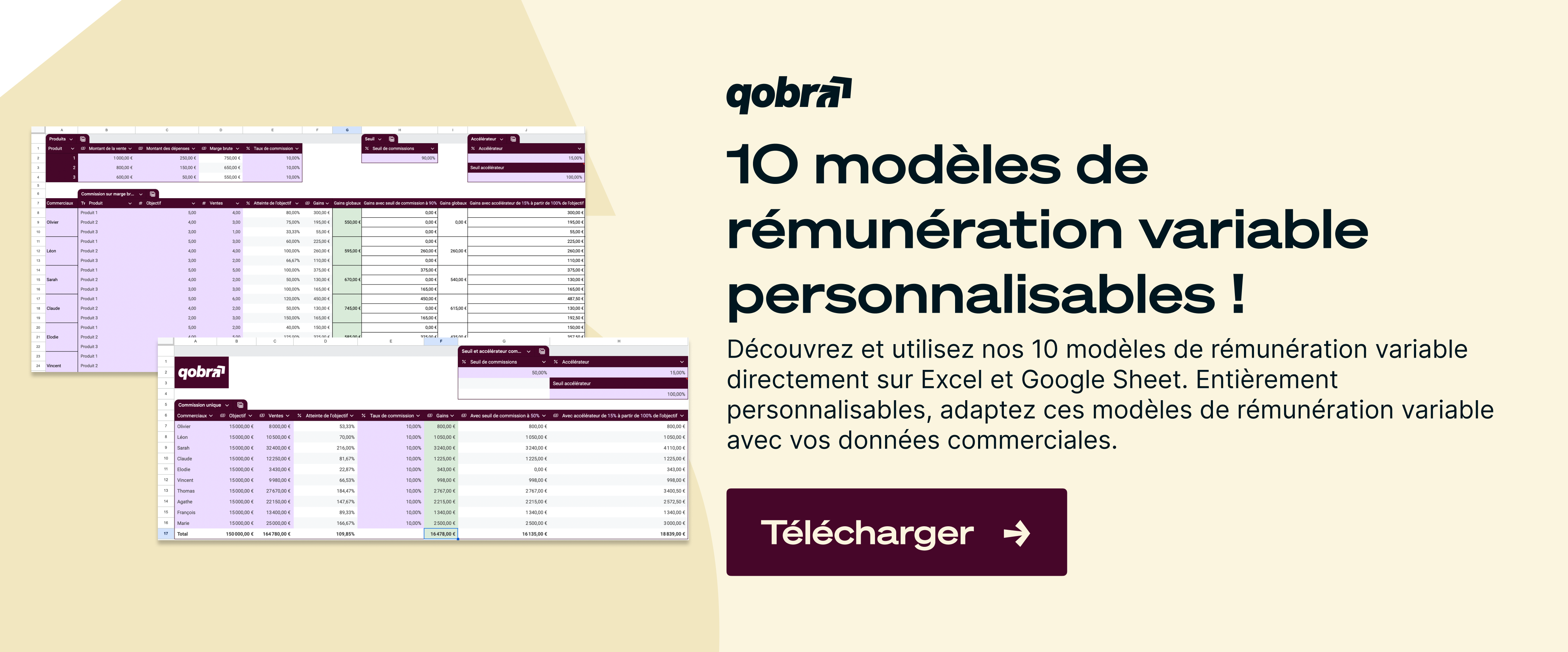
[TÉLÉCHARGER] Votre modèle de programme d'incitation à la vente (Word et Excel)
Pour vous aider à démarrer, nous avons créé un ensemble complet comprenant un document personnalisable et une feuille de calcul.
- Document relatif au plan d'incitation à la vente (Word/Google Docs) : un modèle prêt à l'emploi couvrant toutes les sections mentionnées ci-dessus. Il vous suffit de remplir les informations spécifiques à votre entreprise et à vos fonctions.
- Feuille de calcul pour le calcul des commissions (Excel/Google Sheets) : un outil puissant avec des formules prédéfinies pour modéliser différents scénarios de paiement et suivre les performances tout au long de l'année. Bien qu'utile, n'oubliez pas que même la meilleure feuille de calcul pour le suivi des commissions peut devenir fastidieuse à mesure que votre équipe s'agrandit.
Comment élaborer et mettre en œuvre votre programme : guide étape par étape
Un modèle est un excellent point de départ, mais sa mise en œuvre réussie nécessite un processus mûrement réfléchi.
Étape 1 : Alignez-vous sur les objectifs commerciaux de haut niveau
Avant d'écrire le moindre mot, posez-vous la question suivante : « Quel est le résultat le plus important que nous attendons de notre équipe commerciale cette année ? » S'agit-il d'acquérir de nouveaux clients de manière agressive ? D'améliorer la rétention nette en euros ? De pénétrer un nouveau marché ? Vos mesures incitatives doivent récompenser directement les comportements qui mènent à ces objectifs.
Étape 2 : Définissez des indicateurs clés de performance (KPI) spécifiques à chaque rôle
Tous les rôles commerciaux ne sont pas identiques. Votre plan doit refléter ces différences.
- SDR/BDR : concentrez-vous sur les indicateurs avancés tels que les rendez-vous qualifiés fixés, le pipeline généré ou les opportunités de stade 1 acceptées par les AE.
- Account Executives (AE) : concentrez-vous principalement sur les contrats conclus, mesurés en ARR ou TCV. Vous pouvez ajouter un bonus pour les contrats pluriannuels ou les contrats avec des frais de mise en œuvre élevés.
- Account Managers/CSM : récompensez les renouvellements, les ventes incitatives, les ventes croisées et la rétention du chiffre d'affaires net (NRR).
Étape 3 : Fixez des quotas réalistes et motivants
Les quotas doivent être ambitieux mais réalisables. En règle générale, 60 à 70 % de votre équipe devrait être en mesure d'atteindre son objectif. Basez les quotas sur une combinaison des performances historiques, du potentiel du territoire et des objectifs commerciaux descendants. Des quotas irréalisables sont le moyen le plus rapide de démotiver une équipe commerciale.
Étape 4 : communiquez le plan avec une clarté absolue
Le déploiement est aussi important que le plan lui-même.
- Organisez une réunion de lancement : présentez le plan à l'ensemble de l'équipe.
- Fournissez une documentation détaillée : remettez à chaque représentant une copie de son plan signé.
- Utilisez des exemples concrets : montrez-leur exactement comment leur commission est calculée pour une petite, moyenne et grande transaction.
- Mettez en place une politique de porte ouverte : encouragez les questions et créez un espace sûr où les représentants peuvent demander des éclaircissements.
C'est là que les tableaux de bord en temps réel changent la donne. Au lieu d'attendre la fin du mois pour obtenir un rapport, des plateformes telles que Qobra offrent aux représentants une vue en direct de leurs performances et de leurs gains potentiels. Ils peuvent simuler les commissions sur les transactions en cours, transformant ainsi le plan de rémunération en un facteur de motivation quotidien et dynamique.
Pièges courants à éviter lors de la conception de votre plan
Même avec les meilleures intentions, les plans d'incitation peuvent échouer. Méfiez-vous de ces erreurs courantes.
- Complexité excessive : si votre plan nécessite un doctorat en mathématiques pour être compris, il échouera. La simplicité et la clarté l'emportent toujours sur les formules complexes. Un représentant doit être capable de calculer sa commission au dos d'une serviette en papier.
- Plafonnement des commissions : le plafonnement des revenus incite vos meilleurs vendeurs à cesser de vendre une fois qu'ils ont atteint un certain seuil. Cela a un effet démotivant considérable. Récompensez les performances exceptionnelles par des accélérateurs, ne les punissez pas par des plafonds.
- Incitations mal alignées : faites attention à ce que vous souhaitez. Si vous ne récompensez que les nouveaux revenus, les représentants risquent de négliger les clients existants. Si vous ne récompensez que le volume, ils risquent d'offrir des remises importantes qui nuisent à la rentabilité. Assurez-vous que vos plans de commissionnement des ventes sont bien structurés afin d'encourager les bons comportements.
- Paiements inexacts ou en retard : rien ne détruit plus rapidement la confiance que les erreurs de paie. C'est la raison la plus convaincante pour abandonner les feuilles de calcul manuelles et adopter un logiciel automatisé de rémunération des ventes. L'automatisation garantit des paiements ponctuels et 100 % exacts, à chaque fois.
Un modèle d'incitation à la vente fournit l'architecture nécessaire, mais l'objectif ultime est de créer un système dynamique qui stimule les performances et s'adapte à votre entreprise. En mettant l'accent sur l'alignement, la clarté et la transparence, et en tirant parti des outils modernes pour automatiser le processus, vous pouvez transformer votre plan de rémunération, qui était jusqu'alors une tâche administrative fastidieuse, en un puissant levier stratégique pour la croissance.

FAQ
À quelle fréquence devons-nous revoir notre programme d'incitation à la vente ?
Vous devez procéder à une révision approfondie de votre programme d'incitation à la vente chaque année, en fonction de votre planification stratégique pour l'exercice fiscal à venir. Cependant, il est judicieux d'effectuer des contrôles trimestriels afin de s'assurer que le programme encourage les comportements souhaités et d'apporter des ajustements mineurs si les conditions du marché changent de manière inattendue. Évitez d'apporter des changements fréquents et importants en cours de cycle, car cela peut semer la confusion et frustrer l'équipe.
Quelle est la répartition idéale entre salaire fixe et salaire variable ?
La répartition idéale dépend fortement du rôle commercial, du secteur d'activité et de la durée de votre cycle de vente. Pour les rôles de « chasseurs », tels que les chargés de compte, qui ont un impact direct sur la conclusion de nouvelles affaires, une répartition 50/50 (50 % de salaire fixe, 50 % de salaire variable) est une référence courante. Pour les postes davantage axés sur la génération de prospects (SDR) ou la gestion des comptes existants (gestionnaires de comptes), la part du salaire de base est généralement plus élevée, avec une répartition de 60/40 ou 70/30.
Comment puis-je m'assurer que mon plan d'incitation est juste et équitable ?
L'équité repose sur la transparence et la cohérence. Veillez à ce que les quotas soient fixés sur la base de critères objectifs (par exemple, le potentiel du territoire, les données historiques) plutôt que subjectifs. Les règles du plan, y compris les indicateurs, les taux de rémunération et les accélérateurs, doivent être standardisées et s'appliquer de manière égale à toutes les personnes occupant le même poste. Enfin, l'utilisation d'un système automatisé pour calculer les commissions élimine les biais et les erreurs humaines, garantissant ainsi que chaque représentant est rémunéré avec précision sur la base des règles convenues.
Quelle est la différence entre une commission et une prime ?
Une commission est une forme de rémunération variable calculée en pourcentage de la valeur d'une vente. Elle est directement liée à une transaction individuelle (par exemple, 10 % du revenu annuel récurrent pour chaque transaction conclue). Une prime, en revanche, est généralement un paiement d'un montant fixe accordé pour la réalisation d'un objectif ou d'une étape spécifique, souvent non transactionnel (par exemple, une prime de 5 000 euros pour avoir atteint 100 % du quota trimestriel). Les deux peuvent être utilisés ensemble dans un plan de rémunération des ventes bien équilibré.