Webinar (Wednesday, October 21) — Aligning HR, Finance, and Sales: Mastering Sales Comp Without Breaking Your Plan
Register
- ASC 606 / IFRS 15 requires commissions that are "incremental costs of obtaining a contract" to be capitalized and recognized in line with when revenue is recognized (the five‑step model determines timing).
- Capitalize a commission when it is incremental, expected to be recovered, and its benefit period exceeds one year; expense immediately if the amortization period would be one year or less or if the cost is not incremental (e.g., many manager overrides, marketing).
- Amortize the capitalized commission over the period the company benefits (typically the initial contract term); e.g., a $12,000 commission on a 3‑year deal is recorded as a deferred asset and amortized $333.33/month with corresponding journal entries for deferral and monthly expense.
- Sales Ops must partner with Finance to publish a clear policy (which roles and deal types are capitalized), link every commission to contract start/end dates, and avoid changing compensation design merely to simplify accounting.
- Move off spreadsheets: implement a commission platform integrated with your CRM to automate allocation and amortization schedules, produce audit trails and reports, and monitor the first‑year "false savings" as deferred costs unwind in later years.
Are you certain that the way your company accounts for sales commissions aligns with current financial standards? The shift to ASC 606 (or IFRS 15 for international companies) was more than just a regulatory update; it fundamentally altered how businesses, especially those in the SaaS and subscription space, must report their financials. If you're still relying on complex spreadsheets to manage commission expenses, you could be facing significant compliance risks and missing out on strategic financial insights.
This accounting framework requires a more disciplined approach. It’s no longer about expensing commissions the moment they are paid. Instead, the standard demands that you align these costs with the revenue they help generate over the entire customer lifecycle. So, how do you correctly identify which costs to capitalize, amortize them accurately over time, and maintain a clear, audit-ready trail without getting lost in complexity? For Sales Ops leaders, understanding these rules is no longer optional—it's critical for strategic planning and operational excellence.
What is ASC 606 and Why Does It Matter for Commissions?
ASC 606, "Revenue from Contracts with Customers," is the revenue recognition standard introduced by the Financial Accounting Standards Board (FASB) in the U.S. and its international equivalent, IFRS 15. Its primary goal is to standardize how companies report revenue, providing a more robust and comparable framework across all industries. For businesses with long-term contracts, its impact has been profound.
The core principle of ASC 606 is that revenue should be recognized when performance obligations are satisfied and control of goods or services is transferred to the customer. This often means recognizing revenue over the duration of a contract rather than all at once upon signing.
This directly impacts sales commission accounting. Under previous guidance, commissions were often treated as a period expense, recognized in full when incurred. However, ASC 606 reclassifies commissions directly tied to securing a new contract as "incremental costs of obtaining a contract."
What are incremental costs? These are costs that the company would not have incurred if the contract had not been obtained. The most common example is a sales commission paid to a sales representative for closing a deal.
If these costs are deemed recoverable, they must be capitalized as an asset on the balance sheet. Then, this asset is amortized (i.e., expensed) over a period that reflects the transfer of goods or services to the customer. In essence, the commission expense is methodically matched to the revenue it helped generate, providing a far more accurate picture of a contract's profitability over its lifetime.
The 5-Step Revenue Recognition Model: A Foundation for Commission Accounting
To implement the standard correctly, ASC 606 outlines a five-step model. While this is primarily an accounting function, Sales Ops leaders should understand the logic, as it dictates the timing of revenue recognition, which in turn governs the amortization of commissions.
- Identify the Contract with the Customer: This is the agreement that creates enforceable rights and obligations. It can be a formal signed document or an implied agreement, as long as it meets specific criteria.
- Identify the Performance Obligations: These are the distinct promises within the contract to provide goods or services. For a SaaS company, this could include platform access, implementation services, and premium support.
- Determine the Transaction Price: This is the total consideration the company expects to receive. It includes fixed amounts and must also account for variable elements like discounts or performance bonuses.
- Allocate the Transaction Price: If a contract has multiple performance obligations, the total price must be allocated to each one based on its standalone selling price.
- Recognize Revenue: Revenue is recognized as each performance obligation is satisfied. For a SaaS subscription, revenue is typically recognized over time (e.g., monthly).
Understanding this framework is crucial because the period over which revenue is recognized directly informs the period over which the associated commission costs should be amortized.
Capitalize or Expense? The Core Decision for Sales Ops
Under ASC 606, the most significant change for commission accounting is the requirement to capitalize certain costs. This means Sales Ops must work closely with Finance to build processes that can correctly identify and categorize every commission payment.
When to Capitalize a Commission
The primary rule is that any incremental cost of obtaining a contract that is expected to be recovered should be capitalized if the benefit period is longer than one year.
You must capitalize a commission when:
- It is an incremental cost: The commission would not have been paid if the contract wasn't signed. This applies to most front-line sales rep commissions.
- The benefit period exceeds one year: If a rep sells a three-year contract, the benefit of that commission extends over the full three years. Therefore, the cost must be capitalized.
- The cost is recoverable: The company expects to recover the commission cost through the revenue generated from the contract.
This requirement means your systems must be able to differentiate commissions based on the contract term associated with the deal.
When to Expense a Commission Immediately
Not all sales-related compensation is capitalized. Some costs can still be expensed as they are incurred.
A practical expedient in ASC 606 allows companies to expense commissions immediately if the amortization period would have been one year or less. This simplifies accounting for annual contracts or monthly subscriptions without a long-term commitment.
Furthermore, some compensation is not considered an "incremental cost" of obtaining a specific contract. For example:
- Sales Manager Overrides: Commissions or bonuses paid to sales managers are often recognized immediately. The logic is that their compensation is tied to the overall performance of their team for a specific period (e.g., a quarter), not to securing any single contract.
- Marketing Expenses: Costs associated with generating leads are not incremental to obtaining a specific contract and are expensed as incurred.
Advice for Sales Ops
Collaborate with your finance team to create a clear policy document that defines which types of commissions are capitalized versus expensed. This policy should specify the treatment for different roles (e.g., Account Executive, Sales Manager, Solutions Engineer) and different contract types (e.g., new business, renewal, upsell).
Amortizing Capitalized Commissions: A Practical Example
Once a commission cost is capitalized, it must be amortized. Amortization is the process of gradually expensing the capitalized asset over its useful life. For commissions, this "useful life" is the period during which the company benefits from the obtained contract.
The amortization period is typically the initial contract term. However, it can sometimes be longer, such as the anticipated customer lifetime, if commissions paid on renewals are not commensurate with the commission paid on the initial contract. This is a complex area that requires careful judgment and a solid policy.
Let's walk through a common scenario for a SaaS company.
Scenario:
An Account Executive closes a new three-year contract.
- Total Contract Value (TCV): $120,000 ($40,000 per year)
- Commission Rate: 10% of TCV
- Total Commission Paid: $12,000
Under the old rules, the entire $12,000 might have been expensed in the quarter the deal was signed. Under ASC 606, the accounting treatment is different.
Step 1: Capitalize the Commission
At the time the commission is earned, it is recorded as an asset on the balance sheet, not an expense on the income statement.
- Journal Entry:
- Debit (Increase Asset): Deferred Commission Costs - $12,000
- Credit (Increase Liability): Commissions Payable - $12,000
Step 2: Amortize the Cost Over the Contract Term
The $12,000 asset is then expensed evenly over the 36-month contract term.
- Amortization per year: $12,000 / 3 years = $4,000
- Amortization per month: $12,000 / 36 months = $333.33
Annual Amortization Journal Entry (at the end of Year 1):
- Debit (Increase Expense): Commission Expense - $4,000
- Credit (Decrease Asset): Deferred Commission Costs - $4,000
This process repeats for Year 2 and Year 3, ensuring the expense is perfectly matched with the annual revenue of $40,000.
Here is how the asset balance would look over time:
| Year | Beginning Balance | Annual Amortization Expense | Ending Balance |
|---|---|---|---|
| Year 1 | $12,000 | $4,000 | $8,000 |
| Year 2 | $8,000 | $4,000 | $4,000 |
| Year 3 | $4,000 | $4,000 | $0 |
The Impact on Sales Operations: Your Action Plan
While the accounting entries are handled by Finance, the data and process integrity fall squarely on Sales Ops. ASC 606 has several direct consequences for your team.
Data and System Requirements
Managing these new rules on spreadsheets is not just inefficient—it's an enormous compliance risk. The level of detail required for an audit is nearly impossible to maintain manually at scale.
ASC 606 is the compelling event you’ve been waiting for to modernize your sales compensation management platform. Spreadsheets can no longer handle the need to differentiate commission expense by contract term, individual contributor, and manager, especially once you add in channels, overlays, and other roles.
Your systems must be able to:
- Capture Granular Data: Link every commission payment to a specific contract, including the contract's start and end dates.
- Differentiate Commission Types: Distinguish between commissions for front-line reps (likely capitalized) and bonuses for supervisors (likely expensed).
- Automate Amortization Schedules: Automatically generate and track the amortization schedule for every capitalized commission.
- Provide an Audit Trail: Produce clear reports that demonstrate the link between a contract, the commission paid, and the subsequent amortization over time.
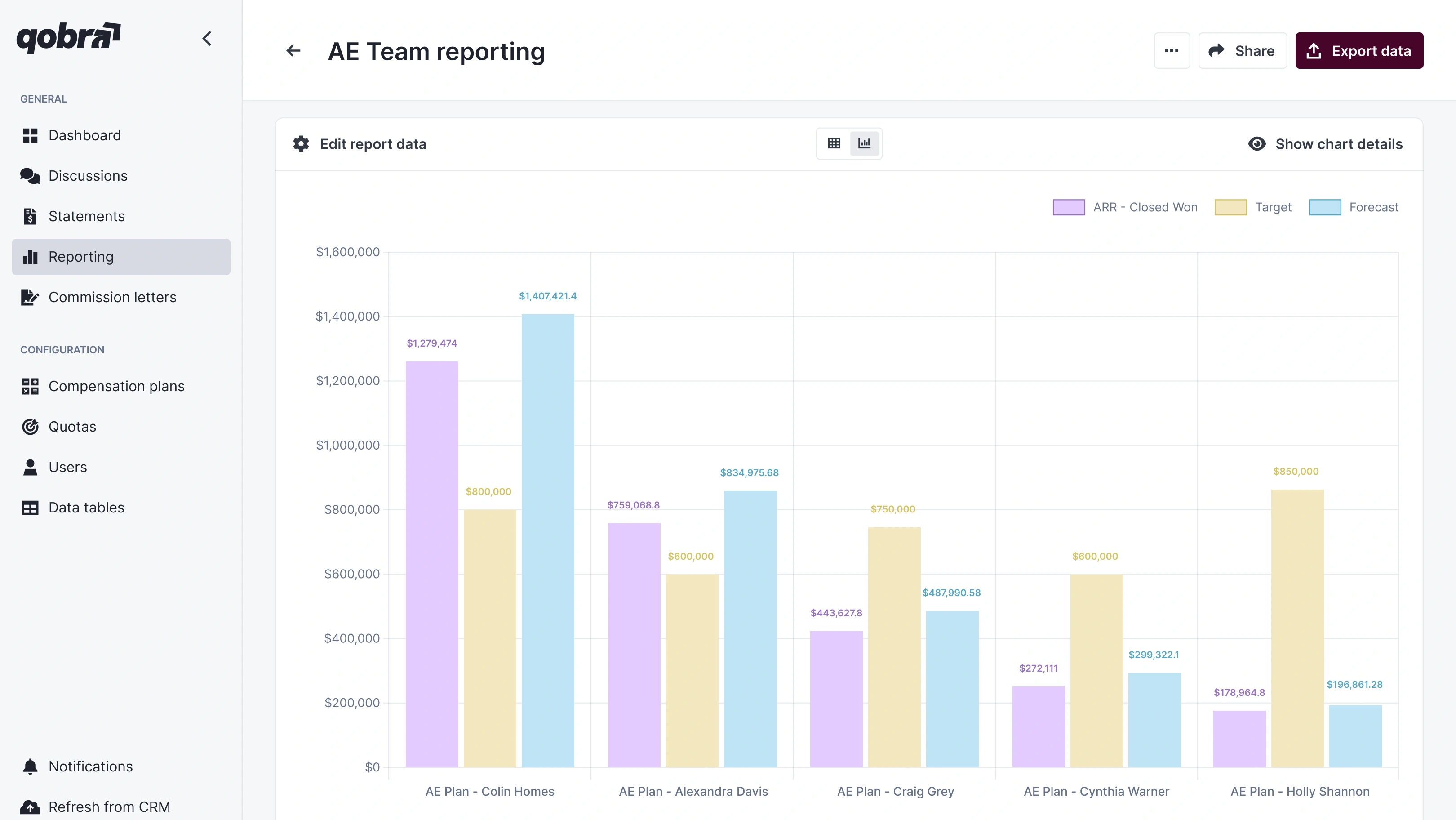
This is where a modern platform for managing sales commissions becomes essential. Solutions like Qobra calculate and record every commission in an auditable way, per contract and per payee, with traceability of the rules applied and of plan versions. This data can be exported to your accounting tools or ERP to support the capitalization and amortization of contract acquisition costs. The ability to integrate directly with your CRM (like Salesforce or HubSpot) ensures that contract data flows seamlessly into the commission calculation engine, providing a single source of truth for both sales performance and financial reporting.
The Hidden Danger of "False Savings"
In the first year of implementing ASC 606, your company's commission expenses may appear artificially low because a large portion of the cost is pushed into future years. Be aware of this when planning headcount. It can be tempting to add more reps based on these "savings," but as amortization schedules from subsequent years stack up, those savings will disappear.
Guarding the Integrity of Your Compensation Plan
A critical point for Sales Ops is to resist pressure to modify compensation plans or product configurations simply to make accounting easier. Your commission plan's primary objective is to motivate sales teams and drive the right behaviors.
Do not simplify a multi-year incentive structure or avoid paying commissions on long-term deals just because it creates an accounting task. The role of Sales Ops is to ensure the company has the right tools and processes to handle the complexity, rather than sacrificing strategic incentives for administrative convenience.
Preparing for Audits
Under ASC 606, auditors will scrutinize your commission accounting. They will expect to see a clear and logical process for:
- Identifying which costs to capitalize.
- Justifying the amortization period for each capitalized cost.
- Demonstrating the accuracy of the amortization calculations.
An automated system provides the robust documentation and reporting needed to satisfy these requests efficiently. A manual, spreadsheet-driven process is fragile and highly susceptible to error, making audits painful and risky.
The complexities of ASC 606 are a clear signal that it's time to move on from outdated methods. Adopting a specialized sales commission software is no longer just about efficiency; it's a fundamental requirement for financial compliance and strategic agility. With the right systems in place, Sales Ops can transform this accounting mandate into an opportunity for greater visibility and control.
FAQ
What are "incremental costs of obtaining a contract"?
Incremental costs are expenses that would not have been incurred if a contract had not been successfully obtained. The most direct example is a sales commission paid to a representative for closing a deal. If the deal is lost, the commission is not paid. This direct link makes it an incremental cost that must be aligned with the contract's revenue stream under ASC 606.
What is the amortization period for sales commissions?
The amortization period should match the period over which the company benefits from the asset (the capitalized commission). Most commonly, this is the initial term of the customer contract. For a five-year contract, the commission is amortized over five years. In some cases, if renewal commissions are significantly lower than the initial commission, the period could be extended to the average customer life, but this requires strong justification.
Does ASC 606 affect how and when we pay commissions to reps?
No. ASC 606 is an accounting standard that dictates how a company recognizes the expense on its financial statements. It does not—and should not—change the timing of cash payments to your sales representatives. You should continue to pay your reps according to the terms outlined in their commission plans to keep them motivated and engaged. The change is purely on the back end, for accounting and reporting purposes.
How do we handle commissions for multi-year contracts with different services?
If a contract contains multiple performance obligations (e.g., a software subscription, an implementation fee, and premium support), the total transaction price is allocated across these items. Similarly, the commission cost should ideally be allocated to each performance obligation. Then, the portion of the commission allocated to each item is amortized over the period that the corresponding revenue is recognized. This requires a robust system capable of tracking commissions at a granular, line-item level.