Webinar: The Biggest Release Sales Comp Has Ever Seen. Come See For Yourself (Wednesday, October 7)
Register
- Sales compensation software replaces error-prone spreadsheets with automated plan design, real-time quota tracking, and audit-ready payout calculations — reducing manual admin by up to 90%.
- Legacy platforms that charge $30K–$50K per plan modification lock teams into rigid comp structures; modern tools like Qobra let you iterate on plans in-house without vendor dependency.
- The best platforms integrate natively with Salesforce, HubSpot, and ERP systems so data flows from CRM to payroll without manual exports.
- When evaluating vendors, weight plan design flexibility (25%) and rep visibility (20%) highest — these two factors drive adoption and reduce shadow accounting.
- Implementation speed matters more than feature count: a platform that goes live in 4–6 weeks delivers ROI months before one that requires a 6-month deployment.
The best sales compensation software for RevOps and finance teams in 2026 combines a no-code plan builder, real-time rep dashboards, and finance controls: a full audit trail of plan and payout changes, automated monthly accruals, ASC 606 and ASC 340-40 support, and a clean handoff to payroll and the ERP. This guide compares Qobra, Xactly Incent, CaptivateIQ, Spiff by Salesforce, Performio, Varicent, Anaplan, QuotaPath, Commissionly and Everstage on those criteria, with USD pricing where vendors publish it.
Key takeaways
- Manual commission processes cost 25 to 40 hours per month in admin time and carry a payout error rate near 8.8 %, which on a $12M variable comp budget means about $1.06M in misallocated payouts per year.
- For finance teams, the deciding criteria are the audit trail (who changed which plan or payout, when, and why), accrual automation by deal, ASC 606 / ASC 340-40 amortization support and journal entry export to the ERP.
- Public USD pricing exists for QuotaPath ($35 or $50 per user per month plus a platform fee), Spiff by Salesforce ($75 per user per month) and Commissionly (from $33 per user per month); every other platform in this guide is quote-based (vendor websites, Sept 2026).
- Platforms with no-code plan builders (Qobra, CaptivateIQ, Everstage, QuotaPath) let RevOps deploy mid-year plan changes without a professional services engagement, which legacy vendors quote at $30,000 to $50,000 per change.
- Qobra, headquartered in New York and Paris, manages $1B+ in commissions across 300+ companies and logs every plan and payout change in an audit log that finance can export for SOX and ASC 606 reviews.
If your RevOps or Finance team still budgets two full days each month to reconcile commission spreadsheets, you are not alone — but you are paying a steep price. Industry data shows that organizations relying on manual compensation workflows spend 25–40 hours per month on admin tasks and carry an average payout error rate of 8.8%. Those errors do not just cost money. They erode trust between sales reps and the company, and they make mid-cycle plan changes practically impossible.
The deeper problem is rigidity. Many legacy compensation platforms treat plan modifications as professional-services engagements, quoting $30,000–$50,000 per change. When the cost of adapting a comp plan exceeds the expected revenue gain, teams stop iterating — and misaligned incentives quietly drain pipeline.
This guide evaluates the 10 best sales compensation software platforms in 2026 across six weighted criteria so you can find the tool that matches your team size, plan complexity, and budget. Whether you manage 20 reps or 2,000, the goal is the same: a compensation management platform that lets you design, calculate, and communicate variable pay without stitching together spreadsheets or waiting on vendor consultants.
What Is Sales Compensation Software?
Sales compensation software is a category of platforms that manage the entire variable pay program — from plan design and quota modeling through calculation, rep-facing dashboards, and payroll handoff. It is distinct from a pure commission calculator, which only computes payouts from a fixed formula.
A full compensation management platform typically includes:
- Plan design and modeling — Build comp plans with accelerators, decelerators, SPIFs, and MBOs using a visual or no-code builder. Model the financial impact of plan changes before they go live.
- Quota management — Set, adjust, and track quotas at the individual, team, and territory level. Support for ramp schedules and mid-year quota adjustments.
- Automated calculation engine — Pull deal data from CRMs and calculate payouts in real time, applying crediting rules, splits, and overrides.
- Rep visibility dashboards — Give each salesperson a real-time view of their earnings, quota attainment, and deal-level commission impact so they can forecast their own paycheck.
- Finance and audit controls — Generate accrual reports, ASC 606 schedules, and approval workflows. Maintain a full audit trail of every plan change and payout adjustment.
- Read the finance-specific checklist in Commission software audit trails for SOX and ASC 606 and the monthly close mechanics in Accrued commissions: how to book and true up.
- Payroll integration — Export finalized commission data to payroll systems (ADP, Workday, etc.) with mapping rules that match your GL structure.
The distinction matters because organizations that treat compensation software as "just a calculator" often outgrow the tool within 12 months. When your team needs to add a new product-line SPIF or restructure territories, a calculator forces you back into spreadsheets. A true comp plan software platform handles that change inside the system.
Why Manual Compensation Management Fails at Scale
Manual compensation workflows — typically a combination of Excel, Google Sheets, and email — work reasonably well when you have fewer than 10 reps on a single plan. Beyond that threshold, three problems compound:
1. Administrative Burden Grows Non-Linearly
Every new rep, plan variation, or territory adds rows, tabs, and lookup formulas. Finance teams report spending 25–40 hours per month reconciling commission data when managing 50+ reps manually. That is not just a time cost; it is an opportunity cost. Those hours could go toward plan optimization, quota analysis, or revenue forecasting.
2. Error Rates Become Systemic
Studies consistently show that manual commission processes carry a payout error rate near 8.8%. At scale, even a 2% error rate on a $5 million annual commission budget means $100,000 in overpayments or underpayments — and the disputes that follow consume additional Finance and Sales Ops bandwidth.
Example scenario:A 200-rep organization with an average annual OTE of $120,000 (50/50 split) pays $12 million in variable compensation. An 8.8% error rate implies $1,056,000 in misallocated payouts per year.
3. Plan Iteration Becomes Impossible
The most damaging consequence of manual processes is strategic: teams that cannot iterate on plans mid-year lose revenue to misaligned incentives. When adjusting a comp plan requires rebuilding a spreadsheet, re-validating every formula, and manually communicating changes to 200 reps, most organizations default to annual plan cycles — even when market conditions change quarterly.
Variable pay software eliminates these failure modes by centralizing plan logic, automating calculations, and providing real-time visibility to every stakeholder.
How We Evaluated These Platforms
To build this ranking, we analyzed G2 and Capterra reviews, vendor-published implementation data, and publicly available feature documentation. We weighted six criteria based on the factors that RevOps and Finance leaders consistently rank as most important:
Why plan design flexibility is weighted highest: The primary value of compensation software is the ability to align incentives with business strategy. If changing a plan requires a $30K vendor engagement and a 3-month timeline, the software is not delivering on its core promise. Platforms that empower RevOps teams to design, test, and deploy plan changes independently scored highest.
The 10 Best Sales Compensation Software Platforms in 2026
1. Qobra — Best for Teams That Want Comp Plan Agility Without Vendor Dependency

Qobra is built for organizations that want commissions to be clear and trusted across Operations, Finance, and Sales — without depending on vendor consultants every time a plan changes.
What sets Qobra apart is plan design agility. The platform provides a no-code plan builder that lets RevOps teams create and modify compensation plans — including multi-tier accelerators, decelerators, SPIFs, MBOs, and team-based overrides — without writing formulas or submitting change requests to a vendor. When a new product line launches or a territory restructure goes into effect, your team deploys the updated plan the same week.
Key capabilities:
- No-code plan builder — Design plans visually with drag-and-drop logic. Support for unlimited plan variations, custom crediting rules, and split calculations. Changes deploy immediately without vendor involvement.
- Real-time quota attainment and deal-level visibility — Every rep sees their current quota attainment, pending deals, and the exact commission impact of each opportunity. Email notifications alert reps when deals close, reinforcing the link between performance and payout.
- In-house implementation — Qobra's team handles implementation directly (no third-party SI required), with most deployments completing in 4–6 weeks. This is a meaningful differentiator for teams that have experienced 4–6 month implementations with legacy vendors.
- Multi-currency support — Calculate and display commissions in local currencies across global teams, with automated exchange-rate handling.
- Finance-grade reporting — Generate accrual reports, audit trails, and ASC 606 schedules. Approval workflows route payout adjustments through the right stakeholders before they reach payroll.
- Native integrations — Connect to Salesforce, HubSpot, and major ERP/payroll systems. A flexible API supports custom data sources. Confirmed connectors: Salesforce, HubSpot, Microsoft Dynamics, Pipedrive, Zoho, Odoo; Snowflake, BigQuery, PostgreSQL, Microsoft SQL, Redshift; SFTP / CSV; Workday, BambooHR, HiBob. Major ERP/payroll systems, payroll export via HRIS, SFTP or API.
Who uses Qobra: Enterprise and mid-market organizations including SAP, AstraZeneca, JCDecaux, ElevenLabs, GoCardless, DataSnipper, Factorial, Go1, Quantcast, and Make.
Qobra, headquartered in New York and Paris, manages $1B+ in commissions across 300+ companies. For US revenue teams it connects Salesforce or HubSpot, an HRIS such as Workday, BambooHR or HiBob, and the payroll export in one flow (see all Qobra integrations), and every plan version, payout adjustment and approval is written to the audit log with user, timestamp and before/after values. Book a Qobra demo to see the finance workflow on your own plans.
Ratings: G2: 4.8/5 | Capterra: 4.9/5
Best for: Revenue Operations and Finance teams that need to iterate on comp plans frequently — launching new SPIFs, adjusting accelerators, restructuring territories — without waiting weeks for vendor-led modifications.
The combination of real-time rep visibility and proactive deal-level notifications drives measurably higher rep engagement. When salespeople can see exactly what they earn on every deal, shadow accounting disappears and trust in the compensation process becomes the default.
AI-Powered Agents — A Unique Differentiator
Qobra includes three purpose-built AI agents that handle real work — not just analytics overlays. The Architect replaces hours of plan implementation with minutes of conversation, building or editing compensation plans autonomously on the platform. The Sales Coach answers rep questions about their commissions instantly, reducing admin ticket volume and building trust between sales teams and operations. The Analyst creates reports and dashboards from plain-language requests and surfaces proactive business intelligence — flagging anomalies, identifying trends, and delivering insights that would take hours of manual analysis.
Learn more about Qobra AI agents for sales compensation.
2. Xactly Incent — Best for Enterprises Needing Comp Benchmarking
Xactly Incent is one of the longest-standing players in the sales compensation software market, and its primary differentiator is a proprietary benchmarking dataset built from billions of compensation transactions.
Key features:
- Pay Intelligence benchmarking — Compare your comp plans against anonymized market data to identify whether your OTEs, accelerators, and quota-to-OTE ratios are competitive.
- Plan modeling — Run what-if scenarios to project the financial impact of plan changes across segments.
- Salesforce and Oracle integrations — Deep connectors for enterprise CRM and ERP ecosystems.
- Compliance and audit — SOC 2 compliance, role-based access, and full audit trail.
Considerations: Xactly's breadth comes with complexity. Implementation timelines frequently extend to 3–6 months, and plan modifications often require engagement with Xactly's professional services team. Organizations with stable, infrequently changing plans benefit most; teams that need to iterate monthly may find the change-management process constraining.
G2 Rating: 4.2/5
Best for: Large enterprises (500+ reps) with mature comp programs that prioritize benchmarking and long-term plan analytics over rapid plan iteration.
3. CaptivateIQ — Best for Finance-Led Comp Teams
CaptivateIQ positions itself at the intersection of compensation management and financial planning, with a spreadsheet-like interface that Finance teams find familiar.
Key features:
- SmartGrid interface — A calculation engine that mirrors spreadsheet logic, making it accessible for Finance users who think in formulas.
- Workflow automation — Approval chains, exception handling, and automated payout routing.
- Commissions accounting — ASC 606 amortization schedules, accrual automation, and journal-entry generation.
- Integrations — Salesforce, HubSpot, Netsuite, and Workday connectors.
Considerations: The spreadsheet paradigm is a double-edged sword. Finance teams ramp quickly, but complex multi-tier plans with branching logic can become difficult to maintain as the number of plan variations grows. Rep-facing dashboards are functional but less visually polished than purpose-built rep portals.
G2 Rating: 4.7/5
Best for: Finance-led organizations where the CFO or Controller owns the comp process and wants an interface that looks and feels like the spreadsheets they already trust.
4. Spiff — Best for Salesforce-Native Organizations
Spiff (now part of Salesforce following its 2024 acquisition) delivers compensation management natively within the Salesforce ecosystem.
Key features:
- Salesforce-native architecture — Commissions data lives inside Salesforce objects, eliminating sync delays and data-mapping complexity.
- Rep-facing Salesforce component — Reps view their commission statements without leaving Salesforce.
- Automated calculations — Real-time commission calculations triggered by Salesforce opportunity updates.
- Plan designer — Visual plan builder with support for accelerators, SPIFs, and draw structures.
Considerations: The Salesforce dependency is absolute. If your CRM is HubSpot, Dynamics, or a custom system, Spiff is not an option. Post-acquisition roadmap clarity has been a concern for some existing customers.
G2 Rating: 4.7/5
Best for: Organizations that run their entire revenue stack on Salesforce and want commissions embedded directly in the CRM.
5. Performio — Best for Multi-Source Data Complexity
Performio is designed for organizations whose commission calculations depend on data from multiple, often non-standard sources — ERP systems, billing platforms, custom databases, and manual uploads.
Key features:
- Flexible data ingestion — Connect to virtually any data source via pre-built connectors, flat-file uploads, or API.
- Complex crediting rules — Support for multi-touch attribution, overlay credits, and team-based splits across disparate data.
- Workflow approvals — Route exceptions and adjustments through structured approval chains.
- Multi-entity support — Manage commissions across legal entities with separate GL mappings.
Considerations: The platform's strength in data complexity means the UI is more functional than elegant. Rep dashboards are informative but less engaging than platforms that prioritize the sales user experience.
G2 Rating: 4.3/5
Best for: Organizations with 100+ reps whose commission data comes from three or more systems and need a platform that can normalize and calculate across all of them.
6. Varicent — Best for Territory-Heavy Enterprise Teams
Varicent (formerly IBM's Incentive Compensation Management) specializes in territory and quota planning alongside compensation management.
Key features:
- Territory optimization — AI-assisted territory carving and balancing based on historical data and market potential.
- Quota allocation — Top-down and bottom-up quota-setting workflows with manager collaboration.
- Comp plan administration — Enterprise-grade calculation engine with support for complex hierarchies.
- Advanced analytics — Pay-for-performance analytics and plan effectiveness dashboards.
Considerations: Varicent is built for large enterprises and priced accordingly. Implementation requires dedicated resources and often involves system integrators. Mid-market organizations may find the platform over-engineered for their needs.
G2 Rating: 4.1/5
Best for: Enterprise organizations (500+ reps) where territory planning and quota allocation are as critical as commission calculation.
7. Anaplan — Best When Comp Is Part of Financial Planning
Anaplan is a connected planning platform that includes compensation management as one module within a broader financial planning suite.
Key features:
- Connected planning — Comp plans integrate directly with revenue forecasts, headcount plans, and financial models.
- HyperBlock engine — Proprietary calculation engine handles large datasets and complex multidimensional models.
- Scenario planning — Model the financial impact of comp plan changes alongside broader business scenarios.
- Enterprise scalability — Supports thousands of payees across complex organizational hierarchies.
Considerations: Anaplan is a planning platform first and a compensation tool second. Organizations that use Anaplan for FP&A get natural synergies, but teams that only need compensation management will find the platform's breadth — and cost — excessive.
G2 Rating: 4.2/5
Best for: Enterprise Finance teams that already use Anaplan for FP&A and want to bring comp planning into the same connected model.
8. QuotaPath — Best for Early-Stage Sales Teams
QuotaPath is purpose-built for startups and early-stage companies that need to manage commissions without dedicated RevOps headcount.
Key features:
- Self-serve plan builder — Intuitive plan designer that does not require compensation expertise to configure.
- CRM integrations — Salesforce and HubSpot connectors with automated deal syncing.
- Rep portal — Clean, modern interface where reps track earnings and forecast commissions.
- Transparent pricing — Published per-user pricing makes budgeting straightforward.
Considerations: The simplicity that makes QuotaPath accessible also limits its ceiling. Complex multi-tier plans, multi-currency support, and advanced finance reporting are either limited or absent. Organizations that scale past 100 reps with complex plan structures often graduate to more robust platforms.
G2 Rating: 4.7/5
Best for: Startups and early-stage companies (10–80 reps) with straightforward comp plans who need to move off spreadsheets quickly.
9. Commissionly — Best for Simple Plans Under 150 Reps
Commissionly offers a lightweight, affordable commission tracking platform for small to mid-size teams.
Key features:
- Quick setup — Deploy in days, not weeks. Minimal configuration required for standard plan types.
- Commission tracking — Calculate commissions from CRM deals with support for tiered rates and bonuses.
- Rep dashboards — Basic but functional earnings views for sales reps.
- Affordable pricing — Positioned as a budget-friendly alternative to enterprise platforms.
Considerations: Commissionly is designed for simplicity, which means limited plan complexity, fewer integrations, and minimal finance/audit features. Organizations with multi-tier plans, ASC 606 requirements, or complex crediting rules will quickly outgrow the platform.
G2 Rating: 4.5/5
Best for: Small businesses (under 150 reps) with simple, single-tier commission structures who need an affordable alternative to spreadsheets.
10. Everstage — A Mid-Market Platform With Plan Modeling
Everstage targets mid-market sales organizations with a focus on gamification and plan modeling capabilities.
Key features:
- Plan designer with modeling — Build plans visually and project their cost impact before deployment.
- Gamification elements — Leaderboards, achievement badges, and performance contests built into the rep experience.
- Earnings estimator — Reps can model their own earnings based on pipeline scenarios.
- Integrations — Salesforce, HubSpot, Close, and Chargebee connectors.
Considerations: The gamification features work well for transactional sales teams but may feel misaligned for enterprise or consultative sales motions where competition-based incentives are less effective.
G2 Rating: 4.8/5
Best for: Mid-market SaaS companies (50–300 reps) with transactional sales motions who want to combine compensation management with rep engagement features.
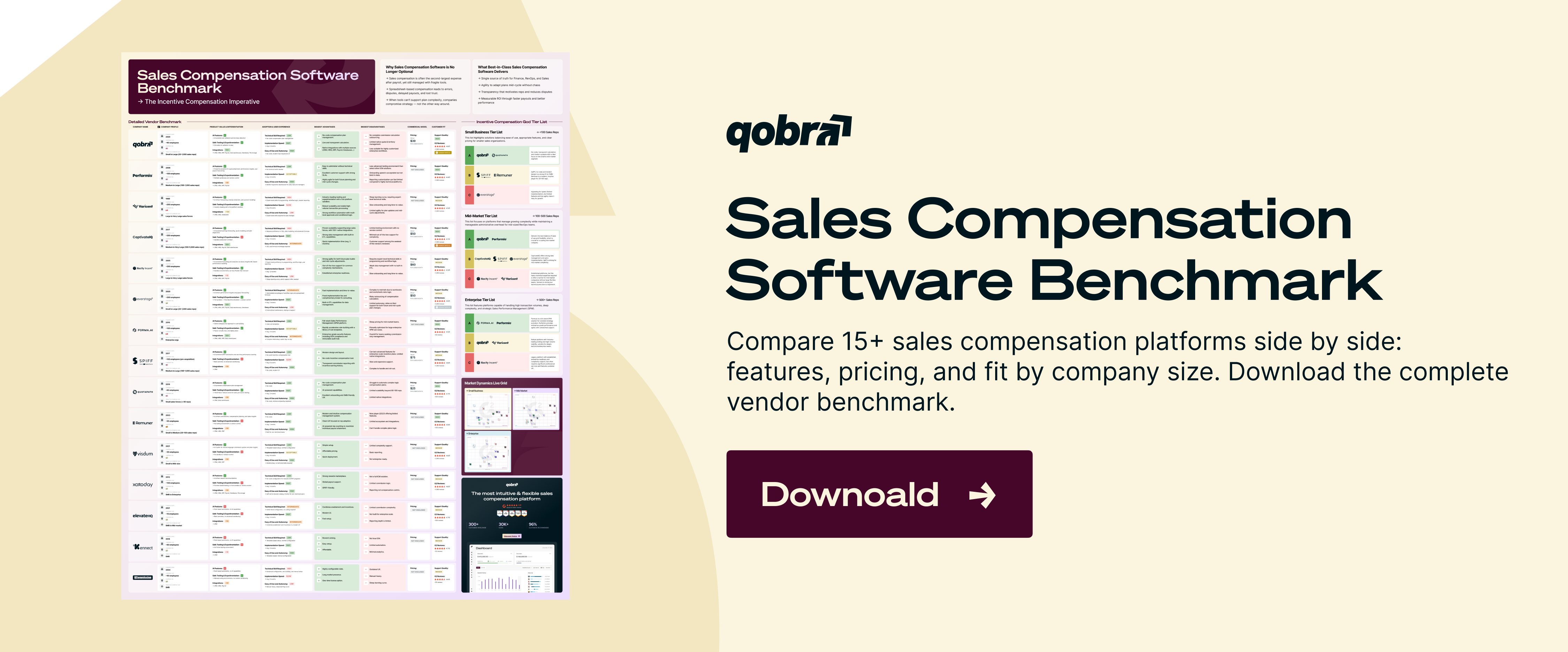
Head-to-Head Feature Comparison
Legend: PS = Professional Services required | SI = System Integrator typically involved
Finance controls comparison
The table below extends the feature comparison with the criteria finance teams ask about during procurement. Vendor claims were checked on vendor websites in September 2026.
How we evaluated: vendor product pages and pricing pages fetched in September 2026 (captivateiq.com/finance-accounting, everstage.com/asc-606-compliance, quotapath.com/pricing, xactlycorp.com/products/commission-expense-accounting, salesforce.com/sales/incentive-compensation-management, varicent.com, performio.co, capterra.com for Commissionly). "Quote-based" means no public price list. See also Best commission reporting and analytics software.
Audit trails: what finance should require
A commission audit trail should record every plan version, crediting rule, data override, payout adjustment and approval with the user, the timestamp and the before and after values, and it should be exportable for auditors without vendor help. That is the minimum for SOX 404 controls over a material expense line and for ASC 340-40 support, because auditors test whether the commission asset was calculated from the plan that was actually in force on the deal date.
Five requirements separate a real audit trail from a change log:
- Plan versioning with effective dates. Each plan change creates a new version, and past statements stay locked to the version that applied. Spiff by Salesforce and Qobra both describe effective-dated plan logic; ask every vendor to show a statement recalculated against a prior version.
- Field-level history on manual overrides. When an admin overrides a CRM value or adds a manual adjustment, the log must show the original value, the new value, the reason and the approver. Overrides are where most disputes and most audit findings originate.
- Approval workflow tied to the log. Statements should not reach payroll until the configured approvers sign off, and the approvals themselves must be part of the record. CaptivateIQ positions this as segregation of duties for SOC 2 and SOX; Qobra routes payout adjustments through approval before export.
- Exportable, filterable history. Finance should be able to export the log by period, by rep and by change type to answer "what changed since the last close" in minutes. Reviewing past pay adjustments should not require a support ticket.
- Retention and access control. Logs should be retained for the statute period that applies to your commission agreements (California Labor Code 2751 requires written, signed commission agreements, and disputes routinely reach back several years) with read access restricted by role.
How Qobra handles audit trails. Qobra keeps an audit log of plan and payout changes, so each plan edit made in the no-code editor, each manual adjustment and each approval is recorded with who did it and when. Disputes run through a claim workflow that attaches the rep's request, the reviewer's decision and the resulting adjustment to the same record. Log export format (CSV, API) and retention period. For a deeper checklist, read Commission software audit trails for SOX and ASC 606.
Automating monthly commission accruals
Automated commission accruals work in three steps: the platform estimates commission by deal as soon as the deal closes or books, posts the total per rep and per GL account at month end, and trues up the estimate at payout so the P&L reflects actual commission expense in the period the revenue was earned. Doing this by hand is the two-day monthly exercise most finance teams want to eliminate.
Accrual by deal. The accrual should be calculated from the same plan logic that will pay the rep, not from a blended rate. That means the commission platform, not the spreadsheet, produces the accrual, using closed-won or invoiced data from Salesforce, HubSpot or the data warehouse. Platforms that support this natively include CaptivateIQ (automated calculations and accruals), Xactly via its CEA module, Everstage (amortization schedules) and Varicent (journal entry reporting).
True-up at payout. When statements are approved and paid, often 30 to 60 days after the accrual, the platform should compare paid versus accrued by rep and post the difference. Clawbacks, splits changed after the fact and disputed deals all land here, which is why the accrual report must link to the audit trail described above.
ASC 606 and ASC 340-40. Under ASC 340-40, incremental costs of obtaining a contract (most sales commissions) are capitalized and amortized over the period of benefit, so the accrual engine needs contract term, renewal expectations and product category per deal. Ask vendors whether amortization schedules are produced inside the platform (Xactly CEA, Everstage, CaptivateIQ, Varicent, Spiff by Salesforce all state ASC 606 support on their sites) or handed to the ERP. Background: ASC 606 commissions: accounting and best practices and the FASB codification at asc.fasb.org.
ERP export. The last step is a journal entry file or API post to NetSuite, QuickBooks, SAP or Workday Financials with debit and credit lines per GL account. Varicent and Xactly CEA describe pre-built accounting integrations; CaptivateIQ states journal entry generation in its materials; QuotaPath includes a ledger on paid plans.
How Qobra handles accruals. Qobra calculates commission at deal level in real time from CRM and warehouse data, so the month-end accrual per rep is available as soon as the period closes, and approved statements give finance the paid amount to true up against. Accrual report: native report and export. Related reading: Accrued commissions explained, Measuring sales compensation ROI, and the Qobra for finance page.
How to Match a Platform to Your Team's Needs
Choosing the right sales comp software depends on four variables. Use this decision framework to narrow your shortlist:
Team Size and Growth Trajectory
- Under 50 reps, simple plans: QuotaPath or Commissionly. You need speed and affordability more than depth.
- 50–300 reps, growing plan complexity: Qobra or Everstage. You need a platform that scales with you — one that handles simple plans today and multi-tier, multi-currency structures next year without re-platforming.
- 300+ reps, enterprise complexity: Qobra, Xactly Incent, or Varicent. At this scale, audit controls, territory planning, and implementation support become critical.
Plan Complexity
- Single-tier or double-tier plans: Most platforms handle these well. Prioritize UX and integration quality.
- Multi-tier accelerators, SPIFs, MBOs, and overlays: Require a robust plan builder. Qobra, CaptivateIQ, and Xactly Incent handle this level of complexity. Test each platform with your most complex plan during evaluation.
- Territory-based plans with manager overrides: Varicent's territory optimization module is purpose-built for this. Qobra handles territory structures within its plan builder without requiring a separate module.
Budget and Total Cost of Ownership
Look beyond the per-user license fee. The true cost of a compensation management platform includes:
- Implementation fees — Self-serve and in-house implementations (Qobra, QuotaPath) cost a fraction of SI-led deployments (Varicent, Anaplan).
- Plan modification costs — Platforms that charge for professional services on each plan change can add $30K–$50K per modification. Qobra and CaptivateIQ enable self-service changes.
- Integration maintenance — Native connectors reduce ongoing engineering costs. Custom API integrations require developer time for updates.
Tech Stack Compatibility
- Salesforce-only shop: Spiff offers native embedding, but also evaluate Qobra and CaptivateIQ for broader flexibility if your stack evolves.
- HubSpot-first: Qobra, CaptivateIQ, Everstage, and QuotaPath offer HubSpot connectors. Xactly and Spiff do not.
- Multi-CRM or custom data: Performio excels at multi-source data ingestion. Qobra's API and flexible data connectors handle custom sources.
Best Practices for Implementing Sales Compensation Software
A successful implementation goes beyond configuring the software. Follow these practices to maximize adoption and ROI:
1. Document your current plans completely before migrating. Export every plan rule, crediting exception, and manual override from your spreadsheets. Undocumented rules are the top cause of implementation delays.
2. Start with your most complex plan, not your simplest. Building the hardest plan first validates that the platform can handle your ceiling. If it passes the stress test, simpler plans will configure quickly.
3. Run parallel calculations for one full pay period. Calculate commissions in both the old system and the new platform for at least one cycle. Compare every payout. Discrepancies reveal data-mapping issues or calculation-logic gaps before they hit rep paychecks.
4. Involve reps in UAT, not just Finance. Sales reps will be the daily users of the dashboard. Include 3–5 reps in user acceptance testing to validate that the data they see matches their expectations. Their feedback on deal-level visibility and earnings clarity is invaluable.
5. Define a clear plan-change workflow from day one. Decide who can propose plan changes, who approves them, and how they are communicated. The software enables agility; the workflow ensures governance.
6. Set up automated notifications before launch. Real-time deal-close notifications and weekly earnings summaries drive rep engagement from the first week. Platforms that support proactive alerts — like Qobra's deal-level email notifications — see higher adoption rates.
7. Schedule a 90-day post-launch review. After three months, assess: Are error rates down? Is admin time reduced? Are reps engaging with their dashboards? Use this data to justify the investment and identify optimization opportunities.

Frequently Asked Questions
What Is the Difference Between Sales Compensation Software and a Commission Calculator?
A commission calculator takes a fixed formula and applies it to deal data to produce a payout number. It handles the math, but not the workflow around it. Sales compensation software manages the entire variable pay lifecycle: plan design, quota setting, automated calculations, rep-facing dashboards, approval workflows, audit trails, and payroll integration. The distinction is critical for organizations with more than one plan type or 50+ reps, because the workflow — not just the math — is where manual processes break down.
How Long Does Implementation Typically Take?
Implementation timelines vary significantly by vendor and complexity. Self-serve platforms like QuotaPath can be configured in days. Mid-market platforms with in-house implementation teams — like Qobra, which typically deploys in 4–6 weeks — offer a balance of speed and depth. Enterprise platforms that require system integrators (Varicent, Anaplan) often take 3–6 months. The key variable is data integration: the more systems you connect and the more complex your crediting rules, the longer the implementation.
Can Sales Compensation Software Handle Multi-Currency Payouts?
Not all platforms support multi-currency natively. Qobra, Xactly Incent, CaptivateIQ, and Performio offer automated exchange-rate handling and currency-specific calculations. QuotaPath and Commissionly are limited to single-currency environments. If you have international teams, verify multi-currency support during evaluation — retrofitting it later is costly.
How Do These Platforms Handle Mid-Year Plan Changes?
This is one of the most important differentiators. Platforms with no-code plan builders (Qobra, CaptivateIQ, Everstage) allow RevOps teams to modify plans and deploy changes immediately. Platforms that require professional services or vendor-led modifications (Xactly, Varicent) can take weeks or months to implement a mid-year change. If your business needs to launch SPIFs, adjust accelerators, or restructure territories more than twice a year, plan-change agility should be a primary selection criterion.
What Integrations Should I Prioritize?
At minimum, your compensation management platform must integrate with your CRM (where deal data originates) and your payroll system (where commissions are paid). Beyond that, prioritize: your ERP for GL mapping and accrual automation, your HRIS for headcount and territory data, and any billing or subscription platform that influences commission calculations. Native connectors reduce maintenance; API-based integrations offer flexibility but require engineering resources.
Is Sales Compensation Software Worth It for Teams Under 50 Reps?
Yes, with a caveat. Teams under 50 reps on simple plans can start with a lightweight platform (QuotaPath, Commissionly) and see immediate value in reduced admin time and improved rep transparency. The investment becomes critical when plan complexity increases — the moment you add a second plan type, introduce accelerators, or hire reps in a new region, spreadsheets become a liability. Starting with a scalable platform early avoids a painful re-platforming later.
Identify automated incentive management solutions with robust audit trails for finance teams
Platforms that document a full audit trail on their own sites include Qobra (audit log of every plan and payout change with approval workflow), CaptivateIQ (audit trails and approval workflows for SOC 2 and SOX), Spiff by Salesforce (effective-dated plan logic and locked historical statements), Xactly Incent, Varicent, Performio and Everstage. Ask each vendor to export the log for a closed period and to recalculate one statement against a prior plan version; that test separates a change log from an auditable record.
Find simple tools for calculating sales commission accruals
For straightforward plans, QuotaPath (from $35 per user per month plus a platform fee) includes a ledger and ASC 606 support, and Qobra calculates commission per deal in real time so the month-end accrual per rep is available without a spreadsheet. If you need amortization schedules under ASC 340-40, look at CaptivateIQ, Everstage or Xactly CEA. A free starting point is the Qobra commission calculator.
Show me software options that integrate with CRM data to streamline monthly commission accrual reporting
Qobra, CaptivateIQ, Everstage, QuotaPath and Spiff by Salesforce all pull closed-won data from Salesforce or HubSpot and calculate commission at deal level, which is the basis for an accrual by deal. Qobra also connects Snowflake, BigQuery, PostgreSQL, Microsoft SQL and Redshift for invoice or collection-based plans (see Qobra integrations). Performio is the strongest fit when accrual data comes from three or more systems.
Which tools offer the most reliable history logs for reviewing past pay adjustments?
Look for field-level history on manual adjustments: original value, new value, reason, approver and timestamp. Qobra records every payout adjustment and dispute resolution in its audit log alongside the approval, Spiff by Salesforce locks historical statements and applies effective dates to any user, plan or logic change, and CaptivateIQ ties adjustments to approval workflows. Commissionly and QuotaPath offer limited history according to public documentation; confirm during a trial.
Next step. Compare the finance controls above against your own close checklist, then book a Qobra demo to see the audit log, approval workflow and accrual view on your plans.