Webinar: The Biggest Release Sales Comp Has Ever Seen. Come See For Yourself (Wednesday, October 7)
Register
- Clearly define the BDM role (distinct from SDR/BDR/AE) and align 2–3 KPIs that reflect strategic value—e.g., pipeline generated, Sales Accepted Leads/qualified meetings, and new ARR/ACV (or margin) to prioritise quality over quantity.
- Set competitive OTE and pay mix based on company stage and sales cycle (common splits 60/40 or 50/50; 70/30 for long cycles), set a SMART quota, and benchmark externally — e.g., OTE $150k with 60/40 yields $60k variable; divide by quota ($800k) = 7.5% base commission.
- Weight KPIs to focus outcomes (avoid overcomplication)—example: 70% on closed New ARR, 30% on qualified pipeline—and convert weights into clear commission rates or milestone payouts.
- Use performance modifiers to drive overachievement and protect against gaming: thresholds/cliffs to ensure baseline productivity, tiered accelerators/uncapped rates for 100%+ attainment (example tiers: 5% / 7.5% / 10% / 12.5%), and defined clawbacks for short-term churn or non-payment.
- Document and communicate the plan transparently, automate calculations via CRM-integrated commission software to prevent disputes, define payout timing and accounting/tax rules, and review the plan annually (avoid mid-cycle changes).
Is your Business Development Manager's commission plan truly driving strategic growth, or is it just rewarding busywork? A well-designed compensation structure is one of the most powerful tools in your arsenal for hitting revenue targets. Get it right, and you attract top talent, motivate high-value activities, and align your entire GTM strategy. Get it wrong, and you risk frustrated employees, a leaky pipeline, and wasted investment.
Designing an effective compensation plan for a Business Development Manager (BDM) goes beyond simple sales commissions. It requires a nuanced understanding of their strategic role, the key behaviors you want to incentivize, and the metrics that genuinely reflect their contribution to the company's long-term success. This guide provides a step-by-step approach to crafting a BDM commission structure that is motivational, fair, and perfectly aligned with your business objectives.
The BDM Role: More Than Just Setting Meetings
Before designing any compensation plan, it's crucial to define the role and responsibilities of your Business Development Manager. While often grouped with Sales Development Representatives (SDRs) or Business Development Representatives (BDRs), the BDM role is typically more senior and strategic.
- SDRs/BDRs are often focused on top-of-funnel activities. Their primary goal is to generate a high volume of qualified appointments or leads for Account Executives (AEs) by following up on inbound inquiries or conducting cold outbound prospecting. Their compensation is usually tied to metrics like meetings booked, meetings held, or Sales Qualified Leads (SQLs).
- Business Development Managers (BDMs), on the other hand, are frequently tasked with opening up new markets, establishing strategic partnerships, or managing complex, long-tail sales cycles. They may be responsible for the entire sales process from prospecting to close, or for generating highly qualified, enterprise-level opportunities.
The success of a BDM isn't just about quantity; it's about the quality and strategic value of the opportunities they create. Therefore, their Key Performance Indicators (KPIs) must reflect this.
Key Performance Indicators for BDMs
Your choice of KPIs will be the foundation of the commission structure. Select metrics that directly influence revenue and align with the BDM's core responsibilities. Common KPIs include:
- Pipeline Generated: The total value of qualified opportunities the BDM adds to the sales pipeline. This is a leading indicator of future revenue.
- Sales Accepted Leads (SALs): Opportunities that have been vetted and formally accepted by the Account Executive team, confirming their quality.
- Number of Qualified Demos or Meetings Held: This focuses on engagement with decision-makers at target accounts.
- New Revenue Booked (ARR/ACV): The ultimate metric. Tying commission directly to closed-won deals ensures the BDM is focused on opportunities that convert.
- Deal Size or Margin: Incentivizing BDMs to pursue larger, more profitable deals rather than small, quick wins.
Core Components of a BDM Compensation Plan
An effective BDM compensation plan is a careful balance of stability and performance-based incentives. This package is typically defined by the On-Target Earnings (OTE), which represents the total potential income a BDM can earn by meeting 100% of their quota.
The main components are:
- Base Salary: This fixed portion provides financial security, allowing the BDM to focus on building long-term relationships and strategic opportunities without worrying about short-term income fluctuations. A competitive base salary is essential for attracting and retaining experienced talent.
- Variable Commission: This performance-based component is the engine of motivation. It directly links a BDM's earnings to their results, rewarding them for achieving and exceeding their targets.
- Pay Mix: This is the ratio between the base salary and variable commission. A 60/40 or 50/50 split is common for BDM roles, offering a balance between security and high earning potential. For roles with longer, more complex sales cycles, a higher base (e.g., 70/30) might be more appropriate.
- Quota: The specific, measurable target a BDM must achieve within a given period (e.g., quarter or year) to earn their full variable pay. Quotas should be challenging but attainable (SMART goals).
- Commission Rate: The percentage or flat amount earned on each unit of the KPI achieved (e.g., 10% of ARR from closed deals, or $500 per qualified meeting held).
Note: Benchmarking is Non-Negotiable
Before setting your OTE and pay mix, research industry and regional benchmarks for BDM roles. A compensation package that isn't competitive will make it nearly impossible to attract or retain top-tier talent. Consider factors like company stage, industry, and the BDM's level of experience.
How to Design Your BDM Commission Structure in 5 Steps
Crafting the perfect plan involves a methodical process. Follow these steps to build a structure that aligns with your strategy and motivates your team.
Step 1: Define Your Business Objectives
Start with the end in mind. What specific outcomes do you want the commission plan to drive? Don't just think "more revenue." Be specific.
- Do you want to penetrate a new market vertical?
- Is the goal to increase the average deal size?
- Should the focus be on acquiring strategic logos?
- Are you trying to promote a new, high-margin product?
Your answers will determine which behaviors and metrics to incentivize. For example, to increase deal size, you might offer a higher commission rate for deals over a certain threshold.
Step 2: Select and Weight Your KPIs
Based on your objectives, choose 2-3 primary KPIs. Avoid overcomplicating the plan with too many metrics, which can dilute focus. For a BDM focused on sourcing large deals, you might weight the KPIs as follows:
- 70% on New Annual Recurring Revenue (ARR) Closed
- 30% on Qualified Pipeline Generated
This structure heavily rewards the ultimate outcome (closed business) while still incentivizing the critical leading activity (pipeline creation).
Step 3: Set the Quota and Commission Rate
Once you have the OTE, pay mix, and KPIs, you can determine the right commission rates.
Example Calculation:
OTE: $150,000
Pay Mix: 60/40 (Base: $90,000, Variable: $60,000)
Annual Quota: $800,000 in New ARR
To find the base commission rate, divide the total variable pay by the quota: $60,000 / $800,000 = 7.5%
In this scenario, the BDM earns a 7.5% commission on all new ARR until they hit their quota.
Step 4: Add Performance Modifiers (Accelerators, Tiers, and Thresholds)
Top performers should be rewarded disproportionately. Performance modifiers create powerful incentives for BDMs to exceed their targets.
- Thresholds (or Cliffs): A minimum performance level a BDM must reach before earning any commission (e.g., 50% of quota). This discourages coasting and ensures a baseline level of productivity.
- Accelerators and Tiers: Increased commission rates for performance above the quota. This is a key driver for overachievement.
| Performance Tier | Commission Rate |
|---|---|
| 0% - 75% of Quota | 5.0% |
| 76% - 100% of Quota | 7.5% |
| 101% - 150% of Quota | 10.0% (Accelerator) |
| 151%+ of Quota | 12.5% (Super Accelerator) |
This tiered model strongly motivates BDMs to push past 100% attainment. The debate around uncapped commissions is ongoing, but for most sales roles, the potential for unlimited earnings is a massive motivator.
Step 5: Document, Communicate, and Automate
A commission plan is useless if it's not understood or trusted.
- Document Clearly: Create a formal compensation plan document that outlines all rules, definitions, metrics, and payout schedules.
- Communicate Effectively: Hold a meeting to walk through the plan, explain the "why" behind it, and answer all questions. Transparency is key to building trust.
- Automate for Trust and Efficiency: Manual commission tracking using spreadsheets is a recipe for disaster. It's prone to errors, creates disputes, and provides zero real-time visibility for reps. This "shadow accounting" forces BDMs to spend time verifying their pay instead of selling.
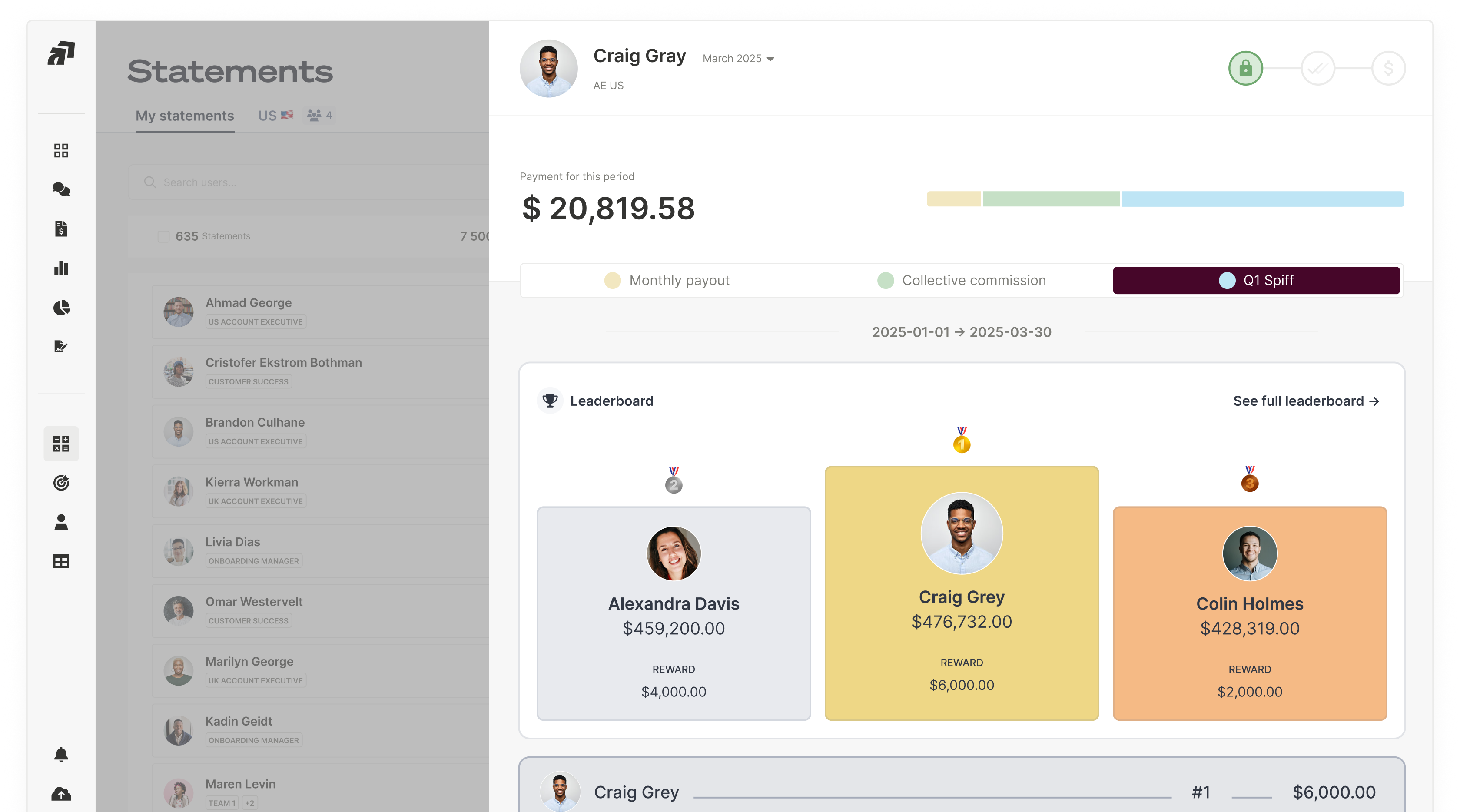
Platforms like Qobra automate the entire process. By integrating directly with your CRM (like Salesforce or HubSpot), they calculate commissions in real-time, providing BDMs with a live dashboard of their performance and earnings. This eliminates errors, saves hours of administrative work, and gives reps the transparency they need to stay motivated. When you're choosing the right commission software, prioritize solutions that offer flexibility, reliability, and a user-friendly interface for your sales team.
Common BDM Commission Models
The right model depends on your sales cycle, business objectives, and industry. Here are a few common structures.
1. Milestone-Based Commission
Best for: Long and complex sales cycles where multiple steps are critical.
This model rewards the BDM for advancing an opportunity through key stages of the sales process. It keeps motivation high even when the final close is months away.
| Milestone | Commission Payout |
|---|---|
| Qualified Meeting Held | $200 |
| Proposal Submitted | $500 |
| Contract Signed (Closed-Won) | 5% of Total Contract Value |
2. Commission on Gross Profit
Best for: Businesses where deal profitability varies significantly.
Instead of paying a percentage of total revenue, you can pay a percentage of the gross profit on each deal. This incentivizes BDMs to protect margins and avoid excessive discounting. Basing commissions on gross profit directly aligns their interests with the company's financial health.
Warning: Watch Out for Unintended Consequences
Every commission plan drives specific behaviors. A plan that only rewards closed deals might discourage BDMs from building a healthy long-term pipeline. Conversely, a plan that only rewards meetings booked might lead to a high volume of low-quality leads. Regularly review your plan to ensure it's encouraging the right activities and not creating unforeseen negative outcomes.
3. Flat Rate Per Deal/Unit
Best for: Simple, transactional sales processes where deal sizes are relatively consistent.
This is the most straightforward model. The BDM earns a fixed dollar amount for every deal closed or unit sold. For example, $1,000 for every new enterprise client signed. While simple, it lacks the nuance to incentivize larger deals.
A well-crafted BDM compensation plan is a strategic asset. It aligns individual motivation with company growth, drives the right behaviors, and helps you win the war for talent. The key is to move beyond simplistic models and design a structure that reflects the unique strategic value your BDMs bring. By focusing on clear objectives, transparent metrics, and powerful incentives, you can build a plan that fuels your business development engine. Finally, automating the process with a dedicated platform ensures accuracy, builds trust, and frees everyone to focus on what matters most: driving growth.
FAQ
How often should we review or change a BDM commission structure?
It's best practice to review compensation plans annually. This allows you to adjust for changes in company strategy, market conditions, or new product launches. However, avoid making frequent changes mid-cycle, as this can erode trust and confuse your team. When you do make changes, be sure you understand how to effectively go about communicating a new compensation plan.
What is a fair OTE split (pay mix) for a BDM?
A 50/50 or 60/40 (base/variable) split is very common for BDM roles. A higher base salary component (e.g., 70/30) may be appropriate for roles with very long sales cycles or those that are more focused on strategic partnerships than transactional sales. The more direct influence a BDM has on closing revenue, the higher the variable component should be.
Should we include clawbacks in the commission plan?
A clawback clause allows the company to reclaim commission paid on a deal if the customer churns or defaults on payment within a specific period (e.g., 90 days). Clawbacks are common, especially in SaaS, as they encourage BDMs to source high-quality, stable customers and align their interests with long-term customer success. Ensure the terms are clearly defined in the compensation plan document.