Webinar: The Biggest Release Sales Comp Has Ever Seen. Come See For Yourself (Wednesday, October 7)
Register
- Aligns executive pay with company strategy and retention: a metric-driven bonus plan rewards measurable contributions from the C‑suite and ties leadership incentives to long‑term value creation.
- Core template elements: clear objective and scope (eligibility, plan period), 3–5 weighted KPIs (financial, strategic, individual), transparent bonus formula (e.g., Base × Target % × Company multiplier × Individual multiplier), payout timing, and clawback/vesting clauses.
- Mix short‑term and long‑term incentives: STIs (annual cash tied to yearly KPIs) drive immediate goals, while LTIs (equity, PSUs, options) promote multi‑year alignment with shareholders.
- Governance, tax and legal safeguards: formal written plan, Board/Comp Committee approval, documented award agreements, attention to tax treatment (supplemental wage withholding, company deductibility) and specialized vehicles (e.g., Section 162 in the US); consult legal and tax advisors.
- Practical implementation steps: define strategic objectives, set eligibility and target payouts, choose measurable KPIs, design thresholds/ caps and funding mechanics, document and secure approvals, then communicate, track (preferably automate) and deliver payouts.
How do you transform your company’s strategic goals into tangible results? A well-crafted executive bonus plan is more than just a reward; it is a powerful tool that aligns the vision of your leadership with the long-term success of the business, driving performance and ensuring you retain your most pivotal talent.
An executive compensation structure serves as a testament to the C-suite's critical role in steering the company. By tethering bonuses to precise, measurable performance metrics, organizations can galvanize their leadership to transcend traditional roles and achieve unprecedented growth. This document provides a comprehensive guide and a foundational template to help you design, structure, and implement an effective executive bonus plan.
What is an Executive Bonus Plan?
An executive bonus plan is a compensation strategy designed to reward top-level employees—typically the C-suite and senior management—for achieving specific individual and company-wide goals. Unlike base salaries, which are fixed, these bonuses are variable and contingent on performance. The primary purpose is to harmonize the executives' objectives with the broader corporate vision, creating a mutually beneficial relationship where leadership is directly incentivized to drive the company's success.
These plans are crucial for both public and private companies, though their structures may differ. While public companies often navigate specific regulations, private equity-backed firms and other private businesses also leverage bonus plans to attract and retain top-tier talent. The core idea remains the same: to catalyze performance by linking financial rewards to strategic achievements.
Key Components of a Robust Executive Bonus Plan Template
A comprehensive executive bonus plan template should be clear, formal, and legally sound. It acts as the foundational document outlining the terms, conditions, and mechanics of the bonus structure. Below are the essential elements every plan should include.
1. Objective and Scope
The plan should begin with a clear statement of its purpose. This section explains why the plan exists—for example, "To reward senior executives for their contribution to achieving the company's annual financial and strategic goals."
The scope defines who is covered.
- Eligibility: Clearly state which positions or employee levels are eligible to participate (e.g., all C-level executives, Vice Presidents, and contract employees with terms exceeding one year). It should also specify who is not eligible, such as seasonal or temporary employees.
- Plan Period: Define the performance period the plan covers, which is typically the fiscal year (e.g., January 1, 2026, to December 31, 2026).
2. Performance Metrics and Goals
This is the heart of the plan. It details what needs to be achieved for a bonus to be paid. Metrics should be a blend of financial, operational, and strategic goals.
- Financial Metrics: Examples include Revenue Growth, EBITDA (Earnings Before Interest, Taxes, Depreciation, and Amortization), Profit Margins, or Net Income.
- Strategic Metrics: These are often non-financial and tied to long-term objectives, such as successful market entry, integration of an acquisition, or achieving a specific market share percentage.
- Individual Metrics: Goals tied to an executive's specific role, such as launching a new product line or reducing operational costs in their department.
Each metric should be assigned a weight to reflect its importance. For instance, company EBITDA might be weighted at 50%, while individual goals are weighted at 20%.
3. Bonus Calculation Formula
The template must transparently explain how the final bonus amount is calculated. This removes ambiguity and builds trust. A common formula is:
Bonus Payout = (Base Salary) x (Target Bonus %) x (Company Performance Multiplier) x (Individual Performance Multiplier)
- Target Bonus Percentage: The expected bonus payout if all goals are met at 100%, expressed as a percentage of base salary (e.g., 50% for a CEO).
- Performance Multipliers: These adjust the payout based on actual results. For example, achieving 80% of the EBITDA goal might result in a 0.8 multiplier, while achieving 120% could yield a 1.2 multiplier. The plan should include clear thresholds (minimum performance for any payout) and caps (maximum possible payout).
4. Payment Schedule and Conditions
This section outlines the logistics of the payout.
- Payment Timing: Specify when bonuses will be paid (e.g., "within 60 days following the end of the fiscal year and the final audit of financial results").
- Employment Status: Clarify that the executive must be employed and in good standing on the payout date to be eligible to receive the bonus.
- Clawback Provisions: Include a clause that allows the company to recover a bonus if it was paid based on erroneous financial data or in cases of executive misconduct.
Clarity is Non-Negotiable
A bonus plan's effectiveness hinges on its clarity. Ambiguous terms or complex, hard-to-understand formulas can demotivate executives and lead to disputes. Ensure every component, from KPIs to payout conditions, is defined in simple, direct language. The plan should serve as a clear roadmap to reward, not a source of confusion.

Structuring Your Bonus Plan: Short-Term vs. Long-Term Incentives
A balanced executive compensation package recognizes the need for both immediate results and long-term sustainability. Therefore, most executive bonus plans incorporate a mix of Short-Term Incentives (STIs) and Long-Term Incentives (LTIs).
Short-Term Incentives (STIs): Rewarding Annual Performance
STIs are designed to reward executives for performance over a brief period, typically a single fiscal year. Their purpose is to motivate and reward immediate achievements that align with the company's annual objectives.
- Structure: Usually paid in cash.
- Performance Metrics: Tied to annual financial targets like revenue, profit margins, or operational goals like project completions or customer acquisition rates.
- Frequency: Assessed and awarded annually, keeping executives focused on current-year goals.
- Benchmarks: Set based on past performance, industry standards, and projected goals for the year. For example, a company might set a revenue growth target based on the previous year's rate, adjusted for current market conditions.
Long-Term Incentives (LTIs): Aligning for Future Growth
LTIs are crafted to align executive actions with the company's long-term strategy and shareholder interests. By rewarding sustained performance over several years, LTIs ensure leaders are invested in the organization's prolonged success.
- Equity Awards: Granting executives a stake in the company, often as shares or Restricted Stock Units (RSUs). This directly aligns their financial interests with shareholders. When the company performs well and its stock value rises, both parties benefit.
- Performance Share Units (PSUs): A type of equity award where executives receive shares only if specific, long-term performance criteria are met over a set period (e.g., three to five years). The criteria could be cumulative earnings growth or achieving a certain market share.
- Stock Options: These give executives the right, but not the obligation, to purchase company shares at a predetermined "strike price." If the stock price rises above the strike price, they can exercise their options and profit from the difference, incentivizing them to increase the company's stock value.
| Feature | Short-Term Incentives (STIs) | Long-Term Incentives (LTIs) |
|---|---|---|
| Objective | Reward immediate results | Drive sustained, long-term value |
| Time Horizon | Typically 12 months or less | Typically 3-5 years or more |
| Typical Form | Cash bonus | Equity (stock, options, PSUs) |
| Metrics | Annual revenue, EBITDA, profit | Stock price appreciation, cumulative EPS |
| Purpose | Motivate annual goal achievement | Foster ownership and strategic alignment |
How to Create an Executive Bonus Plan in 6 Steps
Developing a formal bonus structure requires careful thought and strategic planning. Follow these steps to build a plan that is fair, motivating, and aligned with your business objectives.
- Define the Plan's Strategic Objectives: What business goals should this plan support? Is the priority rapid revenue growth, improving profitability, or expanding into new markets? Your objectives will dictate the types of metrics you choose.
- Determine Eligibility and Target Payouts: Decide which executive roles will participate. Then, establish a target bonus for each role, typically as a percentage of their base salary. This percentage should reflect the role's impact on company performance. For example, a CEO's target might be 100% of their salary, while a VP's might be 40%.
- Select Meaningful Performance Metrics (KPIs): Choose 3-5 key performance indicators that directly reflect the strategic objectives defined in Step 1. Ensure they are measurable and that executives can influence them. A mix of company-wide and individual KPIs creates a balanced approach.
- Design the Bonus Formula and Funding Pool: Define the mechanics of the calculation. This includes setting performance thresholds (the minimum performance required to earn a bonus), targets (100% achievement), and caps (the maximum possible payout). Determine how the overall bonus pool will be funded, for example, as a percentage of net profit.
- Document the Plan and Establish Governance: Formalize all details in a written plan document. This document should be reviewed by legal counsel. The plan must then be approved by the Board of Directors or its Compensation Committee to ensure proper governance and oversight.
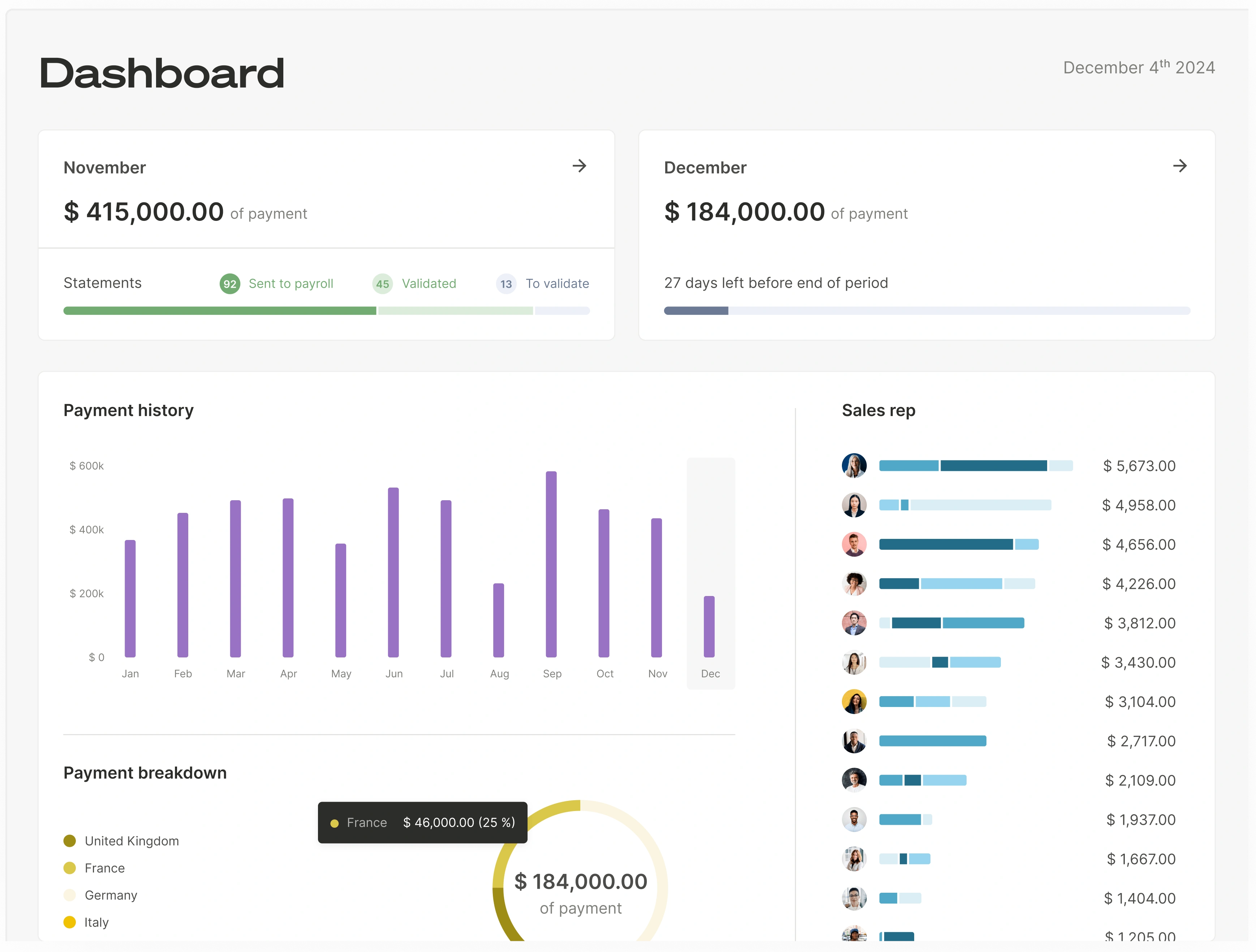
- Communicate and Implement: Clearly communicate the plan to all eligible executives. Ensure they understand their goals, how their performance will be measured, and how their bonus will be calculated. For data-driven plans, managing the calculations manually in spreadsheets can be tedious and error-prone. Platforms for automating variable compensation like Qobra can integrate with your data sources (ERP, CRM) to automate these calculations, providing executives with transparent, real-time dashboards to track their progress and potential earnings.
Beyond Spreadsheets: Automating for Transparency and Trust
Manually calculating executive bonuses using spreadsheets is not only time-consuming but also susceptible to errors that can erode trust. By leveraging a dedicated compensation platform, you can automate complex calculations based on live data. This provides executives with a clear, real-time view of their performance against targets, fostering motivation and ensuring payouts are accurate and defensible.
Navigating Legal, Tax, and Governance Complexities
Implementing an executive bonus plan involves more than just setting targets. It requires careful attention to legal, tax, and governance matters to ensure compliance and fairness.
Governance and Documentation
Proper governance is essential. The plan should be formally approved by the company's Board of Directors or a dedicated Compensation Committee. This oversight ensures the plan is aligned with shareholder interests and meets regulatory standards. All bonus awards should be documented through formal resolutions.
The plan itself should be a formal, written document. Verbal promises of bonuses are often unenforceable and create significant risk. The document should clearly state that the company reserves the right to modify or terminate the plan at any time.
Common Tax Considerations
Bonuses are generally considered taxable income for the executive and a deductible expense for the company. However, the timing and structure of the bonus can have different tax implications.
- For the Executive: Bonuses are typically taxed as supplemental wages, which may be subject to a different withholding rate than regular salary.
- For the Company: The company can generally deduct bonus payments in the year they are paid.
It is crucial for both the company and the executives to consult with tax advisors to understand the full implications.
What is a Section 162 Bonus Plan?
In the United States, a "Section 162 Executive Bonus Plan" is a specific type of benefit arrangement, not a general bonus structure. It uses a cash value life insurance policy to provide supplemental retirement income or death benefits to an executive.
Here's how it generally works:
- The company pays the premiums on a life insurance policy owned by the executive.
- These premium payments are treated as a bonus and are tax-deductible for the company.
- The amount is reported as taxable income to the executive.
- The executive gains the full cash value and death benefit of the policy.
This is a specialized tool often used for retention and retirement planning, distinct from performance-based annual bonuses.
A well-structured executive bonus plan is one of the most powerful strategic tools a company can deploy. It aligns leadership with corporate goals, drives performance, and helps retain the talent that is most critical to success. By moving beyond simple discretionary payouts to a formal, metric-driven system, you create a culture of accountability and shared success. The key is to build a plan that is clear, fair, and directly tied to the value your executives create.
Board approval fixes the metrics; the yearly work is proving that payouts match them. Incentive compensation management software produces that evidence — source data, applied rule, approver — in a form a compensation committee can review.
Frequently Asked Questions (FAQ)
How do you choose the right KPIs for an executive bonus?
Select a balanced mix of 3-5 metrics that reflect the company's top strategic priorities for the year. These should include at least one top-line metric (like revenue growth), one profitability metric (like EBITDA or net profit), and potentially one strategic or operational metric (like market share growth or successful product launch). The chosen KPIs should be directly influenced by the executive team's decisions and actions.
What is the difference between a discretionary and non-discretionary bonus?
A discretionary bonus is paid at the sole discretion of the company. The amount and whether it is paid at all are not guaranteed or promised in advance. In contrast, a non-discretionary bonus is tied to a pre-defined formula or a promise to pay if specific criteria are met. Formal executive bonus plans are typically non-discretionary to ensure clarity and motivate performance toward set goals.
What documents are needed to implement an executive bonus plan?
The primary document is the formal Executive Bonus Plan Document, which outlines all rules, metrics, and calculations. In addition, you will need a Board Resolution from the Board of Directors or Compensation Committee officially approving the plan. Finally, individual Bonus Award Agreements may be provided to each participating executive, confirming their participation and specific targets for the plan year.