Webinar (Wednesday, October 21) — Aligning HR, Finance, and Sales: Mastering Sales Comp Without Breaking Your Plan
Register
- The basic sales commission formula is Commission = Sales Amount × Commission Rate; in a worked example, a salesperson who closes $100,000 in deals at a 5% commission rate earns $5,000 in commission.
- Commission on gross margin is calculated as (Sales Revenue − Cost of Goods Sold) × Commission Rate; in a worked example, a $50,000 equipment sale with $35,000 of COGS and a 20% rate on margin pays $3,000 in commission and discourages heavy discounting.
- In a worked tiered example paying 5% on the first $50,000 of sales, 7.5% from $50,001 to $100,000 and 10% above $100,000 of sales, a salesperson with $120,000 in quarterly sales earns $8,250 ($2,500 + $3,750 + $2,000) because each tier is calculated separately and then added together.
- A 60/40 split means 60% of on-target earnings (OTE) is fixed base salary and 40% is variable commission, so a $100,000 OTE gives a $60,000 base and $40,000 in commissions at quota; a 70/30 split suits longer sales cycles and collaborative roles such as Sales Engineers.
- Commission calculations stay accurate at scale when the CRM, such as Salesforce or HubSpot, is the single source of sales data, the plan defines when a commission is earned, how splits and clawbacks work and who approves payouts, and commission software keeps an audit trail of every change and calculation.
Calculating sales commissions seems simple at first glance. But as a business grows, with more salespeople, complex deals, and diverse products, what started as a basic spreadsheet can quickly become a source of errors, disputes, and frustration. Getting this process right is crucial for motivating your sales team and ensuring your sales compensation strategy is both fair and effective.
This guide provides a clear, step-by-step approach to calculating sales commissions accurately, from basic formulas to the systems needed to manage them at scale.
What is a sales commission and how is it usually calculated?
A sales commission is a form of variable pay given to a salesperson based on the sales they generate. It is a core component of most sales compensation plans, designed to reward sales performance and align the salesperson's goals with the company's revenue objectives.
At its core, the calculation is straightforward. The most basic sales commission formula is:
Commission = Sales Amount × Commission Rate
For example, if a salesperson closes $100,000 in deals with a 5% commission rate, their commission is $5,000 ($100,000 × 0.05). However, the "Sales Amount" and "Commission Rate" can vary significantly depending on the commission structure a company uses.
The basic sales commission formulas explained
While the core formula is simple, the variables can change. The three most common ways to calculate the commission base are based on total sales, gross margin, or performance tiers.
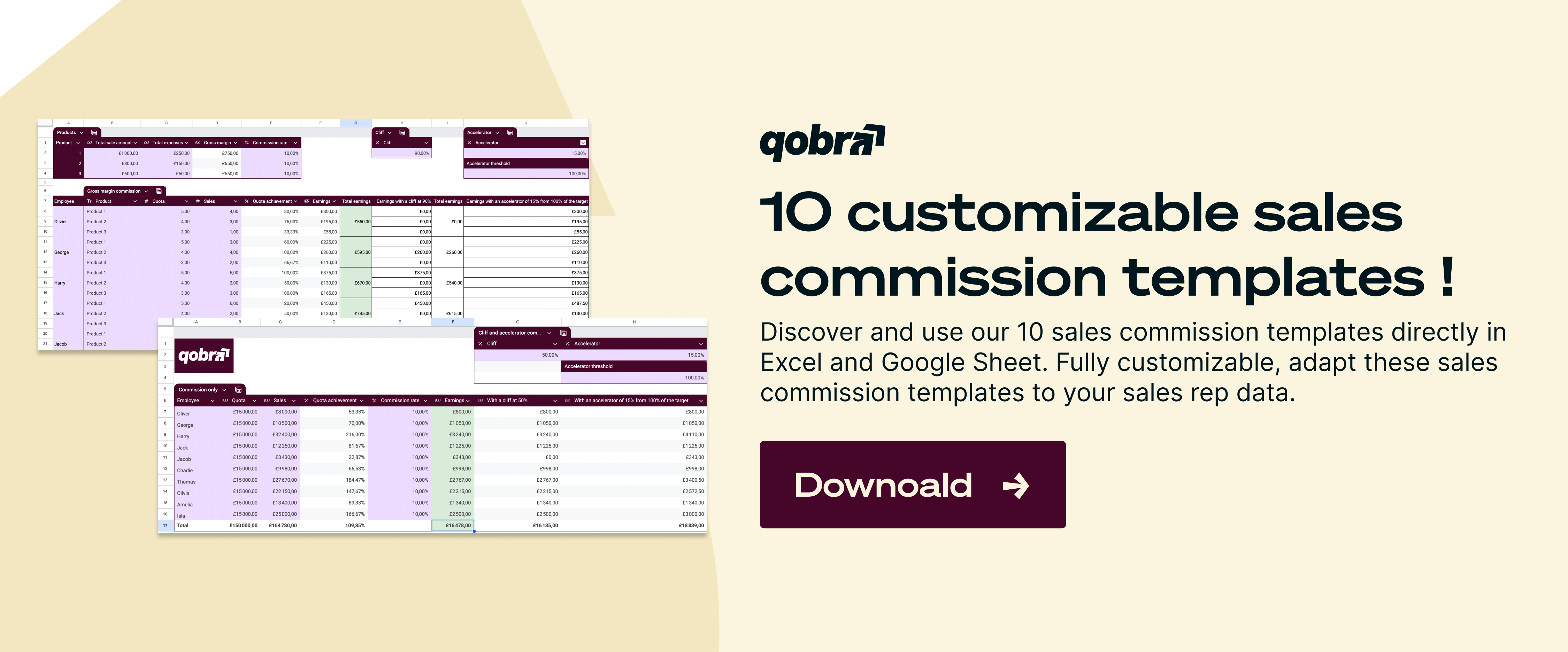
Percentage of total sales
This is the most common method. The commission is a direct percentage of the total revenue generated from a sale. It is easy to understand and calculate, making it ideal for businesses focused on top-line revenue growth.
- Formula:
Commission = Total Sales Revenue × Commission Rate - Example: A sales representative sells a one-year software subscription for $20,000. Their commission rate is 8%.
- Calculation: $20,000 × 0.08 = $1,600
- Their commission for this deal is $1,600.
Commission on gross margin
When profitability is a key concern, companies often use a gross margin commission structure. This method calculates the commission based on the profit from a sale, not the total revenue. It discourages heavy discounting and encourages salespeople to sell more profitable products.
- Formula:
Commission = (Sales Revenue - Cost of Goods Sold) × Commission Rate - Example: A salesperson sells industrial equipment for $50,000. The cost to produce and deliver that equipment (COGS) is $35,000. Their commission rate on the margin is 20%.
- Gross Margin: $50,000 - $35,000 = $15,000
- Calculation: $15,000 × 0.20 = $3,000
- Their commission is $3,000.
Tiered commission and accelerators
A tiered commission structure rewards high performance by increasing the commission rate as a salesperson achieves higher sales volumes. These tiers, or "accelerators," are powerful motivators for exceeding quotas.
- Formula: Commission is calculated separately for each tier and then added together.
- Example: A company has the following tiers for quarterly sales:
- 5% on the first $50,000 in sales (Tier 1)
- 7.5% on sales from $50,001 to $100,000 (Tier 2)
- 10% on all sales above $100,000 (Tier 3)
- A salesperson achieves $120,000 in quarterly sales.
- Tier 1 Commission: $50,000 × 0.05 = $2,500
- Tier 2 Commission: ($100,000 - $50,000) × 0.075 = $3,750
- Tier 3 Commission: ($120,000 - $100,000) × 0.10 = $2,000
- Total Commission: $2,500 + $3,750 + $2,000 = $8,250
How should sales commissions be calculated step by step?
To ensure accuracy and consistency, follow a structured process. This is the most reliable way sales commissions should be calculated:
- Establish Clear Rules in Your Sales Commission Plan: Define what constitutes a "sale." Is it a signed contract, a paid invoice, or a product shipment? Document this in a formal sales commission plan that specifies all rules, rates, and periods.
- Define the Commissionable Amount: Determine if commissions are based on total revenue, gross margin, net profit, or another metric.
- Set the Commission Rate(s): Specify the percentage or flat fee for each type of sale or performance tier.
- Determine the Payout Period: Decide whether commissions will be calculated and paid monthly, quarterly, or annually.
- Gather Accurate Sales Data: Collect all relevant transaction data for the period from a reliable source, typically your Customer Relationship Management (CRM) system.
- Apply the Formula: Use the predefined rules and formulas to calculate the commission earned for each salesperson.
- Review and Approve: Have a manager or finance team member review the calculations for accuracy before processing the payout.
Common commission structures: flat rate, 60/40, 70/30 and more
The formulas above are applied within different commission structures. A flat rate is simply a single percentage for all sales. However, many companies use a "split" model to structure a salesperson's total target earnings.
What is a 60/40 base to commission split?
A 60/40 split refers to the structure of a salesperson's On-Target Earnings (OTE), which is their total potential compensation if they meet 100% of their sales quota. In this model:
- 60% is the fixed base salary. This portion is guaranteed regardless of performance.
- 40% is the variable commission. This portion is earned by hitting sales targets.
For example, if a salesperson's OTE is $100,000 with a 60/40 split, their base salary is $60,000, and they can earn an additional $40,000 in commissions by meeting their quota.
What is a 70/30 split in sales?
Similarly, a 70/30 split means that 70% of the OTE is base salary and 30% is variable commission. This structure provides more stability and is often used in roles with longer sales cycles or where sales efforts are more collaborative, such as for Sales Engineers or Account Managers focused on retention.
Is 5% a good commission? What affects a fair rate
This is a common question, but there is no universal "good" commission rate. A 5% commission might be excellent in one industry and unacceptably low in another. The fairness of a commission rate depends entirely on context.
Factors that influence commission rates include:
- Industry: Rates in high-volume, low-margin retail will be vastly different from low-volume, high-margin enterprise software. Industry-specific data is often unavailable or varies widely, so direct comparisons can be misleading.
- Product/Service Profit Margin: Companies with higher margins can afford to pay higher commission rates.
- Sales Cycle Length: Roles with long, complex sales cycles (e.g., 6-12 months) often have a higher base salary and different commission structures than roles with short cycles.
- Total Deal Size: A 2% commission on a $1 million deal ($20,000) is very different from a 10% commission on a $5,000 deal ($500).
- Salesperson's Role: A Business Development Rep setting appointments will have a different plan than an Account Executive closing the deal.
So, is 5% a good commission? It depends. The goal is to create a fair OTE that is competitive for the role and industry.
Focus on On-Target Earnings (OTE)
Instead of comparing raw commission percentages, it is more productive to benchmark the total On-Target Earnings (OTE) for a specific sales role in your industry and region. A competitive OTE with a well-structured plan is a better indicator of a fair compensation package.
How to calculate sales commissions accurately at scale
As a company grows, manual calculations in spreadsheets become unsustainable. The risk of errors multiplies, leading to payroll mistakes, demotivated reps, and wasted administrative time. To scale accurately, you need a systematic approach.
Standardize rules and commission plans
The first step is to eliminate ambiguity. Your sales commission plans must be documented, clear, and accessible to everyone. Define every term and process:
- When is a commission officially "earned"?
- How are commissions split between multiple reps on a single deal?
- What is the process for handling returns, cancellations, or clawbacks?
- Who needs to approve payouts?
A clear, standardized plan is the foundation for accurate calculations.
Clean source data and handle exceptions
Your commission calculations are only as good as your data. The "Garbage In, Garbage Out" principle applies perfectly here.
- Single Source of Truth: Your CRM (e.g., Salesforce, HubSpot) should be the undisputed source of sales data. Ensure deals are updated correctly and in a timely manner.
- Data Hygiene: Regularly clean your data to remove duplicates, correct errors, and ensure all required fields are filled out.
- Exception Process: Create a formal process for handling one-off situations or disputes that fall outside the standard rules.
Use automation, reports and audit checks
For any company with more than a few salespeople, sales commission automation is a necessity. Spreadsheets are prone to human error, lack security, and offer no transparency.
A dedicated commission management software platform helps you scale by:
- Connecting Directly to Your CRM: Automatically pulling in real-time sales data, eliminating manual entry.
- Automating Complex Calculations: Effortlessly handling tiered structures, splits, bonuses, and other complex rules without formula errors.
- Providing Transparency: Giving salespeople a real-time dashboard to track their earnings and understand how they are calculated, which builds trust and motivation.
- Creating an Audit Trail: Logging all changes and calculations, making it easy to resolve disputes and ensure compliance.
Common mistakes that cause commission errors
Even with a good plan, errors can happen. Being aware of common pitfalls helps you avoid them.
- Unclear Plan Rules: Ambiguous terms lead to different interpretations and disputes.
- Manual Data Entry: Copying and pasting data from a CRM into a spreadsheet is a primary source of errors.
- Incorrect Formulas: A single mistake in a spreadsheet formula can affect every calculation.
- Ignoring Edge Cases: Failing to account for product returns, discounts, or multi-year contracts in your plan.
- Poor Communication: Rolling out a new commission plan without properly explaining it to the sales team can cause confusion and mistrust.
Avoiding these common sales commission mistakes is key to maintaining a motivated and high-performing sales team.
FAQ
How do you calculate commission on net profit?
Calculating commission on net profit is less common for sales roles because sales representatives typically do not control operating expenses. However, the formula is: Commission = (Sales Revenue - COGS - Attributable Operating Expenses) × Commission Rate. This approach is more often used for senior leadership or business unit P&L owners.
How do you find a commission rate without a percentage?
This usually means you are either working backward from a target payout or using a flat-fee model.
- To find the rate:
Commission Rate = Target Commission Amount / Total Sales Amount. - Flat-fee model: A salesperson earns a fixed amount per unit sold (e.g., $500 for every machine sold), regardless of its price.
What is a tiered commission calculator used for?
A tiered commission calculator is a tool—often a pre-built spreadsheet template or a feature in commission automation software—that automatically calculates earnings across different performance tiers. It saves time and prevents errors that can occur when manually calculating commissions for representatives who have reached multiple accelerator levels.
What should a sales commission report include?
A clear sales commission report or statement is essential for transparency. It should include:
- Salesperson's name and the pay period.
- A list of all deals or transactions included in the calculation.
- The commissionable amount for each transaction.
- The commission rate(s) applied.
- Attainment against quota and any tiers reached.
- The total commission earned.
- Any adjustments, draws, or bonuses.
Disclaimer: The information provided in this article is for general informational purposes only. Sales compensation plans, contractual obligations, and tax laws vary by company, industry, and jurisdiction. Please consult with your HR, finance, or legal departments to validate any compensation structure.
Accuracy at scale is only realistic with a sales commission calculation software that automates every payout.