Webinar: The Biggest Release Sales Comp Has Ever Seen. Come See For Yourself (Wednesday, October 7)
Register
- A salesperson's pay is built from a base salary plus variable pay (commissions, bonuses); OTE = base + on‑target variable, and the pay mix (e.g., 50/50 or 70/30) should reflect role risk and sales cycle.
- Choose among salary‑only, commission‑only, base+commission, base+bonus, tiered/accelerator, gross‑margin and hybrid models depending on industry, deal complexity and the behaviors you want to drive.
- Specify clear metrics—quota, commission rate, accelerators/decelerators, SPIFFs and clawbacks—and set realistic, data‑driven quotas tied to OTE and company goals.
- Align compensation with strategic objectives (growth, profitability, retention), tailor plans for SDRs, AEs and CSMs, and benchmark pay against sector standards.
- Operationalize for fairness and efficiency: keep commissions uncapped when possible, ensure pay transparency, automate calculations via CRM‑integrated software, and provide templates and dashboards for reps and finance.
How do you design a sales compensation plan that not only rewards performance but also fuels sustainable growth and keeps your top talent engaged? This question is central to any business looking to build a high-performing sales engine. A well-crafted remuneration structure is more than just a way to pay your team; it is a powerful strategic tool that aligns individual motivations with company objectives, drives desired behaviors, and ultimately defines your sales culture.
The days of one-size-fits-all commission plans are over. Modern sales environments, with their complex products, long sales cycles, and focus on customer lifetime value, demand more nuanced and flexible approaches. From simple salary-plus-commission models to sophisticated tiered structures with accelerators, the right plan can inspire your team to new heights. Conversely, a poorly designed one can lead to frustration, high turnover, and misaligned efforts. This guide provides a comprehensive overview of the models, metrics, and best practices you need to build a sales compensation plan that truly works.
Understanding the Core Components of Sales Compensation
Before diving into specific models, it is crucial to understand the building blocks of any sales pay structure. These components can be mixed and matched to create a plan tailored to your business needs, sales cycle, and team roles.
Base Salary
The base salary is the fixed, guaranteed portion of a salesperson's income, paid regardless of performance. It provides financial stability, ensuring that reps can cover their living expenses even during slow months or while ramping up in a new role.
A stable base salary is particularly important for roles with long or complex sales cycles, where closing a deal can take many months. It allows reps to focus on building relationships and educating prospects without the constant pressure of immediate commission-based income. This stability reduces stress and can lower employee turnover.
Commission
Commission is the variable component of compensation, paid as a percentage of the revenue or profit generated from sales. It is the primary tool for incentivizing performance. Commissions can be structured in various ways—as a flat percentage, on a sliding scale, or based on gross margin. The core idea remains the same: the more a salesperson sells, the more they earn. This direct link between effort and reward is a powerful motivator.
Bonus
Unlike commission, which is typically paid per sale, a bonus is a lump-sum payment awarded for achieving a specific, pre-defined goal over a set period (e.g., quarterly or annually). Bonuses are often tied to objectives that go beyond pure revenue, such as hitting a certain number of new logo acquisitions, achieving a product mix target, or reaching a team-based sales goal. This makes them excellent tools for directing focus towards specific strategic initiatives.
On-Target Earnings (OTE)
On-Target Earnings (OTE) represents the total potential income a salesperson can expect to earn in a year if they meet 100% of their sales quota. It is calculated by adding the annual base salary to the expected variable pay (commission or bonus) at target performance.
OTE = Annual Base Salary + Annual On-Target Commission/Bonus
OTE is a critical figure used in recruiting to communicate earning potential and for finance teams to budget for sales expenses. The ratio between base salary and variable pay within the OTE (the "pay mix") is a key strategic decision. A 50/50 pay mix, for instance, indicates an even split, while a 70/30 mix (70% base, 30% variable) suggests a lower risk for the salesperson.
7 Common Sales Compensation Plan Models
Sales compensation plans vary widely, but most fall into one of several established models. Choosing the right one depends on your industry, sales process, and company culture.
1. Salary-Only
This is the simplest structure, where employees receive a fixed annual salary with no variable component. It is uncommon in traditional sales roles because it lacks a direct incentive for individual performance. A rep who closes ten deals earns the same as one who closes two.
- Why it works: This model is best suited for industries where direct sales are not permitted, for roles where sales is a small part of the job (e.g., some sales engineers), or for team-based environments where individual contributions are difficult to isolate. It fosters collaboration and reduces high-pressure sales tactics.
2. Commission-Only
The polar opposite of salary-only, this high-risk, high-reward model pays salespeople solely based on the sales they generate. There is no guaranteed income.
- Why it works: This structure is common for independent contractors, freelance sales agents, and in industries like real estate or certain high-ticket retail environments. It attracts highly confident, entrepreneurial individuals and minimizes fixed costs for the business, as the company only pays for results.
3. Base Salary + Commission
This is the most widely used compensation model, offering a balance of security and incentive. Salespeople receive a guaranteed base salary plus a commission on every sale. A common pay mix is 60% base and 40% commission, but this can shift depending on the complexity of the sale.
- Why it works: It provides a predictable income stream, which helps attract and retain talent, while the commission component directly motivates sales performance. This model encourages reps to perform non-selling activities, like training new team members or handling administrative tasks, since their entire income is not on the line with every call.
To Cap or Not to Cap?
While some companies cap commissions to control costs, this can demotivate top performers once they hit their limit. One study found that removing commission caps increased a company's revenue by approximately 9%. Whenever possible, keep commissions uncapped to encourage continuous over-performance.
4. Base Salary + Bonus
In this model, a salesperson receives a base salary and is eligible for a bonus upon reaching specific, pre-determined targets. This differs from a commission, which is calculated as a percentage of a deal's value.
- Why it works: This structure is effective when sales cycles are long or when the primary goal is not just revenue, but also milestones like setting qualified appointments (common for SDRs) or achieving customer satisfaction scores. It provides clear, achievable goals for a specific period. Well-structured bonus programs can drive very specific behaviors.
5. Tiered Commission
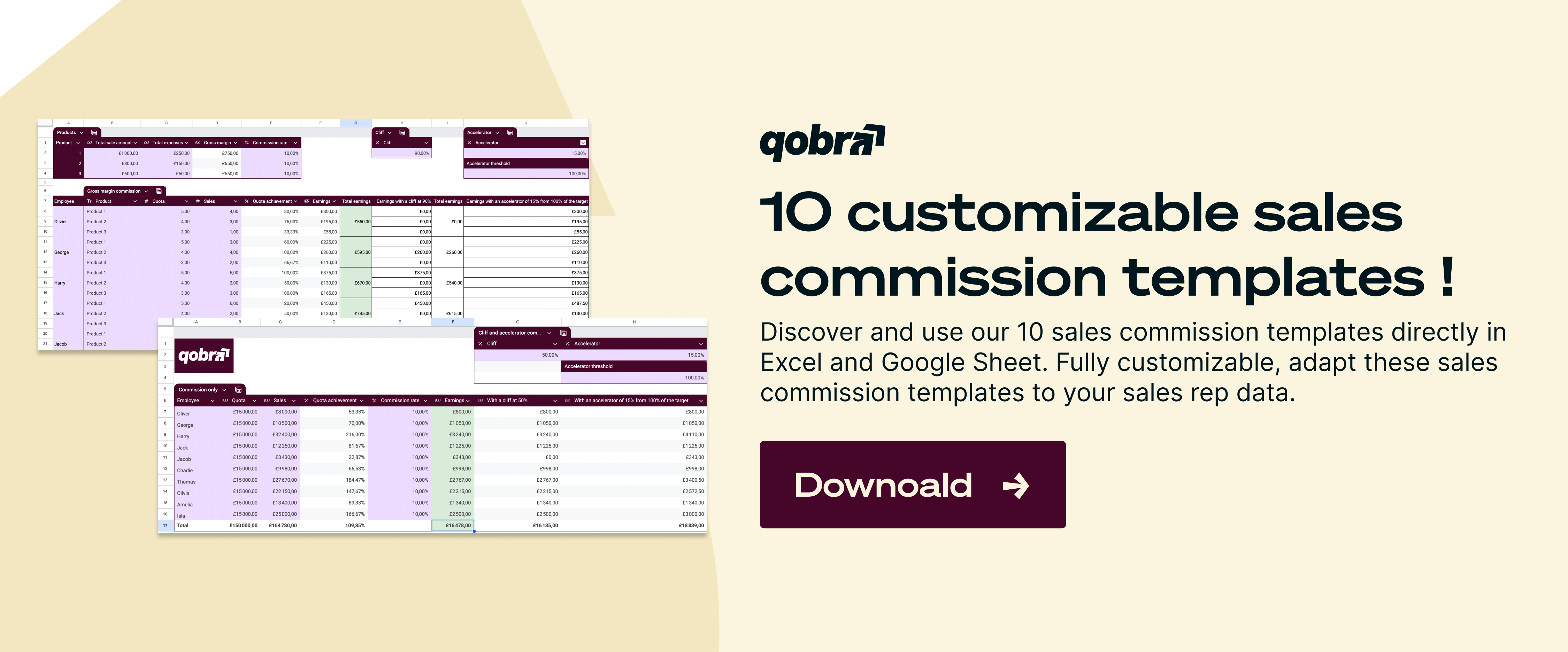
A more dynamic version of the salary + commission model, a tiered structure increases the commission rate as a salesperson achieves higher levels of sales volume or quota attainment. For example, a rep might earn 5% on sales up to their quota, but 8% on all sales once they exceed it.
- Why it works: This model strongly motivates reps to not just meet their quota but to significantly exceed it. The escalating rewards for top performance create a powerful incentive for overachievement. Managing these complex calculations manually can be a challenge, which is why many companies use incentive compensation management software to automate the process.
6. Gross Margin Commission
Instead of paying commission on total revenue, this model bases it on the gross margin of each sale. This is calculated by subtracting the cost of goods sold (COGS) from the revenue.
- Why it works: This plan is ideal when salespeople have control over pricing and discounts. It incentivizes them to sell based on profitability, not just volume, aligning their goals with the company's financial health. It discourages excessive discounting to close deals quickly.
7. Hybrid Models
Many organizations combine elements from different plans to create a custom structure. For example, a plan might include a base salary, a commission on revenue, and an additional bonus for exceeding a new customer acquisition target. These hybrid plans offer the flexibility to reward multiple desired behaviors simultaneously.
Key Metrics and Terminology in Sales Compensation
To effectively design and manage a plan, you need to be familiar with the language of sales compensation.
- Quota: The sales target a salesperson is expected to achieve within a specific period (month, quarter, or year). Quotas must be realistic and attainable to be motivating.
- Commission Rate: The percentage of revenue or margin paid to the salesperson for a closed deal.
- Accelerators: Increased commission rates that kick in after a salesperson surpasses their quota. For example, the rate might jump from 10% to 15% for all revenue above 100% of the target.
- Decelerators: Reduced commission rates for performance below a certain threshold (e.g., below 50% of quota). This discourages underperformance but should be used with care to avoid demoralizing the team.
- SPIFFs (Sales Performance Incentive Funds): Short-term, immediate incentives used to drive focus on a specific product or goal. A SPIFF could be a cash prize for the first person to sell a new product.
- Clawbacks: A contractual provision that allows the company to reclaim commission paid on a deal if the customer cancels their contract or fails to pay within a certain period. Implementing clear clawback policies is essential for protecting a company's finances.
How to Choose the Right Compensation Structure
There is no single "best" sales compensation plan. The optimal structure depends on a thoughtful analysis of your business strategy, sales cycle, team roles, and industry standards.
1. Align with Your Core Business Objectives
Your compensation plan should be a direct reflection of your company's strategic goals. Ask yourself what you want to achieve:
- Aggressive Growth: A plan with high variable pay and strong accelerators will incentivize acquiring new customers quickly.
- Profitability: A gross margin commission model encourages reps to protect margins and avoid deep discounts.
- Market Penetration: Bonuses for landing key accounts in a new territory can help establish a foothold.
- Customer Retention: Tying a portion of compensation to contract renewals or upsells ensures reps focus on long-term value, not just the initial sale.
2. Consider Your Sales Cycle and Product Complexity
The length of your sales cycle and the technical nature of your product should influence your pay mix.
- Short Sales Cycles (e.g., transactional sales): A higher variable component (e.g., 50/50 mix) works well, as reps see rewards quickly.
- Long or Complex Sales Cycles (e.g., enterprise software): A higher base salary (e.g., 70/30 or 80/20 mix) provides the stability needed to nurture leads over months or even years.
3. Tailor Plans to Specific Sales Roles
Different roles within the sales organization contribute in different ways and should be compensated accordingly.
- Sales Development Reps (SDRs): Since their primary goal is to generate qualified leads or book meetings, a plan with a high base salary and a bonus per qualified opportunity is most effective. You can learn more about how to pay an SDR here.
- Account Executives (AEs): Focused on closing new business, they are best suited for a classic Base Salary + Commission model with accelerators.
- Account Managers/Customer Success Managers (CSMs): Their focus is retention and expansion. Compensation should include incentives for renewals, upsells, and cross-sells.
4. Benchmark Against Industry Standards
Compensation varies significantly by sector. What works in SaaS may not work in real estate.
- IT/SaaS: Often uses a Base + Commission model with OTEs reflecting high deal values.
- Real Estate: Primarily commission-only, due to the independent nature of agents and high transaction values.
- Pharmaceuticals: Features complex plans with progressive commissions, rewarding deep product knowledge and long-term client relationships.
- Retail/Supermarkets: Commissions are typically lower due to smaller margins, focusing more on volume.
The Power of Transparency
Regardless of the model you choose, transparency is key. When salespeople can see in real time how their performance translates into earnings, their motivation increases. Manual calculations on spreadsheets are opaque and prone to error, creating distrust. Platforms like Qobra automate calculations and provide reps with live dashboards, fostering a culture of trust and clarity. This move toward pay transparency is a game-changer for sales team engagement.
From Spreadsheets to Strategy: Automating Your Plan
Designing a great plan is only half the battle. The real challenge often lies in its administration. Many companies still rely on complex, error-prone spreadsheets to calculate commissions. This manual process is time-consuming for finance and sales ops teams and creates a lack of visibility for salespeople, leading to disputes and demotivation.
Automating your commission process with a dedicated platform is the final step in creating a world-class compensation system. A solution like Qobra connects directly to your CRM (like Salesforce or HubSpot), pulls deal data automatically, and calculates commissions in real time according to your plan's rules.
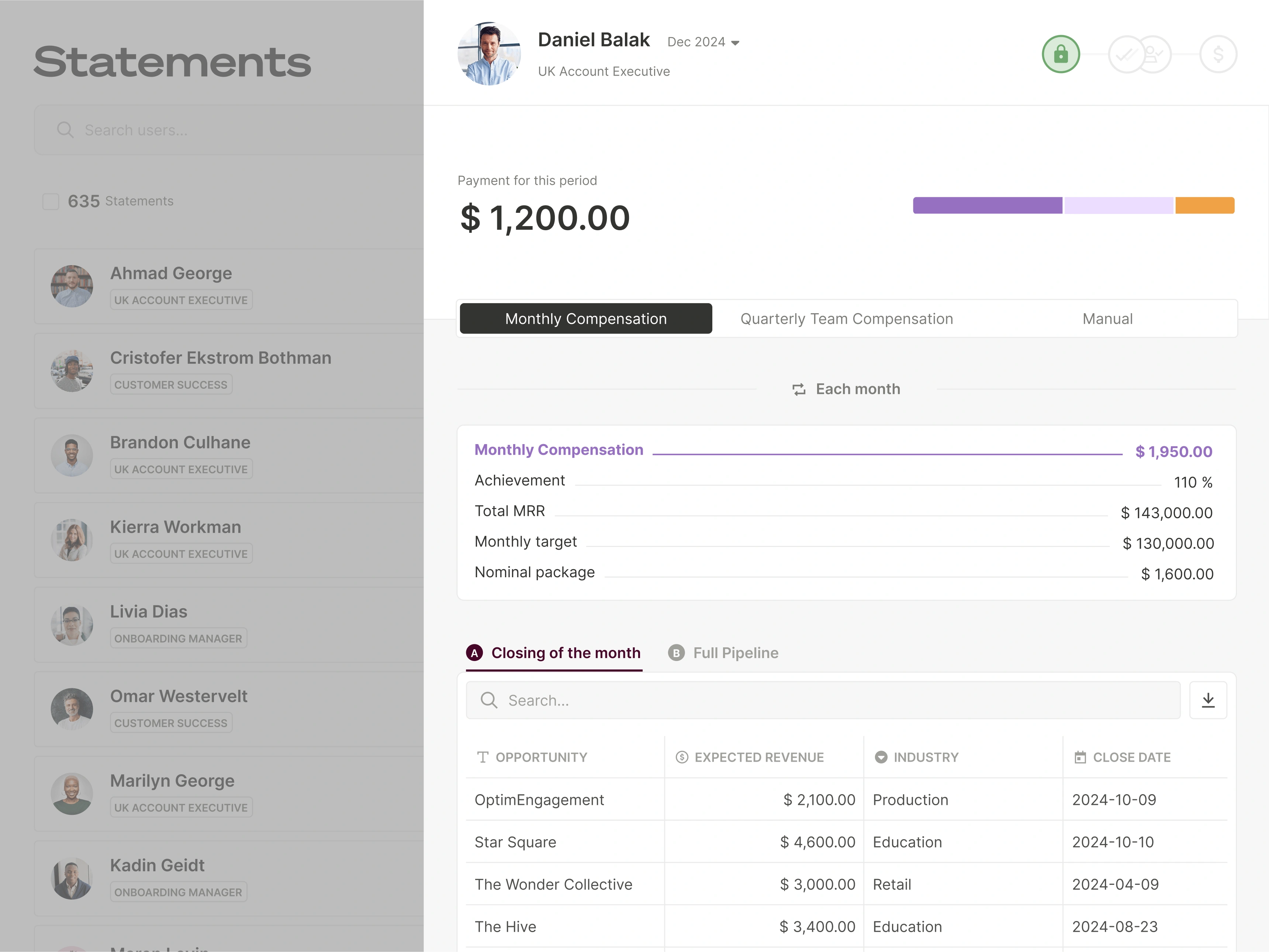
With a no-code rule editor, you can build and adjust even the most complex plans—including tiers, accelerators, and SPIFFs—without needing technical expertise. Sales reps get a personalized dashboard showing their current earnings, progress toward quota, and potential income from their pipeline. This level of transparency transforms compensation from a monthly administrative task into a daily motivational tool.
A strategic, well-designed, and transparently managed compensation plan is one of the most powerful levers for driving sales performance. By moving beyond outdated manual processes and embracing automation, you can ensure your plan not only rewards your team fairly but also becomes a dynamic engine for achieving your company's most ambitious goals.
Frequently Asked Questions
How much does a salesperson typically earn?
A salesperson's income is highly variable and depends on their industry, experience, location, and performance. In high-margin sectors like enterprise software or real estate, experienced agents can earn well over $100,000 annually, with top performers reaching several hundred thousand. In contrast, roles in sectors with lower margins, like retail, generally have more modest earning potential. The OTE is the best indicator, as it combines the security of a base salary with the potential of variable pay.
How do you calculate sales commission?
The basic formula for commission is: Commission = Sale Amount x Commission Rate. For example, if a salesperson closes a $10,000 deal with a 5% commission rate, they earn $500. More complex plans might calculate commission based on gross margin (Revenue - Cost of Goods Sold) or use tiered rates where the percentage increases as the salesperson surpasses their sales targets.
What is the difference between a bonus and a commission?
A commission is a variable payment calculated as a percentage of a sale's value and is typically paid out for each deal closed. It directly rewards the act of selling. A bonus, on the other hand, is a fixed, one-time payment for achieving a specific, non-transactional goal over a set period (e.g., a quarterly bonus for acquiring 10 new enterprise clients or for achieving a team revenue target).
Should sales commissions be capped?
Generally, it is advisable to keep sales commissions uncapped. Capping commissions can demotivate your top performers, as they have no financial incentive to continue selling after they have reached their limit for a given period. Studies have shown that uncapped commissions lead to higher overall sales revenue, as they encourage every salesperson to perform at their absolute best throughout the entire sales period.