Webinar: The Biggest Release Sales Comp Has Ever Seen. Come See For Yourself (Wednesday, October 7)
Register
- Performio is a solid mid-market commission management tool, but teams often outgrow its limited customization options and narrow integration ecosystem as they scale.
- The most common migration triggers are limited CRM and HRIS integrations, a clunky admin experience for plan builders, and difficulty modeling complex, multi-currency commission structures.
- Qobra stands out with wider native integrations (Salesforce, HubSpot, Close, and more), a no-code plan builder that gives Ops teams full autonomy, and built-in multi-currency support for global payouts.
- When evaluating alternatives, prioritize four criteria: CRM integration depth, plan-building autonomy for admins, the day-to-day rep experience, and transparent real-time reporting for Finance.
Performio has earned a reputation as a reliable sales commission platform for mid-market teams. Its structured workflows and calculation engine handle many standard compensation scenarios well. But as organizations grow — adding new sales roles, entering international markets, or layering increasingly complex plan designs — the platform's limitations become harder to work around.
Operations leaders often notice it first: integrations that require manual CSV uploads instead of real-time syncs, a plan builder that demands support tickets for routine changes, or currency handling that forces spreadsheet workarounds for global teams. Finance teams feel it too, when reporting lags behind the close cycle and audit trails lack the granularity regulators expect. And sales reps? They disengage from a tool that does not show them, in real time, exactly what a deal is worth.
If any of those friction points sound familiar, you are not alone. A growing number of revenue operations teams are evaluating Performio alternatives that can keep pace with their complexity.
This guide walks through why teams migrate, the criteria that matter most when choosing a replacement, and a detailed look at the 10 best Performio alternatives in 2026 — starting with the platform that consistently ranks highest for usability and integration depth.
Why Teams Look for Performio Alternatives
Performio covers the fundamentals of incentive compensation management, but several recurring pain points push teams to explore other options. Understanding these drivers helps you build a sharper evaluation framework.
Limited Native Integrations
Performio connects to a handful of CRMs and ERPs, but many teams find the integration catalog too narrow for their stack. When your CRM data, HRIS records, and billing system do not sync natively, Ops teams spend hours each period formatting CSV files, reconciling mismatched fields, and troubleshooting broken imports. That manual overhead compounds as headcount grows.
Admin UX and Plan-Building Friction
Compensation plans change — new accelerators, adjusted quotas, mid-quarter SPIFs. In Performio, modifying plan logic often requires support intervention or deep familiarity with the platform's proprietary configuration layer. For Ops teams that need to iterate quickly, this dependency creates bottlenecks and extends rollout timelines.
Complex Plan Support
Multi-tiered plans, draw-against-commission structures, and plans that span multiple currencies or fiscal calendars push Performio's modeling capabilities. Teams with advanced comp designs frequently report needing workarounds — shadow spreadsheets, manual overrides, or custom scripts — that defeat the purpose of a dedicated platform.
Reporting Depth and Real-Time Visibility
Finance teams need commission accrual data, ASC 606 compliance reporting, and granular audit trails. Sales reps need to see, in real time, exactly how a deal impacts their payout. When the platform cannot deliver both with confidence, trust in the numbers erodes — and that trust is hard to rebuild.
Key Evaluation Criteria for Performio Alternatives
Before comparing individual tools, align your team on the criteria that will drive the decision. These four dimensions separate platforms that look good in a demo from platforms that actually work at scale.
CRM Integration Depth
Surface-level CRM connections are not enough. Evaluate whether the platform can pull custom objects, multi-object relationships, and real-time event triggers from your CRM — not just standard opportunity data. A platform that maps deeply into Salesforce, HubSpot, or Close eliminates the data reconciliation work that slows every commission cycle.
Plan-Building Autonomy
Can your Ops team build, test, and deploy a new commission plan without filing a support ticket or writing code? The best platforms offer a no-code or low-code plan builder with version control, simulation capabilities, and approval workflows — so plan changes happen in hours, not weeks.
Rep Experience and Adoption
A commission tool only delivers value if reps actually use it. Look for real-time dashboards that show reps exactly what they will earn when a deal closes, email or Slack notifications on deal-level commission impact, and an interface clean enough that reps check it voluntarily — not because a manager forces them to.
Finance-Grade Reporting and Compliance
Finance needs more than summary totals. Evaluate the platform's ability to generate ASC 606 / IFRS 15 compliant accrual schedules, granular audit trails down to individual transactions, and multi-level roll-ups by team, region, or legal entity. If your finance team cannot pull a confident close from the platform alone, you will end up maintaining parallel spreadsheets.
The 10 Best Performio Alternatives in 2026
1. Qobra

Best for: Operations, Finance, and Sales teams that need a single, trusted commission platform with real-time visibility and full plan autonomy.
Qobra is built around a core principle: commissions should be clear and trusted across every stakeholder — Operations, Finance, and Sales. That philosophy shows up in every layer of the platform.
Native integrations that eliminate manual work. Qobra connects natively to Salesforce, HubSpot, Close, and a growing list of CRMs, ERPs, and HRIS platforms. These are not flat-file imports — they are real-time, bidirectional syncs that pull custom objects and multi-object relationships directly into your commission calculations. When your data flows automatically, Ops teams reclaim the hours they used to spend reconciling CSVs.
A no-code plan builder that gives Ops full control. Qobra's plan builder lets compensation administrators design, simulate, and deploy even the most complex structures — multi-tiered accelerators, draws, SPIFs, and multi-currency payouts — without writing code or waiting on vendor support. Version control and approval workflows are built in, so plan changes move from draft to production in hours.
Real-time visibility that drives rep engagement. Sales reps see exactly what they will earn when they close a deal, updated in real time. Email notifications break down the commission impact of each deal, so reps understand the direct connection between their activity and their payout. That transparency is why teams that implement Qobra report that reps actively engage with the tool — they want to check it, not avoid it.
Finance-grade reporting and compliance. Finance teams get multi-level commission visibility — by team, by individual, and down to specific commission amounts — accessible at any time. ASC 606 accrual schedules, granular audit trails, and multi-currency support give Finance the confidence to close without parallel spreadsheets.
Multi-currency support built in. For global teams, Qobra handles multi-currency commission calculations natively. No workarounds, no manual conversion tables — just accurate payouts in the right currency for every rep, every period.
Notable customers include JCDecaux, ElevenLabs, AstraZeneca, DataSnipper, GoCardless, Factorial, Go1, SAP, Quantcast, and Make. Qobra holds a 4.8/5 rating on G2 and a 4.9/5 on Capterra.
AI-Powered Agents — A Unique Differentiator
Qobra includes three purpose-built AI agents that handle real work — not just analytics overlays. The Architect replaces hours of plan implementation with minutes of conversation, building or editing compensation plans autonomously on the platform. The Sales Coach answers rep questions about their commissions instantly, reducing admin ticket volume and building trust between sales teams and operations. The Analyst creates reports and dashboards from plain-language requests and surfaces proactive business intelligence — flagging anomalies, identifying trends, and delivering insights that would take hours of manual analysis.
Pricing: Tailored to your team size and plan complexity. Book a demo to see Qobra configured with your own compensation plans.
2. CaptivateIQ
Best for: Mid-market teams that want spreadsheet-like flexibility in a commission platform.
CaptivateIQ combines a familiar spreadsheet interface with commission automation. Its "SmartGrid" lets admins build calculations using formulas they already know, which can lower the learning curve for teams migrating from Excel. The platform integrates with major CRMs and supports moderately complex plan structures. However, teams with highly layered plans or advanced multi-currency needs may find the formula-based approach harder to maintain at scale than a purpose-built plan builder.
Pricing: Custom, based on payee count and plan complexity.
3. Spiff
Best for: Fast-growing teams that need quick implementation and clean UX.
Spiff emphasizes speed of deployment and a modern user interface. The platform handles standard commission structures effectively and offers real-time commission statements for reps. Salesforce integration is a strength. Spiff was acquired by Salesforce, which deepens its CRM connection but may limit flexibility for teams using other CRMs. Complex multi-currency or multi-entity scenarios may require workarounds.
Pricing: Custom, contact Spiff for a quote based on team size.
4. Xactly
Best for: Large enterprises with complex, global compensation programs.
Xactly is one of the longest-standing players in incentive compensation management, offering deep plan modeling, territory management, and benchmarking data drawn from years of anonymized compensation information. The platform handles large-scale, multi-entity compensation structures. The trade-off is complexity: implementation timelines tend to be longer, and day-to-day admin tasks often require specialized training or dedicated Xactly administrators.
Pricing: Enterprise pricing, typically structured as annual contracts.
5. Varicent
Best for: Enterprise organizations that need integrated territory and quota planning alongside commissions.
Varicent combines incentive compensation management with territory planning, sales quota setting, and revenue intelligence. For organizations that want a single vendor across compensation and go-to-market planning, that breadth is appealing. The platform's depth comes with a steeper learning curve and longer implementation cycles, and smaller teams may find the feature set broader than what they need.
Pricing: Enterprise pricing, contact Varicent for custom quotes.
6. QuotaPath
Best for: Early-stage and SMB sales teams that want a simple, affordable starting point.
QuotaPath offers an accessible entry into commission tracking with a clean interface and straightforward plan templates. It connects to Salesforce, HubSpot, and Close, and provides rep-facing dashboards with deal-level commission estimates. The platform is well-suited for teams with simpler plan structures. As plan complexity grows — multi-tiered structures, advanced crediting rules, or global payroll requirements — teams may need to migrate to a more robust platform.
Pricing: Tiered plans starting with a free option for small teams, with paid plans scaling by feature set and payee count.
7. Commissionly
Best for: Small teams looking for a lightweight, budget-friendly commission tracker.
Commissionly focuses on simplicity and affordability. It covers basic commission calculations, supports common CRM integrations, and offers a clean rep dashboard. For small sales teams with straightforward comp plans, it gets the job done without a heavy implementation lift. Larger teams or those with complex, multi-variable plans will likely outgrow its capabilities.
Pricing: Per-user monthly pricing, positioned as one of the more affordable options in the category.
8. Visdum
Best for: SaaS companies that want commission management tailored to recurring revenue models.
Visdum is purpose-built for SaaS compensation, with native support for metrics like ARR, MRR, net retention, and expansion revenue. The platform integrates with billing systems and CRMs to automate calculations around renewals, upsells, and multi-year contracts. Teams in non-SaaS industries may find the platform's specialization limiting, but for SaaS-native Ops teams, the fit is strong.
Pricing: Custom, based on payee count and integration requirements.
9. Sales Cookie
Best for: Small-to-mid-market teams that want self-service setup and fast time to value.
Sales Cookie offers a self-service approach to incentive compensation, with a wizard-driven setup process and template library that accelerate deployment. The platform supports common plan structures and integrates with major CRMs. Its automation features — including automated crediting and payout calculations — reduce manual admin work. More advanced enterprise requirements, such as ASC 606 reporting or complex multi-entity structures, may require supplementary tooling.
Pricing: Tiered monthly plans based on the number of payees and feature tier.
10. Everstage
Best for: Revenue teams that prioritize gamification and rep-facing dashboards.
Everstage focuses on the rep experience, offering leaderboards, goal tracking, and commission estimators that keep sales teams engaged. Its plan designer covers common structures including tiered rates and accelerators. Integration options include Salesforce, HubSpot, and several billing platforms. Everstage works well for teams that want to drive motivation through visibility, though Finance teams with complex accrual and compliance requirements may need supplementary reporting.
Pricing: Custom, typically quoted per payee per month.
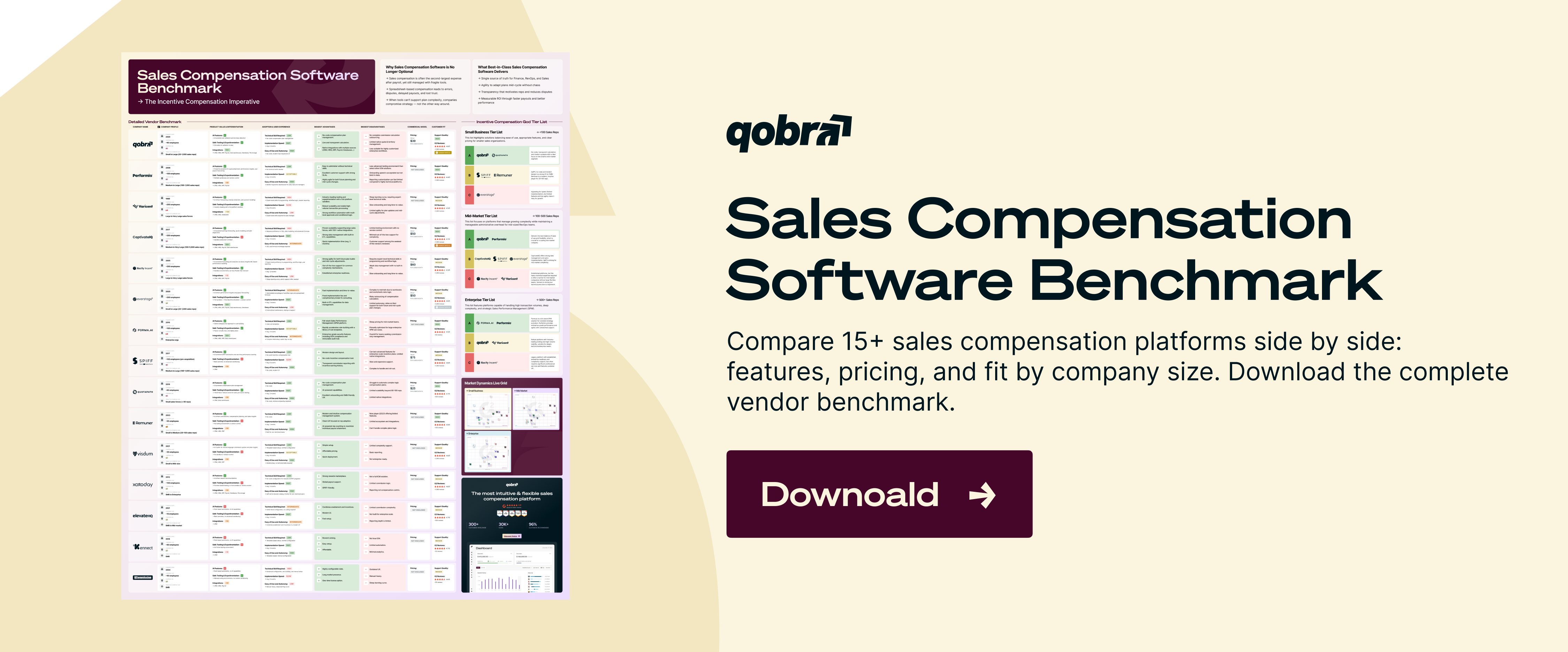
Feature Comparison Table
Frequently Asked Questions
What Is the Biggest Limitation of Performio?
The most frequently cited limitation is integration depth. Performio connects to a limited set of CRMs and data sources, which means many teams rely on manual CSV imports to feed commission calculations. As teams grow and add more tools to their revenue stack, this constraint creates significant operational overhead and increases the risk of commission payment errors.
How Long Does It Take to Migrate From Performio to a New Platform?
Migration timelines vary depending on plan complexity and data volume. Platforms with strong onboarding support — like Qobra, which configures demos around your own compensation plans — can typically complete migration in 4 to 8 weeks for mid-market teams. Enterprise migrations with dozens of plans and global entities may take longer. The key accelerator is how cleanly your current data can be exported and mapped to the new platform's data model.
Can I Use a Commission Platform Alongside My Existing Payroll System?
Yes. Most modern commission platforms, including Qobra, are designed to complement your payroll system, not replace it. The commission platform calculates and validates commission amounts, then exports finalized payout data to your payroll or ERP system for disbursement. Native integrations with payroll and ERP platforms reduce the manual handoff between systems.
What Should I Prioritize When Evaluating Performio Alternatives?
Focus on four dimensions: CRM integration depth (does the platform pull the specific data objects your plans need?), plan-building autonomy (can your Ops team make changes without vendor support?), rep experience (will reps actually use it day to day?), and Finance-grade reporting (can your finance team close confidently from the platform alone?). Weight these based on which pain points drove your decision to evaluate alternatives in the first place.
Is Qobra Suitable for Global Teams With Multi-Currency Compensation Plans?
Yes. Qobra handles multi-currency commission calculations natively, supporting global teams that pay reps in different currencies across regions. Combined with multi-entity reporting and granular audit trails, Finance teams can manage international payroll-readiness from a single platform without maintaining conversion spreadsheets.