Sales Compensation Software Benchmark | Compare 15+ Sales Compensation Platforms
Download
- Sales compensation is a mix of fixed base salary and variable pay (commissions, bonuses); On-Target Earnings (OTE) = annual base + on-target commission—evaluate both the split and quota attainability.
- Benchmarks vary by role, experience and industry: typical French ranges move from SDRs (€30–45k base; €40–70k OTE) to AEs (€40–90k base; €60–180k+ OTE) and Sales Managers (€70–120k base; €100–200k+ OTE), with SaaS, finance and real estate driving large differences.
- Commission models differ: straight commission vs salary+commission; bases can be revenue or gross profit; rates commonly span ~5%–50% depending on margin, cycle and support; advanced rules include accelerators, draws and caps.
- Calculate OTE simply: OTE = Base + (Quota × Commission rate); factor in clawbacks, payment timing and non-recoverable draws which materially affect cash flow and realized earnings.
- Design fair, motivating plans with clear, transparent rules and automated tracking (dashboards, no‑code tools) to reduce errors, foster trust and align sales behaviour with company profitability.
How can you determine if a sales compensation package is truly competitive, or design one that attracts and retains top talent? Navigating the world of sales salaries and commissions can feel like trying to hit a moving target. Remuneration is highly variable, influenced by everything from industry and experience to the specific structure of the commission plan.
A salesperson's pay is a powerful strategic tool. For sales professionals, it dictates earning potential and career trajectory. For companies, it's a critical lever for motivating performance and aligning sales behaviours with business objectives. This guide breaks down the essential components of sales compensation, providing clear benchmarks and practical examples to help both salespeople and managers master this crucial subject.
The Core Components of Sales Compensation
Sales remuneration is almost always a blend of fixed and variable elements. Understanding these components is the first step toward evaluating or creating a compelling compensation package.
Fixed Pay: The Base Salary
The base salary is the guaranteed, fixed portion of a salesperson's income, paid out regularly regardless of performance. It provides financial stability and covers living expenses, ensuring that sales reps are not entirely dependent on the volatility of their sales results. This fixed component is crucial for attracting talent, as it mitigates risk, especially for roles with long or complex sales cycles where commissions may be infrequent.
Variable Pay: Commissions and Bonuses
Variable pay is the performance-based component of a salesperson's earnings. It's designed to incentivize and reward success. The most common forms include:
- Commission: A percentage of the value of a deal, paid to the salesperson who closes it. This is the primary driver of performance in most sales roles. The structure can vary immensely, from a simple percentage of revenue to more complex calculations based on profitability or product type.
- Bonus: A lump-sum payment awarded for achieving or exceeding specific, often non-recurring, targets. Unlike recurring commissions, a bonus is typically tied to a time-bound objective, such as hitting a quarterly team quota, closing a strategic account, or successfully launching a new product.
On-Target Earnings (OTE)
On-Target Earnings (OTE) represents the total potential income a salesperson can expect to earn in a year if they meet 100% of their sales quota. It is the sum of the annual base salary and the total commission they would earn at target.
OTE = Annual Base Salary + Annual On-Target Commission
OTE is the most important metric for understanding a sales role's true earning potential. When evaluating a job offer, sales reps should focus on the OTE, while also scrutinizing the split between base and variable pay (e.g., 50/50, 60/40) and the feasibility of achieving the sales target.
Average Sales Salaries: A Benchmark by Role and Experience
Salaries and OTEs fluctuate significantly based on the role's responsibilities and the required level of experience. While figures vary by country and company, the following benchmarks provide a general overview.
Sales Development Representative (SDR) / Business Development Representative (BDR)
SDRs are typically entry-level roles focused on prospecting and generating qualified leads for Account Executives. Their compensation is often heavily weighted towards activity and meeting-setting metrics.
Experience Level | Average Base Salary (France) | Average OTE (France) |
|---|---|---|
Junior (0-2 years) | €30,000 - €38,000 | €40,000 - €50,000 |
Senior (2+ years) | €38,000 - €45,000 | €55,000 - €70,000 |
Account Executive (AE)
Account Executives are responsible for closing deals generated by SDRs or their own prospecting. Their compensation is directly tied to the revenue they generate, with a higher variable component.
Experience Level | Average Base Salary (France) | Average OTE (France) |
|---|---|---|
Junior (1-3 years) | €40,000 - €50,000 | €60,000 - €80,000 |
Mid-level (3-5 years) | €50,000 - €65,000 | €85,000 - €110,000 |
Senior (5+ years) | €65,000 - €90,000 | €120,000 - €180,000+ |
Sales Manager / Team Lead
Sales Managers oversee a team of reps. Their compensation includes a variable component tied to their team's overall performance against its collective quota.
Experience Level | Average Base Salary (France) | Average OTE (France) |
|---|---|---|
Mid-level (5-8 years) | €70,000 - €90,000 | €100,000 - €140,000 |
Senior (8+ years) | €90,000 - €120,000 | €150,000 - €200,000+ |
Key Factors That Influence Sales Compensation
Beyond role and experience, several external factors heavily impact earning potential.
Industry Benchmarks: From SaaS to Real Estate
The industry is one of the biggest determinants of sales compensation due to differences in deal value, margin, and sales cycle complexity.
- IT & SaaS: This fast-growing sector often offers competitive OTEs with a typical 50/50 base-to-variable split. Commissions are attractive, especially in B2B software sales where deal sizes are large and recurring revenue is key.
- Real Estate: Agents often work on a straight commission model. While the risk is high, the potential rewards are significant, with top agents earning well over €100,000 annually due to the high value of properties.
- Pharmaceutical & Medical: This industry involves complex products and long-term relationship building. Sales reps are well-remunerated with progressive commission structures and substantial bonuses for hitting targets.
- Finance & Insurance: Similar to IT, this sector offers high earning potential, particularly in roles selling complex financial products or services to high-value clients.
- Retail & Supermarkets: Margins are typically lower, so commissions are more moderate. Compensation often relies on achieving high sales volumes rather than high-value individual sales.
The Impact of Geography and Company Size
Compensation levels vary significantly between countries and even regions. For instance, salaries in the US tech hubs like San Francisco are generally higher than in European cities to account for a higher cost of living.
Company size also plays a role. Large, established enterprises may offer higher base salaries and more comprehensive benefits. In contrast, startups might offer lower base pay but compensate with higher commission potential and stock options, allowing reps to share in the company's long-term success.
Note for Sales Professionals
When comparing offers, don't just look at the OTE. Consider the entire package: the base/variable split, the company's market position, the realism of the quota, and the quality of the product you'll be selling. A high OTE with an unattainable quota is less valuable than a slightly lower, but achievable, one.
Decoding Sales Commission Structures
The heart of any variable pay plan is the commission structure. A well-designed plan motivates the right behaviours, while a poorly designed one can lead to confusion, frustration, and misaligned efforts.
Straight Commission vs. Salary Plus Commission
- Straight Commission: The salesperson earns only a percentage of the sales they generate. There is no base salary. This model offers the highest earning potential but also the greatest risk. It is common in industries like real estate and for independent sales agents.
- Salary Plus Commission: This is the most common model. It combines the security of a fixed salary with the incentive of variable commission. Our research shows over 70% of businesses use a base salary plus commission or bonus structure. This model provides stability while still rewarding high performance.
How Commission Rates Are Determined
There is no single "average" commission rate. Rates can range from 5% in high-volume, low-margin businesses with generous base salaries, to an average of 20-30% in many B2B sectors. In roles requiring deep technical expertise or those with a pure commission structure, rates can reach as high as 40-50%.
The rate is typically influenced by:
- The difficulty and length of the sales cycle.
- The total value and margin of the product or service.
- The amount of support the rep receives from marketing and SDRs.
- The company's strategic goals.
Revenue vs. Gross Profit: What's the Base for Your Commission?
A critical element of any plan is the base on which commission is calculated.
- Revenue-Based Commission: A percentage of the total contract value. It's simple to calculate but can incentivize discounting to close deals, potentially hurting profitability.
- Gross Profit-Based Commission: A percentage of the profit margin on a sale. This model is increasingly popular because it aligns the salesperson's goals directly with the company's profitability. It encourages reps to protect pricing and sell on value. Building a commission structure based on gross profit ensures sales efforts contribute directly to the bottom line.
Advanced Commission Models: Accelerators, Draws, and Caps
To further motivate reps, companies often use more sophisticated structures:
- Tiered Commissions (Accelerators): The commission rate increases as the salesperson surpasses certain thresholds of their quota. For example, they might earn 10% on sales up to 100% of their quota, and 15% on all sales beyond that. This strongly incentivizes overperformance.
- Commission Draw: An advance against future commissions, paid to new hires to provide income security while they build their pipeline. The draw is later paid back from earned commissions.
- Commission Caps: A limit on the total commission a salesperson can earn in a given period. While intended to control costs, caps are widely seen as demotivating for top performers. Decapping commissions is a powerful way to foster a high-performance culture.
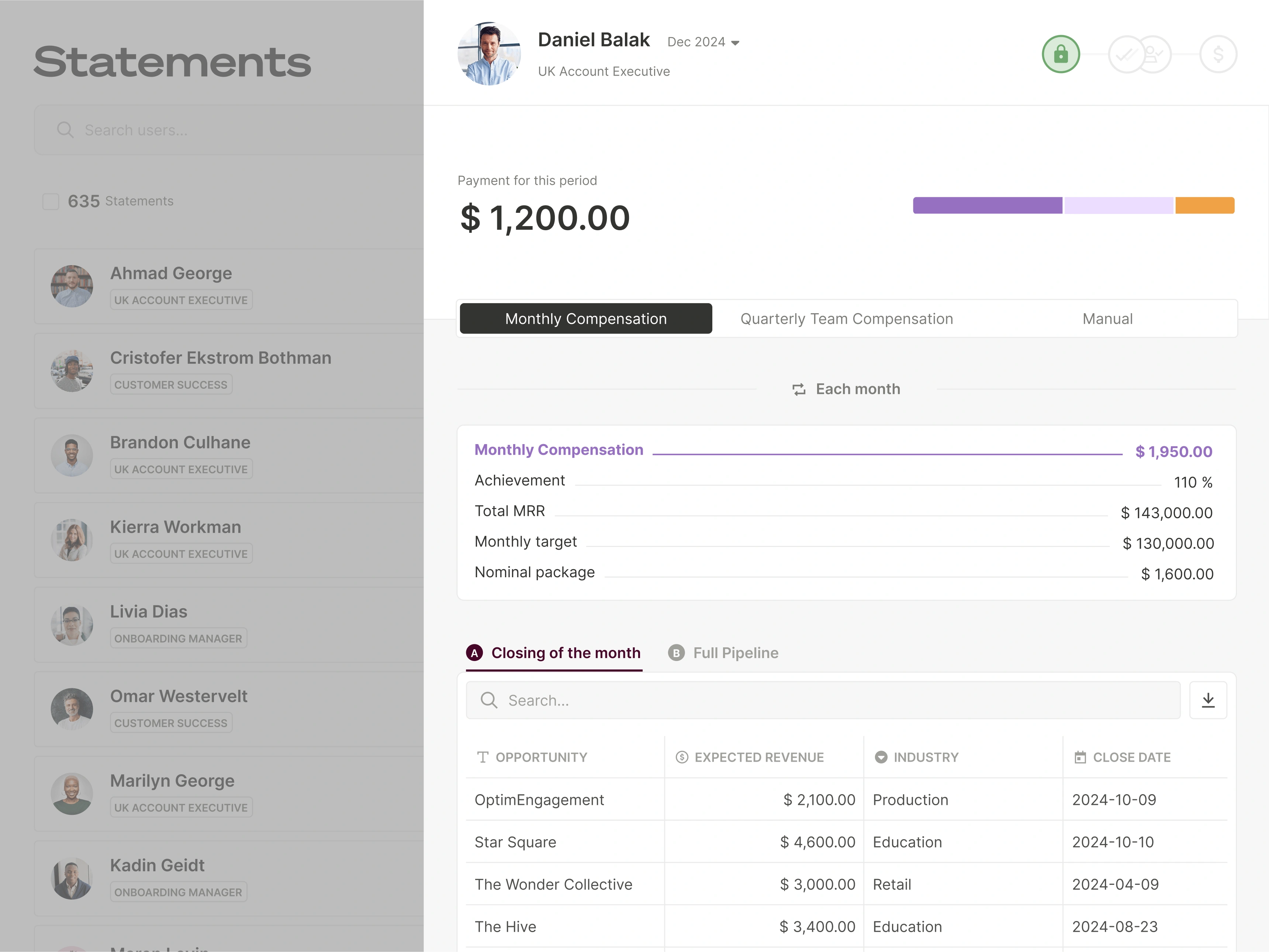
Managing these complex rules on spreadsheets is a recipe for disaster, leading to errors, disputes, and wasted time. This is where a dedicated platform becomes essential. With an automated solution like Qobra, companies can effortlessly build, manage, and track any type of commission plan. The no-code editor allows Sales Ops and Finance teams to implement rules for accelerators, bonuses, and tiered rates in minutes, while providing sales reps with a real-time, transparent dashboard of their earnings.
How to Calculate and Project Your Total Earnings
Understanding how to calculate OTE is essential for both negotiating a salary and forecasting income.
The OTE Formula Explained
As mentioned, the formula is straightforward: OTE = Annual Base Salary + Annual On-Target Commission. The on-target commission is the amount you'll earn by hitting 100% of your quota.
For example, if a role has an annual quota of €800,000 and a commission rate of 10%, the on-target commission is €80,000. If the base salary is €60,000, the OTE would be: €60,000 (Base) + (€800,000 * 10%) = €60,000 + €80,000 = €140,000 OTE
Real-World Examples
Role & Industry | Base Salary | Quota | Commission Structure | OTE Calculation |
|---|---|---|---|---|
Junior AE (SaaS) | €45,000 | €500,000 | 10% of Annual Contract Value (ACV) | €45,000 + (€500,000 * 10%) = €95,000 |
Senior AE (Finance) | €80,000 | €1,200,000 | 8% of revenue | €80,000 + (€1,200,000 * 8%) = €176,000 |
Real Estate Agent | €0 | N/A | 3% of property sale price (Target sales volume: €3M) | €0 + (€3,000,000 * 3%) = €90,000 |
Warning: The "Hidden" Complexities
Your official commission plan may not tell the whole story. Pay attention to clawbacks (commission reversals on canceled contracts), payment schedules (when commissions are paid out), and non-recoverable draws. These details can significantly impact your net earnings and cash flow.
A well-structured sales compensation plan is far more than a way to pay your team; it's a strategic asset that aligns individual ambitions with corporate goals. Whether you are a sales professional evaluating your next career move or a leader designing a plan to fuel growth, focusing on clarity, fairness, and motivation is paramount. By leveraging accurate benchmarks and transparent systems, you can create a framework where high performance is not just expected but enthusiastically pursued.

Frequently Asked Questions
What is a typical total compensation for a salesperson?
Total compensation, or OTE (On-Target Earnings), varies widely by role, industry, and experience. A junior Sales Development Representative (SDR) might have an OTE of €45,000, while a senior Account Executive in a high-growth sector like SaaS or finance could earn an OTE of €150,000 or much more.
What is a good commission rate in sales?
A "good" rate depends on the context. While the average commission rate often falls between 20-30% of base salary, it can be as low as 5% for roles with very high base pay or as high as 40-50% for highly technical roles or those based on straight commission. The key is how the rate combines with the base salary and quota to create a competitive OTE.
How is On-Target Earnings (OTE) calculated?
OTE is calculated by adding the annual base salary to the total commission you would earn if you hit 100% of your sales quota. For example, with a €60,000 base salary and €40,000 in on-target commissions, your OTE is €100,000.
What is the difference between commission and a bonus?
A commission is a recurring payment calculated as a percentage of a sale you make. It's a core part of the variable pay structure. A bonus is typically a one-time, fixed payment for achieving a specific, often strategic, objective within a set period (e.g., a quarterly team target or winning a key logo).
How can I ensure my commission plan is fair and motivating?
Fairness and motivation hinge on transparency, clarity, and alignment. The rules should be simple to understand and the goals achievable. Using a dedicated commission management platform like Qobra is the best way to ensure this. It automates calculations, eliminates errors, and gives every salesperson a real-time dashboard of their performance and earnings, fostering trust and keeping the team focused on selling.