Webinar: The Biggest Release Sales Comp Has Ever Seen. Come See For Yourself (Wednesday, October 7)
Register
- A commission pay structure is the ruleset that links sales performance to pay — a strategic tool to motivate reps, align behavior with company goals, and make compensation costs variable and scalable.
- Key models to know: Base salary + commission, straight commission, tiered/accelerators, gross‑margin, residual, territory/team, draw against commission, and multiplier structures — each suited to different business models (e.g., SaaS, B2B, retail, high‑ticket sales).
- Design fundamentals: start by aligning the plan to your strategic objective, define OTE and pay mix, set realistic quotas, choose commission formulas (rate, tiers, multipliers) and exemplify with numeric calculations.
- Operational and legal rules matter: specify payment frequency, eligibility, reference periods, caps/clawbacks, margin and cost data sources, and ensure compliance, clear contracts and audit‑ready reporting.
- Best practices: keep the plan simple and transparent, communicate and train sales teams, automate calculations with an SPM tool to avoid errors and disputes, and iterate using performance data and stakeholder feedback.
How can you build a sales compensation plan that not only motivates your team but also acts as a strategic lever for your company's growth? The answer lies in designing the right commission pay structure. A well-crafted plan is more than just a way to pay salespeople; it's a powerful tool to align sales behaviors with business objectives, attract top talent, and drive revenue.
A strong commission structure directly impacts team performance and loyalty. It provides clarity on expectations and rewards, turning a salesperson's ambition into tangible results for the company. But with so many models to choose from, selecting the right one can be a complex challenge. Let's break down the most common structures and provide a clear roadmap for designing a plan that wins.
What is a Commission Pay Structure and Why Does it Matter?
A sales commission structure is a formal system that outlines how salespeople are compensated based on their performance. This compensation, known as a commission, is typically a percentage of the revenue generated from a sale or a flat fee per unit sold. It's a core component of a sales incentive plan, designed to motivate reps to hit and exceed their targets.
The importance of getting this structure right cannot be overstated. A thoughtful compensation model offers significant benefits for both the sales team and the organization.
- Drives Motivation: By directly linking earnings to performance, commission plans encourage reps to push their limits, close more deals, and exceed quotas.
- Attracts and Retains Top Talent: A competitive and transparent commission structure is a key differentiator in the job market, helping you attract and keep the best salespeople.
- Aligns Sales with Business Goals: You can use the structure to incentivize specific behaviors. Want to push a new product, enter a new market, or improve profitability? Adjust the commission plan to reward those activities.
- Provides Cost Control: Since a large portion of compensation is variable, costs are directly tied to revenue. The company pays more when it earns more, making it a financially efficient model.
Vladimir Ionesco, Director of Global Sales Performance at Doctolib, states, "There's no mystery about it, a good commission pay plan drastically impacts retention, motivation and performance." The key is to create a plan that is simple, transparent, and strategically aligned.
8 Common Sales Commission Structures Explained
There are numerous ways to structure sales commissions, each with its own advantages, disadvantages, and ideal use cases. Choosing the right one depends on your industry, sales cycle, business model, and company culture.
1. Base Salary + Commission
This is the most popular and widely used commission pay structure. Sales reps receive a fixed annual salary (the base) plus a variable commission on the sales they generate. The split between base and variable pay—often called the "pay mix"—can vary widely, from 70/30 (70% base, 30% variable) to 50/50.
How it works: A rep earns a predictable base salary for stability, plus a percentage of every sale they close.
Example: A rep has a $60,000 base salary and earns a 10% commission on all deals. If they close $400,000 in sales for the year, their commission is $40,000.
Total Earnings = $60,000 (Base) + (10% of $400,000) = $60,000 + $40,000 = $100,000.
- Pros: Offers financial security, which boosts morale and retention. It's predictable for both the employee and the company.
- Cons: Can sometimes lead to complacency if the base salary is too high and commission rates are too low.
- Best for: Most B2B sales roles, especially those with long sales cycles. It provides stability while still rewarding performance.
2. Straight Commission (Commission-Only)
In a straight commission model, a salesperson's entire earnings come from their sales. There is no base salary. This structure offers the highest risk but also the highest potential reward.
How it works: Reps earn a high commission rate on their sales, as this is their only source of income.
Example: A real estate agent works on a 100% commission model and earns 3% on every home sale. If they sell a $500,000 house, their commission is $15,000.
- Pros: Hugely motivating for top performers and cost-effective for the company, as compensation is paid only when revenue is generated.
- Cons: High-pressure environment that can lead to aggressive sales tactics and high employee turnover. It offers no financial stability during slow periods.
- Best for: Industries with high-ticket items and short sales cycles, like real estate or car sales. It's also common for independent contractors or freelance sales roles.
3. Tiered Commission
A tiered commission structure incentivizes overperformance by increasing the commission rate as a salesperson achieves higher levels of sales volume. The more they sell, the higher their commission percentage becomes.
How it works: Commission rates are set in tiers. Once a rep surpasses a certain sales threshold, they unlock a higher rate for subsequent sales.
Example: A SaaS salesperson has the following tiers:
- 0% - 80% of quota: 8% commission
- 81% - 100% of quota: 10% commission
- 101%+ of quota: 12% commission
If their quarterly quota is $100,000 and they sell $120,000, their commission is calculated on the tiers they've reached.
- Pros: Strongly motivates reps to exceed their quota. It creates a clear path for high achievers to maximize their earnings.
- Cons: Can be complex to calculate and track, especially with manual systems. If tiers are set poorly, it can demotivate reps who feel the top tiers are unreachable.
- Best for: Businesses looking to drive rapid growth and motivate their entire sales force, not just the top performers.
4. Gross Margin Commission
Instead of paying a commission on total revenue, this structure bases the payout on the profit generated from a sale. This aligns the sales team's goals directly with the company's profitability.
How it works: Commission is calculated as a percentage of the gross margin (Revenue - Cost of Goods Sold) of a deal.
Example: A rep sells a product for $10,000. The cost to produce and deliver it is $6,000, leaving a gross margin of $4,000. If the commission rate is 20% of the gross margin, the rep earns $800.
- Pros: Discourages heavy discounting and encourages reps to sell on value, protecting the company's profit margins.
- Cons: Requires transparent and accurate data on the cost of goods sold, which can be complex to provide in real-time.
- Best for: Companies where salespeople have significant control over pricing and discounting.
5. Residual Commission
Common in subscription-based businesses (like SaaS or insurance), a residual commission structure pays a salesperson as long as the accounts they closed continue to generate revenue.
How it works: The rep earns an ongoing commission for the life of the customer or for a specified period (e.g., the first year).
Example: A rep closes a new client on a $1,000/month subscription. They earn a 10% residual commission. For every month the client remains active, the rep receives $100.
- Pros: Motivates reps to acquire high-quality customers who are likely to stay long-term, reducing churn. It builds a stable, recurring income stream for the salesperson.
- Cons: Payouts can become complex to track over time. The cumulative cost can be high for the company if not capped.
- Best for: SaaS companies, insurance agencies, and any business with a recurring revenue model.
Note: Automating Complex Calculations
Structures like tiered, gross margin, and residual commissions are powerful but can quickly become an administrative nightmare if managed on spreadsheets. The manual calculations are prone to errors, which leads to disputes and demotivation. Using a dedicated commission management platform like Qobra automates these complex calculations in real-time, ensuring accuracy and providing full transparency for sales reps through live dashboards.
6. Territory Volume Commission
In this model, commissions are based on the total sales of a specific geographic territory rather than individual performance. The total commission pot is then split among the sales team covering that territory.
How it works: The company sets a sales target for a territory. If the team meets or exceeds it, they share a commission pool.
Example: A team of four reps covers the Northeast region. The region's total sales for the quarter are $1 million. The total commission pool is 5% of sales, or $50,000. This is split among the team, possibly based on seniority or a base split ($12,500 each).
- Pros: Encourages teamwork, collaboration, and knowledge sharing. It prevents internal competition over leads within the same area.
- Cons: Can lead to social loafing, where some reps rely on the high performance of others. It may not adequately reward individual high-achievers.
- Best for: Industries where team selling and market penetration are more important than individual deal-making.
7. Draw Against Commission
A draw against commission provides reps with a guaranteed minimum payment (the "draw") at the beginning of each pay period. This draw is an advance on their future commission earnings.
How it works: A rep receives, for example, a $4,000 draw for the month. They then earn commissions. If they earn $6,000 in commissions, they receive an additional $2,000. If they only earn $3,000, they owe the company $1,000 (a "deficit"), which is typically carried over to the next month.
- Pros: Offers a safety net for new hires during their ramp-up period or for roles with highly variable income.
- Cons: Can create debt for the salesperson if they consistently underperform, which is highly demotivating. It requires careful tracking by the finance team.
- Best for: Onboarding new sales reps or for businesses in industries with long and unpredictable sales cycles where income can be lumpy.
8. Multiplier Commission
This advanced structure modifies the commission rate based on the achievement of certain non-revenue KPIs, such as selling specific products, deal profitability, or contract length.
How it works: A base commission rate is set. This rate is then multiplied by a factor depending on performance against strategic goals.
Example: A rep's base commission rate is 8%.
- If they sell a strategic high-priority product, the multiplier is 1.2x (effective rate becomes 9.6%).
- If they sign a multi-year contract instead of a one-year deal, the multiplier is 1.5x (effective rate becomes 12%).
- Pros: Extremely effective for aligning sales behavior with specific, nuanced business objectives beyond just top-line revenue.
- Cons: Can be the most complex structure to design and communicate. If there are too many multipliers, the plan becomes confusing.
- Best for: Mature sales organizations that want to fine-tune sales behaviors and drive strategic initiatives.
How to Design a High-Performing Commission Pay Structure
Creating an effective commission plan involves more than just picking a structure from the list above. It requires a strategic approach that connects your business goals to individual incentives.
Step 1: Align with Your Strategic Business Goals
Before you think about percentages or tiers, ask yourself: what is the most important outcome we want from our sales team right now? Your commission plan is a powerful tool to direct their focus.
- For rapid growth: A tiered structure with strong accelerators for overperformance will incentivize high volume.
- For profitability: A gross margin commission plan ensures reps protect margins and avoid excessive discounting.
- For market expansion: You might offer a "spiff" or bonus for the first ten deals closed in a new territory or industry.
- For customer retention: A residual commission plan rewards the acquisition of loyal, long-term customers.
Consider which KPIs are most relevant to your sales process and build your plan around them.
Step 2: Define Key Components of Your Plan
Once your strategic goals are clear, you can define the mechanics of the plan. Key elements to decide on include:
- On-Target Earnings (OTE): The total expected compensation for a salesperson if they meet 100% of their quota. This is composed of their base salary and variable commission.
- Pay Mix: The ratio of base salary to variable commission (e.g., 60/40, 50/50). A higher variable component drives more aggressive selling, while a higher base provides more security.
- Quotas: The sales target a rep is expected to achieve in a given period. Quotas should be challenging but attainable to keep motivation high.
- Commission Rate: The percentage or flat fee paid upon a successful sale. You can find guidance on how to calculate commission rates to ensure they are competitive and sustainable.
- Accelerators and Decelerators: These are adjustments to the commission rate. Accelerators (tiers) reward overperformance, while decelerators (lower rates for underperformance) protect the company if quotas are missed.
- Commission Caps: A limit on the total commission a salesperson can earn. While some companies use them to control costs, it's often better to consider the benefits of decapping commissions, as caps can demotivate top performers from exceeding their targets.
- Payment Frequency: Decide whether commissions will be paid monthly or quarterly. Monthly payments provide more immediate reinforcement, while quarterly payments can encourage a longer-term view.
Step 3: Ensure Clarity and Transparency
A commission plan is only effective if your sales team understands it, trusts it, and can track their progress against it in real-time.
A commission structure that salespeople don't understand is a structure that doesn't motivate. Complexity is the enemy of performance. The plan, its rules, and its calculations must be crystal clear from day one.
This is where manual processes fall short. Spreadsheets are opaque, updated infrequently, and filled with potential for human error. This lack of visibility creates friction and mistrust.
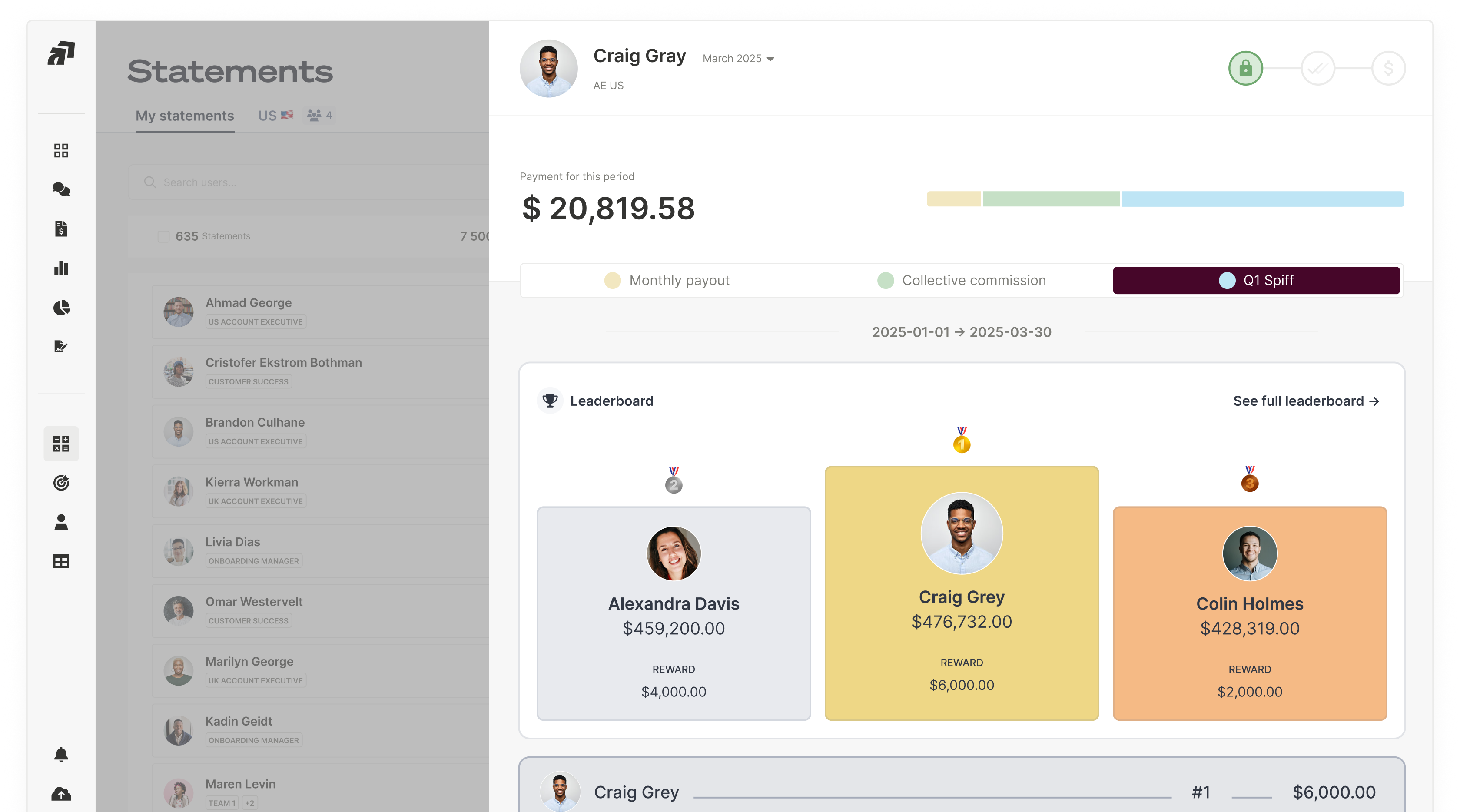
Investing in a Sales Performance Management (SPM) solution provides the power of real-time commission tracking. With a platform like Qobra, each salesperson gets a personalized dashboard showing exactly where they stand against their quota, what their potential earnings are for deals in the pipeline, and how every closed deal translates into commission. This transparency eliminates disputes and turns the commission plan into a true, day-to-day motivational tool.
Warning: Avoid Common Implementation Mistakes
When you're ready to launch your new plan, be mindful of common pitfalls. The biggest mistake is poor communication. Another is having overly complex rules that nobody can follow. Make sure you avoid these critical sales commission mistakes to ensure your plan lands successfully and drives the results you expect.
Building and implementing a commission pay structure is a strategic project that directly fuels your company's revenue engine. By choosing the right model, aligning it with your business goals, and ensuring full transparency, you create a powerful system that rewards performance, retains top talent, and accelerates growth.
The eight structures above rarely stay pure: teams end up combining tiers, accelerators and per-product rates. A sales commission platform lets you model that combination and test it before it reaches the payroll file.
Frequently Asked Questions about Commission Pay Structures
What is a good commission rate for sales?
There is no single "good" commission rate. It varies significantly by industry, company, role, and the structure of the compensation plan. For a "Base Salary + Commission" model, rates for B2B sales often range from 5% to 12% of revenue. In a "Straight Commission" model, rates must be much higher—often 20% to 40% or more—since it is the rep's only source of income. The key is to benchmark against your industry and ensure the On-Target Earnings (OTE) are competitive.
What is the difference between a commission and a bonus?
A commission is a predetermined percentage or flat fee paid to a salesperson for achieving a specific sales metric (like closing a deal). It is a direct, formulaic part of their variable pay. A bonus, on the other hand, is typically a lump-sum payment given for achieving a broader goal that may not be directly tied to a single sale, such as hitting a team quota, winning a sales contest (a "spiff"), or achieving a specific MBO (Management by Objective). You can explore the difference between bonuses and commissions in more detail.
How do you communicate a new commission plan effectively?
Effective communication is critical for the success of any new compensation plan. Start early, be transparent about why the changes are being made, and provide clear documentation. Hold training sessions to walk through the new structure with examples. Most importantly, provide tools—like the real-time dashboards in Qobra—that allow reps to see exactly how the new plan affects them. For a complete guide, see these best practices on how to communicate a new commission plan.