Webinar: The Biggest Release Sales Comp Has Ever Seen. Come See For Yourself (Wednesday, October 7)
Register
- Variable commission is performance-based pay added to base salary, subject to tax/social contributions, and required to be itemized on the payslip.
- Well-designed variable pay drives strategic alignment—boosting motivation, accountability, and attraction/retention of top talent.
- Key calculation models: flat percentage, tiered rates, objective-based (MBO) bonuses, and ranking pools—each with clear formulas and example use cases.
- Implement by defining measurable, achievable KPIs, embedding terms in the employment contract, respecting legal/tax obligations, and communicating changes transparently.
- Use automated commission software to replace error-prone spreadsheets, ensuring accuracy, real-time transparency for reps, and operational scalability.
How can you build a compensation system that not only rewards effort but also actively drives your company's strategic goals? The answer often lies in a well-structured variable commission plan. More than just a supplement to a fixed salary, variable pay is a powerful lever for aligning employee performance with business success. It transforms compensation from a static cost into a dynamic investment in motivation, accountability, and growth.
This guide provides a comprehensive overview of how variable commission works, from its core definitions and calculation models to the legal framework and best practices for implementation. Whether you are a manager, an HR professional, or a salesperson, understanding these mechanisms is key to unlocking their full potential.
What is Variable Commission? A Clear Definition
Variable commission is a form of remuneration paid to an employee in addition to their fixed base salary. Its amount fluctuates based on the achievement of predefined performance metrics. The primary purpose is to incentivize and reward employees for their direct contribution to the company's success, making it a cornerstone of performance-driven cultures.
This type of pay is subject to the same social security contributions and income tax as a standard salary. It must be detailed on the employee's payslip to ensure full transparency.
Commission vs. Variable Compensation: Understanding the Nuances
Variable Compensation is a broad category that includes any form of performance-linked pay. This can encompass:
- Commissions: Typically linked directly to sales or revenue.
- Bonuses: Often tied to achieving specific objectives (individual, team, or company-wide).
- Profit-Sharing: A portion of the company's profits distributed among employees.
- Gain-Sharing: Rewards for collective performance improvements, like cost savings or productivity gains.
Commission, therefore, is a specific type of variable compensation. It is the most direct form, usually calculated as a percentage of a measurable outcome, like the value of a sale or the margin generated.
Why is Variable Commission a Strategic Tool for Businesses?
Implementing a variable commission structure goes far beyond simply paying for performance. It’s a strategic initiative that can profoundly impact an organization's culture and bottom line.
- Stimulates Performance and Motivation: The direct link between effort and reward is a powerful motivator. When employees see that their hard work translates into higher earnings, their engagement and productivity naturally increase. A well-designed plan encourages them to go the extra mile.
- Promotes Accountability: Clear, measurable goals give employees ownership of their results. This fosters a culture of responsibility where individuals and teams are accountable for reaching their targets.
- Attracts and Retains Top Talent: High-performing individuals are often drawn to compensation structures that reward their abilities. A competitive variable pay plan is a key differentiator in the job market, helping to attract and retain the best talent who are confident in their capacity to deliver. Explore the pros and cons of commission-based sales jobs to understand what top candidates are looking for.
- Aligns Employee Behavior with Strategic Goals: Variable compensation can be tailored to steer focus toward key business priorities. Whether the goal is to increase market share, improve customer satisfaction, or boost profitability, the plan can be designed to reward the specific behaviors that lead to those outcomes.
The Core Models of Variable Commission Calculation
There is no one-size-fits-all approach to calculating commissions. The best model depends on your industry, business objectives, and company culture. Here are the most common structures.
Direct Commission (The Classic Model)
This is the most straightforward method. The employee earns a fixed percentage of the sales they generate. It is simple to understand, easy to calculate, and directly links reward to revenue.
Formula: Commission = Sale Amount × Commission Rate
For example, if a salesperson has a 5% commission rate and closes a deal worth $20,000, their commission is $1,000. This model is popular in industries where individual sales contributions are easily tracked. Companies often need a clear framework for these calculations, and using a commission proposal template can ensure clarity from the start.
Tiered Commission (Rewarding Over-performance)
A tiered structure incentivizes salespeople to exceed their targets by offering progressively higher commission rates as they reach certain thresholds. This model is excellent for motivating top performers and driving exceptional growth.
Example of a Tiered Commission Structure:
| Monthly Sales Revenue | Commission Rate |
|---|---|
| $0 - $50,000 | 3% |
| $50,001 - $100,000 | 5% |
| Above $100,000 | 7% |
If a salesperson generates $120,000 in revenue, their commission could be calculated on each tier, or they might earn the highest rate on the total amount, depending on the plan's design. This structure makes it crucial to avoid common sales commission mistakes, such as setting unattainable tiers.
Objective-Based Bonuses
Also known as a Management by Objectives (MBO) bonus, this model links variable pay to the achievement of specific, pre-agreed goals. These objectives must be SMART: Specific, Measurable, Achievable, Relevant, and Time-bound. They can be quantitative (e.g., "Acquire 15 new clients in Q3") or qualitative (e.g., "Improve customer satisfaction score by 10%").
This approach is highly flexible and can be adapted to almost any role, not just sales. It helps align individual efforts with broader departmental or company goals.
Choosing the Right KPIs
The success of an objective-based plan hinges on selecting the right Key Performance Indicators (KPIs). The chosen metrics should be fair, directly influenceable by the employee, and clearly support the overall business strategy. For inspiration, you can review some popular examples of KPIs used in commission plans.
Ranking Systems and Bonuses
In this model, employees are ranked against each other based on performance metrics like sales volume or revenue. A fixed bonus pool is then distributed among them according to their rank. For example, the top performer might receive 30% of the pool, the second-place performer 20%, and so on.
While this can foster a competitive environment, it also carries risks. It can discourage collaboration and create a negative atmosphere if not managed carefully. The total cost is predictable for the company, but the reward for individuals is not guaranteed.
Implementing a Variable Commission Plan: A Step-by-Step Guide
A successful variable pay system requires careful planning and clear communication. Rushing the implementation can lead to confusion, demotivation, and even legal disputes.
1. Define Clear and Fair Performance Metrics
The foundation of any plan is its metrics. They must be:
- Quantifiable and Objective: Easily measured and free from subjective interpretation.
- Realistic and Achievable: Goals should be challenging but attainable. Unrealistic targets are demotivating.
- Within the Employee's Control: Employees should be rewarded for outcomes they can directly influence.
- Aligned with Business Strategy: The metrics should drive behaviors that support the company's overarching goals.
2. Establish the Contractual Framework
Any variable compensation plan must be formally documented, typically within a clause in the employment contract or a subsequent addendum. This document is legally binding and serves as the source of truth for both parties.
The clause should specify:
- The objectives to be achieved.
- The precise calculation method for the commission or bonus.
- The payment period (e.g., monthly, quarterly).
- Conditions for modification or termination of the plan.
A clearly written agreement prevents misunderstandings and provides a solid basis for resolving any disputes.
3. Understand Legal and Compliance Considerations
Employers must adhere to several legal principles when setting up a variable pay plan. According to established case law, particularly in jurisdictions like France, objectives must:
- Be independent of the employer's sole discretion.
- Not infringe on the employee's rights and freedoms (e.g., by encouraging excessive working hours).
- Not transfer the inherent business risk to the employee.
- Ensure the employee's total remuneration (fixed + variable) does not fall below the statutory minimum wage or the amount set by a collective bargaining agreement.
Employers have the right to modify objectives from one period to the next, but they must communicate these changes transparently and in advance. Failure to do so can result in the employer being held liable. The legal obligations for modifying a sales commission plan are strict and must be respected.
The Peril of Capping Commissions
While it may seem like a way to control costs, capping commissions can severely demotivate top performers. Once they hit the cap, their financial incentive to continue performing at a high level disappears for the rest of the period. Consider the benefits of uncapped commissions to keep your best talent fully engaged and continuously driving results.
4. Ensure Transparency in Tax and Social Security
Variable pay is considered a component of salary and is therefore subject to the same tax and social security obligations. Both employer and employee contributions are calculated on the total gross remuneration, including any commissions or bonuses earned. This amount must be clearly itemized on the employee's payslip.
Automating Commission Management for Accuracy and Motivation
As companies grow and commission plans become more complex, managing them with spreadsheets becomes a significant challenge. Manual processes are prone to errors, lack transparency, and consume countless hours for finance and sales operations teams. This "Excel hell" can lead to disputes, demotivation, and a lack of trust in the compensation system.
This is where automated commission management platforms come in. A modern solution like Qobra is designed to eliminate these challenges. As a leading no-code platform, Qobra allows businesses to build, adapt, and manage even the most complex commission plans without needing developers or external consultants.
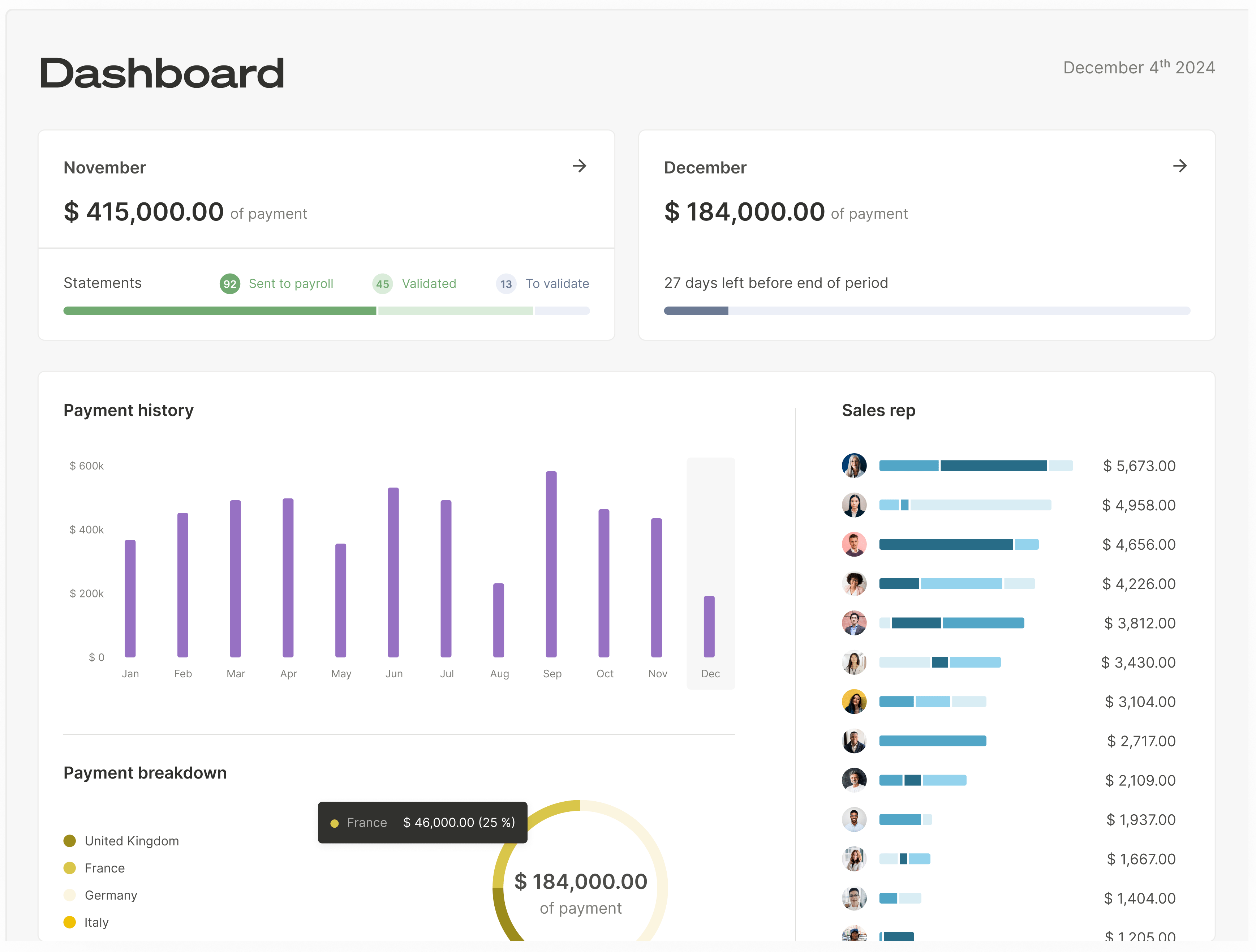
By integrating directly with your CRM (like Salesforce or HubSpot) and other data sources, the platform automates calculations in real-time. The key benefits include:
- Accuracy and Reliability: Automation eliminates manual errors, reducing calculation mistakes by up to 95% and ensuring commissions are always accurate.
- Enhanced Transparency: Sales representatives get access to a personal, real-time dashboard showing their current earnings, progress toward goals, and potential future commissions. This visibility is a powerful motivational tool.
- Significant Time Savings: Finance and Ops teams can reduce the time spent on commission management from days to just a few hours per month.
- Flexibility and Scalability: The no-code editor allows you to easily adjust plans as your business strategy evolves, without complex and costly reprogramming.
Adopting a specialized tool is no longer a luxury but a necessity for companies seeking to build a scalable, transparent, and motivating sales compensation engine. When you're ready to move beyond spreadsheets, it's wise to learn how to choose the right commission software for your needs.
A well-designed and properly managed variable commission plan is a true win-win. It empowers employees by directly rewarding their contributions and provides the business with a powerful tool to drive performance and achieve strategic objectives. By moving from manual, opaque processes to transparent, automated systems, you can build a culture of trust and high achievement where everyone is aligned and motivated to succeed.
Frequently Asked Questions (FAQ)
How do I calculate a sales commission?
The most common way is to use a percentage-based formula: Commission = Sale Value × Commission Rate. For example, on a $10,000 sale with a 4% commission rate, the commission earned is $400. The rate can be flat or tiered based on volume or other KPIs.
Can an employer change the commission plan?
Yes, an employer can modify a commission plan for future periods. However, they must do so with reasonable notice and absolute transparency. Changes cannot be applied retroactively to completed sales periods, and the new objectives must remain fair and achievable.
What should be included in a commission agreement?
A comprehensive commission agreement, whether as part of the employment contract or a separate document, should detail: the base salary, the exact commission rate or bonus structure, the basis for calculation (e.g., revenue, gross margin), the payment schedule (monthly, quarterly), specific targets or quotas, and any conditions for clawbacks or adjustments.
Is variable pay considered part of the salary?
Yes. For all legal, tax, and social security purposes, variable compensation like commissions and bonuses is considered part of an employee's total remuneration. It is subject to the same deductions and contributions as the fixed base salary.