Sales Compensation Software Benchmark | Compare 15+ Sales Compensation Platforms
Download
- A compensation plan is a formal document defining total pay (base, variable, benefits) with the objectives to attract and retain talent, motivate performance, ensure fairness, and align employee actions with company goals—especially critical for sales roles where variable pay links performance to earnings.
- Use a compensation plan template to standardize design, save time, increase transparency, ensure consistency and pay equity, and act as a checklist so you don't miss elements like accelerators, caps, or payout triggers.
- Core template components: employee & role info, base salary, On-Target Earnings (OTE) and pay mix, quotas and KPIs, commission/bonus rules (rates, tiers, cliffs, cadence, triggers), draw/cap rules, and indirect benefits (health, equity, PTO).
- Choose the right plan type (salary-only, commission-only, salary+commission, tiered, draw-against, profit-based) based on role, sales cycle, company goals and behavior you want to drive; use clear examples and simple formulas to illustrate payouts.
- Implement by defining business objectives, benchmarking market pay, calibrating OTE/quota and pay mix, modeling financial scenarios, documenting and communicating the plan clearly to reps, monitoring results, iterating annually, and automating calculations where possible to reduce errors.
Are you struggling to design a compensation plan that truly motivates your team while aligning with your business goals? Crafting a structure that is fair, transparent, and competitive can feel like a daunting task, often buried in complex spreadsheets prone to error. A well-designed compensation plan template provides the foundation to build a clear and scalable strategy, ensuring clarity for both your company and your employees.
This guide provides a comprehensive walkthrough of everything you need to know, from the essential components of a compensation plan to practical steps for implementation. We will explore different plan types with concrete examples to help you create a system that attracts top talent, drives performance, and fosters long-term retention.
What is a Compensation Plan?
A compensation plan is a formal document that outlines the complete package of salary, benefits, and incentives an employee receives from their employer. It goes beyond a simple base salary to detail every aspect of an employee's remuneration. For sales roles, this plan is particularly critical as it directly connects performance to earnings through variable pay.
The primary objectives of any compensation plan are to:
- Attract and retain top talent: A competitive package is essential in today's market.
- Motivate employees: By linking pay to employee performance, you encourage the right behaviors and give managers a clear benchmark for evaluation.
- Ensure fairness and equity: A standardized approach helps eliminate biases and supports pay equity initiatives.
- Align individual goals with company objectives: The plan should reward actions that contribute directly to strategic goals, such as increasing market share or improving profitability.
While a general compensation plan covers all employees, a sales compensation plan is specifically designed to incentivize sales teams. It typically includes a significant variable component, like commissions and bonuses, tied to achieving sales targets. Managing this complexity is where a dedicated framework becomes indispensable.
Defining Your Company's Compensation Philosophy
Before filling in any template, a company needs a clear compensation strategy, a formal position on how it thinks about pay. It answers three questions:
- How does the company want to position itself relative to the market: lead, match, or lag?
- What behaviors should compensation reward?
- And what is the right balance between fixed and variable pay?
A well-defined philosophy makes every subsequent template decision easier. It guides pay structures, sets employee expectations, and ensures that compensation decisions remain consistent as the company scales. Without it, even a well-built template risks becoming inconsistent over time, particularly when new roles are created or markets change.
Three common positioning choices:
- Lead the market: pay above the 75th percentile to attract top talent aggressively. Common in high-growth tech companies.
- Match the market: align with the 50th percentile. Balances cost control with competitiveness.
- Lag the market: pay below median, often offset by stronger equity, culture, or mission. Risky for retention in competitive markets.
Why Use a Compensation Plan Template?
A compensation plan template serves as a structured blueprint for defining and standardizing your company's remuneration strategy. Instead of starting from scratch, a template provides a clear framework, ensuring you cover all critical elements consistently across different roles and teams.
Using a standardized document offers several key advantages:
- Clarity and Transparency: It provides employees with a clear understanding of how their pay is calculated, what they need to achieve to earn more, and when they can expect payouts. This transparency builds trust and reduces disputes. It gives managers a clear basis for evaluating employee performance against defined targets.
- Time Savings: Templates streamline the creation process, saving HR and finance teams countless hours.
- Consistency and Fairness: By applying the same structure to similar roles, you ensure equitable treatment and reduce the risk of pay discrepancies.
- Completeness: A good template acts as a checklist, preventing you from overlooking crucial components like accelerators, caps, or non-financial benefits.
Ultimately, a template transforms an often-ambiguous process into a structured, repeatable system that benefits the entire organization.
Employee Compensation Plan Template: Key Components
A robust compensation plan template should be detailed and adaptable. While specifics will vary by role and industry, every effective plan includes several core sections that define the complete remuneration package.
1. General Information
This section identifies the employee and the terms of the plan.
- Employee Name & ID: The full name and employee identifier.
- Job Title/Role: The employee's official position (e.g., Account Executive, SDR).
- Team/Department: The team the employee belongs to.
- Effective Period: The timeframe the plan is valid for (e.g., January 1, 2026 - December 31, 2026).
2. Direct Financial Compensation
Direct compensation is built on two pillars: a fixed base salary and a variable component tied to performance. Getting this balance right is the most consequential decision in any compensation plan.
- Base Salary: The fixed, guaranteed annual salary paid regardless of performance.
- On-Target Earnings (OTE): The total potential income an employee can earn by meeting 100% of their performance targets. It is the sum of the base salary and the target variable compensation. You can learn more about how to define on-target earnings for different roles.
- Pay Mix: The ratio of base salary to target variable compensation. For example, a 70/30 pay mix on a $100,000 OTE means a $70,000 base salary and $30,000 in target variable pay.
3. Variable Compensation
This section is the heart of any incentive compensation plan template. It defines how performance translates directly into earnings for sales roles.
- Commissions: The most common form of variable pay, typically a percentage of revenue or profit generated. The commission and variable pay structure should be clearly defined.
- Quota: The minimum performance target an employee must reach within a specific period (monthly, quarterly) to earn their full variable pay. Setting a fair and realistic sales quota is crucial for motivation.
- Bonuses: One-time rewards for achieving specific milestones or exceeding expectations, such as a signing bonus, a quarterly performance bonus, or a MBO (Management by Objectives) bonus.
- Triggers and Cadence: Defines when a commission is earned (e.g., on contract signature, on cash collection) and the frequency of payouts (e.g., monthly, quarterly).
Define Your Performance Metrics Clearly
Your plan's success hinges on well-defined Key Performance Indicators (KPIs). Instead of just rewarding "revenue," consider more specific metrics that align with your strategy, such as Annual Recurring Revenue (ARR), customer lifetime value (CLV), or profit margin. Clearly outlining these KPIs ensures your team focuses on what truly matters.
4. Advanced Compensation Mechanisms
These components add nuance and can be used to drive specific behaviors.
- Tiered Commissions / Accelerators: Commission rates that increase as a salesperson exceeds their quota. This strongly incentivizes overperformance.
- Cliffs: A minimum performance threshold that must be met before any commission is paid out. For example, a rep might earn 0% commission until they reach 50% of their quota.
- Caps: A maximum limit on the amount of variable compensation an employee can earn in a period. While sometimes used to control costs, caps can demotivate top performers.
- Draw Against Commission: An advance payment to new hires or employees in industries with long sales cycles. The draw is later paid back from earned commissions.
5. Indirect Compensation and Benefits
This section details the non-cash components of the package.
- Health & Wellness: Health insurance, dental care, disability coverage, and employee assistance programs (EAP).
- Retirement Planning: Details on 401(k) plans, pension programs, or company matching contributions.
- Equity Compensation: Information on stock options, Restricted Stock Units (RSUs), or other forms of company ownership.
- Paid Time Off (PTO): The number of paid vacation days, sick days, personal days, and paid holidays.
- Perks and Other Benefits: Other valuable offerings like professional development budgets, gym memberships, flexible work options, or meal plans.
Total Compensation Plan Template: Going Beyond Salary
A total compensation plan template gives employees a complete picture of what they receive — not just their salary. It translates every component into a monetary value: base pay, target variable, employer health contributions, retirement matching, equity value, and the equivalent cost of perks (PTO, training budget, remote allowance).
Sharing this view during onboarding and annual reviews is one of the most effective ways to improve retention. Most employees underestimate the value of their full package by 20-30% when they only see their payslip.
6 Types of Sales Compensation Plans (with Examples)
Your template fits compensation models. The right choice depends on your industry, sales cycle length, company maturity, and the specific role. Here are six common examples.
Each model below serves as a compensation package example you can adapt directly — adjust the figures to match your market benchmarks and OTE targets.
1. Salary-Only Plan
This plan offers a fixed salary with no variable component. It provides stability and is best suited for roles where sales cycles are very long or the focus is on relationship management rather than closing deals.
- Best for: Enterprise Account Managers, Sales Engineers, roles focused on nurturing long-term client relationships.
- Example Structure:
- Base Salary: $90,000/year
- Variable Pay: $0
- Additional Perks: Annual profit-sharing, stock options.
2. Commission-Only Plan
A high-risk, high-reward model where earnings are 100% based on sales performance. It is highly motivating for aggressive sellers but can lead to high turnover.
- Best for: Real estate, auto sales, freelance sales roles, industries with short sales cycles.
- Example Structure:
- Base Salary: $0
- Commission Rate: 10% of total deal value (uncapped).
- A sale of $100,000 results in a $10,000 commission.
3. Salary + Commission Plan
This is the most common sales commission structure in B2B sales , combining income stability with performance incentives.
- Best for: Most B2B sales roles, including SDRs and Account Executives.
- Example Structure:
- Base Salary: $60,000/year
- On-Target Commission: $40,000/year
- OTE: $100,000
- Commission Rate: 5% on all closed deals.
If you work in SaaS specifically, see our dedicated SaaS Sales Compensation Plan Template for industry-specific examples.
4. Tiered Commission Plan
This structure rewards overperformance by increasing the commission rate as sales volume grows. It is excellent for motivating reps to exceed their quotas.
- Best for: High-growth companies aiming to aggressively capture market share.
- Example Structure:
- Monthly Quota: $50,000
- Tier 1 (0-100% of quota): 5% commission
- Tier 2 (101-150% of quota): 8% commission
- Tier 3 (151%+ of quota): 12% commission
| Sales Amount | Calculation | Commission Earned |
|---|---|---|
| $120,000 | (50k * 5%) + (25k * 8%) + (45k * 12%) | $2,500 + $2,000 + $5,400 = $9,900 |
5. Draw Against Commission Plan
This model provides a guaranteed base income (the "draw") that acts as an advance on future commissions. If commissions earned are less than the draw, the deficit may need to be repaid.
- Best for: New hires during their ramp-up period, industries with seasonal or irregular sales cycles.
- Example Structure:
- Monthly Draw: $3,000 (recoverable)
- Commission Rate: 8% of sales
- If a rep earns $3,200 in commission, they receive an additional $200.
- If a rep earns $1,600, they owe the company $1,400 from future earnings.
6. Profit-Based Commission Plan
Instead of rewarding revenue, this plan ties commissions to the profitability of each deal. It encourages reps to protect margins and avoid excessive discounting.
- Best for: Companies where profitability per deal varies significantly and needs to be a key focus.
- Example Structure:
- Base Salary: $70,000/year
- Commission Rate: 15% of the gross profit on each deal.
💡 Executive Compensation Plan Template
Senior leaders follow a different logic. Their package typically combines a higher base salary, an annual bonus tied to company-wide KPIs (revenue growth, EBITDA), and long-term incentives like stock options or RSUs vesting over 3-4 years. The pay mix shifts heavily toward variable — often 50%+ of total compensation — to align executive behavior with long-term company value.
From Template to Automation
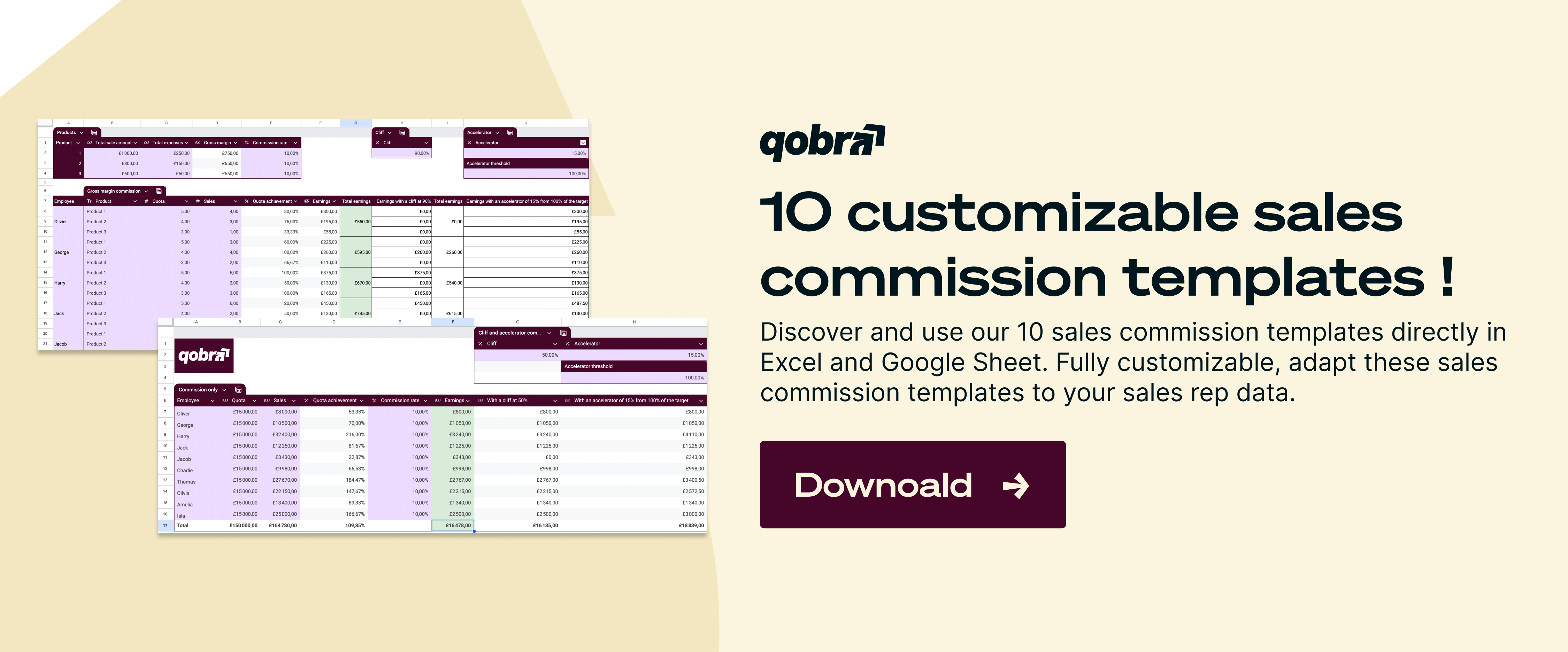
While templates are a great starting point, managing complex plans—especially tiered structures—in Excel can become a nightmare of manual calculations and potential errors. This is where modern software excels. Platforms like Qobra automate the entire process, connecting directly to your CRM to calculate commissions. This eliminates errors, provides reps with transparent dashboards, and frees up your finance team from tedious manual work. A commission calculator tool can be the perfect next step after finalizing your plan design.
7 Steps to Creating Your Compensation Plan
A template gives you the structure. These seven steps give you the process. Together, they're what separates an effective compensation plan from one that looks good on paper but fails in practice.
- Define Your Business Objectives: What do you want to achieve? Increase new logo acquisition? Boost customer retention? Expand into a new market? Your compensation plan should directly reward the behaviors that support these goals.
- Research and Benchmark: Analyze what your competitors are offering for similar roles in job descriptions. Use industry reports and salary surveys to ensure your OTE and pay mix are competitive enough to attract and retain talent.
- Choose the Right Compensation Model: Based on your objectives and roles, select the appropriate plan type (e.g., Salary + Commission, Tiered). Keep it simple—a plan with more than three core components can become confusing and lose its motivational power.
- Define Key Metrics (OTE, Quota, Pay Mix):
- Set the OTE: Determine the target annual income for a fully performing employee.
- Establish the Pay Mix: Decide the ratio of base salary to variable pay. A 50/50 mix is common for AEs, while a 80/20 mix might be better for Account Managers.
- Set Quotas: Quotas should be challenging but achievable. A good rule of thumb is that 60-80% of your team should be able to hit their target. The quota-to-OTE ratio is a critical factor; a common benchmark is 5x OTE (e.g., a $500,000 quota for a $100,000 OTE).
- Model and Simulate Scenarios: Use your template to run financial simulations. How much will the plan cost if 50% of the team hits quota? What if your top performers reach 200%? Modeling helps you understand the financial impact and avoid overspending. This is also the time to pressure-test the plan for any loopholes.
- Document and Communicate the Plan: Create a formal plan document for each employee. Schedule meetings to walk them through it, explaining how it works and answering any questions. Transparency is key to getting buy-in and ensuring the plan is effective.
- Review and Iterate: A compensation plan is not static. Review its effectiveness at least annually. Gather feedback from sales reps and managers. Is it driving the right behaviors? Is it still competitive? Be prepared to make adjustments as your business evolves.
A compensation plan is one of the most powerful tools you have to drive your company's growth. By starting with a comprehensive template and following a structured approach, you can create a system that motivates your team, aligns with your strategy, and sets you up for long-term success. Getting employee pay right, not just the base, but the full mix of variable, benefits, and incentives, is what turns a good plan into a competitive advantage. The right remuneration structure not only rewards performance but also makes compensation a driver of performance rather than a source of friction.

A template that worked at 20 reps rarely survives at 100, as noted above — usually because maintenance, not design, is what breaks. Qobra's sales compensation platform takes over that maintenance: plan versioning, exceptions, approvals.
FAQ
What is a compensation plan template and why should I use one?
A compensation plan template is a pre-formatted document that provides a standardized framework for outlining an employee's total compensation, including salary, commissions, bonuses, and benefits. It should be used to save time, ensure consistency and fairness, improve transparency for employees, and make sure no critical components of the compensation package are overlooked.
What are the most important metrics in a sales compensation plan?
The most critical metrics are On-Target Earnings (OTE), which sets the total expected income; the Pay Mix, which defines the balance between fixed salary and variable pay; and the Quota, which is the performance target reps must hit to earn their full variable compensation. The relationship between these metrics determines the plan's risk and reward profile.
How can I ensure my compensation plan is fair and equitable?
To ensure fairness, start by using a standardized template for all employees in similar roles. Base your compensation structures on objective market data and benchmarks rather than individual negotiations. Regularly conduct pay equity audits to identify and correct any disparities. Finally, make the plan and its mechanics transparent to all employees so they understand the criteria for their pay.
How do you align a compensation plan with business goals?
Start with the outcomes the company wants to drive — new logo acquisition, retention, margin improvement — and work backwards. If the goal is margin, tie commission to profit rather than revenue. If the goal is market share, reward volume with an uncapped tiered structure. The company's compensation plan should make the right employee behaviors the most financially rewarding ones.
How often should an employee compensation plan template be updated?
At minimum once a year, aligned with business planning cycles. Trigger an earlier review when: roles or quotas change significantly, top employees are leaving, salary benchmarks shift, or pay disputes are recurring. A plan that worked at 20 reps rarely works unchanged at 100.