Sales Compensation Software Benchmark | Compare 15+ Sales Compensation Platforms
Download
- A KPI bonus is variable pay tied to measurable, pre-defined targets to align motivation, performance and company strategy while increasing transparency and fairness.
- Key formulas to track and calculate: Bonus % of Salary = (Total Bonuses / Total Base Salaries) × 100; Average Bonus per Employee = Total Bonuses / Number of Employees; Individual payout = Bonus at 100% × (Actual / Target) (with optional accelerators or caps).
- Implement by cascading high-level objectives into departmental and individual KPIs, assigning weights, setting thresholds/accelerators and choosing an appropriate payout frequency (monthly/quarterly/annual) with crystal-clear documentation.
- Use automated tools integrated with CRM/payroll for real‑time dashboards, error reduction and downloadable templates/calculators; visualize trends and correlate bonus metrics with HR/financial indicators (turnover, cost of labour, productivity).
- Guardrails: avoid single misleading metrics (Goodhart), pair quantitative and qualitative KPIs, ensure strategic alignment, factor in fiscal/social constraints and budget impact, and review KPIs regularly to prevent gaming.
Is your company's bonus system truly driving performance, or is it just an annual line item in your budget? Tying bonuses to Key Performance Indicators (KPIs) can transform your compensation strategy from a simple reward mechanism into a powerful engine for aligning employee efforts with strategic business goals. But how do you design a system that is fair, motivating, and easy to manage?
A well-structured KPI bonus system provides clarity for employees, predictability for finance departments, and a direct link between individual contribution and company success. It moves beyond discretionary bonuses to create a transparent framework where performance is objectively measured and rewarded. This guide breaks down what a KPI bonus is, how to calculate the most important metrics, and how to implement a successful system in your organization.
What is a KPI Bonus?
A KPI bonus is a form of variable compensation awarded to an employee or a team for achieving pre-defined performance targets. Unlike a discretionary bonus, which is often decided subjectively, a KPI bonus is directly linked to measurable indicators that reflect key business objectives. The core idea is simple: track employee performance, and if they meet or exceed their targets, reward them with a bonus designed to motivate even greater results.
This approach serves several critical functions for a business:
- Motivation: It creates a clear incentive for employees to focus their efforts on activities that matter most to the company.
- Alignment: It ensures that individual and team goals are directly aligned with the overarching strategic objectives of the organization.
- Objectivity: It introduces fairness and transparency into the compensation process, reducing perceptions of bias.
- Performance Culture: It helps foster a culture where results are tracked, discussed, and celebrated.
KPI bonuses can be structured in various ways, from simple individual incentives to complex team-based rewards. For example, a salesperson might have a bonus tied to their sales quota, while a customer support team could be bonused on their customer satisfaction (CSAT) score. The key is that the metric is specific, measurable, achievable, relevant, and time-bound (SMART).
How to Calculate Key Bonus KPIs
To effectively manage and assess your bonus strategy, you need to track specific indicators related to the bonuses themselves. These KPIs help HR and finance leaders understand the financial impact of the bonus program and its evolution over time.
Bonus Percentage of Salary
This is a fundamental indicator for measuring the overall weight of variable pay within your total compensation structure. It represents the average portion of an employee's salary that is made up of bonuses.
Formula:
Bonus Percentage of Salary = (Total Bonuses Paid / Total Base Salaries Paid) x 100
Example:
Imagine a company paid €2,000,000 in total base salaries and €250,000 in bonuses over the last year.
- Calculation: (€250,000 / €2,000,000) x 100 = 12.5%
- Interpretation: On average, bonuses represent 12.5% of an employee's salary at this company.
Tracking this KPI over time in a line graph allows you to see if the importance of variable pay is increasing or decreasing and compare it against industry benchmarks or internal targets.
Average Bonus Per Employee
This metric provides a straightforward view of the typical bonus amount distributed across the workforce. It's useful for budgeting and for understanding the average incentive value offered to employees.
Formula:
Average Bonus Per Employee = Total Bonuses Paid / Total Number of Employees
Example:
If the same company with €250,000 in total bonuses has 100 employees:
- Calculation: €250,000 / 100 = €2,500
- Interpretation: The average bonus paid out per employee for the period was €2,500.
This can be segmented by department or role to analyze how variable pay is distributed across different functions.
Target Achievement Bonus Calculation
This is less of a monitoring KPI and more of a calculation method for determining an individual's bonus. It directly links the bonus payout to the percentage of a specific goal that was achieved.
Structure:
- Target: The pre-defined goal (e.g., generate €100,000 in new revenue).
- Bonus at 100% Achievement: The amount paid if the target is met exactly (e.g., €5,000).
- Performance Result: The actual achievement (e.g., generated €120,000 in new revenue).
Example Calculation:
| Metric | Value |
|---|---|
| Sales Target (Quarterly) | €100,000 |
| Bonus at 100% Target | €5,000 |
| Actual Sales Achieved | €120,000 |
| Percentage of Target Achieved | (€120,000 / €100,000) x 100 = 120% |
| Bonus Earned | €5,000 x 120% = €6,000 |
This linear model is simple and transparent. More complex structures can include accelerators (where the payout rate increases above 100% achievement) or caps to manage costs. For a deeper understanding, you can explore different types of sales compensation plans that use these principles.
Clarity is Non-Negotiable
Whatever formula you choose, it must be crystal clear to every employee. An effective bonus plan is one that an employee can use to calculate their own potential earnings without needing help from HR or finance. Ambiguity breeds mistrust and demotivation.
A Step-by-Step Guide to Implementing a KPI-Based Bonus System
Moving from theory to practice requires a structured approach. Implementing a KPI bonus system is not just a mathematical exercise; it's a strategic initiative that involves goal setting, communication, and the right technology.
1. Define High-Level Business Objectives
Before defining any individual KPIs, start with the company's main goals for the period. Are you trying to increase market share, improve profitability, enhance customer satisfaction, or reduce churn? These high-level objectives will serve as the foundation for your entire system.
For example, your objectives could be:
- Increase annual recurring revenue (ARR) by 30%.
- Achieve a Net Promoter Score (NPS) of 60.
- Reduce customer support ticket resolution time by 20%.
2. Cascade Objectives into Relevant Departmental and Individual KPIs
Once the company goals are set, they must be broken down and translated into meaningful KPIs for each department and, ultimately, each employee. The key is to ensure every individual understands how their daily work contributes to the bigger picture.
This cascading process is crucial. A top-level strategic goal, like increasing earnings per share, is meaningless to a frontline employee. Their KPIs must be linked to outcomes they can directly influence.
Here are some examples of cascaded KPIs for different roles:
- Sales Representatives: Number of new clients signed, total contract value, sales cycle length.
- Service Technicians: Number of orders processed, average repair time, positive customer reviews received.
- Warehouse Staff: Order picking speed, inventory accuracy, reduction in shipping errors.
- Marketing Team: Number of qualified leads generated, cost per acquisition, conversion rate from a campaign.
All assigned tasks should be clear, quantifiable, and time-bound to avoid any ambiguity when it comes time for evaluation.
3. Establish a Fair and Transparent Bonus Structure
Define the rules of the game. How much is the bonus worth? What happens if an employee achieves 80% of their target, or 150%? This structure must be documented and communicated clearly.
Consider these elements:
- Payout Logic: Will it be a percentage of salary, a fixed amount, or a tiered system?
- Thresholds and Accelerators: Is there a minimum performance level (a threshold) required to earn any bonus? Does the payout rate increase (accelerate) for over-performance?
- Weighting: If an employee has multiple KPIs, assign a weight to each one based on its importance. For instance, for a salesperson, new business revenue might be weighted at 70%, while product up-sells could be 30%.
- Frequency: Bonuses can be paid annually, semi-annually, quarterly, or even monthly. Shorter cycles often provide more immediate motivation.
4. Choose the Right Tools for Calculation and Communication
This is where many companies stumble. Managing KPI bonuses on spreadsheets is notoriously difficult. It's time-consuming, prone to human error, and lacks the transparency needed to truly motivate employees. A simple formula error can lead to incorrect payouts, damaging trust and morale.
This is why modern organizations are turning to dedicated platforms. For instance, a sales commission software like Qobra automates the entire process. Qobra integrates directly with your CRM (like Salesforce or HubSpot) and other data sources. Qobra syncs CRM data automatically throughout the day, and on demand in one click.
With a solution like Qobra, you can:
- Automate Calculations: Eliminate manual errors and save dozens of hours for your finance and ops teams each month.
- Provide Real-Time Transparency: Give employees access to a personal dashboard where they can see their progress toward targets and their estimated earnings at any moment. This visibility is a powerful motivational tool.
- Model and Adapt Plans: Use a no-code editor to easily build, test, and adjust compensation plans without needing technical expertise or expensive consultants.
Automating this process transforms the bonus system from an administrative burden into a strategic asset.
From Spreadsheet Chaos to Automated Clarity
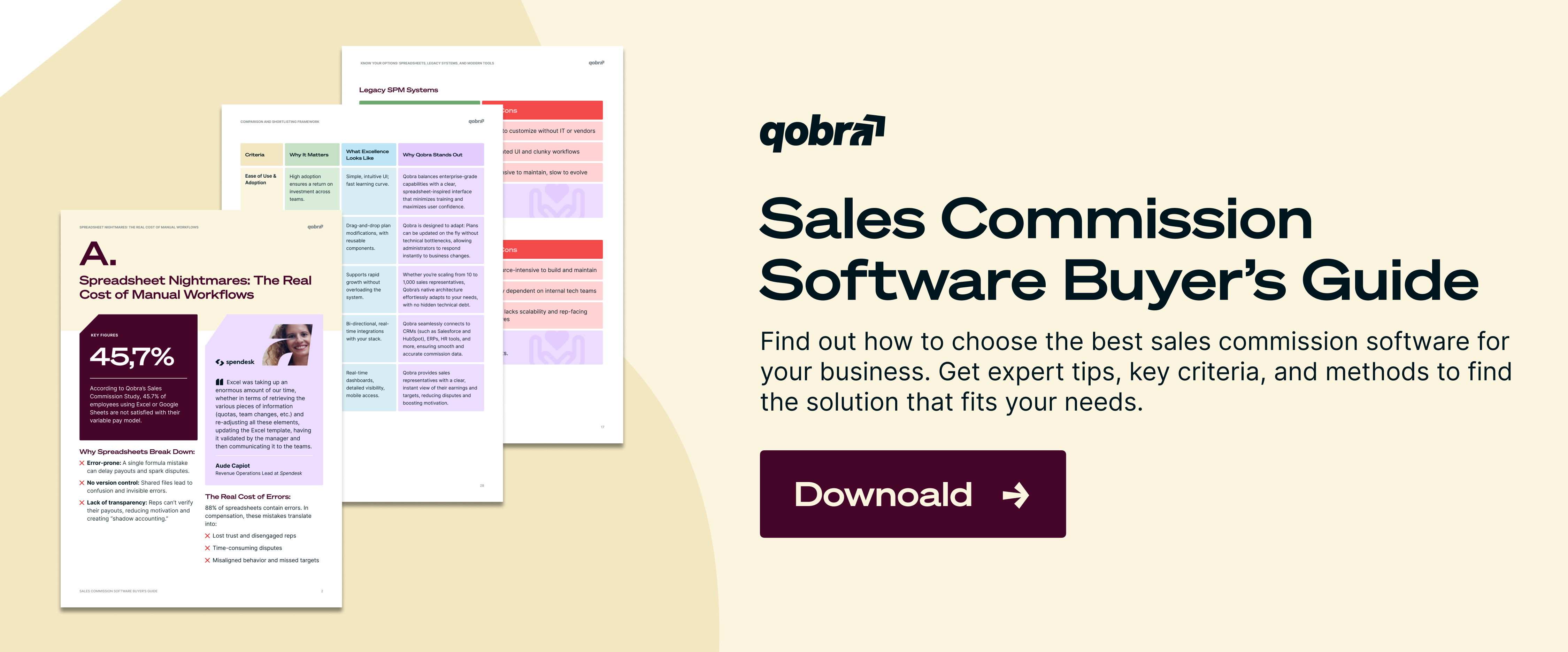
Companies often report that switching from Excel to an automated platform reduces errors by over 95% and cuts the time spent on commission management by a factor of 5 to 10. This frees up your team to focus on strategic analysis rather than manual data entry and dispute resolution.
Common Pitfalls to Avoid with KPI Bonuses
While powerful, a poorly designed KPI bonus system can backfire, leading to unintended behaviors and demotivation. Here are some critical traps to avoid.
Biased or Misleading Performance Metrics
Choosing the wrong KPI can incentivize the wrong behavior. For example, if you bonus sales reps solely on the total value of deals closed, they might focus on large, low-margin deals and neglect long-term customer relationships or profitability. Similarly, rewarding a support team only for the number of tickets closed could lead to them rushing through customer issues without resolving them properly.
Solution: Always use a balanced set of KPIs. Pair a quantitative metric (e.g., revenue) with a qualitative one (e.g., customer satisfaction or margin). Before finalizing a KPI, ask yourself: "What negative behavior could this metric unintentionally encourage?"
Lack of Alignment with Company Strategy
This often occurs when KPIs are not properly cascaded. If top management is measured on profitability but the sales team is bonused on raw revenue, there is a fundamental disconnect. Everyone may hit their individual targets, yet the company could still miss its primary goal.
Solution: The cascading process described earlier is essential. Every KPI, at every level of the organization, should have a clear and logical link back to a higher-level company objective. This strategic alignment is a cornerstone of an effective sales performance management strategy.
The "Carrot and Stick" Trap
Relying solely on financial incentives can sometimes undermine intrinsic motivation. According to Douglas McGregor's "Theory Y," many employees are naturally self-motivated and driven by self-esteem, creativity, and personal development. A bonus system that feels like a controlling "carrot and stick" mechanism can stifle this creativity.
Solution: Frame the bonus system as a tool for recognition and shared success, not just a transaction. Combine it with non-financial rewards, public recognition, and opportunities for growth. The goal is to make employees feel like valued partners in the company's journey, not just cogs in a machine responding to stimuli.
Don't Let the KPI Become the Goal
Goodhart's Law states: "When a measure becomes a target, it ceases to be a good measure." Be wary of employees "gaming the system" to hit a KPI at the expense of common sense or the company's best interests. Regularly review your KPIs to ensure they are still driving the desired overall outcomes.
A well-designed KPI bonus system is more than just a way to pay people—it's a communication tool that continuously reinforces what's important for the business. By defining goals clearly, calculating rewards accurately, and providing transparent visibility, you can build a high-performance culture where everyone is aligned and motivated to succeed. Using modern tools to automate this process ensures it remains fair, efficient, and impactful.
A KPI bonus only motivates if each rep can see, at any moment, where they stand against the threshold. That visibility is what incentive compensation management software provides: live attainment per KPI, instead of a figure discovered on the payslip.
FAQ
How often should we pay out KPI bonuses?
The ideal frequency depends on the role and the business cycle. For sales roles with short cycles, monthly or quarterly bonuses can be highly motivating. For roles focused on long-term projects, semi-annual or annual bonuses may be more appropriate. The key is to make the feedback loop between action and reward as short as is practical.
Can we apply KPI bonuses to non-sales roles?
Absolutely. Any role where performance can be quantified is a candidate for a KPI bonus. This includes customer support (CSAT, resolution time), marketing (lead generation, conversion rates), operations (efficiency metrics, error reduction), and even developers (sprint completion rates, bug-free releases). The challenge is to find meaningful metrics that the employee can directly influence.
What's the difference between a bonus and a commission?
While both are forms of variable pay, they differ in their calculation. A commission is typically a direct percentage of a transaction an employee generates (e.g., 5% of every sale). A bonus is usually a lump sum paid for achieving a pre-set target or objective, which may or may not be directly tied to a single transaction. Many modern compensation plans, particularly in sales, often blend both elements. Understanding how to calculate sales commissions is fundamental to designing an effective plan.