Webinar: The Biggest Release Sales Comp Has Ever Seen. Come See For Yourself (Wednesday, October 7)
Register
- Variable compensation software automates the full spectrum of variable pay (commissions, bonuses, MBOs, profit sharing, and SPIFs) replacing error-prone spreadsheets with auditable, real-time calculations.
- Spreadsheet fragmentation creates tangible compliance and financial risk, from ASC 606 reporting failures to overpayments that erode margin and employee trust.
- The best platforms in 2026 unify every variable pay type in a single system, giving Operations, Finance, and Sales teams shared visibility into earnings, forecasts, and payouts.
- Qobra stands out for making variable compensation visible and trusted across the organization, with real-time dashboards for reps, granular finance-level reporting, and a G2 rating of 4.8/5.
Variable compensation drives performance across every revenue-generating function. Yet most organizations still manage it through a patchwork of spreadsheets, disconnected point solutions, and manual reconciliation processes. Left unmanaged, this produces calculation errors, delayed payouts, compliance gaps, and a workforce that does not trust the numbers it is paid on. Learning to manage variable compensation well starts with treating it as an entire organization problem, not a sales-only one.
The problem intensifies when you look beyond sales commissions. Bonuses tied to quarterly objectives, MBO payouts for customer success teams, profit-sharing distributions, and project-based incentives all follow different calculation logic, approval workflows, and accrual timelines. Managing these in silos means Finance cannot forecast total variable cost exposure, Operations cannot audit plan compliance, and employees cannot see how their efforts translate into earnings.
Variable compensation software solves this by centralizing plan design, calculation, reporting, and payout management in one compensation system. In this guide, we evaluate the 10 best variable compensation platforms in 2026, examining how each handles not just commissions, but the full range of variable pay. We walk through evaluation criteria, compare features side by side, and share best practices for selecting and implementing the right solution.
What Is Variable Compensation Software?
Variable compensation software, sometimes called compensation management software, is a category of enterprise tools that automate the design, calculation, tracking, and reporting of all pay components that fluctuate based on performance or business outcomes. Unlike payroll systems that process fixed salaries, variable compensation platforms handle the logic-heavy, rule-driven calculations behind:
- Sales commissions: percentage of revenue, tiered rates, accelerators, split deals
- Bonuses: quarterly or annual payouts tied to individual, team, or company targets
- Management by Objectives (MBOs): weighted goal attainment with multi-stakeholder approval
- Profit sharing: allocation formulas based on company or business-unit profitability
- SPIFs and contests: short-term incentive programs with custom rules and eligibility windows
Why "Beyond Commissions" Matters
Many platforms in this space originated as sales commission calculators. That legacy shows in their architecture: they assume a quota-attainment model, a sales-rep persona, and CRM-sourced deal data. Organizations that also need to manage CS bonuses, finance MBOs, or operations profit sharing often find themselves running a second (or third) system alongside their commission tool.
The best variable compensation platforms in 2026 treat commissions as one compensation type among many. A unified calculation engine for diverse plan structures. A shared reporting layer for end-to-end Finance visibility into variable cost. Role-specific dashboards for every participant, not just sales reps, on what they earned and why. This matters as much for HR and Total Rewards teams managing STIP and LTIP programs as it does for sales-driven organizations running commission plans.
Why Spreadsheet Fragmentation Is a Compliance Risk
Spreadsheets remain the default variable compensation tool at many mid-market and enterprise organizations. A 2024 Deloitte survey found that over 60% of companies with more than 500 employees still use spreadsheets for at least part of their incentive compensation process. The risks are well-documented but worth restating because they compound as variable pay complexity grows.
Calculation Errors and Overpayments
Every manual formula is a potential point of failure. Complex calculations involving multiple tiers, accelerators, or exceptions make this worse: when bonus logic changes mid-quarter, spreadsheet owners must update every affected cell, sheet, and file. A single missed reference can produce overpayments that are politically difficult to claw back - or underpayments that erode trust and trigger disputes.
Audit and Compliance Gaps
ASC 606 and IFRS 15 require organizations to capitalize and amortize commission costs over the expected customer benefit period. Spreadsheet-based processes rarely maintain the versioned, timestamped payout data and audit trail that external auditors require. When variable pay extends to bonuses and profit sharing, full audit trails become even more important, since accrual and disclosure requirements multiply with every additional pay type.
Fragmented Visibility
When each department manages its own incentive spreadsheets, Finance cannot produce a consolidated view of compensation data across departments. Forecasting becomes guesswork, and month-end close cycles extend as teams reconcile conflicting numbers, without the financial reporting a controller can actually sign off on.
The Trust Deficit
Reps and managers who cannot independently verify their earnings lose confidence in the compensation process. That trust deficit shows up in higher dispute volumes, longer resolution times, and, ultimately, attrition. A platform that provides real-time, self-service visibility into variable pay calculations directly addresses this root cause.
How We Evaluated the 10 Best Variable Compensation Software
We assessed each platform across six dimensions that matter most when managing variable pay beyond commissions:
- Variable pay breadth: Does the platform support commissions, bonuses, MBOs, profit sharing, and SPIFs in a single system, or is it commission-only?
- Plan design flexibility: Can admins build complex, multi-component plan configurations without engineering support? Does the platform handle tiered rates, weighted objectives, multi-currency, and split-credit scenarios?
- Real-time visibility: Do reps, managers, and Finance teams get live dashboards and proactive notifications, and performance tracking, or do they wait for batch calculations?
- Finance and compliance tooling: Does the platform provide ASC 606-ready accrual reporting, audit trails, and workflow automation for approvals that satisfy external auditors?
- Integrations and data connectivity: How easily does the platform connect to CRM, ERP, HRIS, and billing systems to ingest the data needed for diverse variable pay types?
- User experience and adoption: Is the interface intuitive enough that participants actively engage with it, or does it become another ignored tool?
Each platform was evaluated using publicly available product documentation, G2 and Capterra reviews, analyst reports, and direct product information. Platforms are listed in order of overall fit for organizations managing variable pay beyond commissions.
The 10 Best Variable Compensation Software Platforms in 2026
1. Qobra: Best for Unified Variable Pay Visibility Across Operations, Finance, and Sales

Qobra is a variable compensation platform built for organizations that want every stakeholder, Operations, Finance, and Sales, to rely on a single tool for managing and understanding variable pay. Unlike platforms that bolt on bonus or MBO modules as afterthoughts, Qobra's architecture treats every variable pay type as a first-class component with shared calculation logic, shared reporting, and shared dashboards.
What Sets Qobra Apart
Real-time visibility for every role. Qobra provides role-specific dashboards that give reps a live overview of their earnings, managers a team-level view, and Finance granular reporting down to individual commission and bonus amounts, accessible at any time. This is not a batch-calculated report delivered weekly, it is a continuously updated view that eliminates the shadow accounting spreadsheets reps and managers build when they do not trust the system.
Proactive notifications that drive engagement. When a deal closes or a target is met, Qobra sends email notifications that help reps track incentives and understand the impact of each event on their variable pay. This combination of real-time access plus proactive updates is what drives the platform's unusually high adoption rates. When Qobra is implemented, participants actively engage with it and respond positively to using it.
Operations-first plan management. Sales leaders and Operations teams get a compensation process that is easier to run and easier to adopt. Plan design, rule configuration, and payout approval workflows are built for ops teams, not engineers. Complex plan structures like tiered commissions, weighted MBOs, multi-component bonus plans, split-credit scenarios, can be configured without code through Qobra's no code platform.
Finance-grade reporting and compliance. Beyond visibility, Finance teams need proof. ASC 606 accrual support, approval workflows, role based access controls, and a complete audit trail give controllers and auditors the documentation they need, without waiting on a monthly export.
Built-in integration architecture. Qobra connects to CRM, ERP, and HRIS systems such as Workday or SuccessFactors, pulling in the diverse performance data needed to calculate commissions, bonuses, MBOs, and profit-sharing allocations in one place.
Ratings and Customers
- G2: 4.8/5
- Capterra: 4.9/5
- Notable customers: SAP, AstraZeneca, JCDecaux, ElevenLabs, GoCardless, Factorial, DataSnipper, Go1, Quantcast, Make
Best For
Organizations that need a single platform to manage all variable pay types with real-time visibility for every stakeholder. Especially strong for companies where trust in the compensation process is a strategic priority.
Book a demo. Qobra offers a demo experience tailored to your own compensation plans.
AI-Powered Agents: A Unique Differentiator
Qobra includes three purpose-built AI agents that handle real work, not just analytics overlays. The Architect replaces hours of plan implementation with minutes of conversation, building or editing compensation plans autonomously on the platform. The Sales Coach answers rep questions about their commissions instantly, reducing admin ticket volume and building trust between sales teams and operations. The Analyst creates reports and dashboards from plain-language requests and surfaces proactive business intelligence, flagging anomalies, identifying trends, and delivering insights that would take hours of manual analysis.
2. Beqom: Best for Large Enterprises With Complex Global Pay Structures
Beqom is a total compensation platform that handles variable pay, salary planning, and equity grants. Its strength is global scalability - multi-country payroll integration, currency management, and compliance with local regulations. The platform supports commissions, bonuses, and MBOs within a unified data model.
Key strengths: Global pay rules engine, enterprise-grade configurability, strong HR/payroll integration.
Considerations: Implementation timelines can be long. The platform's breadth means a steeper learning curve for teams focused primarily on variable pay.
Best for: Large enterprises (5,000+ employees) with global compensation complexity.
3. CaptivateIQ: Best for Revenue Operations Teams That Need Flexible Plan Modeling
CaptivateIQ offers a flexible incentive compensation management platform with a spreadsheet-like interface that appeals to operations teams accustomed to building plans in Excel. The platform supports commissions and bonus structures with a visual plan builder.
Key strengths: Intuitive plan design interface, strong data transformation layer, good CRM integrations.
Considerations: Primarily oriented toward sales commissions. Bonus and MBO capabilities are less mature than commission workflows.
Best for: Revenue operations teams at mid-market SaaS companies seeking commission automation with familiar UX.
4. Xactly: Best for Mature Sales Organizations With Deep Analytics Needs
Xactly is one of the longest-standing players in sales performance management. Its Incent module handles commission calculations, while Connect manages plan design and forecasting. The platform offers strong benchmarking data drawn from its large customer base.
Key strengths: Compensation benchmarking, territory and quota planning modules, mature enterprise integrations.
Considerations: The platform's legacy architecture can make configuration and customization resource-intensive. Non-commission variable pay types may require additional modules.
Best for: Large sales organizations that need compensation analytics and benchmarking alongside calculation.
5. Varicent: Best for Organizations That Need Integrated Territory and Quota Planning
Varicent (formerly IBM's ICM solution) combines incentive compensation management with territory and quota management, and sales analytics. The platform is built for organizations that want to connect compensation outcomes to territory and capacity models.
Key strengths: Integrated territory and quota planning, AI-driven scenario modeling, strong analytics.
Considerations: The full suite can be complex to implement and administer. Organizations seeking a lightweight variable pay solution may find it over-engineered.
Best for: Enterprise sales organizations that manage compensation, territory, and quota planning as an integrated process.
6. Performio: Best for Mid-Market Companies With Complex Commission Structures
Performio provides incentive compensation management with a focus on handling complex commission structures - multi-rate tiers, crediting rules, and custom calculation logic. The platform positions itself as more configurable than entry-level tools but more accessible than enterprise suites.
Key strengths: Flexible commission rule engine, pre-built integrations, transparent calculation audit trails.
Considerations: Stronger on commissions than on broader variable pay types like bonuses or profit sharing. Reporting depth can lag behind enterprise competitors.
Best for: Mid-market companies with 100-2,000 reps whose commission plans require custom calculation logic.
7. Anaplan: Best for Finance-Led Organizations That Embed Compensation in Broader Planning
Anaplan is a connected planning platform that includes compensation management as part of a broader financial planning and analysis (FP&A) suite. Organizations already using Anaplan for budgeting, forecasting, or workforce planning can extend the same models to incentive compensation.
Key strengths: Unified planning across finance, sales, and HR; powerful modeling engine; enterprise scalability.
Considerations: Anaplan is a platform, not a purpose-built compensation tool. Building compensation plans requires significant configuration. The learning curve for plan administrators is steep.
Best for: Finance-led organizations already invested in the Anaplan ecosystem that want to consolidate compensation planning with FP&A.
8. QuotaPath: Best for Small Sales Teams That Need Simple Commission Tracking
QuotaPath offers straightforward commission tracking and forecasting for small to mid-sized sales teams. The platform emphasizes simplicity. Reps can see their earnings in real time, and managers can build basic commission plans without technical support.
Key strengths: Easy setup, clean rep dashboard, affordable pricing for small teams.
Considerations: Limited support for non-commission variable pay. Plan design flexibility is constrained compared to enterprise platforms.
Best for: Small sales teams (under 50 reps) that need basic commission visibility without enterprise complexity.
9. Commissionly: Best for Small Businesses Seeking Affordable Commission Automation
Commissionly is a lightweight commission management tool designed for small businesses. It provides basic commission calculation, rep dashboards, and CRM integrations at an accessible price point.
Key strengths: Low cost, quick setup, CRM integrations for common small-business platforms.
Considerations: Limited to commission calculations. No support for bonuses, MBOs, profit sharing, or other variable pay types. Reporting and compliance features are basic.
Best for: Small businesses with straightforward commission structures and limited budget.
10. Everstage: Best for Fast-Growing Sales Teams That Prioritize Rep Experience
Everstage focuses on sales commission automation with a modern, rep-friendly interface. The platform provides gamification features, leaderboards, and deal-level commission visibility designed to motivate sales teams.
Key strengths: Clean rep-facing UX, gamification and engagement features, fast implementation.
Considerations: Primarily built for sales commissions. Organizations needing unified bonus, MBO, and profit-sharing management alongside commissions may find the scope limited.
Best for: High-growth sales teams that want to drive rep engagement through commission visibility and gamification.
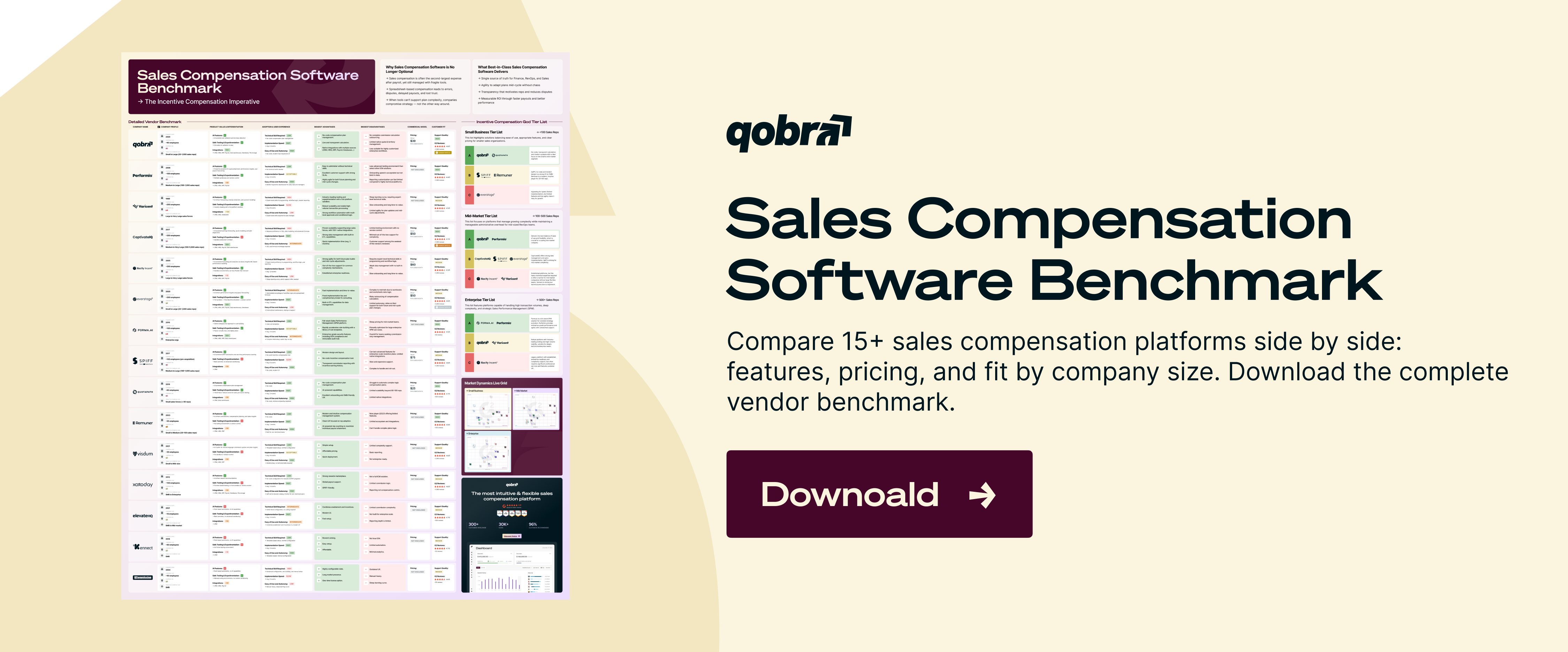
Feature Comparison Table
Best Practices for Selecting and Implementing Variable Compensation Software
1. Map Your Full Variable Pay Landscape Before Evaluating Tools
Do not start with a commission tool and hope it will stretch to cover bonuses and MBOs later. Inventory every variable pay program across every department (sales commissions, CS bonuses, management MBOs, operations incentives, profit-sharing plans) and document how each one contributes to the total compensation package, along with the calculation logic, data sources, approval workflows, and reporting requirements for each.
2. Prioritize Unified Visibility Over Feature Count
Choosing the right compensation management software comes down to prioritizing unified visibility over feature count. A platform that unifies five variable pay types in one reporting layer is worth more than five best-of-breed tools that each handle one type brilliantly but cannot produce a consolidated view.
3. Require Real-Time Calculation and Self-Service Access
Batch-calculated compensation reports delivered weekly or monthly keep reps and managers guessing instead of building confidence. Insist on real-time calculation and self-service dashboards where reps, managers, and Finance can check earnings, accruals, and forecasts at any time without filing a ticket.
4. Validate Compliance and Audit Capabilities Early
If your organization is subject to ASC 606, SOX, or local regulatory requirements, test the platform's audit trail, version history, and accrual reporting during evaluation, not after implementation. Ask for a sample audit export and have your controller review it.
5. Plan for Adoption, Not Just Implementation
A variable compensation platform only delivers value if people use it. Evaluate the rep-facing experience with the same rigor you apply to admin features. Look for proactive notifications, intuitive dashboards, and mobile access. Track adoption metrics (login frequency, dispute volume, time-to-resolution) as leading indicators of implementation success.
6. Integrate Early and Broadly
Variable pay calculations depend on data from CRM, ERP, HRIS, billing, and project management systems. Map your integration requirements in the evaluation phase and validate that the platform supports your specific systems - not just generic "API available" claims.
Frequently Asked Questions
What Is the Difference Between Variable Compensation Software and Sales Commission Software?
Sales commission software focuses specifically on calculating and tracking commissions earned by sales representatives. These commissions are typically based on deal revenue, quota attainment, and tiered rate structures. Variable compensation software is a broader category that encompasses commissions plus bonuses, MBOs, profit sharing, SPIFs, and other performance-based pay components. The best variable compensation platforms handle all these pay types in a single system with unified reporting and dashboards.
How Long Does It Typically Take to Implement Variable Compensation Software?
Implementation timelines vary significantly by platform complexity and organizational scope. Lightweight tools focused on basic commission tracking can be operational in 2-4 weeks. Enterprise platforms that handle multiple variable pay types, complex plan logic, and global compliance requirements typically require 6-12 weeks for full deployment. The key factors are data integration complexity, number of distinct compensation plans, and the depth of historical data migration required.
Can Variable Compensation Software Handle Non-Sales Incentive Plans?
The best platforms in 2026 can. Look for platforms that support configurable plan types beyond quota-attainment models. These should include weighted objective scoring (for MBOs), formula-based allocation (for profit sharing), and event-triggered payouts (for SPIFs and project bonuses). Not all platforms labeled as "variable compensation" actually support these structures, so validate with specific use cases during your evaluation.
What Integrations Should I Prioritize When Evaluating Variable Compensation Platforms?
At minimum, your platform should integrate with your CRM (for deal data), ERP or accounting system (for financial reconciliation), and HRIS such as Workday, SuccessFactors, or ADP (for employee data, org structure, and role changes). If you manage non-sales variable pay, you may also need integrations with project management tools, customer success platforms, or custom data sources. Evaluate both the availability and the depth of each integration: a surface-level CRM sync that misses custom fields will create manual workarounds.
How Does Variable Compensation Software Support ASC 606 Compliance?
ASC 606 requires organizations to capitalize incremental costs of obtaining contracts (including sales commissions) and amortize them over the expected customer benefit period. Variable compensation platforms support this by maintaining a timestamped record of every commission event, automating amortization schedules, generating journal entries for accrual and recognition, and providing the audit trail that external auditors require. Platforms that extend beyond commissions to bonuses and profit sharing should also support the accrual and disclosure requirements for those pay types.
Variable pay usually sits alongside sales commissions, so it is worth comparing the broader commission management software market too.