Sales Compensation Software Benchmark | Compare 15+ Sales Compensation Platforms
Download
- A "bonus incentive" is a bonus paid within a formal incentive program that ties variable pay to predefined, measurable performance goals—distinct from commissions or discretionary bonuses.
- Design your plan with SMART objectives and clear KPIs, choose reward types (cash, equity, PTO), and define thresholds, tiers/accelerators, caps and payout frequency.
- Prioritize fairness and transparency: publish a concise plan document, train managers, provide real‑time dashboards and a clear dispute resolution process.
- Mitigate risks (quantity over quality, gaming, toxic competition) by blending quantitative and qualitative KPIs, using team-based metrics where appropriate, and keeping rules simple.
- Implement formally: run a kickoff, balance eligibility/territories, consult HR/legal on tax/compliance, and automate calculations to ensure accuracy and trust.
How can you transform your company's strategic goals into tangible actions for your employees? While a shared vision is crucial, aligning daily efforts with long-term objectives often requires a more concrete lever. This is where incentive bonuses come into play—a powerful tool designed to motivate performance, reward excellence, and drive specific business outcomes. Yet, crafting a system that genuinely inspires rather than inadvertently manipulates is a delicate art.
An incentive bonus, often translated from English into French as a prime incitative or prime d'intéressement, is more than just an extra payment. It is a form of variable compensation tied directly to the achievement of predetermined goals. Unlike a standard salary, which rewards presence and responsibility, an incentive is designed to reward performance. Properly structured, it creates a direct link between an employee's contribution and the company's success, making everyone a stakeholder in the collective journey.
What Exactly Is a "Bonus Incentive"? Definition and Nuances
While the terms are often used interchangeably, it's essential to understand the subtle differences between them, especially in a compensation context. An incentive plan is a formal system that encourages specific actions or behaviours through rewards. A bonus is typically the reward itself, often a lump-sum payment.
Therefore, a "bonus incentive" is a cash payment (the bonus) given as part of a structured program (the incentive) to drive performance.
Let's clarify the common terms used in variable compensation:
| Term | Definition | Primary Goal | Example |
|---|---|---|---|
| Commission | A percentage of revenue or profit generated by a sale. | Directly reward sales volume. | A salesperson earns 5% of every deal they close. |
| Bonus | A lump-sum payment, often discretionary or tied to company/individual performance. | Reward past performance or share profits. | An annual bonus based on the company hitting its revenue target. |
| Incentive | A pre-defined reward for achieving a specific, future-oriented goal. | Drive specific future behaviours and outcomes. | A €1,000 payment for any developer who resolves 50 critical bugs in a quarter. |
| Prime (in French) | A general term for an extra payment, which can encompass bonuses, commissions, or other rewards. | General term for additional pay. | Prime de fin d'année (year-end bonus). |
In essence, all commissions are incentives, but not all incentives are commissions. A "bonus incentive" is a specific type of incentive that takes the form of a bonus, moving beyond the purely transactional nature of sales commissions to reward a wider range of achievements.
The Different Types of Incentive Plans
Incentive plans are not one-size-fits-all. The right structure depends on your objectives, company culture, and the roles you want to motivate. They can be categorized based on the nature of the reward, the target audience, and the performance period.
By Nature of the Reward
- Monetary Incentives: These are the most common and directly impactful.
- Cash Bonuses: Lump-sum payments for achieving targets (e.g., MBOs - Management by Objectives).
- Commissions: Percentage-based earnings, typical for sales roles.
- Profit-Sharing: A portion of company profits is distributed among employees.
- Gainsharing: Rewards are based on improvements in team productivity or cost savings.
- Non-Monetary Incentives: These focus on recognition, development, and equity.
- Stock Options / Restricted Share Units (RSUs): Granting employees ownership in the company, aligning their long-term interests with shareholders.
- Additional Paid Time Off (PTO): Rewarding high performers with extra vacation days.
- Gifts, Vouchers, or Experiences: Tangible rewards like electronics, travel, or dining experiences.
By Target Audience
- Individual Incentives: Rewards are based solely on an employee's personal performance. This is highly effective for roles with clear, individual metrics, such as sales representatives or recruiters.
- Team-Based Incentives: The entire team receives a reward if a collective goal is met. This fosters collaboration and is ideal for project teams, customer support squads, or production units. For example, a support team might get a bonus if their collective CSAT score exceeds 95% for the quarter.
By Duration
- Short-Term Incentive Plans (STIPs): These plans focus on performance over a year or less.
- SPIFFs (Sales Performance Incentive Fund): Spontaneous, short-term contests to boost sales of a specific product or drive activity in a short period (e.g., a €200 bonus for the first person to book 5 demos this week).
- Quarterly/Monthly Bonuses: Tied to achieving targets within a specific period.
- Long-Term Incentive Plans (LTIPs): These plans typically span three to five years and are designed to retain key talent and executives. They often involve equity, such as stock options or performance shares that vest over time, encouraging a focus on the company's sustained growth.
How to Design an Effective Incentive Bonus Plan: A Step-by-Step Guide
A successful incentive plan is not improvised. It requires careful thought to ensure it is clear, fair, and aligned with your business strategy. Rushing the process often leads to confusion, frustration, and unintended negative consequences.
Step 1: Define Clear and Measurable Objectives (SMART)
The foundation of any good plan is its objectives. What behaviour do you want to encourage? What business result are you trying to achieve? Your goals should be SMART:
- Specific: "Increase sales of Product X by 15%" is better than "Sell more."
- Measurable: The goal must be quantifiable. Use clear KPIs.
- Achievable: The target should be challenging but realistic. An impossible goal is demotivating.
- Relevant: The objective must align with the company's overall strategy.
- Time-bound: Set a clear deadline (e.g., "by the end of Q3").
Step 2: Choose the Right Key Performance Indicators (KPIs)
KPIs are the metrics used to measure the achievement of your objectives. For a sales team, this might be Annual Recurring Revenue (ARR) or customer retention rate. For a marketing team, it could be Marketing Qualified Leads (MQLs) or Customer Acquisition Cost (CAC). The key is to choose "leading" indicators (which predict future success) over "lagging" indicators (which report past results).
Expert Tip: Balance Quantitative and Qualitative KPIs
Relying solely on quantitative metrics (like revenue or number of units sold) can sometimes encourage the wrong behaviours, such as sacrificing quality for speed. Consider blending them with qualitative KPIs, like Customer Satisfaction (CSAT) scores or client retention rates. This ensures that employees are focused on sustainable growth, not just short-term wins.
Step 3: Structure the Payout Mechanics
This is where you define how the bonus is calculated and earned. Key elements to consider:
- Threshold: The minimum level of performance required to earn any incentive. For example, a salesperson might need to hit 80% of their quota to qualify for a bonus.
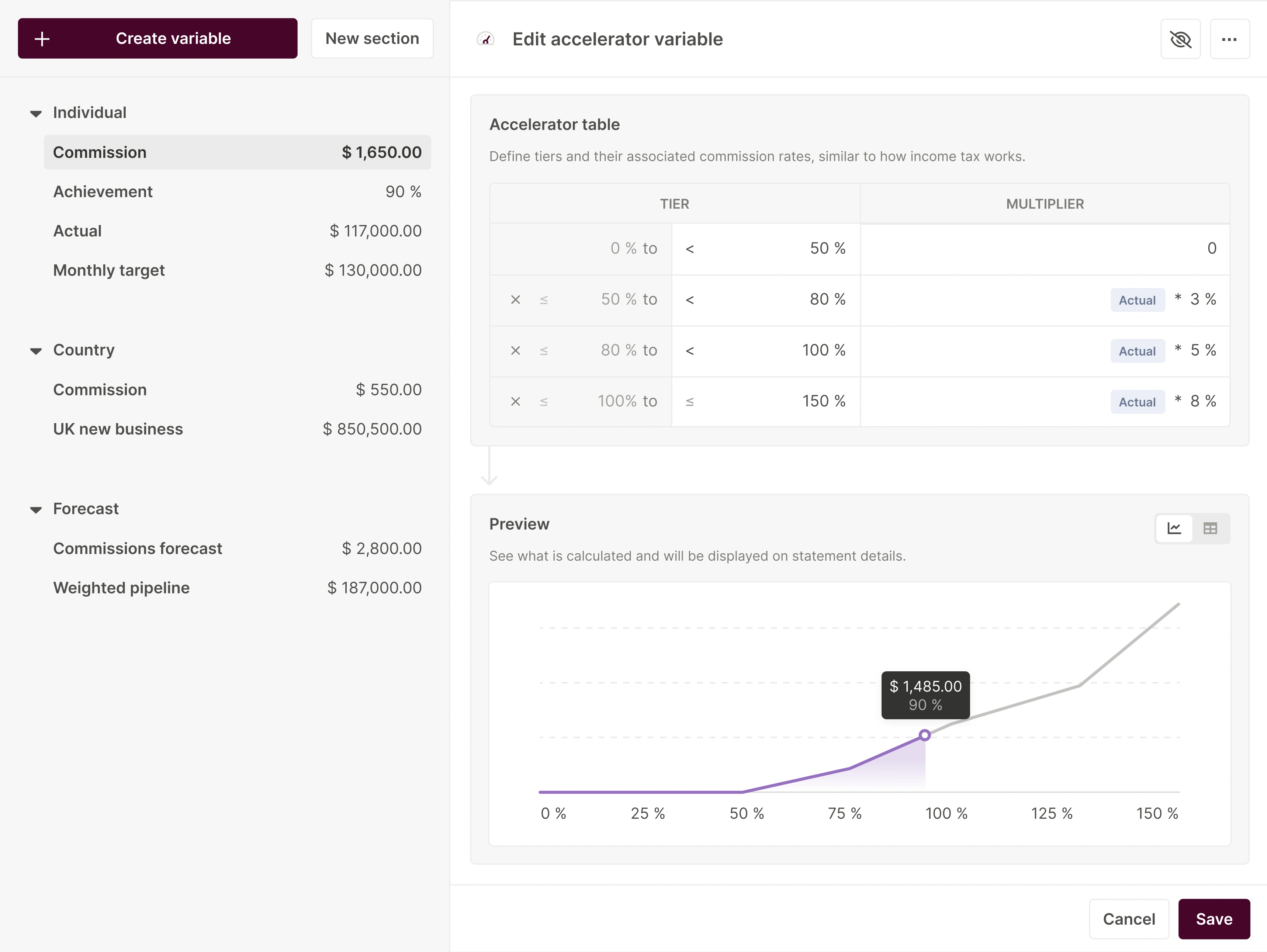
- Tiers and Accelerators: Create different payout levels to reward overperformance. For example, 100% of the bonus is paid at 100% of the target, but 150% is paid if the target is exceeded by 20%. This motivates top performers to keep pushing.
- Caps: Decide if there will be a maximum payout. While caps can control costs, they can also demotivate star performers who feel their potential earnings are limited.
- Frequency: Decide how often bonuses are calculated and paid out (monthly, quarterly, annually). More frequent payouts can be more motivating for shorter sales cycles.
Manually managing these complex rules in spreadsheets is a recipe for disaster. It leads to errors, delays, and a lack of trust. This is where a dedicated platform becomes essential. For instance, automating commission calculations with a no-code tool like Qobra ensures that every rule, tier, and accelerator is applied correctly and in real-time. Salespeople can see their potential earnings update with every new deal, transforming the compensation plan into a live motivational dashboard rather than a mysterious quarterly statement.
Step 4: Ensure Fairness and Transparency
For an incentive plan to be motivating, employees must trust it. This requires absolute transparency. Every employee should understand exactly how their bonus is calculated and be able to track their progress toward their goals in real-time. Opaque rules or "black box" calculations breed suspicion and demotivation.
"A healthy incentive system is quickly understood, easily verified, and remains stable throughout the performance period. As soon as you have to 'interpret' the rules, ask for weekly clarifications, or guess what really matters, the incentive ceases to be a guide. It becomes a lever of control."
Providing employees with a personal dashboard where they can see their performance against their targets and simulate future earnings is a game-changer for motivation. This visibility eliminates disputes and empowers them to take ownership of their results.
From Motivation to Manipulation: The Risks to Avoid
While powerful, incentive bonuses carry significant risks if poorly designed. The line between encouraging high performance and manipulating behaviour can be thin.
- Focusing on Quantity over Quality: A plan that rewards only the number of closed tickets in a contact center may lead agents to rush through complex issues or close tickets prematurely, leading to frustrated customers and repeat inquiries. The work isn't done better; it's just postponed.
- Unhealthy Internal Competition: Individual incentives, if not balanced with team goals, can discourage collaboration. Salespeople might "hoard" leads or refuse to help colleagues, damaging team cohesion.
- Creating Unethical Shortcuts: If the pressure to hit a target is too high, employees may be tempted to cut corners, hide mistakes, or engage in questionable sales practices to secure a bonus.
- The "Labyrinth" Effect: Overly complex plans with numerous exceptions, special conditions, and micro-rules become confusing. Instead of guiding behaviour, they encourage employees to "game the system" or spend more time trying to understand the rules than performing their jobs.
Warning: The Perils of Unfairness
Perceived unfairness is the fastest way to kill motivation. If two salespeople have the same quota but one has a much more lucrative territory or consistently receives better leads, the incentive plan no longer rewards performance. It rewards circumstance. Ensure that territories are balanced and that lead distribution follows a clear, traceable logic.
The quickest test of a healthy plan is to ask: "To succeed, does an employee have to make a bad decision?" If hitting the goal requires closing a ticket too quickly, keeping a lead for oneself, or sacrificing product quality, the system is flawed.
Communicating and Implementing Your Incentive Plan
A brilliant plan will fail if it's poorly communicated. The launch is a critical moment to build excitement and ensure everyone is on the same page.
Your implementation checklist should include:
- A Formal Plan Document: Create a clear, concise document that outlines all the rules: eligibility, performance period, KPIs, calculation formulas, and payment schedule.
- A Kick-Off Meeting: Present the plan to all eligible employees. Explain the "why" behind it—how it connects to the company's strategic goals. Allow plenty of time for questions.
- Provide Real-Time Visibility: Give employees access to a dashboard where they can track their progress. This is non-negotiable for maintaining motivation and trust throughout the performance period.
- Train Managers: Ensure managers understand the plan inside and out so they can answer their team's questions and coach them effectively.
- Establish a Dispute Resolution Process: Define a clear process for handling questions or disputes about calculations. An automated system with a full audit trail, like Qobra, drastically reduces these disputes by providing a single source of truth.
Legal and Tax Considerations
Incentive bonuses are considered part of an employee's salary and are therefore subject to specific legal and tax rules.
A Note on Compliance
In most jurisdictions, incentive bonuses are subject to social security contributions and income tax, just like a regular salary. They must be clearly shown on the payslip. It's crucial to consult with a legal or HR expert to ensure your plan complies with local labour laws regarding variable compensation, non-discrimination, and contractual obligations. This is not legal advice, and professional consultation is always recommended.
A well-designed incentive bonus plan is one of the most powerful strategic tools a company can wield. It aligns individual ambitions with corporate objectives, rewards excellence, and fosters a culture of high performance. However, its success hinges on clarity, fairness, and transparency. By moving away from manual, error-prone processes and embracing tools that provide real-time visibility and accuracy, you can unlock the true motivational power of incentives and turn your compensation plan into a genuine competitive advantage.
Frequently Asked Questions
What is the difference between an incentive and a bonus?
An incentive is a pre-defined reward designed to drive a specific future behavior or outcome (e.g., "sell 10 units and get €500"). A bonus is often a more discretionary payment given to reward past performance, which may or may not have been tied to a pre-set target. A "bonus incentive" combines these, offering a bonus as the reward within a structured incentive plan.
How do you calculate an incentive bonus?
The calculation depends entirely on the plan's structure. A simple formula might be: "(Performance / Target) * Bonus Amount". More complex plans use tiers, where the payout percentage increases as performance exceeds the target. For example, 100% of the bonus is paid at 100% of the goal, but 120% is paid at 110% of the goal. Using an automated platform is the best way to handle these calculations accurately.
Are incentive bonuses effective for all roles?
They are most effective in roles where individual or team performance can be clearly measured and directly linked to business outcomes, such as sales, marketing, or production. For roles where contribution is harder to quantify (e.g., some administrative or creative roles), other forms of recognition or team-based profit-sharing might be more appropriate.
How can I ensure my incentive plan is fair?
Fairness comes from three key areas: clear and universally applied rules, achievable targets based on comparable opportunities (e.g., balanced sales territories), and complete transparency in how performance is tracked and how payouts are calculated. Giving everyone access to the same information and the same set of rules is fundamental.
Running bonus incentives without errors takes an incentive compensation management platform connected to your CRM.