Webinar (Wednesday, October 21) — Aligning HR, Finance, and Sales: Mastering Sales Comp Without Breaking Your Plan
Register
- Align bonuses with strategic goals so employees think like owners—use variable pay (not permanent salary) to reward company success and protect cash flow.
- Choose the right mix of structures—performance-based, profit-sharing, spot bonuses, annual/holiday payouts and referral bonuses—and combine them (hybrid) to match roles and objectives.
- Design clearly: define business objectives, translate them into measurable KPIs/OKRs, set timeframes, and decide pool size and distribution method (pro‑rata, flat, or tiered).
- Keep plans simple, fair and sustainable—document rules, account for taxes and payroll, avoid favoritism, and consult legal/accounting advisors before launching.
- Implement transparently and iterate—communicate the "why/how/what," use automation or dashboards for real‑time visibility, collect feedback, and adjust targets and payouts regularly.
As a small business leader, are you constantly thinking about how to keep your team motivated, engaged, and aligned with your company's ambitious goals? While a competitive salary is fundamental, in today's talent market, it's often not enough. A well-designed bonus structure can be the strategic lever that transforms your workforce from simply productive to truly high-performing, fostering a culture of ownership that drives sustainable growth.
For small companies, designing the right incentive program is a balancing act between affordability and impact. It’s not about matching the massive bonus pools of large corporations, but about creating a smart, transparent, and motivating system that links individual effort directly to company success. This guide will walk you through the most effective bonus structures for small businesses, providing a clear framework for designing and implementing a plan that boosts morale, performance, and retention.
Why a Formal Bonus Structure is a Game-Changer for Your Small Business
Implementing a structured bonus plan is more than just a financial transaction; it's a powerful communication tool that reinforces your company’s values and priorities. Even with limited resources, a well-planned incentive program can yield significant returns.
A key benefit is the alignment of employee and owner incentives. When employees see a direct connection between their work, the company's financial success, and their own take-home pay, they begin to think like owners. This fosters a proactive culture where team members are more conscious of costs, quality, and customer satisfaction. Furthermore, it allows your business to manage costs flexibly. Unlike salary increases, which become a fixed expense, bonuses are a variable cost tied to performance. This gives you greater control over your liquidity, allowing you to reward success generously when times are good without over-committing during leaner periods.
In a competitive hiring landscape, a compelling bonus structure can be a major differentiator. It signals to top talent that your company is invested in shared success and is willing to reward exceptional contributions. This can help you attract and retain key employees who might otherwise be drawn to larger organizations with higher base salaries. Ultimately, a formal bonus plan moves compensation from being a simple cost of doing business to a strategic investment in your most valuable asset: your people.
5 Common Bonus Structures Suited for Small Companies
There is no one-size-fits-all solution for employee bonuses. The best approach often involves a blend of different models tailored to your specific goals, industry, and company culture. Here are five of the most effective and popular bonus plans for small businesses.
1. Performance-Based Bonuses
This is perhaps the most direct way to incentivize specific outcomes. Performance bonuses are granted to individuals or teams who meet or exceed predefined goals. These goals should be specific, measurable, achievable, relevant, and time-bound (SMART).
- Who it's for: Ideal for roles where output is easily quantifiable, such as sales, marketing, customer service, or operations. For sales teams, this often takes the form of commissions, which are a core part of their sales compensation package.
- Example: A marketing manager receives a $1,000 bonus for generating 150 qualified leads in a quarter. A development team shares a $5,000 bonus for launching a new product feature on schedule and under budget.
- Pros: Directly links reward to results, highly motivating for goal-oriented employees, and clearly communicates performance expectations.
- Cons: Can be administratively complex to track, may unintentionally discourage collaboration if focused solely on individual goals, and requires very clear goal-setting to be effective.
2. Profit-Sharing Plans
Profit sharing directly connects employees' rewards to the company's bottom-line success. A portion of the company's profits over a specific period (quarterly or annually) is distributed among the staff. The distribution can be an equal flat amount for everyone or weighted based on factors like salary, role, or tenure.
- Who it's for: Company-wide application. It’s excellent for fostering a sense of collective ownership and encouraging all employees to think about efficiency and profitability.
- Example: A company pledges to share 10% of its annual pre-tax profits with employees. If the profit is $200,000, a $20,000 bonus pool is distributed.
- Pros: Unites the entire team towards a common goal, improves employee loyalty, and is financially sustainable since bonuses are only paid when the company is profitable.
- Cons: The link between individual effort and the final reward can feel indirect, and external market factors beyond employees' control can affect profitability, potentially leading to disappointment.
3. Spot Bonuses
As the name suggests, spot bonuses are given "on the spot" for exceptional performance that goes above and beyond normal job duties. They are typically smaller, immediate rewards meant to recognize a specific achievement in real-time.
- Who it's for: Any employee who demonstrates outstanding effort, innovation, or commitment on a particular task or project.
- Example: An employee who stays late to help resolve a critical customer issue receives a $150 gift card the next day. A team member who devises a clever cost-saving process is given a $250 cash bonus.
- Pros: Provides immediate positive reinforcement, is highly flexible, and builds a culture of recognition and appreciation.
- Cons: Must be awarded fairly and consistently to avoid perceptions of favoritism, which can damage morale. The criteria should be objective, even if the award is discretionary.
4. Annual or Holiday Bonuses
This is a traditional and widely recognized form of bonus, typically paid out at the end of the year. It can be a discretionary gift to thank employees for their hard work or a more structured reward based on the overall performance of the company for the year.
- Who it's for: Usually distributed to all employees as a gesture of goodwill and appreciation.
- Example: Every employee receives a bonus equivalent to one week's pay in December.
- Pros: Boosts morale during the holiday season and can be a factor in employee retention, especially as January is a popular month for job hunting.
- Cons: Can become an entitlement if given every year regardless of performance, losing its motivational impact. Its link to specific performance metrics is often weak.
5. Referral Bonuses
Finding and hiring high-quality talent is one of the biggest challenges for small businesses. A referral bonus program incentivizes your current employees to tap into their professional networks to find qualified candidates.
- Who it's for: Any employee who refers a candidate who is subsequently hired and stays with the company for a minimum period (e.g., 90 days).
- Example: An employee receives a $500 bonus after their referred candidate successfully completes their probationary period.
- Pros: Highly cost-effective recruiting method, improves the quality of applicants, and helps strengthen company culture by bringing in people who are already connected to the team.
- Cons: Potential for disappointment if a referral is not hired; clear communication about the process is essential.
Note: Mix and Match for Maximum Impact
You don't have to choose just one type of bonus. The most effective incentive programs for small businesses often use a hybrid approach. For example, you might have a company-wide profit-sharing plan to foster unity, combined with performance-based bonuses for your sales team and a spot bonus program to reward exceptional ad-hoc contributions.
How to Design and Implement Your Bonus Structure: A Step-by-Step Guide
Creating a successful bonus program requires careful planning and transparent execution. A poorly designed plan can be worse than no plan at all. Follow these five steps to build a structure that works for your business.
Step 1: Define Your Business Objectives
Before you think about bonus amounts, ask yourself: What specific business outcome am I trying to drive? Your bonus plan should be a tool to achieve a strategic goal. Is your primary objective to:
- Increase annual revenue by 20%?
- Improve customer retention from 85% to 92%?
- Reduce project delivery times by 15%?
- Successfully launch a new service line?
The goals you set will determine which type of bonus structure is most appropriate. For revenue growth, performance bonuses for the sales team are a clear fit. For customer retention, a team-based bonus for the support department might be more effective.
Step 2: Set Clear, Measurable Criteria
Once your objectives are clear, translate them into measurable Key Performance Indicators (KPIs) for your employees. Vague criteria like "work hard" or "be a team player" are impossible to measure and lead to confusion and perceived unfairness. An effective incentive plan is built on clarity.
Good Criteria: "Achieve a customer satisfaction (CSAT) score of 95% or higher for the quarter."
Bad Criteria: "Provide excellent customer service."
For each bonus, define who is eligible, what they need to achieve, the timeframe for achievement, and how the reward will be calculated. Document this in a clear policy that is accessible to everyone.
Step 3: Calculate the Bonus Pool and Structure the Payouts
Determine how much the company can afford to allocate to bonuses. This could be:
- A percentage of net profit.
- A fixed amount per employee for hitting a specific target.
- A percentage of revenue growth.
Next, decide how the pool will be distributed. Common methods include:
- Pro-rata based on salary: An employee earning $80,000 would receive twice the bonus of someone earning $40,000.
- Flat rate: Every eligible employee receives the same amount.
- Tiered system: Payouts vary based on role, seniority, or level of contribution to the goal.
Let's consider an example for a 5-person agency with a $15,000 profit-sharing pool:
| Employee Role | Base Salary | Distribution Method | Bonus Amount |
|---|---|---|---|
| Senior Designer | $90,000 | Pro-rata (36% of salary pool) | $5,400 |
| Project Manager | $75,000 | Pro-rata (30% of salary pool) | $4,500 |
| Junior Developer | $60,000 | Pro-rata (24% of salary pool) | $3,600 |
| Office Admin | $25,000 | Pro-rata (10% of salary pool) | $1,500 |
| Total | $250,000 | 100% | $15,000 |
Step 4: Communicate Transparently and Consistently
The success of your bonus plan hinges on communication. If your employees don't understand how it works, it won't motivate them. Before launching the program, hold a meeting to explain:
- The "why": The business goals behind the program.
- The "how": The specific mechanics of how bonuses are earned and calculated.
- The "what": The potential rewards they can earn.
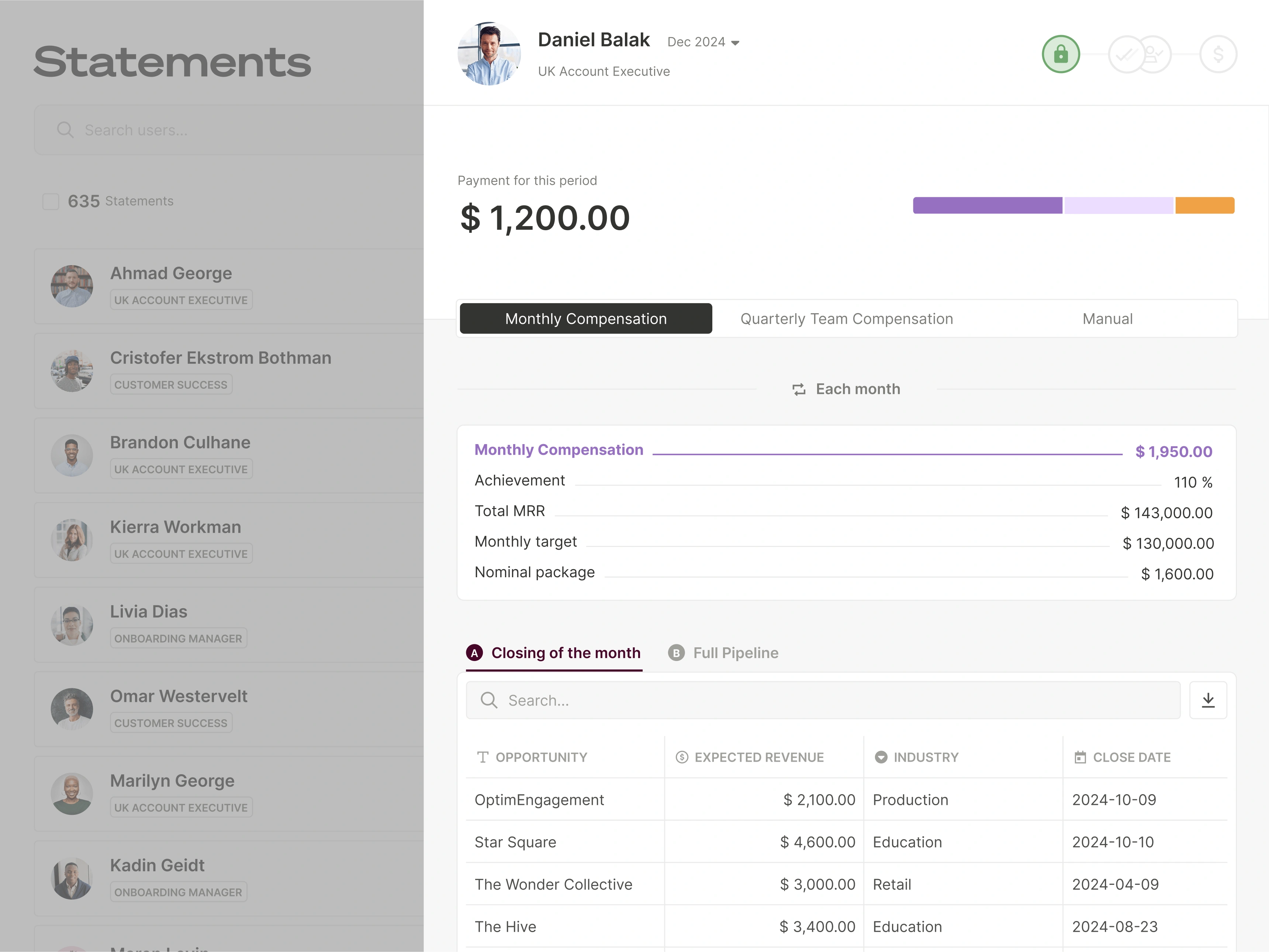
For roles with complex variable pay, like sales, transparency is even more critical. Manually tracking commissions on spreadsheets is prone to errors and creates a black box for salespeople. This is where modern software is invaluable. A platform like Qobra automates the entire process, providing sales reps with real-time dashboards where they can see exactly how their performance translates into commissions. This level of transparency eliminates disputes and keeps them focused and motivated.
Step 5: Track, Evaluate, and Adjust
A bonus structure is not a "set it and forget it" initiative. Regularly track progress towards the goals and monitor the program's impact on morale and performance. Actively solicit feedback from your team. Are the goals seen as achievable? Is the system perceived as fair? Be prepared to make adjustments. Perhaps an initial target was too aggressive, or the reward isn't meaningful enough. A willingness to refine the program shows your employees that you are committed to creating a fair and effective system.
Avoiding Common Pitfalls
Overly Complex Plans
If you need a PhD in mathematics to understand your bonus plan, it's too complicated. Simplicity is key. Employees should be able to quickly understand the connection between their actions and a potential reward. For teams with necessarily complex commission plans, using a no-code platform to manage the rules can preserve sophistication on the back end while presenting clear, simple dashboards to the employees.
Ignoring Financial and Legal Realities
Ensure your bonus plan is financially sustainable. Don't promise what you can't deliver. From a legal standpoint, remember that most cash bonuses are considered supplemental wages and are subject to income and payroll taxes. It’s also wise to have a formal, written bonus agreement, especially for performance-based bonuses, to avoid misunderstandings. Always consult with an accountant and a legal advisor when formalizing your plan.
Unfair or Inconsistent Application
Fairness is paramount. If bonuses are perceived as being awarded based on favoritism rather than objective criteria, it will severely damage trust and morale. This is another area where automation can help. By using clear, data-driven rules, you remove subjectivity and ensure that everyone is evaluated against the same standard.
Expert Tip: Align with Your Overall Compensation Philosophy
Your bonus program should be a logical extension of your entire compensation structure. It should complement your base salary strategy and contribute to a competitive total target compensation. Consider whether you want to lead, meet, or lag the market, and ensure your bonus potential aligns with that philosophy.
A well-crafted bonus structure is one of the most powerful tools a small business can use to build a motivated, high-performing team. By aligning individual incentives with company goals, you create a powerful engine for growth. It requires thoughtful planning, transparent communication, and a commitment to fairness, but the investment in your team will pay dividends in productivity, loyalty, and long-term success.

Prorating part-time bonuses, as described above, is exactly the kind of rule that breaks a spreadsheet as headcount grows. Incentive tracking software encodes it once and applies it to every payroll cycle.
Frequently Asked Questions
How much should a small business budget for bonuses?
There's no magic number, but a common approach is to budget a percentage of payroll (e.g., 2-5%) or a percentage of net profits (e.g., 5-15%). The right amount depends entirely on your company's profitability, cash flow, industry standards, and strategic goals. Start with a conservative figure that you are confident you can sustain.
Should bonuses be a percentage of salary or a flat amount?
This depends on your goal. A percentage of salary recognizes higher-paid employees' greater relative contribution or responsibility. A flat amount promotes egalitarianism and teamwork, sending the message that everyone contributed equally to the success. Many companies use a hybrid model, with different structures for different teams or bonus types.
Can we change the bonus structure once it's in place?
Yes, but it must be done with extreme care and transparent communication. If you need to adjust the plan (e.g., due to changing business goals or market conditions), explain the reasons clearly and provide as much notice as possible. Avoid making changes mid-cycle for goals already in progress, as this can be seen as moving the goalposts and will erode trust.
How do we handle bonuses for part-time employees?
It is crucial to include part-time employees in your bonus plans to ensure fairness and maintain morale. The most common and equitable method is to prorate their bonus based on the number of hours they work compared to a full-time employee. For example, if a full-time bonus is $1,000, a half-time employee would receive $500 for the same level of performance.