Webinar (Wednesday, October 21) — Aligning HR, Finance, and Sales: Mastering Sales Comp Without Breaking Your Plan
Register
- Total compensation = direct pay (base salary, bonuses, commissions) plus indirect benefits (health, retirement match, PTO, equity, perks) — evaluate the whole package, not just base salary.
- Calculate step-by-step: Total Direct = base + expected bonus + expected commissions; Total Indirect = employer-paid insurance + retirement match + PTO (daily rate × days) + annualized equity value; then Total Compensation = Total Direct + Total Indirect.
- Use quick formulas: Bonus = Base × Target Bonus % × Performance Multiplier; Commission ≈ Sale Amount × Commission Rate (adjust for tiers/accelerators); Severance = Weeks per Year × Years of Service × Weekly Pay.
- Value equity and PTO practically: RSUs = vested shares/year × market price; options ≈ potential spread above strike price (consider vesting/IPO uncertainty); PTO value = Annual Salary / 260 × paid days.
- Benchmark regularly, account for tax and jurisdictional rules, and use calculators or automated tools for complex commission plans to ensure accurate comparisons and stronger negotiation positions.
When you receive a job offer, is the base salary the only number you look at? While it is a critical figure, focusing solely on it means you could be overlooking tens of thousands of dollars in value. True compensation is a complete package of rewards, both monetary and non-monetary, that an employer provides. Understanding how to assess this entire package is essential for making informed career decisions and for companies aiming to attract and retain top talent.
This guide provides a comprehensive, step-by-step breakdown of how to determine compensation in all its forms. From calculating your total compensation package to deciphering bonuses, commissions, and severance pay, you will learn the formulas and methods needed to see the full picture.
Understanding the Building Blocks: Direct vs. Indirect Compensation
Before you can calculate anything, it is crucial to understand the two main categories that make up an employee's remuneration: direct and indirect compensation. Together, they form the total compensation package.
Direct Compensation: The Money in Your Pocket
Direct compensation includes all monetary payments made directly to an employee. It is the most straightforward part of the equation and typically includes:
- Base Salary or Hourly Rate: The fixed, predictable amount you earn for your work, paid out on a regular schedule.
- Variable Pay: This is performance-based pay that is not guaranteed. It is designed to motivate employees and align their efforts with company goals. Common forms include:
- Bonuses: Additional cash compensation often tied to individual, team, or company performance targets.
- Commissions: A percentage of revenue generated, most common in sales roles.
- Profit Sharing: A plan that gives employees a share in the company's profits.
- Overtime Pay: Additional payment for hours worked beyond the standard workweek, typically applicable to non-exempt employees.
Indirect Compensation: The Hidden Value
Indirect compensation encompasses all the non-monetary benefits and perks that have significant financial value. This is where many people underestimate the true worth of a job offer. These benefits can dramatically increase the overall value of your package.
Key components of indirect compensation include:
- Insurance: Health, dental, vision, life, and disability insurance policies paid for, in whole or in part, by the employer.
- Retirement Plans: Employer contributions to plans like a 401(k) or pension.
- Paid Time Off (PTO): This includes paid vacation days, sick leave, public holidays, and parental leave.
- Equity: Stock options or Restricted Stock Units (RSUs) that give you ownership in the company.
- Employee Perks: Additional benefits like gym memberships, wellness stipends, commuter benefits, subsidized meals, or professional development funds.
How to Calculate Your Total Compensation Package: A 4-Step Guide
Calculating your total compensation is an essential exercise whether you are evaluating a new job offer or assessing your current role. It provides a holistic view of what your employer is truly investing in you.
Step 1: Tally Up Your Direct Compensation
Start with the easiest part: adding up all the direct monetary payments you receive or expect to receive over a year.
Base Salary + Expected Bonus + Expected Commissions + Other Cash Allowances = Total Direct Compensation
- Base Salary: Your annual gross salary.
- Expected Bonus: If your bonus is performance-based, use the "target" bonus percentage. For example, if your target is 10% of your $100,000 salary, add $10,000.
- Expected Commissions: For sales roles, this is often expressed as "On-Target Earnings" (OTE), which combines base salary and expected commissions at 100% of quota attainment. If you do not have an OTE, use a conservative estimate based on the role's performance history.
Step 2: Assign a Monetary Value to Indirect Benefits
This step requires a bit more research but is critical for an accurate calculation. You need to determine the annual dollar value of the benefits your employer provides.
- Health Insurance: Ask HR for the total annual premium cost and how much the company contributes. Your employer's contribution is the value to add.
- Retirement Match: If your company matches 401(k) contributions up to a certain percentage, calculate the maximum possible match. For example, a 100% match on contributions up to 6% of a $100,000 salary is worth $6,000 per year.
- Paid Time Off (PTO): Convert your paid days off into a monetary value. First, find your daily rate:
Annual Salary / 260(the approximate number of workdays in a year). Then, multiply that rate by your total number of paid days off (vacation + sick days + holidays). - Equity (Stock Options/RSUs): Valuing equity can be complex, especially for private companies.
- RSUs: The value is the number of vested shares per year multiplied by the current stock price.
- Stock Options: The value is harder to pinpoint, as it depends on the "spread" between the strike price and the market price. For an estimate, you can look at the potential value if the company's valuation grows.
Expert Tip: Valuing Employee Stock Options
When assessing stock options, do not just look at the number of shares. Consider the strike price (the price you pay to purchase the stock) and the vesting schedule (the timeline over which you earn the right to exercise them). The real value lies in the potential appreciation of the stock price above your strike price. For pre-IPO companies, this value is speculative but can represent significant upside.
Step 3: Apply the Total Compensation Formula
Once you have gathered all the data, the final calculation is simple.
Total Compensation = Total Direct Compensation + Total Value of Indirect Compensation
This final number represents the company's total annual investment in you as an employee. It is the most accurate figure to use when comparing different job offers or negotiating your salary.
Step 4: Review and Benchmark Regularly
For employers, calculating total compensation is not a one-time task. To remain competitive, HR and finance teams must regularly review and benchmark their packages against industry standards. Factors to consider include:
- Cost of living adjustments in your location.
- Industry benchmarks for similar roles.
- Internal equity to ensure fairness across the organization.
- Performance metrics to link compensation to results.
Putting It All Together: A Total Compensation Example
Let us illustrate with an example. Consider a job offer for a Sales Executive role.
| Compensation Component | Category | Calculation/Notes | Annual Value |
|---|---|---|---|
| Base Salary | Direct | The fixed annual salary offered. | $80,000 |
| Target Commission | Direct | On-target earnings at 100% of quota. | $60,000 |
| Total Direct Compensation | $140,000 | ||
| Health Insurance | Indirect | Employer's annual premium contribution. | $8,500 |
| 401(k) Match | Indirect | 100% match up to 5% of base salary. | $4,000 |
| Paid Time Off (PTO) | Indirect | 20 vacation + 5 sick + 10 holidays = 35 days. Daily rate: $80,000 / 260 = $307.69. 35 * $307.69. | $10,769 |
| Wellness Stipend | Indirect | $75 per month for gym or wellness apps. | $900 |
| Professional Development | Indirect | Annual budget for courses and certifications. | $2,000 |
| Total Indirect Compensation | $26,169 | ||
| TOTAL COMPENSATION | $166,169 |
As you can see, the total compensation of $166,169 is nearly $26,200 higher than the direct on-target earnings. This hidden value can make a significant difference when comparing offers.
Deconstructing Key Pay Components: How to Calculate Bonuses, Commissions, and Severance
Beyond the total package, it is important to know how specific variable components are calculated.
Calculating Performance Bonuses
Bonuses are typically tied to achieving specific goals. The formula is usually straightforward.
Bonus = Base Salary × Target Bonus Percentage × Performance Multiplier
The performance multiplier is based on how well you, your team, or the company performed against set targets. If you meet targets exactly, the multiplier is 1.0. If you exceed them, it might be 1.2 or higher. Understanding the distinction between bonuses and commissions is key to evaluating a compensation structure.
A Deep Dive into Sales Commission Calculations
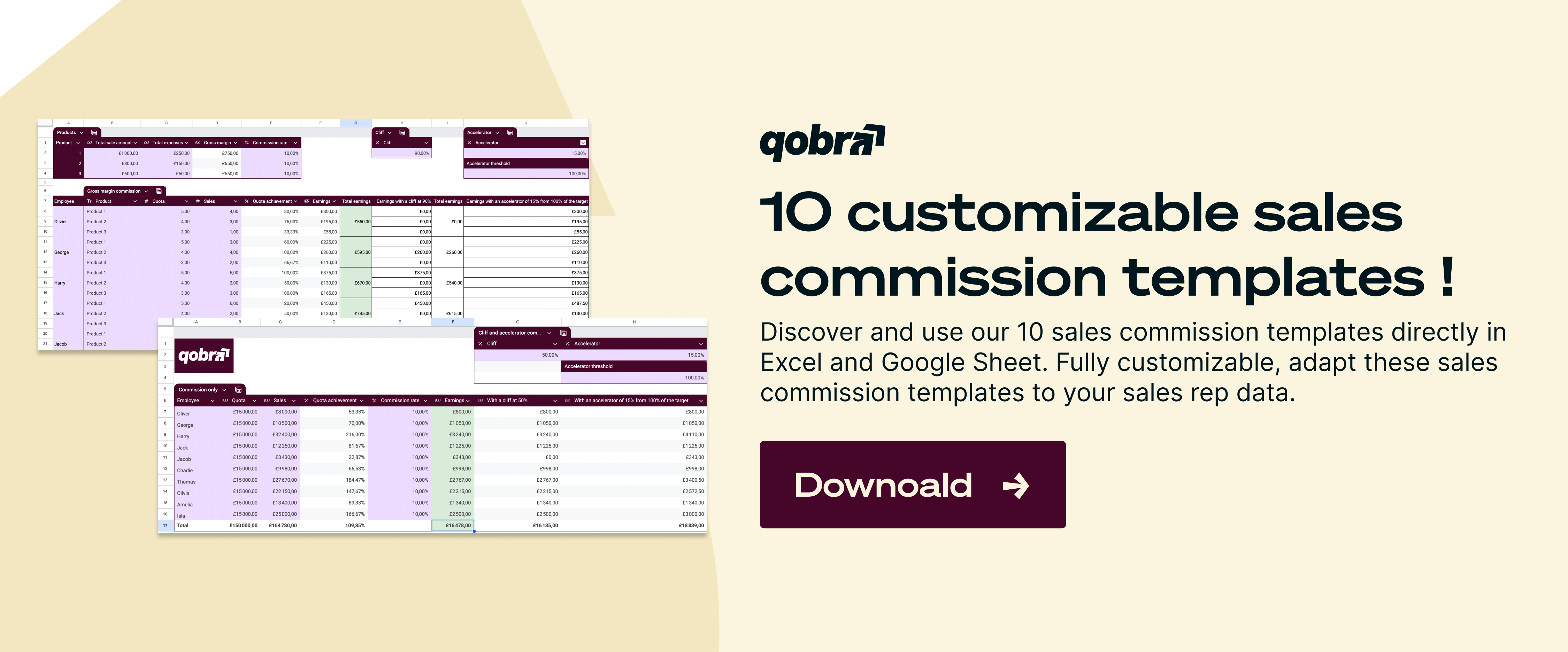
Sales commissions are the lifeblood of many sales teams, but their calculation can be notoriously complex. Structures can include tiers, accelerators, kickers, and clawbacks, making manual tracking in spreadsheets prone to error and dispute.
The most basic formula is:
Commission = Sale Amount × Commission Rate
However, reality is rarely this simple. Modern commission plans often involve multiple variables:
- Tiered Commissions: The commission rate increases as a salesperson sells more (e.g., 5% on the first $50k in sales, 8% on the next $50k).
- Gross Margin Commissions: Commissions are based on the profitability of a deal, not just the revenue. This encourages more profitable sales.
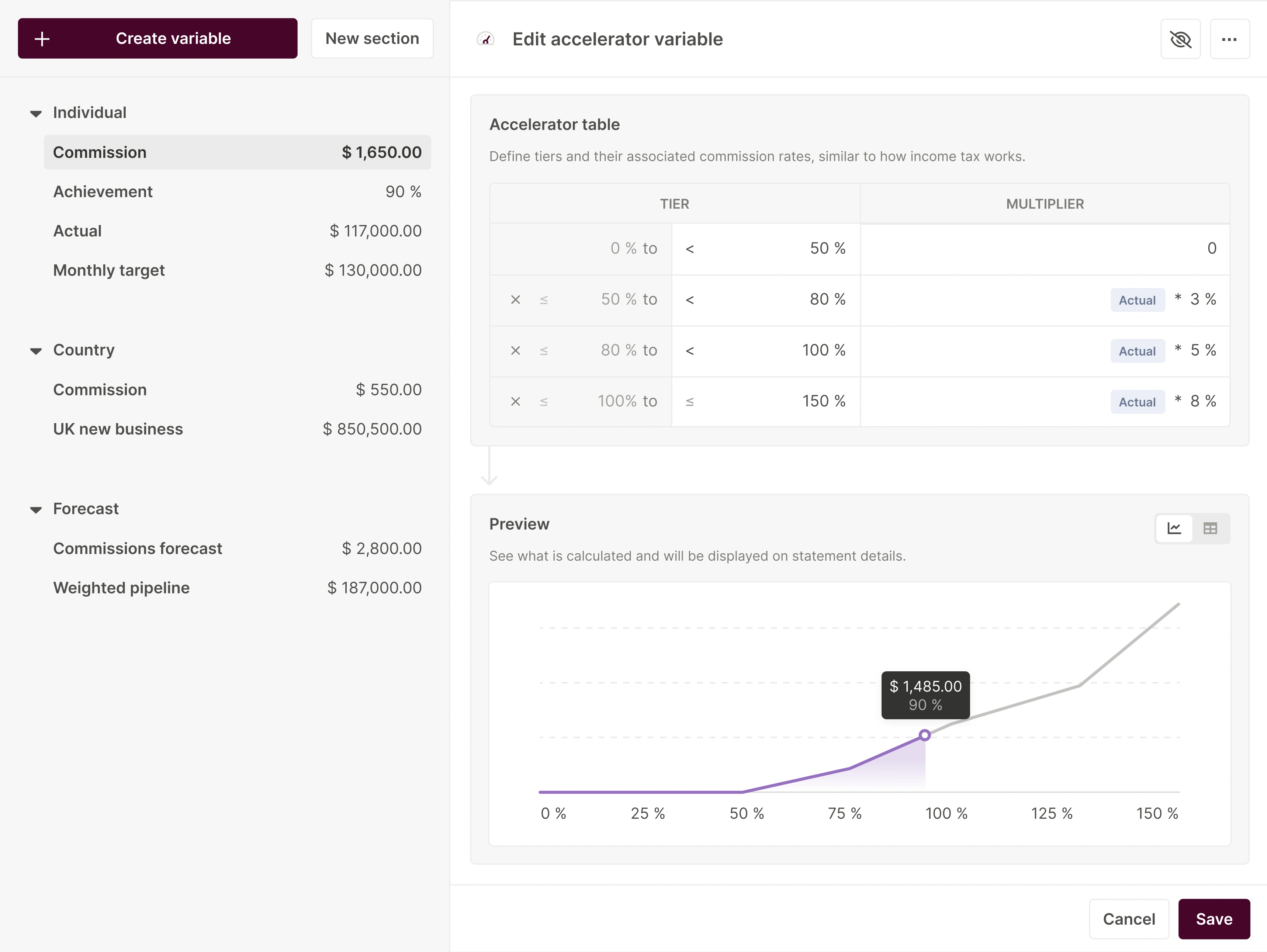
- Accelerators: Higher commission rates that kick in after a salesperson hits 100% of their quota, rewarding top performers.
Manually calculating these complex structures is a major challenge for Sales Ops and Finance teams. This is where automated platforms become essential. A dedicated solution like Qobra connects directly to your CRM to automate calculations in real-time, providing complete transparency for sales reps and eliminating costly errors. Automating this process ensures reps trust their paychecks and stay motivated to hit their goals.
Understanding Severance Pay Calculations
Severance pay is compensation an employee may receive upon involuntary termination of their employment. There is no universal legal requirement for it in many jurisdictions, but it is a common practice governed by company policy or employment contracts.
A common formula used by companies is:
Severance Pay = (Weeks of Pay per Year of Service) × (Number of Years of Service) × (Weekly Pay)
For example, if a company's policy is to offer two weeks of pay for every year of service, an employee who worked for 5 years with a weekly salary of $1,500 would receive:
2 weeks × 5 years × $1,500/week = $15,000
Note on Legal Requirements
Severance calculation can be subject to local labor laws and regulations. For instance, collective bargaining agreements or specific national laws may dictate minimum severance amounts. It is always advisable to consult local legal resources or an HR professional to understand specific obligations.
Base Salary vs. Total Compensation: Why the Bigger Picture Matters
Let us compare two hypothetical job offers to demonstrate why focusing only on base salary can be misleading.
| Component | Offer A | Offer B |
|---|---|---|
| Base Salary | $110,000 | $100,000 |
| Target Bonus | 5% ($5,500) | 10% ($10,000) |
| Health Insurance (Employer Share) | $6,000 | $12,000 |
| 401(k) Match | 3% of Salary ($3,300) | 6% of Salary ($6,000) |
| Value of PTO | $8,461 | $9,615 (5 extra days) |
| Total Compensation | $133,261 | $137,615 |
At first glance, Offer A seems better because of the higher base salary. However, when you calculate the total compensation, Offer B is worth over $4,000 more per year due to its superior bonus structure and benefits package. This analysis empowers you to negotiate more effectively or choose the offer that truly aligns with your financial goals.
Understanding and articulating the value of a total compensation package is a powerful tool for both individuals and organizations. It moves the conversation beyond a single number and fosters a deeper appreciation for the full spectrum of rewards associated with a job. By mastering these calculations, you can make smarter career choices and build more competitive and motivating reward systems.

The four-step calculation above holds as long as one person can redo it in a spreadsheet each month. Past a few dozen plans and a moving quota, teams switch to sales commission software that recalculates payouts from CRM data instead.
Frequently Asked Questions
What is the main difference between direct and indirect compensation?
Direct compensation is the money paid directly to an employee, such as salary, bonuses, and commissions. Indirect compensation consists of non-monetary benefits that have financial value, like health insurance, retirement contributions, paid time off, and other perks provided by the employer.
How do you properly value stock options or RSUs?
For Restricted Stock Units (RSUs), the value is relatively straightforward: multiply the number of shares vesting in a year by the current market price of the stock. For stock options, the value is the potential profit, which is the difference between the market price of the stock and the lower "strike price" at which you can purchase it. This value is speculative, especially in private companies, but represents significant financial upside.
How can businesses automate complex commission calculations?
Businesses can automate their commission calculations using specialized software. Platforms like Qobra integrate directly with CRM systems (like Salesforce or HubSpot) to pull deal data automatically. They use a no-code rule editor to configure even the most complex commission structures, eliminating manual errors from spreadsheets and providing sales teams with a real-time view of their earnings, which boosts motivation and transparency.