Webinar: The Biggest Release Sales Comp Has Ever Seen. Come See For Yourself (Wednesday, October 7)
Register
- Clarify the term: distinguish the two meanings—(a) a commission policy as a formal sales compensation agreement (use this in business contexts) and (b) a policy produced by an expert commission; the guide should focus on the sales-compensation sense.
- Include essential clauses: parties and effective dates, role/responsibilities, commission structure and rates (flat/tiered/margin), quotas and measurement, clear trigger for “earned” commissions, payment cadence and method, clawback rules, termination treatment, dispute resolution, and signatures.
- Cover legal and compliance requirements: provide a written, signed contract; respect jurisdictional rules (e.g., California/New York require explicit written commission agreements), follow contract and employment law in EU/UK, and require transparent notice and consent for material changes.
- Operationalise with tools and processes: stop relying on spreadsheets—integrate CRM and finance, use automated commission software for reliable calculations, real-time rep dashboards, audit trails, and clear reporting to reduce disputes and save ops time.
- Deliver practical assets and cadence: supply templates, worked examples (e.g., tiered calculation), a checklist for completeness, and schedule annual reviews or updates whenever plans materially change.
How can you ensure your sales team is motivated, aligned with company goals, and crystal clear on how their performance translates into earnings? The answer lies in a robust, transparent, and legally sound commission policy. This document is the cornerstone of any successful sales compensation strategy, yet the term itself can cause confusion.
The phrase "commission policy" can refer to two distinct concepts. It might describe the official stance or operational rules of an expert body, like the European Commission or a specialised working group on arbitration. However, in the world of business and sales, it almost always refers to a sales commission policy or commission agreement—a formal contract that outlines the structure of a salesperson's variable pay. This article focuses exclusively on this second, crucial definition, providing a complete guide for Sales Ops, Finance leaders, and HR professionals to build, implement, and manage effective commission policies.
What is a Commission Policy? Clarifying the Two Meanings
Before diving into the mechanics of creating a sales compensation agreement, it's essential to distinguish between the two primary uses of the term to avoid any ambiguity.
The Sales Commission Policy (or Commission Agreement)
A sales commission policy is a formal, written contract that details every aspect of a salesperson's incentive compensation package. It serves as the single source of truth for how commissions are earned, calculated, and paid.
The primary purposes of this document are to:
- Motivate Performance: Clearly link sales activities and results to financial rewards.
- Ensure Transparency: Eliminate confusion and disputes by defining all rules in advance.
- Provide Legal Protection: Create a binding agreement that protects both the company and the employee.
- Align Teams with Business Goals: Structure incentives to drive specific outcomes, such as selling high-margin products or acquiring new logos.
This policy is the foundational document for any variable pay structure and is indispensable for managing sales teams effectively. A well-crafted policy prevents misunderstandings and aligns the entire revenue organisation.
The Policy of an Expert Commission
In a completely different context, a "commission policy" can refer to the mandate, procedures, or official positions of a formal commission or committee. These bodies are typically established by governments or international organisations to study specific issues, create regulations, or provide recommendations.
Examples include:
- The European Commission: This is the executive branch of the European Union, responsible for proposing legislation, implementing decisions, and managing the day-to-day business of the EU. Its policies cover vast areas like trade, agriculture, and digital services.
- Specialised Working Groups: An organisation like the International Chamber of Commerce (ICC) has commissions, such as the Commission on Arbitration and ADR. These groups, composed of experts, develop rules and guidelines that become the policy for their respective fields.
While these commissions are vital in their own domains, they are unrelated to sales compensation. The remainder of this guide will focus solely on the creation and management of sales commission policies.
The Essential Components of a Sales Commission Policy
A comprehensive commission policy leaves no room for interpretation. It must be detailed, precise, and cover every potential scenario. Omitting a key clause can lead to disputes, demotivation, and legal challenges. Here are the indispensable elements your agreement must include.
1. Parties and Agreement Period
This foundational section identifies the company and the employee covered by the policy. It must also clearly state the effective start and end dates of the agreement, which typically align with the fiscal year or sales period.
2. Role and Responsibilities
Briefly outline the employee's job title and their core responsibilities. This clarifies the context in which the commissions can be earned and ensures the policy is tied to a specific role.
3. Commission Structure and Rate
This is the heart of the policy. It details how commissions are earned. Your policy should explicitly define the commission structure, which could be:
- Flat Rate: A single percentage of revenue or profit for all sales.
- Tiered Commission: Rates that increase as the salesperson achieves higher levels of sales volume.
- Territory Volume: Commissions based on the total sales within a specific region.
- Gross Margin Commission: Commissions calculated on the profit of a sale, not just the revenue.
For each structure, the specific rates must be clearly stated. For a deeper dive, explore this detailed guide to sales commissions to find the best fit for your business.
4. Sales Goals and Quotas
The policy must define the sales targets or quotas the employee needs to meet to be eligible for commissions. This section should specify the quota amount, the period it covers (e.g., monthly, quarterly), and how attainment is measured.
5. Basis of Calculation
When is a commission officially "earned"? This clause is critical for preventing disputes. The trigger event must be unambiguous. Common triggers include:
- When a contract is signed.
- When the customer's first invoice is paid.
- When the product or service is delivered/implemented.
- When revenue is fully recognised by the finance department.
6. Payment Schedule and Process
This section outlines the operational details of payment. It should answer:
- Frequency: Are commissions paid monthly, quarterly, or on another schedule?
- Timing: How long after the close of a period are commissions paid out (e.g., "by the 15th of the following month")?
- Method: How will the payment be delivered (e.g., included in the regular paycheck)?
7. Clawback Clause
A clawback clause, or provision for retro-commissions, protects the company in cases where a sale is reversed after a commission has been paid. It defines the conditions under which the company can reclaim commissions, such as:
- Customer returns a product.
- Customer cancels a contract during a "cooling-off" period.
- Customer defaults on payment.
The timeframe and mechanism for the clawback (e.g., deduction from future commissions) must be clearly explained.
8. Termination Terms
What happens to pending commissions when a salesperson leaves the company, whether voluntarily or involuntarily? This clause should specify how commissions are handled for deals closed before the departure date but paid by the customer afterward.
Clarity on Termination is Non-Negotiable
The termination clause is one of the most common sources of legal disputes. Be extremely precise about the conditions for final commission payouts. Specify a clear cut-off date and define the status a deal must have (e.g., "invoice paid in full") by that date to be eligible for commission. This transparency protects both parties and minimises legal risk.
Practical Examples and Models
Translating these components into a clear and fair policy requires careful thought. Let's illustrate with a practical example and a checklist.
Example of a Commission Calculation
Imagine a Sales Representative with the following tiered commission plan for Q1:
- Quarterly Quota: $100,000
- Commission Rate:
- 8% on all revenue up to 100% of quota attainment.
- 12% on all revenue above 100% of quota attainment.
In Q1, the rep closes $130,000 in eligible revenue. Here is how the commission would be calculated:
Description | Revenue | Commission Rate | Commission Earned |
|---|---|---|---|
Revenue up to quota | $100,000 | 8% | $8,000 |
Revenue above quota | $30,000 | 12% | $3,600 |
Total | $130,000 | $11,600 |
This simple table demonstrates the importance of defining tiers and accelerators clearly within the policy document.
Commission Policy Template Checklist
Use this checklist to ensure your commission agreement is comprehensive.
- Agreement Details: Company & Employee Name, Job Title, Effective Dates.
- Compensation Plan: Base Salary, Variable Target Incentive.
- Quota: Clearly defined quota for the period (monthly/quarterly/annually).
- Commission Structure: Type of plan (e.g., flat, tiered, bonus).
- Commission Rates: Explicit percentages or fixed amounts for each tier or event.
- Definition of a "Sale": The exact trigger point for earning a commission.
- Payment Cadence: Schedule and timing of commission payouts.
- Clawback Clause: Conditions for commission reversals.
- Termination Policy: Rules for final payments upon departure.
- Dispute Resolution Process: Steps to follow in case of a disagreement.
- Signatures: Dated signatures from both the employee and a company representative.
Legal and Compliance Considerations by Region
A commission policy is a legally binding contract, and its requirements can vary significantly by jurisdiction.
In the United States (California & New York)
Certain states have strict laws governing commission agreements. For instance:
- California: Labor Code Section 2751 requires that any employee paid by commission must be provided with a written contract that details how commissions are calculated and paid. This contract must be signed by both parties.
- New York: A similar law requires employers to provide commissioned salespeople with a written agreement outlining the terms of their compensation.
Failure to comply in these states can result in significant penalties. It's crucial to ensure your policy is written, signed, and provided to the employee.
In the European Union & UK
While the EU and UK may not have specific "commission laws" as prescriptive as those in California, general principles of contract and employment law apply. An oral agreement is often insufficient and difficult to enforce. A written policy is considered a best practice to:
- Ensure Clarity: It serves as clear evidence of the agreed-upon terms.
- Prevent Disputes: It reduces the likelihood of litigation under employment law.
- Comply with Transparency Rules: Some jurisdictions have rules requiring employers to provide written statements of key employment terms.
When making changes to a compensation plan, understanding the legal obligations is critical to ensure a smooth transition and maintain trust.
Operationalizing Your Commission Policy: From Plan to Paycheck
Having a well-written policy is only half the battle. The real challenge—and opportunity—lies in its implementation.
Choosing the Right Tools for Tracking and Calculation
Many companies still rely on spreadsheets to manage commissions. While seemingly simple, this approach is fraught with risks:
Spreadsheets are prone to human error, lack scalability, and offer zero transparency to the sales team. A single broken formula can lead to incorrect payments, disputes, and a significant loss of trust. The process is also incredibly time-consuming for Sales Ops and Finance teams, who spend days instead of minutes verifying data and running calculations.
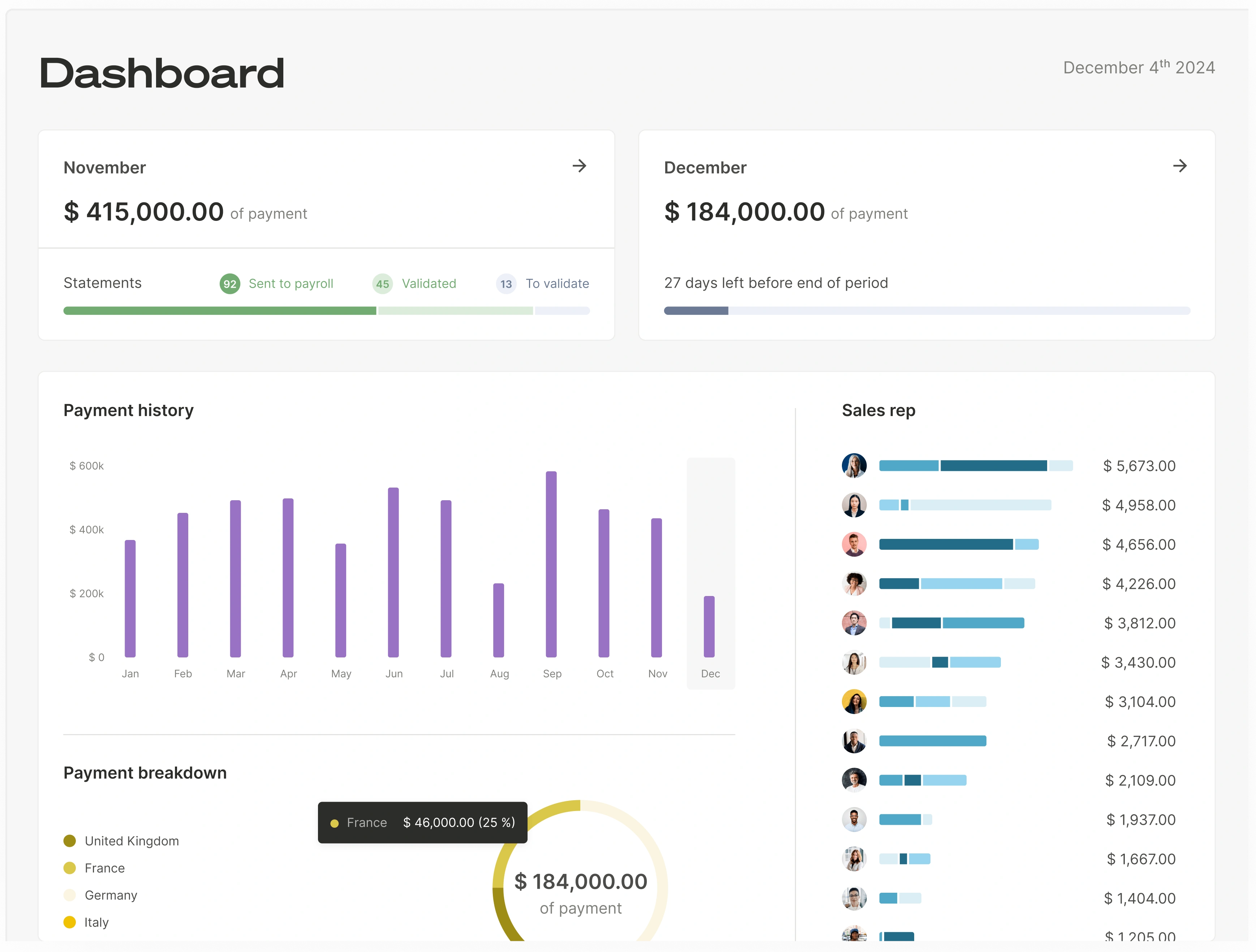
This is where automated commission management platforms transform the process. A modern solution like Qobra is designed to eliminate these pain points. By integrating directly with your CRM (like Salesforce or HubSpot) and other data sources, it automates the entire lifecycle:
- Reliable Calculation: The platform pulls data in real-time and applies the rules defined in your policy, eliminating manual errors.
- Full Transparency: Sales reps get a dedicated dashboard where they can see their commissions in real time, track their progress toward quotas, and even simulate potential earnings from their pipeline.
- Time Savings: Automation drastically reduces the administrative burden on Ops and Finance, freeing them up for more strategic tasks. The process becomes 5 to 10 times faster.
- Audit Trail: Every calculation and adjustment is tracked, providing a reliable audit trail for compliance and dispute resolution.
When choosing the right commission software, look for a no-code platform that allows you to configure and adapt complex plans without relying on developers.
The Power of Transparency
Giving salespeople real-time visibility into their earnings is one of the most powerful motivators. When a rep can see a commission appear on their dashboard moments after closing a deal, it creates a direct and immediate feedback loop that reinforces positive behaviour. This transparency builds trust, reduces shadow accounting (reps keeping their own spreadsheets), and focuses the team on selling.
A commission policy is far more than an administrative necessity; it is a strategic tool that directly impacts sales performance, team morale, and your company's bottom line. By ensuring your policy is clear, comprehensive, and legally sound, you lay the foundation for a motivated and high-achieving sales organisation. Paired with modern tools that automate calculation and enhance transparency, your commission policy can become a true competitive advantage, turning your compensation plan from a source of friction into a powerful engine for growth.

Frequently Asked Questions (FAQ)
What should a commission policy contain to be legally sound?
To be legally sound, a commission policy must be a written document that clearly defines all terms, including the commission rate, calculation method, payment schedule, and conditions for earning commissions. It must also include clauses covering termination and disputes. Most importantly, it should be signed and dated by both the employee and an authorized company representative.
How often should we update our commission policy?
A commission policy should be reviewed and updated at least once a year, typically before the start of a new fiscal year. It must also be updated any time you make material changes to your sales compensation plans. Any changes should be communicated clearly, and a new agreement signed by the employee.
How do you handle commissions on sales with discounts or returns?
This should be explicitly addressed in your policy. For discounts, specify whether commissions are paid on the gross or net sale value. For returns or cancellations, the clawback clause should detail the process for reclaiming any commission already paid on that transaction.
What's the difference between a commission policy and a commission plan?
The terms are often used interchangeably, but there's a subtle difference. The commission plan refers to the set of rules and structures for calculating variable pay (e.g., the tiers, rates, and accelerators). The commission policy is the formal, legally binding document or contract that contains the commission plan and all the surrounding terms and conditions.
Can an employer change a commission policy?
Yes, an employer can typically change a commission policy, but it cannot be done retroactively to affect commissions that have already been earned. Changes should be communicated in writing with reasonable notice, and employees should be required to sign a new agreement reflecting the updated terms. Unilateral changes can lead to legal challenges.