Sales Compensation Software Benchmark | Compare 15+ Sales Compensation Platforms
Download
- Commission solutions automate the full variable-pay lifecycle—plan design, calculations, approvals, and reporting—centralizing data and replacing error-prone spreadsheets to become a single source of truth.
- Three main options exist: dedicated SaaS platforms (flexible, no-code, real-time integrations), custom in-house systems (highly tailored but costly and rigid), and ERP/CRM modules (integrated but often limited in capability).
- Must-have features: no-code plan builder, real-time CRM integration, transparent rep dashboards and simulators, workflow automation with audit trails, and robust reporting/analytics.
- Implementation best practices: assess pains and future needs, clean and map CRM data, define requirements, configure integrations and plans, run parallel tests/UAT, then train users and communicate benefits for adoption.
- Typical ROI: major time savings (5–10x faster), drastic error reduction (automation can cut errors by >95%), measurable uplifts in sales performance (often cited at 15–20% quota improvement) and faster strategic agility.
Are your finance and sales ops teams still drowning in spreadsheets at the end of every quarter? The hours spent manually calculating commissions, correcting errors, and fielding disputes from sales reps not only drain resources but also undermine the very purpose of compensation: to motivate and align your team. If this sounds familiar, it's time to look beyond manual processes. A modern commission solution is no longer a luxury but a strategic necessity for scaling businesses that want to drive performance, ensure accuracy, and retain top talent.
These powerful platforms transform commission management from a painful administrative task into a dynamic lever for growth. By automating calculations, providing real-time visibility, and integrating seamlessly with your existing tools, they eliminate friction and empower your teams to focus on what they do best. This guide will walk you through everything you need to know, from understanding the different types of solutions to choosing and implementing the perfect platform for your organization.
What Are Commission Solutions and Why Do They Matter?
A commission solution is a specialized software or system designed to automate the entire lifecycle of variable compensation management. This includes designing commission plans, calculating payouts, managing approvals, and providing detailed reporting and analytics for all stakeholders—from individual sales reps to the C-suite.
The alternative, which is still surprisingly common, is relying on spreadsheets. While seemingly free, this manual approach carries significant hidden costs:
- Costly Errors: Manual data entry and complex formulas are breeding grounds for mistakes. Overpayments directly impact your bottom line, while underpayments can lead to demotivated reps and even legal disputes. Automated systems can reduce these errors by over 95%.
- Lack of Transparency: When reps can't see how their commissions are calculated, they lose trust in the process. This leads to "shadow accounting"—reps wasting time maintaining their own spreadsheets—and constant queries to your finance team.
- Wasted Administrative Time: Finance and Sales Ops teams can spend days, or even weeks, each pay period consolidating data, running calculations, and verifying payouts. This is time that could be spent on strategic analysis and planning.
- Inflexibility: Modifying a commission plan built on a complex web of spreadsheets is a daunting task. This lack of agility prevents businesses from adapting their incentive strategies to changing market conditions or business goals.
A dedicated commission solution addresses these issues head-on. By centralizing all data and logic, it becomes the single source of truth for compensation, fostering trust, driving motivation, and transforming raw sales data into actionable business intelligence.
Types of Commission Management Solutions
Not all commission management tools are created equal. They generally fall into three main categories, each with its own set of advantages and disadvantages.
Dedicated Commission Software (SaaS)
This is the modern standard for managing variable pay. These are specialized, cloud-based platforms built specifically for the complexities of sales commissions. Solutions like Qobra are leaders in this space, offering a powerful combination of flexibility and ease of use.
Pros:
- Automation: End-to-end automation of calculations saves immense time and eliminates manual errors.
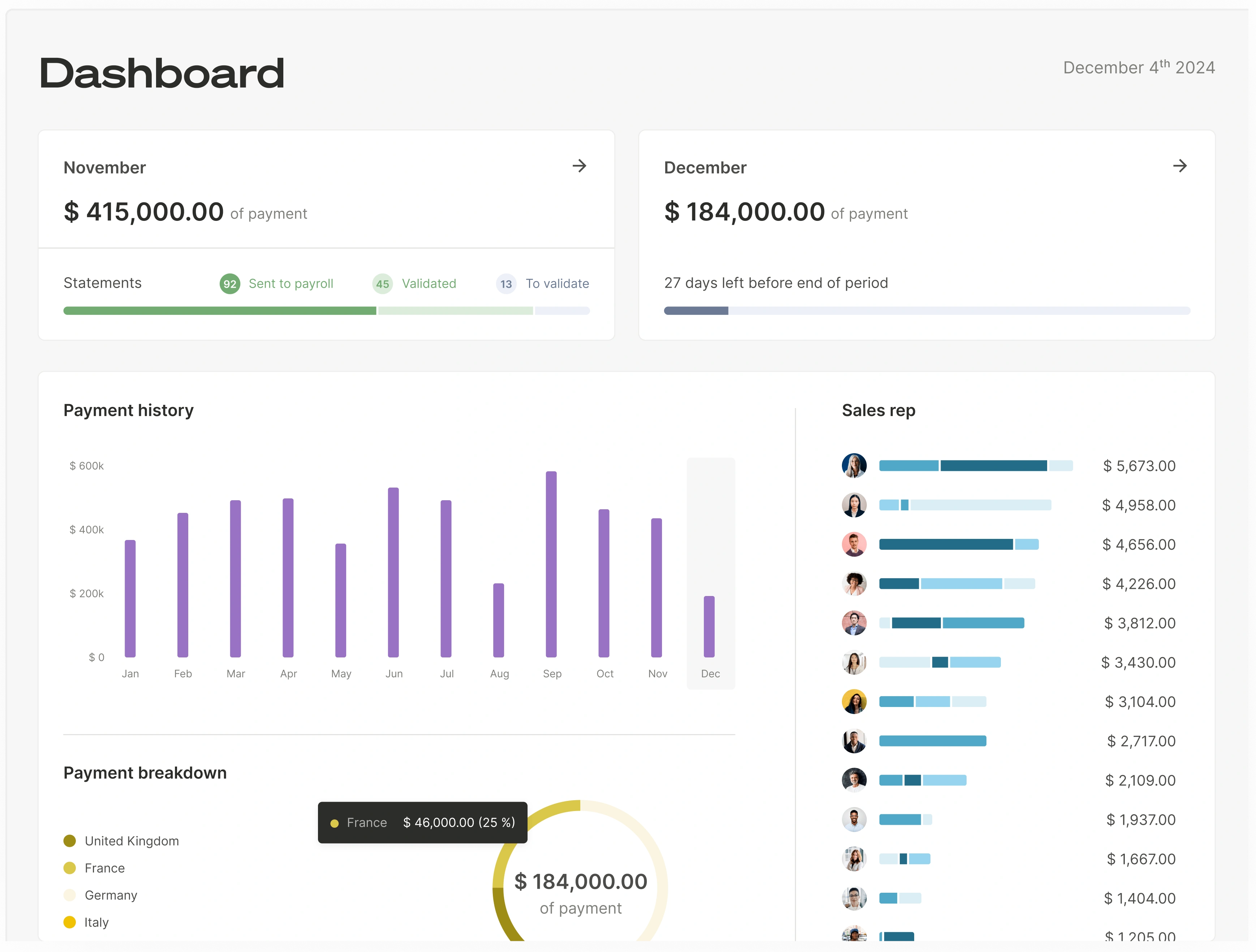
- Transparency: Real-time dashboards give sales reps clear visibility into their earnings and progress toward goals, which is a massive motivator.
- Flexibility: Advanced no-code plan builders allow administrators in Finance or Ops to configure and adjust complex compensation plans without needing to write a single line of code or rely on developers.
- Integration: Native integrations with CRM (Salesforce, HubSpot), ERP, and HRIS systems ensure data is always accurate and up-to-date.
- Scalability: Built to handle growth, including multiple currencies, complex team hierarchies, and evolving product lines.
Cons:
- Requires a subscription fee, though the ROI from time savings and error reduction often provides a quick payback.
In-house/Custom-Built Systems
Some large enterprises with very unique requirements opt to build their own commission systems from scratch using their internal development teams.
Pros:
- Can be perfectly tailored to highly specific and unconventional business processes.
Cons:
- Extremely High Cost: Development and ongoing maintenance are incredibly expensive and resource-intensive.
- Long Timelines: It can take months or even years to build, test, and deploy a stable system.
- Rigid and Difficult to Change: Any modification to the plan requires developer time, creating a significant bottleneck.
- High Risk: The project is dependent on the internal team's expertise and can easily become a "legacy system" that is difficult to support over time.
ERP/CRM Modules
Many major ERP (Enterprise Resource Planning) and CRM (Customer Relationship Management) platforms offer add-on modules for commission management.
Pros:
- Data is already within the existing ecosystem, simplifying integration.
Cons:
- Limited Flexibility: These modules are often an afterthought. They typically struggle to handle anything beyond the most basic commission structures, such as flat-rate percentages.
- Poor User Experience: The interfaces are rarely designed with the sales rep or the plan administrator in mind, leading to low adoption and frustration.
- Lack of Specialization: They lack key features found in dedicated tools, such as plan simulation, detailed audit trails, and robust reporting.

Core Features to Look for in a Commission Platform
When evaluating dedicated commission software, certain features are non-negotiable for achieving a true return on investment.
No-Code Plan Builder
The heart of any modern commission solution is its ability to be managed by the people who own the compensation strategy—typically Sales Ops or Finance. A no-code, intuitive plan builder allows administrators to create, test, and deploy any type of rule through a drag-and-drop or visual interface. This includes:
- Tiered commission rates
- Accelerators and bonuses
- Spiffs and sales contests
- Multi-currency payouts
- Complex conditional logic
This agility means you can adapt your commission plans in hours, not weeks, empowering you to respond swiftly to market dynamics.
Real-Time Data Integration
A commission platform is only as good as the data it receives. Look for solutions with robust, native integrations to your core business systems, especially your CRM. The data sync should be automatic and programmable (e.g., hourly or even in real-time) to ensure that when a deal is marked "Closed-Won" in Salesforce, the corresponding commission instantly appears on the rep's dashboard. This power of real-time commissions is a game-changer for motivation.
Transparent Dashboards for Sales Reps
For sales reps, clarity is currency. The ideal solution provides each user with a personal, interactive dashboard that clearly displays:
- Total earnings for the current period.
- Progress toward quota and other KPIs.
- A detailed breakdown of every deal contributing to their payout.
- A simulator to forecast potential earnings based on their sales pipeline.
This transparency eliminates disputes and empowers reps to understand exactly what they need to do to maximize their earnings.
Don't Underestimate the Power of Transparency
Providing sales reps with real-time visibility into their commissions is more than just a feature—it's a cultural shift. It builds trust, eliminates the need for "shadow accounting" on personal spreadsheets, and creates a direct, immediate link between effort and reward. Companies that embrace this transparency often see a significant uplift in motivation and a reduction in sales team turnover.
Workflow Automation and Auditing
Managing commissions involves more than just calculation. A robust platform should automate the entire workflow, from validation and adjustments to final approval. Look for features like:
- Configurable approval chains: Route commission statements to managers and finance for sign-off.
- Adjustment management: A simple interface to handle exceptions or apply manual bonuses with a full audit trail.
- Compliance support: A complete history of all calculations, changes, and approvals is crucial for financial audits and compliance with standards like ASC 606.
Robust Reporting and Analytics
Beyond individual payouts, a commission solution should serve as a powerful analytics tool for leadership. Managers and finance teams need dashboards to track key metrics like:
- Total commission expenses vs. budget.
- Sales team performance against quotas.
- The effectiveness of different incentive plans.
- Cost of sales by team, region, or product line.
This data provides invaluable insights for optimizing sales strategy and forecasting future performance.
How to Choose the Right Commission Solution for Your Business
Selecting the right platform is a critical decision. Follow this structured approach to ensure you find the perfect fit.
Step 1: Assess Your Current Pains and Future Needs
Before looking at any software, document your current process and identify the key friction points. Ask your team:
- How many hours per month are spent on commission calculations and validation?
- What is the estimated financial impact of payment errors in the last year?
- How often do reps question the accuracy of their commission statements?
- Are our current compensation plans too simple because our current system can't handle complexity?
- What are our growth plans for the next 1-3 years (e.g., team expansion, entering new markets)?
Step 2: Define Your Key Requirements
Use your assessment to build a checklist of requirements. Prioritize them into "must-haves" and "nice-to-haves."
| Feature Category | Key Questions to Ask |
|---|---|
| Plan Complexity | Can the tool handle our tiered rates, accelerators, and bonus structures? |
| Integration | Does it offer a native, real-time integration with our CRM (e.g., Salesforce)? |
| User Experience | Is the interface intuitive for both admins and our sales reps? |
| Scalability | Can it support multi-currency, multiple business units, and a growing team? |
| Reporting | Does it provide the dashboards and analytics our leadership team needs? |
| Security | Does it offer enterprise-grade security features like SSO and role-based permissions? |
This process of choosing the right software will help you focus your evaluation and compare vendors objectively.
Step 3: Evaluate Vendors and Request Demos
With your requirements in hand, create a shortlist of vendors. Schedule personalized demos and come prepared with specific scenarios based on your commission plans. During the demo, pay close attention to the platform's ease of use. A powerful tool that is difficult to navigate will result in low adoption and failed implementation.
Implementing Your New Commission Solution: A Practical Checklist
A successful implementation is about more than just technology; it's about process and people.
Phase 1: Preparation and Planning
- Assemble the Team: Involve key stakeholders from Sales, Sales Ops, Finance, and HR.
- Document Everything: Create a detailed document outlining every rule and exception in your current commission plans.
- Clean Your Data: The new system will pull data directly from your CRM. Ensure this data is clean and accurate. Garbage in, garbage out.
The Data Quality Trap
Even the most advanced automation platform is at the mercy of its source data. Before going live, conduct a thorough audit of your CRM data. Are deal values correct? Are opportunity owners properly assigned? Investing time in data cleansing upfront will prevent countless headaches and calculation errors down the line.
Phase 2: Configuration and Integration
- Connect Data Sources: Establish the integration between the commission platform and your CRM.
- Build the Plans: Use the no-code editor to replicate your documented plans in the new system.
- Set Up Users: Define roles and permissions for administrators, managers, and sales reps.
Phase 3: Testing and Validation
- Run in Parallel: For at least one pay period, calculate commissions using both your old method (e.g., spreadsheets) and the new platform. Compare the results to ensure 100% accuracy.
- User Acceptance Testing (UAT): Involve a small pilot group of managers and trusted reps to test the system and provide feedback.
Phase 4: Rollout and Training
- Communicate the "Why": Before launch, explain the benefits of the new system to the entire sales team. Focus on transparency, accuracy, and real-time visibility. Communicating a new plan effectively is key to adoption.
- Conduct Training: Hold separate training sessions for administrators (on plan building) and for sales reps (on using their dashboards).
Following a structured process for implementing your sales commission plan will ensure a smooth transition and immediate value.
The Tangible ROI of Automating Commission Management
Investing in a commission solution delivers clear, measurable returns across the business.
- Massive Time Savings: Companies report that automating commissions is 5 to 10 times faster than manual processes. This frees up your highly skilled finance and ops teams to focus on strategic initiatives instead of administrative tasks. Explore the full time-saving benefits of a commission tool.
- Drastic Error Reduction: Automation eliminates human error, saving money on overpayments and preventing the trust erosion caused by underpayments.
- Increased Sales Performance: The transparency and motivation provided by real-time dashboards can lead to a significant uplift in performance. Some companies see a 15-20% increase in quota attainment after implementation.
- Enhanced Strategic Agility: With a no-code platform, you can test, model, and deploy new incentive plans in a fraction of the time, allowing your business to pivot quickly and effectively.
Moving away from spreadsheets is more than an operational upgrade; it's a strategic investment in the accuracy, efficiency, and motivation of your most critical revenue-generating teams. By embracing a modern commission solution, you provide your team with the clarity and tools they need to succeed, while giving your business the reliable data and agility required to thrive.
Frequently Asked Questions
How long does it take to implement a commission solution?
Implementation time can vary depending on the complexity of your plans and the cleanliness of your data. For a straightforward setup, many companies can be fully live in just a few weeks. More complex projects with multiple integrations might take 2-3 months.
Can a commission tool handle very complex, multi-tiered plans?
Yes, this is a primary strength of dedicated solutions. Unlike basic CRM modules, platforms like Qobra are designed with a flexible, no-code engine capable of handling virtually any rule, including multi-level tiers, accelerators, kickers, splits, and complex bonus structures.
How do these solutions integrate with payroll systems?
Most modern commission platforms provide finalized payout reports that can be easily exported in a format compatible with your payroll system (e.g., CSV). This ensures a seamless handoff to the payroll team for final processing, without requiring them to re-calculate anything.
Is a dedicated commission solution better than using our CRM's built-in module?
For any business with more than a handful of reps or a compensation plan that goes beyond a simple flat percentage, a dedicated solution is almost always the superior choice. They offer far greater flexibility, a better user experience for sales reps, more robust auditing, and deeper analytics than the limited functionality found in most CRM add-ons.
Are there solutions that link commission payouts to real-time sales performance data?
Yes. Dedicated commission platforms integrate natively with core business systems, especially the CRM, so sales data feeds the commission calculation without manual consolidation. The data sync should be automatic and programmable, for example hourly. Each sales rep then sees, on a personal dashboard, total earnings for the current period, progress toward quota and a detailed breakdown of every deal contributing to the payout.