Sales Compensation Software Benchmark | Compare 15+ Sales Compensation Platforms
Download
- "Commission strategy" has two meanings: an institutional strategy (e.g., the European Commission’s multi-year policy roadmap) and a commercial strategy (sales compensation designed to align behavior with business goals).
- Institutional strategies focus on long-term priorities, stakeholder negotiation, formal planning cycles, impact assessments and tactical adaptations (illustrated by cases like the EU–Mercosur negotiations).
- Commercial commission strategies center on clear objectives and core plan elements—OTE, quotas, commission rates, accelerators/decelerators, clawbacks—and require transparent communication to build trust.
- Practical implementation follows four steps: gather and validate data, model scenarios and financial impact, automate calculations and CRM integration for real-time visibility, then deploy with training and documentation.
- Evaluate success with KPIs such as quota attainment, sales cost ratio, employee turnover and time-to-productivity, and review the plan at least annually (with quarterly monitoring for rapid adjustment).
What does it take to turn a high-level vision into tangible results, whether in the halls of parliament or on a sales floor? The answer often lies in a well-defined "commission strategy," a term that carries distinct meanings in two very different worlds: the political corridors of institutions like the European Commission and the dynamic environment of corporate sales teams. While one shapes international policy and trade, the other drives revenue and motivates performance. Understanding both is key to grasping how ambitious goals are translated into concrete action.
This guide will explore both facets of commission strategy. We will first delve into the complex world of institutional policy-making, using the European Commission as a prime example. Then, we will pivot to the commercial sphere, providing a detailed blueprint for designing, implementing, and measuring a sales commission strategy that aligns your team and accelerates growth.
Unpacking "Commission Strategy": Two Distinct Worlds
At its core, a strategy is a plan of action designed to achieve a major or overall aim. The term "commission," however, fundamentally changes the context. Disambiguating these two applications is the first step toward mastering the concept.
Institutional Strategy: The European Commission's Blueprint
In the political arena, "commission strategy" refers to the long-term vision and operational roadmap of a governmental or supranational body, such as the European Commission. This type of strategy is about setting political priorities, allocating resources, and creating legislation to achieve societal, economic, and geopolitical objectives.
Key Characteristics of Institutional Strategy:
Long-Term Horizon: Typically set for multi-year periods (e.g., the European Commission's five-year term).
Broad Scope: Covers diverse policy areas like climate change, digital transformation, economic stability, and international relations.
Stakeholder Complexity: Must balance the interests of member states, parliaments, citizens, and international partners.
Process-Driven: Relies on a formal cycle of planning, legislation, implementation, and reporting.
Commercial Strategy: Driving Sales Performance
In a business context, a "commission strategy" is the framework that governs how sales professionals are compensated based on their performance. It's a powerful tool designed to motivate specific behaviors, align sales activities with company goals, and ultimately, drive revenue growth. It is a critical component of the overall sales compensation plan.
Key Characteristics of Commercial Strategy:
Performance-Linked: Directly ties earnings to measurable achievements (e.g., sales volume, revenue, profit margin).
Goal-Oriented: Designed to incentivize specific outcomes, such as acquiring new customers, selling certain products, or increasing market share.
Dynamic: Often reviewed and adjusted annually or quarterly to reflect changing business priorities.
Tool for Motivation: Acts as a primary lever for motivating and retaining top sales talent.
The Architecture of Institutional Strategy: A European Commission Case Study
The European Union provides a masterclass in developing and executing a complex institutional strategy. Its overall political direction is developed collectively by its main institutions, with the European Council setting the broad goals in a five-year EU Strategic Agenda. The European Commission, as the executive branch, is then responsible for translating these goals into actionable policies and initiatives.
From High-Level Goals to Concrete Actions
The process follows a well-defined annual cycle:
- Setting Priorities: At the start of each five-year term, the President of the Commission outlines the key political priorities. These form the foundation of the Commission's work.
- Annual State of the Union: Every year, the President delivers the State of the Union address to the European Parliament. This speech reviews the past year's achievements and announces the major initiatives planned for the coming year.
- The Commission Work Programme: Based on these priorities, the Commission publishes an annual work programme. This document details the specific legislative proposals, policy reviews, and initiatives that will be undertaken to turn the strategic vision into concrete actions.
- Strategic Foresight and Impact Assessments: Before major initiatives are proposed, the Commission conducts strategic foresight to anticipate future trends and prepares detailed impact assessments to analyze the potential economic, social, and environmental effects of its proposals.
Case Study: The EU-Mercosur Agreement Strategy
Trade agreements are a powerful illustration of institutional strategy in action. The proposed EU-Mercosur deal (covering Brazil, Argentina, Paraguay, and Uruguay) highlights the tactical maneuvers a commission may employ to achieve its objectives, especially when facing opposition.
- Splitting the Agreement: The original negotiation mandate required the trade, political, and cooperation pillars of the agreement to be treated as a single package. To bypass potential vetoes from certain member states, the Commission proposed splitting it into two parts: an "interim Trade Agreement" (iTA) and a broader "Global Partnership Agreement." This move allows the trade component, which falls under exclusive EU competence, to be approved with a qualified majority rather than unanimity.
- Introducing a "Rebalancing Mechanism": To appease Mercosur countries concerned about new EU environmental regulations (e.g., on deforestation), the Commission inserted a novel clause. This mechanism could allow a party affected by a "unilateral measure" to demand trade compensations, potentially weakening the impact of future European environmental standards on imports.
- Adding a Safeguard Clause: To address the concerns of the European agricultural sector, a safeguard clause was included. However, its effectiveness in protecting EU farmers from a surge in imports remains a point of contention.
This case demonstrates that an institutional strategy is not just about planning; it's also about political negotiation, procedural tactics, and adapting to overcome obstacles.
Designing an Effective Sales Commission Strategy
While institutional strategies shape nations, commercial commission strategies shape companies. A poorly designed plan can demotivate teams, encourage the wrong behaviors, and misalign sales with business objectives. Conversely, a strong plan can be a powerful engine for growth.
Defining Your Objectives: The "Why" Behind the Plan
Before drafting any rules or calculating percentages, you must define what you want your commission strategy to achieve. Your goals should be directly linked to the company's overarching business objectives.
Common objectives include:
- Increasing overall revenue: The most common goal.
- Acquiring new logos: Rewarding reps for bringing in new customers.
- Improving profitability: Basing commissions on gross margin rather than just revenue.
- Promoting a new product: Offering higher commission rates or bonuses (SPIFFs) for sales of a specific product.
- Increasing contract length or value: Incentivizing multi-year deals or upselling.
Clarifying these objectives for your sales commission plan is the most critical step in the entire process.
Key Components of a Robust Commission Plan
A comprehensive commission plan should be clear, fair, and easy to understand. It typically includes several core components:
- On-Target Earnings (OTE): The total expected compensation for a salesperson if they meet 100% of their quota, comprising a base salary and a variable commission component.
- Quotas: The specific, measurable targets a salesperson must achieve within a given period (e.g., quarterly revenue goal).
- Commission Rate: The percentage or fixed amount earned on a sale. This is a critical lever, and understanding how to calculate commission rates is fundamental.
- Payout Frequency: When commissions are paid (e.g., monthly, quarterly). More frequent payouts can be more motivating.
- Accelerators and Decelerators: Higher commission rates for over-performance (accelerators) and lower rates for under-performance (decelerators).
- Clawbacks: A provision that allows the company to reclaim commission payments under certain circumstances, such as when a customer churns shortly after a sale.
Communication is Key
A brilliant plan is useless if your sales team doesn't understand it or trust it. When you communicate a new commission plan, be transparent about the "why" behind the changes. Host Q&A sessions, provide clear documentation, and offer illustrative examples to ensure everyone is on the same page.
Common Sales Commission Models
Model Type | How It Works | Best For |
|---|---|---|
Straight Commission | Reps earn a percentage of the sales they generate, with no base salary. | Industries with high ticket prices and short sales cycles (e.g., real estate). Risky for reps. |
Salary + Commission | A fixed base salary plus a variable commission. The most common model. | Providing income stability while still motivating performance. Suitable for most B2B sales roles. |
Tiered Commission | Commission rates increase as a rep surpasses certain sales thresholds. | Strongly motivating high performers to exceed their quotas. |
Gross Margin Commission | Commissions are calculated based on the profit of a sale, not the total revenue. | Businesses where deal profitability varies significantly. Encourages reps to avoid excessive discounting. |
Territory Volume | A team of reps is compensated based on the total sales within a designated territory. | Collaborative sales environments where teamwork is essential for success. |
Choosing the right structure is crucial, and it's often beneficial to explore different types of commission plans before settling on one.
From Design to Deployment: A Practical Guide
Creating a strategy on paper is one thing; implementing it effectively is another. Manual processes using spreadsheets are prone to errors, lack transparency, and consume countless hours for your Sales Ops and Finance teams.
Step 1: Data Gathering and Analysis
Use historical sales data and CRM information to set realistic quotas. Analyze top performer data to understand what is achievable and model your plan accordingly. Inaccurate data will undermine your entire strategy.
Step 2: Modeling and Simulation
Before you roll out the plan, simulate its financial impact. How much will you pay out if 50%, 100%, or 150% of the team hits their quota? What is the impact of a single massive deal? Modeling prevents costly surprises and ensures the plan is financially sustainable.
Step 3: Implementation and Automation
This is where traditional methods break down. Managing complex commission plans on spreadsheets is a recipe for disaster. It leads to:
- Calculation Errors: Manual data entry and complex formulas result in frequent mistakes, eroding trust.
- Lack of Transparency: Reps can't see how their commissions are calculated in real-time, leading to disputes and demotivation.
- Wasted Time: Finance and Ops teams spend days, not hours, calculating and verifying payouts each month.
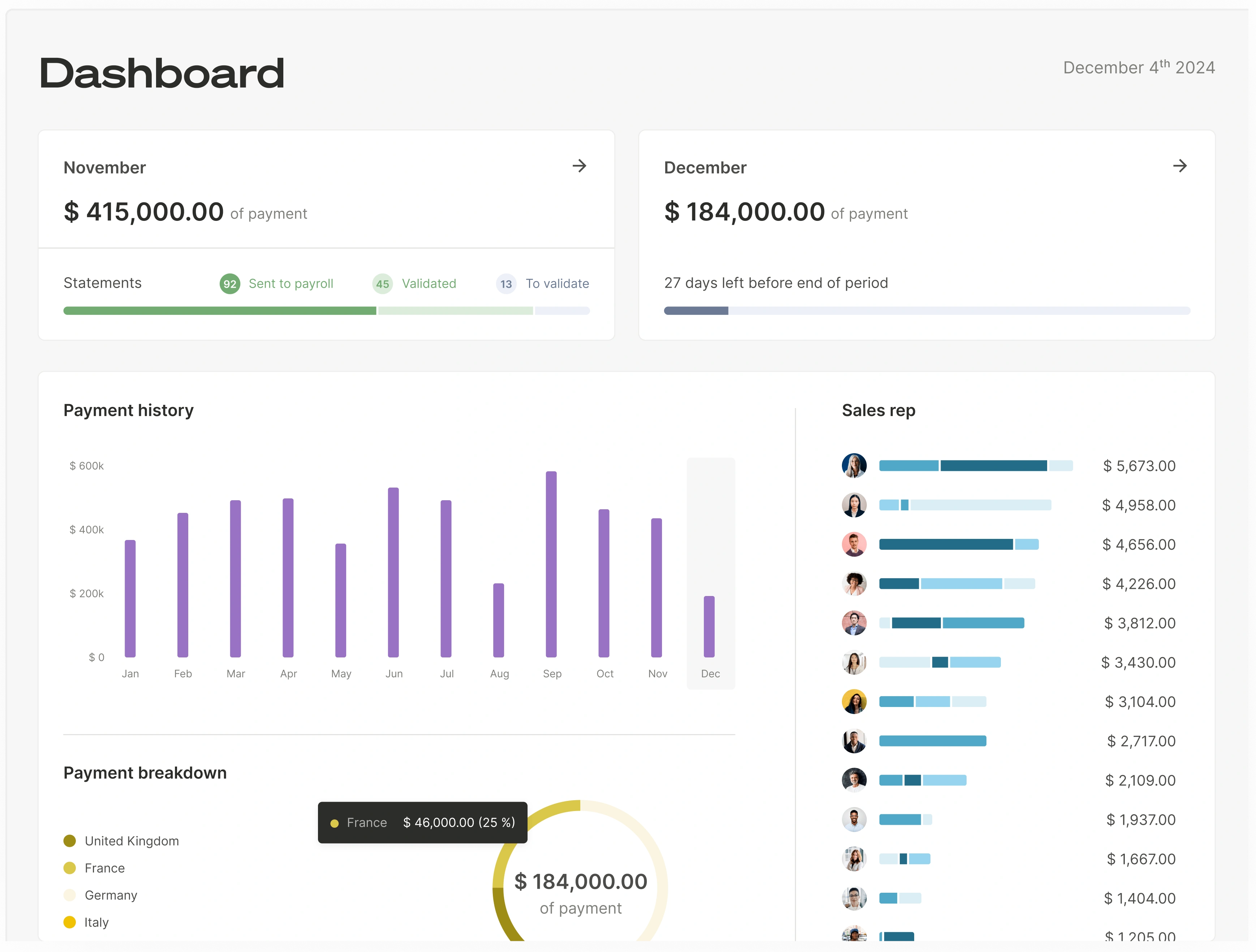
Modern businesses are turning to dedicated platforms to overcome these challenges. A solution like Qobra automates the entire process. Its no-code rule editor allows you to build and modify any plan without technical help. By integrating directly with your CRM (like Salesforce or HubSpot), it pulls data automatically and calculates commissions in real-time. This provides reps with a live dashboard of their earnings, fostering motivation and complete transparency.
The Power of Real-Time Visibility
When salespeople can see their potential earnings increase the moment they close a deal, it creates a powerful motivational feedback loop. This visibility turns the commission plan from a backward-looking paycheck calculation into a forward-looking performance tool. Adopting a platform that enables real-time commission tracking is one of the most impactful changes you can make to your strategy.
Step 4: Monitoring, Reporting, and Adjusting
A commission strategy is not static. You must continuously monitor its effectiveness. Track key performance indicators (KPIs) to see if the plan is driving the desired behaviors. With an automated platform, you can easily access dashboards showing performance against targets, total commission costs, and individual rep attainment, allowing you to make data-driven adjustments as needed.

Measuring the Success of Your Commission Strategy
How do you know if your strategy is working? Look beyond just total revenue. A holistic evaluation includes a mix of performance, financial, and talent metrics.
- Quota Attainment Rate: What percentage of your sales team is achieving their quota? A rate between 40-60% is often considered healthy. If it's too high, quotas may be too easy; if it's too low, they may be unrealistic or the plan may be demotivating.
- Sales Cost Ratio (SCR): The total cost of your sales team (salaries + commissions + overhead) as a percentage of the revenue they generate. Your commission strategy should help optimize this ratio.
- Employee Turnover: High turnover among your sales team, especially top performers, can be a red flag that your compensation plan is uncompetitive or perceived as unfair.
- Time to Productivity: How quickly do new hires start hitting their quotas? A clear and motivating commission plan can significantly shorten this ramp-up time.
Whether orchestrating international policy or steering a sales team toward its next revenue target, a well-conceived strategy is indispensable. For the European Commission, it's a multi-year blueprint built on diplomacy, legislation, and careful planning. For a modern business, it's an agile compensation framework designed to motivate, align, and drive performance. In both cases, success hinges on clear objectives, transparent execution, and the ability to measure impact and adapt. By moving away from manual, opaque processes and embracing automated, transparent tools, businesses can ensure their commission strategy is not just a plan, but a powerful engine for sustained growth.
Frequently Asked Questions
What is the first step in creating a sales commission strategy?
The first step is to clearly define your business objectives. Before thinking about percentages or tiers, you must decide what you want the plan to achieve—be it acquiring new customers, increasing profitability, or promoting a specific product line. The entire strategy should be built to support these core goals.
How often should a sales commission plan be reviewed?
A sales commission plan should be reviewed at least annually. However, it's wise to monitor its performance quarterly. Major business shifts, such as a new product launch, a market entry, or changes in corporate strategy, may necessitate more immediate adjustments to ensure the plan remains aligned and effective.
What's the difference between a commission plan and a commission strategy?
A commission plan refers to the specific document outlining the rules of compensation: the rates, tiers, quotas, and payment terms. The commission strategy is the higher-level thinking behind the plan. It encompasses the "why"—the business objectives the plan is designed to achieve and the specific behaviors it aims to incentivize.
How does automation improve a commission strategy?
Automation, through platforms like Qobra, transforms a commission strategy from a static document into a dynamic performance management tool. It eliminates manual errors, provides real-time visibility for salespeople, saves countless hours for administrative teams, and delivers the data-driven insights needed to measure success and make informed adjustments. This makes the strategy more trusted, more motivating, and ultimately, more effective.