Webinar (Wednesday, October 21) — Aligning HR, Finance, and Sales: Mastering Sales Comp Without Breaking Your Plan
Register
- A compensation formula is a precise mathematical rule that calculates variable pay—commissions, bonuses, service credits or royalties—to align individual rewards with business goals and drive measurable behaviors.
- Core components to define are quota/target, commission or credit rate, accelerators and decelerators, caps/floors, prorata rules and clawbacks; these levers determine motivation, fairness and cost control.
- Common models include straight commission, tiered/accelerator structures, margin‑based commissions, profit sharing and SLA service credits—each with clear step‑by‑step calculations to translate performance into pay.
- Implement by designing simple goal‑aligned formulas, documenting them in formal plans, communicating examples to teams, and reviewing at least annually to ensure they still drive desired outcomes.
- Automate and secure accuracy by integrating formulas into CRM/payroll or commission software, provide downloadable templates/calculators for users, and manage legal risks by honoring contracts and avoiding retroactive changes.
How do you transform a compensation plan from a simple expense line into a powerful strategic lever for growth? The answer lies in moving beyond arbitrary bonuses and opaque calculations to a clear, motivating, and mathematically sound compensation formula. This predefined expression is the engine behind any effective remuneration strategy, dictating how financial rewards are calculated under specific circumstances, whether in sales, service agreements, or contractual obligations.
A well-designed compensation formula does more than just determine a paycheck. It aligns individual performance with overarching business goals, fosters a culture of transparency and trust, and eliminates the confusion that can kill morale. From driving sales performance to ensuring compliance with service level agreements, these structured calculation methods turn abstract targets into tangible, predictable rewards. When your team understands exactly how their efforts impact their earnings, their motivation and performance naturally follow suit.
What is a Compensation Formula?
A compensation formula is a specific equation used to calculate the performance-based portion of an individual's or party's pay. Unlike a total compensation package, which includes base salary, benefits, and other perks, this formula strictly defines how variable payouts are earned based on measurable outcomes.
It serves four core purposes:
- Structured Calculation: It provides a clear, mathematical definition of how incentives are earned, often based on metrics like revenue, deals closed, or service uptime.
- Performance Alignment: It directly ties financial rewards to the behaviors and results that align with company priorities, such as profitability, customer retention, or new market penetration.
- Motivation and Clarity: It incentivizes performance by creating a transparent link between effort and reward. When the rules are clear, teams are more driven to achieve their goals.
- Fairness and Consistency: It ensures that compensation is awarded equitably across the team, reducing the risk of disputes and building trust in the system.
While most commonly associated with sales commissions, compensation formulas are used across various business functions, including service credits for SLAs, profit-sharing plans, and royalties.
Core Components of Any Compensation Formula
Every effective incentive plan is built from a few fundamental components. Understanding these levers is the first step to designing a formula that is both motivating and fair.
- Quota or Target: This is the anchor of your incentive plan. The quota is the baseline goal a team member is expected to meet within a specific period (e.g., monthly, quarterly). It can be based on revenue, units sold, or other key performance indicators (KPIs).
- Commission Rate: This is the percentage or flat fee earned on a sale or achieved target. The rate can be fixed or variable, changing based on performance levels. For guidance on setting the right percentage, explore these methods for how to calculate commission rates.
- Accelerators: These are triggers that increase the commission rate after a salesperson surpasses their quota. Accelerators are powerful motivators for top performers, encouraging them to continue pushing even after their baseline target is met.
- Decelerators: The opposite of accelerators, decelerators reduce the commission rate for performance below a certain threshold of the quota (e.g., below 80% attainment). They are used to discourage underperformance.
- Caps and Floors: A cap is a maximum limit on the total commission an individual can earn in a given period. While sometimes used to control costs, many modern sales organizations favor uncapped commission plans to maximize motivation. A floor guarantees a minimum payout, even if performance is low.
- Clawbacks: A provision that allows the company to reclaim previously paid commissions under specific circumstances, such as when a customer churns shortly after a sale or fails to pay their invoice.
Types of Compensation Formulas with Examples
Compensation formulas vary significantly depending on the industry, role, and business objectives. Below are some of the most common models, complete with step-by-step calculation examples.
Sales Compensation Formulas
Sales incentives are the most common application of compensation formulas. The goal is to motivate reps to drive revenue, acquire new customers, and grow existing accounts.
1. Straight Commission Formula
Formula:
Commission = Total Sales Revenue × Commission Rate
Example:
A sales rep has a 5% commission rate. In a given month, they close deals worth $150,000.
- Calculation:
$150,000 × 0.05 = $7,500 - Total Commission: $7,500
This model is easy to understand but doesn't incentivize overperformance as effectively as tiered structures.
2. Tiered Commission Formula with Accelerators
This model rewards high achievers by increasing the commission rate as they surpass performance milestones.
Example:
A rep earns 5% on sales up to their $100,000 quarterly quota.
- From 101% to 125% of quota, the rate accelerates to 7.5%.
- Above 125% of quota, the rate accelerates to 10%.
If the rep achieves $140,000 in sales for the quarter:
| Tier | Sales Amount in Tier | Commission Rate | Commission Earned |
|---|---|---|---|
| 0-100% of Quota | $100,000 | 5% | $5,000 |
| 101-125% of Quota | $25,000 | 7.5% | $1,875 |
| >125% of Quota | $15,000 | 10% | $1,500 |
| Total | $140,000 | $8,375 |
This structure strongly motivates reps to exceed their targets.
3. Commission Based on Gross Margin
To encourage profitable sales, some companies base commissions on gross margin rather than just revenue. This is particularly useful when products have varying profitability.
Formula:
Commission = (Revenue - Cost of Goods Sold) × Commission Rate
Example:
A rep sells a software package for $20,000. The cost associated with delivering this package (e.g., server costs, third-party licenses) is $4,000. The commission rate on margin is 15%.
- Gross Margin:
$20,000 - $4,000 = $16,000 - Calculation:
$16,000 × 0.15 = $2,400 - Total Commission: $2,400
This aligns the sales team's incentives with the company's financial health. To learn more, see our guide to commission structures based on gross profit.
4. Profit Sharing Formula
This formula is often used for team-based or company-wide incentives. A portion of company profits is distributed among employees, typically based on hours worked or salary.
Formula:
Employee Share = (Total Profit Pool × (Employee Hours / Total Company Hours))
Example:
A company allocates 10% of its semi-annual profit of $500,000 to a profit-sharing pool ($50,000).
- A full-time employee worked 1,000 hours during this period.
- The total hours worked by all eligible employees was 20,000.
- Calculation:
$50,000 × (1,000 / 20,000) = $2,500 - Employee's Profit Share: $2,500
Beyond Commissions: A Holistic Approach
An effective compensation structure often includes more than just commissions. Consider incorporating flat amounts for other valuable contributions, such as:
- Professional Development Budget: A fixed amount per year based on level to encourage continuous learning.
- Cost of Living Adjustments: An annual percentage increase to account for inflation.
- Stock Options: Granted based on level and tenure to promote long-term loyalty.
This multi-faceted approach ensures employees feel valued for their overall contribution, not just their sales numbers.
Service Level Agreement (SLA) Compensation Formulas
In service-based industries, compensation formulas often appear as "service credits" owed to a client if performance targets are not met.
Downtime-Based Service Credit Formula
This is a predefined calculation used to determine the financial remuneration owed to a client when a service fails to meet its guaranteed uptime.
Formula:
Service Credit = ((Total Minutes in Period - Uptime Minutes) / Total Minutes in Period) × Monthly Fee × Credit Percentage
Example:
A SaaS provider guarantees 99.9% uptime for a monthly fee of $5,000. The credit percentage for failing to meet this is 10%. In a 30-day month (43,200 minutes), the service experienced 90 minutes of downtime.
- Guaranteed Uptime:
43,200 minutes × 99.9% = 43,156.8 minutes - Actual Uptime:
43,200 - 90 = 43,110 minutes(Target missed) - Downtime Percentage:
(90 / 43,200) = 0.208% - Calculation:
$5,000 × 10% = $500 - Service Credit Owed: $500
This formula provides a clear and legally sound method for handling service disruptions.
Why Accurate Compensation Calculations Matter
An incentive plan is only as good as its math. If your team can't trust the numbers behind their paycheck, you're facing a problem far bigger than missed quotas. Accuracy in incentive formulas isn't just a payroll issue—it's foundational to performance, trust, and long-term growth.
According to the Incentive Research Foundation, well-structured incentive programs can boost employee performance by as much as 44%. Sales reps thrive on clarity; when they know exactly what actions lead to what rewards, it fuels their ambition. Inaccurate or opaque calculations lead to disengagement, disputes, and attrition. Overpaying erodes profit margins, while underpaying destroys morale and opens the door to legal challenges.
Ultimately, trust is the currency of a high-performing sales team. When your formula is transparent and your calculations are consistently accurate, that trust is built. Reps can confidently forecast their earnings, plan their pipelines, and focus on selling, knowing the system is fair. This is why many companies are moving away from error-prone spreadsheets and towards automated solutions that guarantee accuracy.
How to Implement and Manage Compensation Formulas Effectively
Designing the right formula is only half the battle. Successful implementation and ongoing management are critical to realizing its benefits.
Step 1: Design the Right Formula
Start by defining your business objectives. Do you want to increase market share, improve profitability, or drive renewals? Your formula should directly incentivize the behaviors needed to achieve these goals. Keep the formula as simple as possible. If a rep needs a calculator and a rulebook to figure out their commission on a deal, it's too complicated. For guidance, review some of the most common types of commission plans.
Step 2: Document and Communicate Clearly
Once designed, the formula must be documented in a formal compensation plan. This document should clearly outline all components: quotas, rates, accelerators, payment schedules, and rules of engagement. After documentation, it's vital to clearly communicate the new compensation structure to the entire team. Hold a meeting to walk through examples and answer any questions to ensure everyone understands how they will be rewarded.
The Power of Automation
Manual commission tracking using spreadsheets is not only time-consuming but also riddled with risks. A single formula error can lead to significant overpayments or underpayments, eroding trust and creating payroll chaos. The process often takes days each month, pulling valuable resources away from more strategic activities.
Step 3: Automate the Calculation with the Right Tools
This is where technology becomes a game-changer. Manual processes are the enemy of accuracy and transparency. A dedicated commission management platform like Qobra eliminates these challenges by automating the entire process.
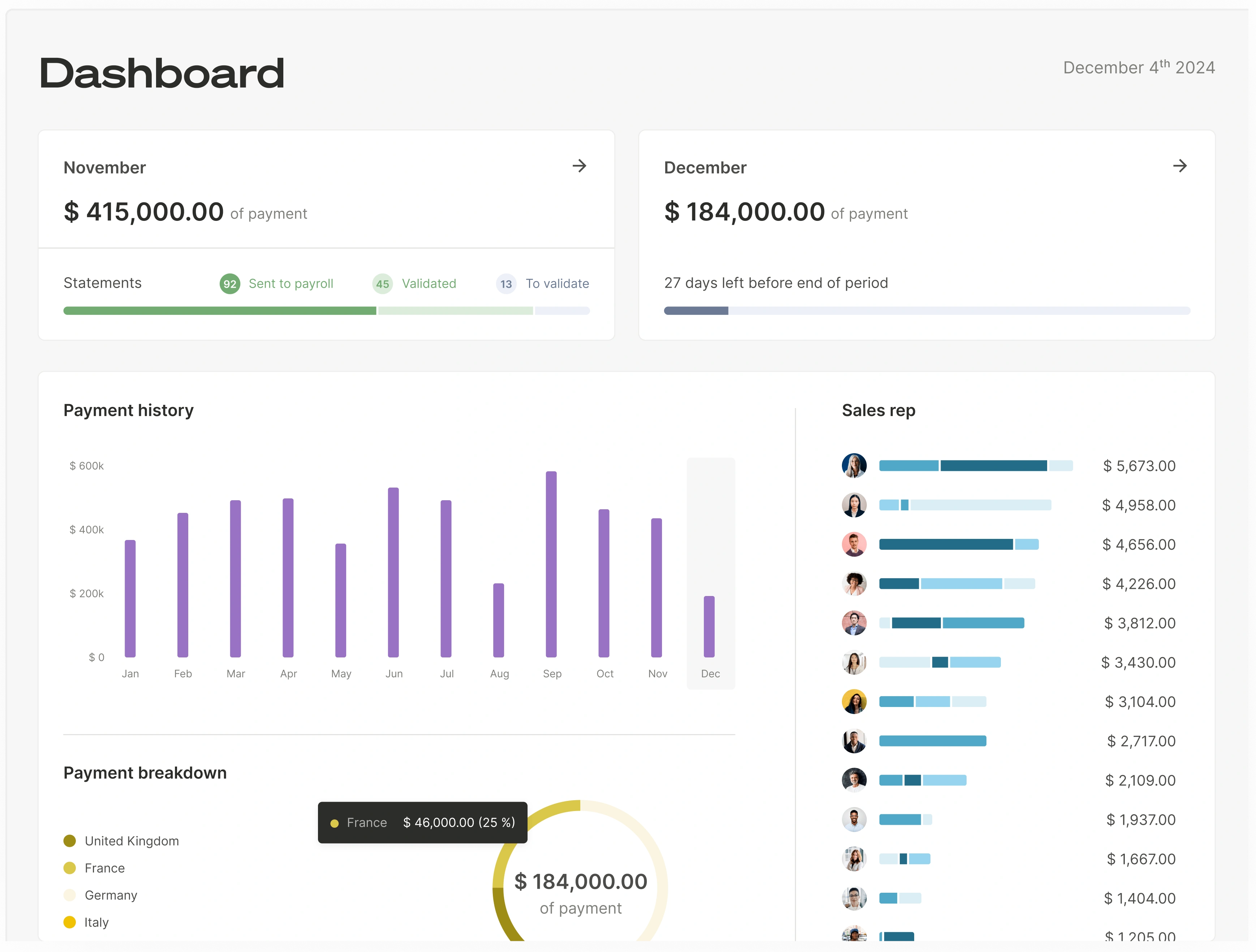
By integrating directly with your CRM (like Salesforce or HubSpot), ERP, and other data sources, Qobra calculates commissions in real-time. As soon as a deal is marked "Closed-Won," the rep can see the corresponding commission in their personal dashboard. This provides the real-time visibility into their earnings that is crucial for motivation.
Our no-code rule editor allows finance and sales ops teams to build and modify even the most complex tiered or margin-based formulas without writing a single line of code. This agility means you can adapt your incentive plans as your business strategy evolves, without relying on expensive consultants. By automating calculations, Qobra reduces errors by over 95% and cuts down administrative time from days to just a few hours.
Step 4: Review and Adapt
Compensation plans are not set in stone. The market changes, business priorities shift, and your formula should evolve as well. Plan to review your compensation structure at least annually. Analyze performance data to see if the plan is driving the intended behaviors. Gather feedback from the sales team and managers to identify any points of confusion or demotivation.
A compensation formula is a living document that should be refined over time to ensure it remains a powerful tool for driving your business forward. Successfully implementing your new plan is an ongoing process of optimization.
A well-crafted compensation formula is more than a mathematical equation; it is a strategic instrument that translates business objectives into tangible motivation. By ensuring clarity, accuracy, and alignment, you can build a high-performing culture where everyone understands their contribution and is fairly rewarded for their success. Moving from manual, error-prone spreadsheets to a powerful, automated platform is the final step in unlocking the full potential of your compensation strategy, transforming it from an administrative burden into a true competitive advantage. When considering your options, choosing the right commission software is a critical decision that will impact your team's performance and morale for years to come.
FAQ
What is the difference between a compensation plan and a compensation formula?
A compensation plan is the complete document that outlines all aspects of a person's remuneration, including base salary, benefits, variable pay rules, and payment terms. The compensation formula is the specific mathematical equation within that plan used to calculate the variable pay component, such as sales commissions or bonuses.
How often should we review our compensation formulas?
It's best practice to review compensation formulas at least once a year. However, more frequent reviews may be necessary if you are launching a new product, entering a new market, or if you notice the current formula is no longer driving the desired behaviors from your team.
Can a compensation formula be changed legally?
Yes, but it must be done carefully. Any changes should be communicated in writing well in advance of taking effect, and you must adhere to the terms of your existing employment contracts. It's crucial to ensure changes do not retroactively affect already earned commissions. For detailed guidance, it's wise to consult our article on the legal obligations when modifying commission plans.
What is the best compensation formula for a startup?
For early-stage startups, a simple and aggressive formula is often best. A straight commission model or a simple tiered structure with a high potential for earnings can attract and motivate the ambitious talent needed to drive initial growth. As the company matures, the formula can evolve to include components that encourage profitability and customer retention.