Webinar (Wednesday, October 21) — Aligning HR, Finance, and Sales: Mastering Sales Comp Without Breaking Your Plan
Register
- Core components to include: base salary, On-Target Earnings (OTE), commission rate (revenue or profit-based), quotas, accelerators/tiers, bonuses, clawbacks, and payout frequency—each defined clearly for transparency.
- Common plan models and fit: Salary+Commission (AE/mid-market), Tiered Commissions (high-growth sellers), Commission-Only (short-cycle/high-ticket roles), Salary-Only (long-cycle/retention-focused roles), Territory Volume and Profit-Based schemes for team or margin objectives.
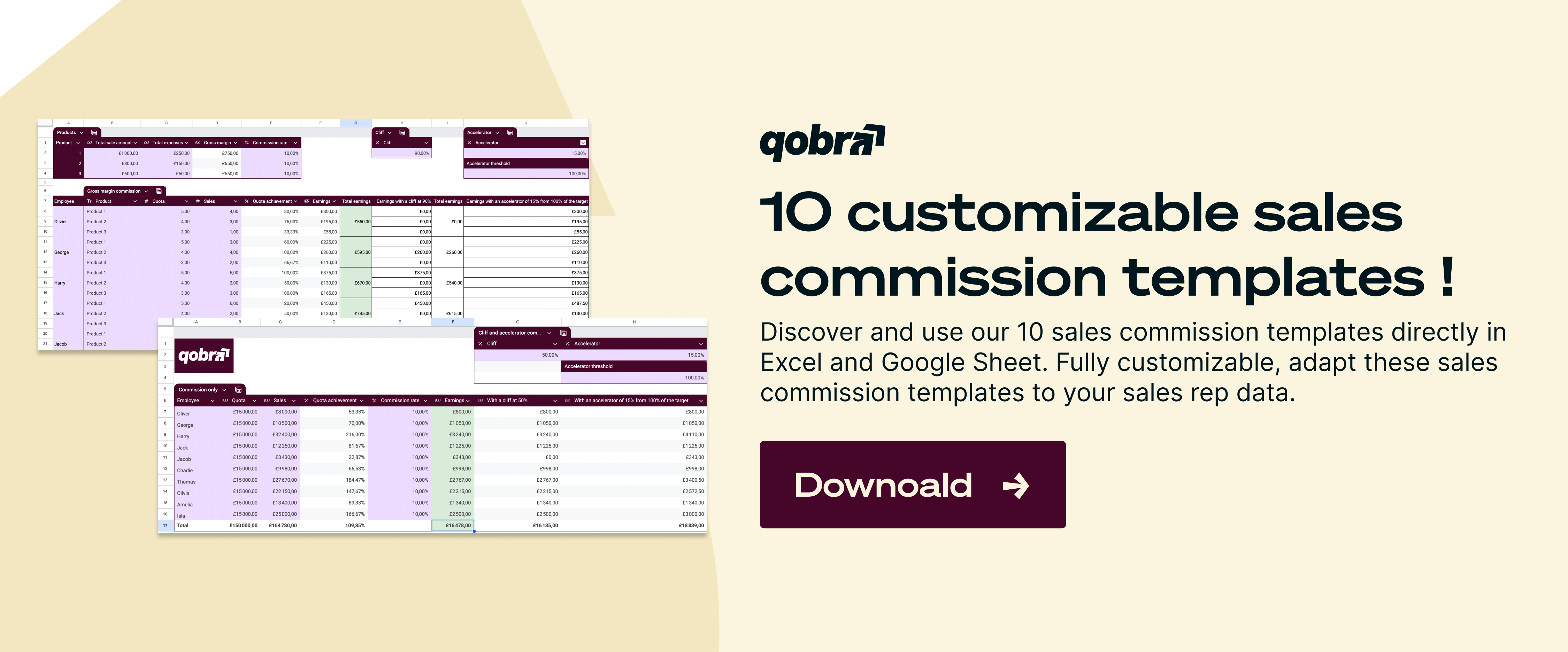
- Provide reusable templates and examples: downloadable Excel/Google Sheets with formulas and scenarios for AE, SDR and Sales Manager plans (including sample OTE, pay mix, quota, commission tiers and calculation examples).
- Implementation checklist: align plan design to strategic goals (growth vs. margin vs. retention), model financial outcomes and edge cases, automate calculations with an ICM tool, and roll out with personalized documentation and training.
- Measure and safeguard: track KPIs (quota attainment, ARR/ACV, churn, conversion rates, sales cycle length), avoid common traps (commission caps, excessive complexity, frequent plan changes), and iterate annually based on results.
Are your sales compensation plans truly designed to attract top talent and drive performance, or are they a source of confusion and frustration for your team? With the median tenure for sales reps hovering around three years, a poorly structured plan isn't just a missed opportunity—it's an expensive liability. A well-crafted sales compensation plan is a strategic lever for growth, aligning individual motivation with overarching business goals.
Designing these plans can feel like a delicate balancing act. You need to motivate high performance without overpaying, ensure financial stability for your reps, and align with the strategic objectives laid out by finance and leadership. The perfect one-size-fits-all template doesn't exist, but by understanding the core components and exploring proven structures, you can build a plan that fuels your sales engine for 2026 and beyond.
This guide provides a complete breakdown of sales compensation models, detailed sample plans for key roles, and best practices to ensure your plan is a powerful tool for retention and revenue growth.
The Core Components of a Modern Sales Compensation Plan
Before diving into specific examples, it's essential to understand the building blocks of any effective compensation structure. Each component serves a specific purpose, from providing security to incentivizing overperformance.
- Base Salary: This is the fixed, guaranteed portion of a salesperson's income, paid regardless of performance. It provides financial stability, which is crucial for roles with long or complex sales cycles.
- On-Target Earnings (OTE): OTE represents the total potential income a salesperson can expect to earn if they meet 100% of their sales quota. It's the sum of the base salary and the variable, at-risk commission or bonus potential (e.g., $70,000 base + $70,000 variable = $140,000 OTE).
- Commission Rate: This is the percentage or fixed amount a rep earns on a sale. It can be a straight percentage of revenue, a percentage of gross profit, or a flat fee per unit sold.
- Sales Quota: The minimum sales target a rep must achieve within a specific period (monthly, quarterly, annually) to earn their full on-target variable pay.
- Accelerators (or Tiers): These are increased commission rates that kick in after a rep exceeds their quota. For example, the commission rate might jump from 8% to 12% for all sales above 100% of the quota. Accelerators are powerful motivators for top performers.
- Bonuses: Unlike commissions, which are tied to individual sales, bonuses are typically fixed amounts awarded for achieving specific, non-transactional goals. This could be signing a key logo, completing a product certification, or hitting a team-based objective.
- Clawbacks: A clawback clause is a contractual provision that allows the company to reclaim commission that has already been paid out. This is typically used if a client churns within a short period or if a deal is found to be fraudulent. Understanding the mechanics of a clawback clause is crucial for both fairness and risk management.
- Payout Frequency: This defines how often commissions are paid out (e.g., monthly, quarterly). More frequent payouts can be more motivating as the reward is closer to the action.
6 Common Sales Compensation Plan Models
Sales compensation plans vary significantly depending on the company’s goals, sales cycle length, and team structure. Here are six of the most common models, each with its own strengths and weaknesses.
1. Salary + Commission
This is the most common and balanced structure. It combines a stable base salary with variable commission, offering security while rewarding performance. The typical split between base and variable pay (the "pay mix") is often 60/40 or 50/50.
- Best for: Most B2B sales roles, including Account Executives and mid-market sales teams.
- Pros: Attracts a wide range of talent, provides income stability, and directly incentivizes sales performance.
- Cons: Can become costly if base salaries are high and quotas are consistently missed.
2. Tiered Commission (Accelerators)
This model motivates reps to push beyond their targets by increasing the commission rate as they hit higher sales thresholds. It creates a "gamified" experience where each new level brings a greater reward.
- Best for: High-growth companies aiming to aggressively increase market share.
- Pros: Powerfully motivates overperformance and rewards top reps disproportionately.
- Cons: Can be complex to calculate and track manually. Spreadsheets often lead to errors, which is why many companies turn to incentive compensation management software like Qobra to automate these calculations and provide real-time visibility.
3. Commission-Only
In this high-risk, high-reward model, a salesperson's entire income is derived from commission. There is no base salary.
- Best for: Industries with very short sales cycles and high transaction values, like real estate or car sales, or for freelance sales contractors.
- Pros: Offers unlimited earning potential and is highly motivating for driven, confident sellers. Low fixed cost for the company.
- Cons: Leads to high turnover, as a bad month means zero income. Can encourage aggressive, short-sighted sales tactics.
4. Salary-Only
This plan offers a predictable, fixed salary with no variable component. It's less common for traditional closing roles.
- Best for: Roles with extremely long sales cycles (e.g., enterprise hardware), account management roles focused on retention, or sales engineers.
- Pros: Predictable income for reps, reduces pressure to close deals prematurely.
- Cons: Offers limited motivation to exceed expectations or go the extra mile.
5. Territory Volume Commission
Here, commission is based on the total sales generated within a specific geographic territory or market segment. It can be paid to an individual or split among a team covering that territory.
- Best for: Teams where collaboration is key and it's difficult to assign credit for a sale to a single individual.
- Pros: Encourages teamwork and a focus on maximizing the entire territory's potential.
- Cons: Can lead to "free-rider" problems where some reps coast on the efforts of others.
6. Profit-Based Commission
Instead of paying commission on total revenue, this plan ties compensation to the gross profit of each sale.
- Best for: Businesses where discounting is common and margin protection is a key strategic goal.
- Pros: Aligns sales behavior directly with company profitability. Discourages deep, margin-eroding discounts.
- Cons: Requires transparent and accurate profit margin data for each deal, which can be difficult to provide.
Sample Sales Compensation Plan Templates by Role
A plan for a Sales Development Representative (SDR) focused on lead generation should look very different from a plan for an Account Executive (AE) focused on closing deals. Here are three detailed sample plans for common sales roles.
Sample Plan 1: The Account Executive (AE)
AEs are responsible for closing new business. Their plan should be heavily weighted towards revenue generation, with accelerators to reward overachievement.
Component | Details |
|---|---|
On-Target Earnings (OTE) | $140,000 |
Pay Mix | 50/50 (Base: $70,000, Variable: $70,000) |
Quota | $700,000 Annual Recurring Revenue (ARR) per year |
Payout Frequency | Monthly |
Commission Rate | 10% of ARR on all deals up to 100% of quota |
Accelerators | Tier 1: 12% commission on ARR between 101% and 150% of quota. |
Bonus | $5,000 quarterly bonus for signing at least one deal with a Total Contract Value (TCV) over $100,000. |
Calculation Example:
Commission on first $175,000: $175,000 * 10% = $17,500
Commission on next $25,000 (Tier 1): $25,000 * 12% = $3,000
Total Quarterly Commission: $17,500 + $3,000 = $20,500
This AE exceeded their on-target variable pay for the quarter.
Sample Plan 2: The Sales Development Representative (SDR)
SDRs focus on the top of the funnel: prospecting, qualifying leads, and booking meetings for AEs. Their compensation should be tied to these activities (an MBO, or Management by Objectives, model).
Component | Details |
|---|---|
On-Target Earnings (OTE) | $75,000 |
Pay Mix | 70/30 (Base: $52,500, Variable: $22,500) |
Quota | 15 Sales Qualified Opportunities (SQOs) per month |
Payout Frequency | Monthly |
Commission Structure | $125 per SQO (up to 15) |
Accelerators | $200 for every SQO generated after the 15th in a month. |
Bonus | 1% of the total contract value for any deal that closes from one of their generated SQOs, paid upon closing. |
Expert Tip: Aligning SDR and AE Incentives
The "closer bonus" for the SDR is critical. It ensures SDRs are focused on generating high-quality opportunities that are likely to convert, rather than just booking meetings to hit a volume target. This aligns their motivation with the success of the entire sales team.
Sample Plan 3: The Sales Manager
A Sales Manager's compensation should be tied to the overall success of their team. A common model is a team override, where the manager earns a percentage of their team's total sales.
Component | Details |
|---|---|
On-Target Earnings (OTE) | $200,000 |
Pay Mix | 60/40 (Base: $120,000, Variable: $80,000) |
Quota | Team quota of $3,500,000 ARR per year (5 AEs with $700k quotas) |
Payout Frequency | Quarterly |
Override Rate | 2% of all team-generated ARR up to 100% of the team quota. |
Accelerators | 3% override on all team ARR generated between 101% and 125% of quota. |
Bonus (MBO) | $10,000 annual bonus tied to team retention (less than 15% voluntary turnover) and successful onboarding of new hires. This is a key part of an effective management incentive plan. |
Designing and Implementing Your Sales Compensation Plan
Creating a plan is one thing; rolling it out successfully is another. A great plan that is poorly communicated can cause more harm than a mediocre plan that everyone understands.
Step 1: Align with Business Objectives
Your compensation plan must directly support your company’s primary goals.
- Goal: Increase Market Share? Incentivize new logo acquisition with higher commission rates or bonuses for new customers.
- Goal: Boost Profitability? Implement a profit-based or gross-margin commission model to discourage discounting.
- Goal: Improve Retention? Offer bonuses or commission multipliers for multi-year contracts or upsells to existing clients.
Step 2: Model and Test
Before you finalize the plan, run simulations. How much will top performers earn? What about average reps? What is the total cost to the company if the entire team hits 125% of their quota? Modeling helps you avoid unintended consequences, like overpaying or creating unattainable targets.
Step 3: Automate and Ensure Transparency
Manual commission tracking on spreadsheets is slow, error-prone, and opaque. It erodes trust and wastes countless hours for your sales ops and finance teams. This is where a dedicated platform is invaluable.
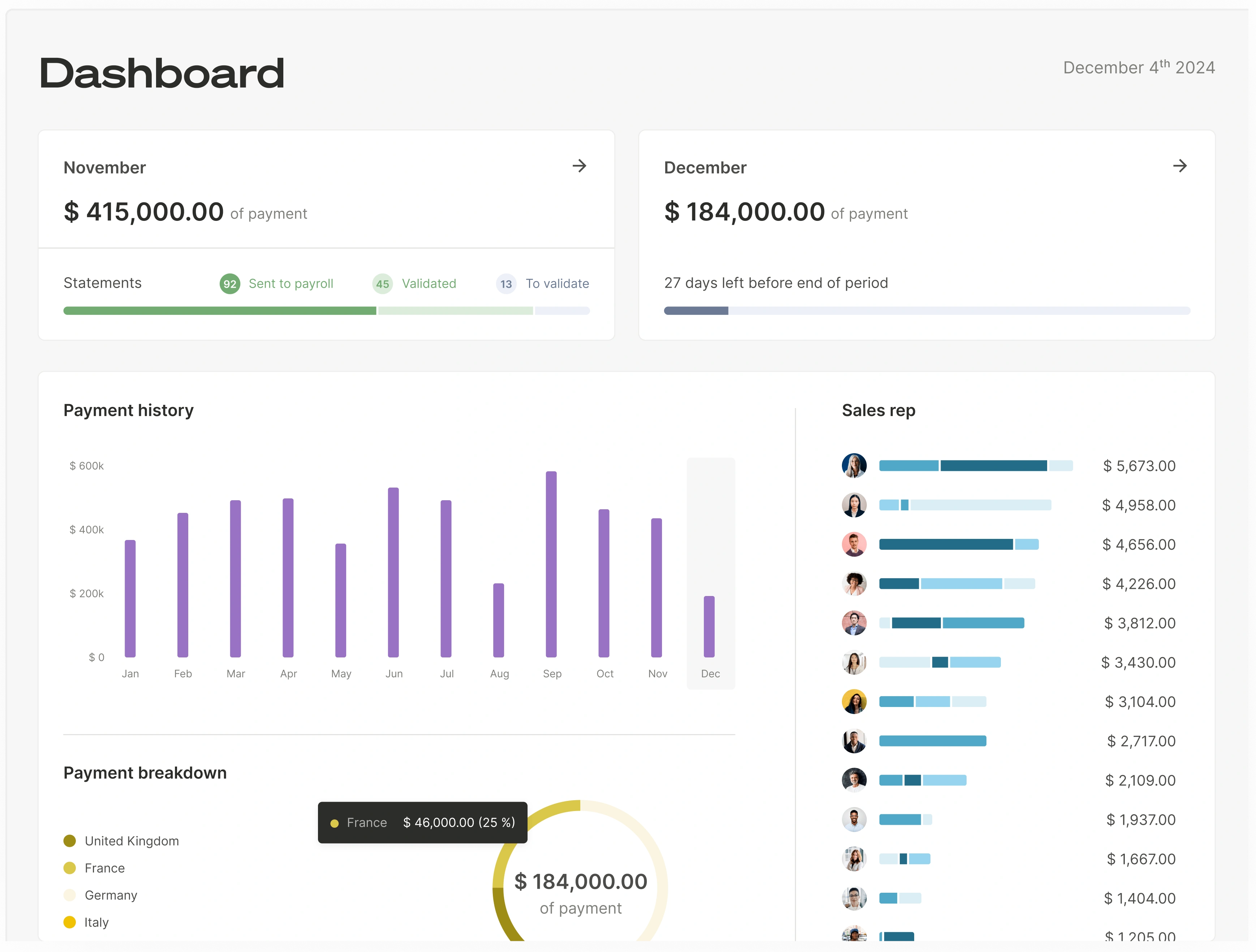
Qobra automates the entire process, integrating directly with your CRM (like Salesforce or HubSpot) to calculate commissions in real-time. With our no-code editor, you can build and modify even the most complex tiered plans in minutes. For reps, our transparent dashboards provide a live view of their quota attainment and potential earnings, eliminating disputes and boosting motivation. The goal is to achieve total pay transparency, which builds trust and fosters a healthier sales culture.
Step 4: Communicate Clearly
When rolling out the plan, provide clear, comprehensive documentation. Host a kickoff session to walk through the details and answer questions. Each rep should receive a personalized document that outlines their specific quota, OTE, and commission structure. Ensure they understand exactly how their efforts translate into earnings.
Warning: Avoid These Common Mistakes
Capping Commissions: Placing a cap on earnings is one of the fastest ways to demotivate your top performers. Once they hit the cap, their incentive to keep selling disappears for the rest of the period.
Overly Complex Rules: If a salesperson needs a Ph.D. in mathematics to understand their commission statement, your plan is too complicated. Simplicity drives behavior. A plan should be simple enough for a rep to calculate their own commission on the back of a napkin.
A well-designed sales compensation plan is more than just a method for paying your team; it's a reflection of your company's strategy and a powerful driver of the behaviors you want to encourage. By leveraging these models and best practices, you can create a structure that not only rewards performance but also attracts and retains the talent needed to fuel your growth in 2026 and beyond.
Frequently Asked Questions
What is a good OTE pay mix for a sales role?
The ideal pay mix depends on the role and industry. A 50/50 split (50% base, 50% variable) is common for Account Executives with direct closing responsibility. For roles with longer sales cycles or more account management duties, a 60/40 or 70/30 split is more appropriate. For SDRs, a 70/30 or 80/20 mix provides security while still incentivizing performance on leading indicators.
How often should we review or change our sales compensation plan?
Sales compensation plans should be reviewed annually. However, they should only be changed if there is a significant shift in business strategy, product offerings, or market conditions. Changing plans too frequently can create instability and confusion. The goal should be consistency and predictability.
Should sales commissions be capped?
In most cases, no. Capping commissions demotivates top performers and can lead them to leave for competitors with uncapped earning potential. An uncapped plan with accelerators is the best way to encourage reps to consistently exceed their targets. If cost control is a concern, it's better to adjust quotas or commission rates than to implement a cap.