Sales Compensation Software Benchmark | Compare 15+ Platforms (Features, Pricing, User Reviews, etc.)
Download
- Align pay with business goals by selecting clear KPIs (ARR, new logos, margin, NRR) and weight any metric you want to drive at least 20% of variable pay.
- Start simple and role‑tailored: choose an appropriate pay mix/OTE (e.g., 70/30 or 60/40) and different metrics for SDRs, AEs, and CSMs.
- Set realistic but stretching quotas using a blend of top‑down and bottom‑up data so ~60–80% of the team can hit quota in a normal period.
- Model and simulate payouts across scenarios (50/100/150% attainment), run pilots, and use automation to provide live, transparent commission dashboards.
- Establish governance and communication: document rules (splits, clawbacks, exceptions), review the plan annually, and use short‑term SPIFFs for tactical priorities.
Your sales team is packed with talent, energy, and ambition. But are they all pulling in the same direction? A well-designed incentive plan is the engine that transforms individual effort into predictable revenue growth, yet a poorly constructed one can lead to confusion, burnout, and a focus on the wrong activities. How can you be sure your plan is a strategic driver and not just an administrative burden?
A powerful sales incentive plan does more than just pay commissions; it aligns your team's day-to-day actions with your company's most critical goals. It provides clarity on what matters most and gives reps a tangible reason to push harder, quarter after quarter. Without this structure, even the most enthusiastic teams risk chasing small deals, focusing on the wrong metrics, or becoming complacent. This guide provides a complete framework for designing, implementing, and managing a sales incentive plan that genuinely drives results.
What is a Sales Incentive Plan?
A sales incentive plan, also known as a sales compensation program, is a structured framework that rewards sales professionals for achieving specific targets. These targets can be financial, such as revenue quotas, or non-financial, like securing a certain number of new logos or improving product adoption. It forms the variable portion of a salesperson's On-Target Earnings (OTE), typically making up 30-50% of their total compensation package, complementing their base salary.
The core purpose of a sales remuneration structure is to create a direct link between what your business needs and what your sales team is motivated to do. Instead of just instructing reps to "sell more," you provide a clear roadmap showing how specific actions and achievements translate into personal financial rewards. This alignment is critical for channeling effort effectively.
These programs come in many forms, from simple commission rates on every deal to complex hybrid models involving tiered bonuses, accelerators, and strategic goals. The right structure depends entirely on your business model, sales cycle, and strategic priorities. Ultimately, an effective plan eliminates ambiguity, encourages high-impact behaviors, and keeps your team engaged and performing at its peak.
The Core Principles of an Effective Sales Compensation Program
Before diving into complex formulas and models, it's crucial to ground your plan in solid principles. A successful program is built on a foundation of simplicity, strategic alignment, and clear communication. Done right, it becomes a key driver of growth. Done wrong, it fosters a revenue-at-any-cost mentality, creates internal conflict, and leads to overpaying for mediocre results.
Here are the foundational principles for building a plan that works:
- Start with Simple Foundations: If you're a startup or launching a new team, the biggest mistake is over-engineering your plan. Without historical performance data, complex structures are just guesswork. Begin with a straightforward model for all sales roles and add layers of sophistication as you gather data and understand what truly drives performance.
- Align with Business Strategy: Your incentive plan should be a direct reflection of your company's overarching goals. Are you focused on acquiring new customers, penetrating a new market, or increasing profitability? The metrics you choose to reward must support these objectives.
- Tailor for Different Roles: A one-size-fits-all approach rarely works. The incentives for a Sales Development Representative (SDR) focused on booking meetings should be different from those for an Account Executive (AE) closing deals or an Account Manager responsible for renewals and expansion.
- Set Realistic but Stretching Targets: Quotas should be attainable to maintain motivation, but challenging enough to encourage growth and high performance. If targets are perceived as impossible, reps will disengage.
- Prioritize Clarity and Communication: Sales reps must be able to understand their plan easily and predict their earnings. A plan that requires a complex spreadsheet to decipher will create confusion and mistrust. Transparency is non-negotiable.
Common Sales Incentive Plan Structures and Examples
Designing the right incentive structure can feel like hitting a moving target. Fortunately, you don't have to reinvent the wheel. The following models are proven structures used by high-performing companies to drive motivation and align reps with revenue goals.
Salary + Commission Plan
This is one of the most common and balanced approaches. It combines a fixed base salary with a variable commission, offering reps income stability while motivating them to sell more. The mix between salary and commission—often called the "pay mix"—can vary. A 60/40 split (60% base salary, 40% variable) is common, but a 70/30 split might be used for more complex sales cycles where significant customer education is required. This model is a win-win, attracting driven salespeople without placing the entire compensation risk on them.
Commission-Only Plan
In a commission-only plan, a rep's income is derived solely from the deals they close. There is no base salary. This high-risk, high-reward structure is highly motivating for top performers and is often used in industries with high-ticket transactional sales like real estate or for independent sales contractors. It keeps fixed costs low for the company but can lead to high turnover if reps struggle to close deals consistently.
How it Works: Reps are paid a fixed percentage for each sale. For example, with a 20% commission rate, a rep closing a $50,000 deal earns $10,000. It directly ties reward to performance.
Tiered Commission Plan
A tiered commission structure motivates reps to exceed their goals by increasing the commission rate as they hit higher sales levels. It’s like a video game where each new level brings greater rewards. This model is excellent for encouraging over-performance and preventing reps from coasting once they've hit their basic quota.
Here’s a simple example of a tiered structure based on quarterly revenue:
| Quarterly Revenue Achieved | Commission Rate |
|---|---|
| $0 - $100,000 | 8% |
| $100,001 - $150,000 | 10% |
| $150,001+ | 12% |
Bonus-Based Plan
Unlike commissions, which are a percentage of a sale, bonuses are fixed amounts paid for achieving specific targets. These targets can be revenue-based (e.g., a $5,000 bonus for hitting the quarterly quota) or tied to non-financial activities, such as completing a certain number of product demos or signing a strategic new client. Bonuses are a direct way to incentivize particular goals that may not be directly tied to deal size.
Other Common Models
- Territory Volume Commission: Commissions are based on the total sales within a rep's assigned geographic or industry territory. This encourages reps to develop a broad sales strategy across their entire area.
- Set Rate Commission: Reps earn a fixed dollar amount for each unit sold or deal closed. This works well for products with consistent pricing and encourages high-volume selling.
- SPIFFs (Sales Performance Incentive Funds): These are short-term, tactical bonuses used to motivate teams around a specific, immediate goal, such as pushing a new product or clearing out old inventory.
How to Design Your Sales Incentive Plan: A Step-by-Step Guide
Creating a plan from scratch requires a methodical approach. Follow these steps to build a structure that aligns with your business, motivates your team, and stands up to scrutiny.
Step 1: Define Your Business Goals
Before you think about percentages or quotas, ask the most important question: What is the business trying to achieve? Your incentive plan is a tool to drive specific outcomes. Are your primary goals to:
- Increase Annual Recurring Revenue (ARR)?
- Acquire a certain number of new logos?
- Improve gross margin by selling higher-value products?
- Reduce customer churn and increase Net Revenue Retention (NRR)?
- Accelerate the sales cycle?
Your answers will determine which behaviors and results you need to incentivize. For example, a goal of improving margins might lead to a plan that pays a higher commission rate on more profitable products.
Step 2: Choose the Right Performance Metrics (KPIs)
Once your goals are defined, translate them into measurable Key Performance Indicators (KPIs). These metrics are the basis for calculating commissions and bonuses. Avoid the temptation to track too many KPIs, as this can dilute focus.
Common KPIs include:
- Revenue Booked: The total value of deals closed.
- Number of New Customers: Focuses on acquisition.
- Contract Value: Encourages larger deals.
- Conversion Rate: Rewards efficiency in moving deals through the pipeline.
- Profitability/Margin: Aligns sales with overall business health.
The 20% Rule for Weighting
When designing a plan with multiple metrics, ensure any single metric you want to drive behavior is weighted as at least 20% of the total variable pay. Anything less is unlikely to capture a salesperson's attention or significantly influence their actions.
Step 3: Segment Your Roles and Tailor the Plan
Different roles contribute to revenue in different ways, and their incentive plans should reflect this.
- Sales Development Reps (SDRs/BDRs): Their primary job is to generate qualified opportunities. Incentivize them on the number of qualified leads passed to AEs or appointments set.
- Account Executives (AEs): Their focus is closing new business. Their plan should be heavily weighted towards closed-won revenue or new ARR.
- Account Managers (AMs) or Customer Success Managers (CSMs): Their goal is retention and expansion. Incentivize them on renewal rates, upsells, cross-sells, and Net Revenue Retention.
Step 4: Structure the Compensation and Set Quotas
This is where you define the financial mechanics.
- Define On-Target Earnings (OTE): Research market rates to determine a competitive total compensation package for each role.
- Determine the Pay Mix: Decide on the base vs. variable split (e.g., 70/30, 50/50).
- Set Quotas: Quotas should be challenging yet achievable. A good rule of thumb is that 60-80% of your team should be able to hit their quota in a typical period. Use historical data to set quotas, and if you don't have any, start with conservative estimates based on business projections and iterate.
Step 5: Test, Simulate, and Refine
Never launch a sales compensation plan without modeling it first. Manually running simulations in spreadsheets is a common starting point, but it's notoriously prone to errors and incredibly time-consuming for finance and operations teams. It's difficult to forecast the financial impact and can lead to costly mistakes.
The Danger of an Untested Plan
Launching a plan without rigorous testing can have serious consequences. You might accidentally create a plan that overpays for average performance, demotivates top performers with unattainable accelerators, or misaligns sales efforts with company goals. Simulating payouts at different levels of attainment (50%, 100%, 150% of quota) is critical to ensure the plan is financially sound and motivating.
Modern compensation platforms automate this process, allowing you to model different scenarios, visualize the impact on rep earnings and company costs, and refine the plan before it goes live. You can even use a commission ROI calculator to understand the financial implications better.

Deploying and Managing Your Incentive Plan
A well-designed plan is only effective if it's managed and communicated properly. The final stage is about execution, transparency, and governance.
The Challenge of Manual Management
Managing commissions on spreadsheets is a recipe for disaster as a company scales. This manual approach is plagued by issues:
- Errors: Manual data entry and complex formulas lead to frequent calculation mistakes, eroding trust.
- Disputes: When reps can't see how their commission was calculated, they question the numbers, leading to time-consuming shadow accounting and disputes.
- Lack of Visibility: Reps are often "flying blind," unsure of their earnings until payday. This kills motivation and makes it impossible to course-correct during a quarter.
- Administrative Burden: Sales Ops and Finance teams spend days each month pulling data, running calculations, and resolving issues instead of focusing on strategic activities.
Leveraging Technology for Transparency and Motivation
This is where dedicated sales compensation software makes a transformative impact. By automating the entire process, these platforms eliminate the pain points of manual management. With a solution like Qobra, you can build your plan with a no-code editor, connect it directly to your CRM through seamless integrations, and automate calculations in real time.
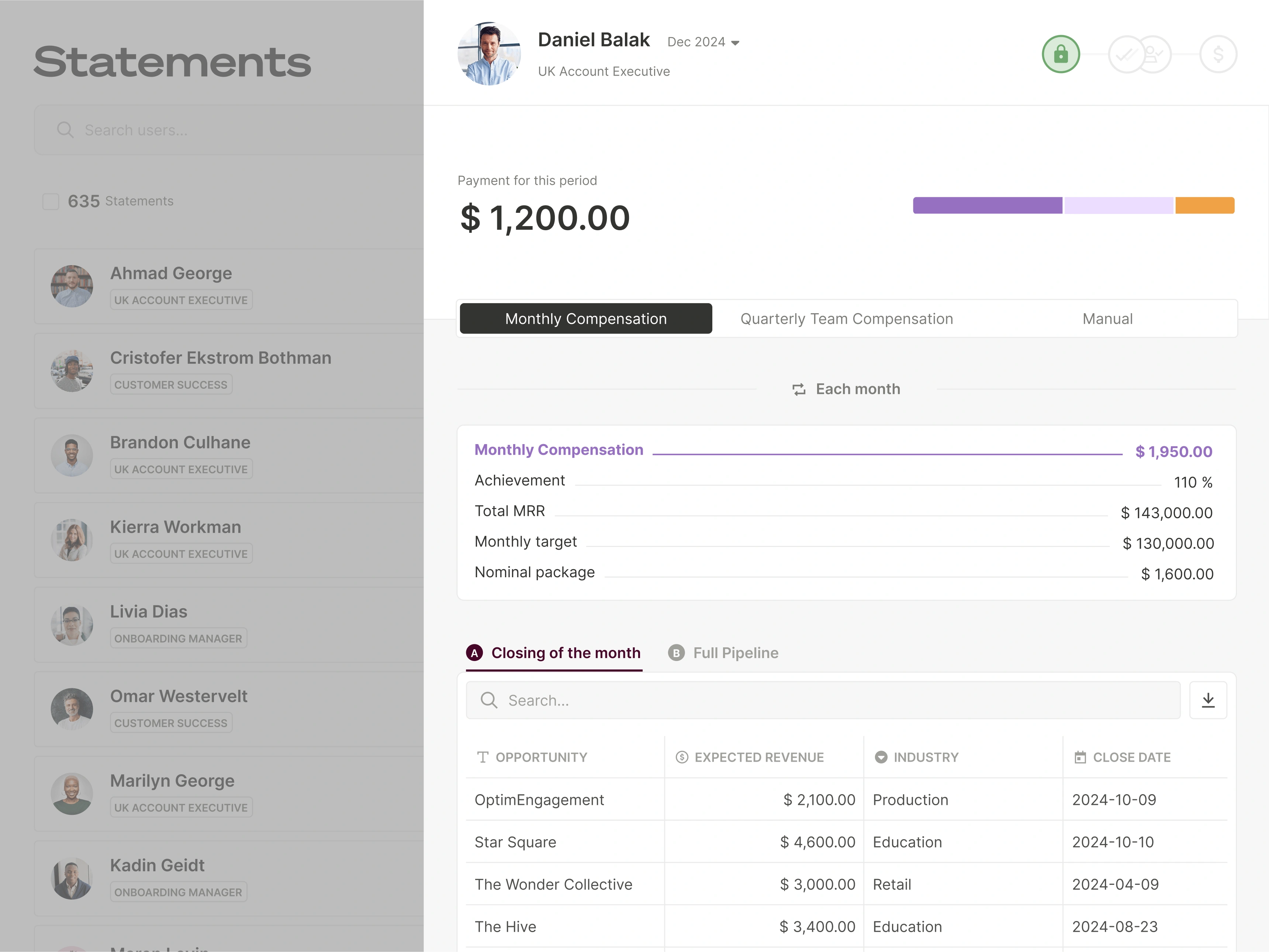
The result is a single source of truth. Sales reps get live, transparent dashboards showing exactly where they stand against their goals and what their projected earnings are. This immediate feedback loop is a powerful motivator, turning the compensation plan from a mysterious payroll process into a dynamic performance tool. For sales leaders, this means fewer disputes, a more motivated team, and more time to focus on coaching and strategy.
Governance and Regular Reviews
Your sales incentive plan is not a "set it and forget it" document. It requires ongoing governance.
- Establish Clear Rules: Create a policy document that outlines rules for handling exceptions, such as split commissions on team-based deals or clawbacks for churned accounts.
- Set a Review Cadence: Review the plan's effectiveness at least annually. Is it still driving the right behaviors? Is it aligned with current business goals? Be prepared to iterate based on performance data and team feedback.
A successful sales incentive plan is a living document—a strategic lever that evolves with your business. By moving beyond error-prone spreadsheets to a transparent, automated system, you not only save time and build trust but also unlock the full potential of your sales team.
SPIFFs, quotas and accelerators each have their own cadence, and running them side by side is where plan administration gets expensive. Sales incentive management software handles the three in one place, on the same deal data.
Frequently Asked Questions (FAQ)
How often should we review or change our sales incentive plan?
It's best practice to review your plan at the end of each fiscal year. Avoid making major changes mid-year unless there's a significant shift in business strategy, as this can disrupt momentum and create confusion. Minor tweaks or SPIFFs can be introduced quarterly to address short-term goals.
What's the difference between a commission and a bonus?
A commission is a variable payment calculated as a percentage of a sale's value (e.g., 10% of every deal closed). A bonus is a fixed, lump-sum payment awarded for achieving a specific, predefined objective (e.g., a $2,000 bonus for hitting a quarterly sales target).
How do you set a realistic sales quota?
A realistic quota is typically set using a top-down or bottom-up approach. A top-down approach starts with the company's revenue target and divides it among the sales team. A bottom-up approach analyzes historical performance, territory potential, and sales cycle length to build individual quotas. The best method often combines both to ensure quotas are ambitious but grounded in reality.
What are SPIFFs and when should you use them?
SPIFFs (Sales Performance Incentive Funds) are short-term contests or rewards designed to drive focus on a specific goal over a limited period (e.g., a week or a month). They are effective for motivating quick action, such as selling a new product, clearing out excess inventory, or driving activity during a slow period.