Sales Compensation Software Benchmark | Compare 15+ Sales Compensation Platforms
Download
- Residual commission is a recurring-pay compensation model: salespeople earn ongoing payments (e.g., a percentage of MRR/ARR) for as long as the customer they acquired remains active and generates revenue.
- Common models include percentage-based, tiered, fixed-time, or hybrid structures; calculation is Residual Commission = Recurring Revenue × Commission Rate (e.g., €1,000 MRR × 5% = €50/month → €1,800 over 3 years).
- Widely used across SaaS, insurance, financial services, telecoms and affiliate marketing, residuals align rep incentives with retention, upsells and increased customer lifetime value (LTV).
- To implement: define clear objectives, choose a model and fair rates, document rules (eligibility, payout cadence, termination clauses), track KPIs (MRR, churn, LTV) and automate calculations via commission software integrated with CRM/billing while maintaining strong data hygiene.
- Main challenges—complex tracking, delayed earnings for new reps, and churn-driven volatility—are addressed by automation platforms, hybrid compensation (base/draw or higher upfront payouts), multi-year contract incentives and legally explicit termination/buyout clauses.
What if a single sale could pay you not just once, but every single month for years to come? Imagine the effort you put into closing a deal today continuing to reward you long after the initial handshake. This isn't a sales fantasy; it's the core principle behind one of the most powerful compensation models for modern businesses: residual commission.
This structure shifts the focus from short-term wins to long-term value, transforming how sales teams operate and aligning their goals directly with the sustainable growth of the company. It rewards the creation of lasting customer relationships, making every salesperson a true partner in the company's success.
What Is Residual Commission?
Residual commission, also known as recurring commission, is a compensation model where a salesperson earns ongoing payments for the revenue generated by a customer they originally acquired. Unlike a traditional one-time commission that rewards only the initial transaction, this model provides a continuous income stream for as long as that customer remains active and generates revenue.
In essence, the salesperson receives a percentage of the recurring payments made by their client, such as monthly subscription fees or annual policy renewals. This fundamentally changes the incentive from simply closing a deal to acquiring high-value customers and ensuring their long-term satisfaction.
Let's consider a simple example:
- A SaaS salesperson closes a deal for a software subscription that costs €1,000 per month.
- Their residual commission rate is 5% of the monthly recurring revenue (MRR).
- As long as the client continues their subscription, the salesperson receives €50 every month.
- If that client stays for three years, that single sale will have generated €1,800 in commissions for the salesperson.
This approach directly incentivizes behaviors that reduce customer churn and increase customer lifetime value (LTV), two of the most critical metrics for any subscription-based business.
How Do Residual Commission Models Work?
While the concept is straightforward, residual commission structures can be designed in several ways to fit different business models, sales cycles, and strategic objectives. The key variables are the commission rate, the duration of the payouts, and the performance metrics they are tied to.
Percentage-Based Model
This is the most common structure, where the salesperson earns a fixed percentage of the recurring revenue generated by their client. This could be calculated on Monthly Recurring Revenue (MRR) or Annual Recurring Revenue (ARR). It is simple, predictable, and easy to understand.
- Scenario: A sales rep sells a marketing automation tool with a subscription of €500/month.
- Commission Rate: 10% of MRR.
- Monthly Payout: €50.
This model is ideal for SaaS companies, telecom providers, and any business with a consistent subscription fee.
Tiered Model
A tiered model introduces performance-based escalations to the commission rate. The percentage earned by the salesperson increases as they hit certain milestones, which are often tied to customer longevity or revenue growth. This encourages a deeper focus on customer success and upselling.
| Customer Retention Period | Residual Commission Rate |
|---|---|
| Year 1 | 5% |
| Years 2-3 | 7% |
| Year 4+ | 10% |
This structure strongly motivates reps to not only retain customers but also to nurture the relationship over many years, as their own income grows alongside the customer's loyalty.
Fixed-Time Model
In this model, commissions are paid for a predetermined period after the initial sale, such as the first 12 or 24 months of a customer's contract. After this period, the salesperson no longer receives commissions for that client.
This approach provides a powerful short-to-medium-term incentive while allowing the company to control long-term commission costs. It is often used in industries with high initial acquisition costs where the focus is on securing the first one to two years of a customer relationship.
Real-World Examples Across Industries
The applicability of recurring commissions extends far beyond the SaaS world. Several industries have built their sales compensation around this model to foster loyalty and sustainable growth.
- Insurance: An agent earns a commission on the initial policy sale and then continues to earn a smaller percentage each year the client renews their policy. This incentivizes the agent to provide excellent service and maintain the relationship.
- Financial Services: A financial advisor often earns a commission based on the assets under management (AUM). As the client's portfolio grows, so does the advisor's recurring income, perfectly aligning their interests.
- SaaS: As seen in our examples, SaaS reps earn a percentage of the monthly or annual subscription fees. This is a natural fit for a business model built entirely on recurring revenue.
- Telecommunications: Sales agents who sign up customers for mobile or internet plans may receive a small, fixed amount each month for every active contract they initiated.
- Affiliate & Network Marketing: Marketers earn commissions on sales they generate and often on the sales made by other marketers they recruit into their "downline," creating a multi-layered residual income stream.
Expert Tip: Combine and Conquer
The most effective compensation plans often blend different models. Consider offering a larger upfront commission on the initial sale to reward the acquisition effort, combined with a smaller, long-term residual commission to incentivize retention. This provides an immediate reward for new reps while still encouraging a long-term focus.
The Core Benefits of a Residual Commission Structure
Adopting a recurring commission model offers significant advantages for both the sales team and the company as a whole, creating a powerful synergy that drives growth.
For the Sales Team
- Consistent and Predictable Income: Unlike the feast-or-famine cycle of one-time commissions, a residual model allows salespeople to build a stable and predictable monthly income stream based on their past successes.
- Unlimited Earning Potential: Top performers can build a substantial "book of business" that generates significant income over time. This makes it one of the most attractive types of commission plans for ambitious reps.
- Motivation for Stronger Relationships: When their income is tied to customer longevity, salespeople are naturally motivated to act as trusted advisors, provide excellent service, and ensure their clients are successful.
For the Company
- Reduced Customer Churn: Aligning sales compensation with customer retention is the most direct way to incentivize churn reduction. Salespeople become the first line of defense in ensuring customer satisfaction.
- Increased Sales Team Retention: High-performing salespeople who have built a significant residual income are far less likely to leave, as they would be walking away from a guaranteed revenue stream. This helps you retain your top sales talent.
- Alignment with Long-Term Growth: The model encourages a focus on acquiring high-quality, long-term customers rather than chasing quick, low-value wins. This directly supports sustainable revenue growth and a healthier bottom line.
Navigating the Challenges of Recurring Commissions (And How to Solve Them)
While powerful, residual commission plans introduce a layer of complexity that can be challenging to manage without the right processes and tools in place.
Complexity in Tracking and Calculation
Manually tracking hundreds or thousands of recurring payments across different salespeople, with varying rates and tenures, is a monumental task. Using spreadsheets is not only time-consuming but also extremely prone to errors, leading to disputes, distrust, and demotivated reps. This is one of the key reasons why spreadsheets are no longer sufficient for modern sales teams.
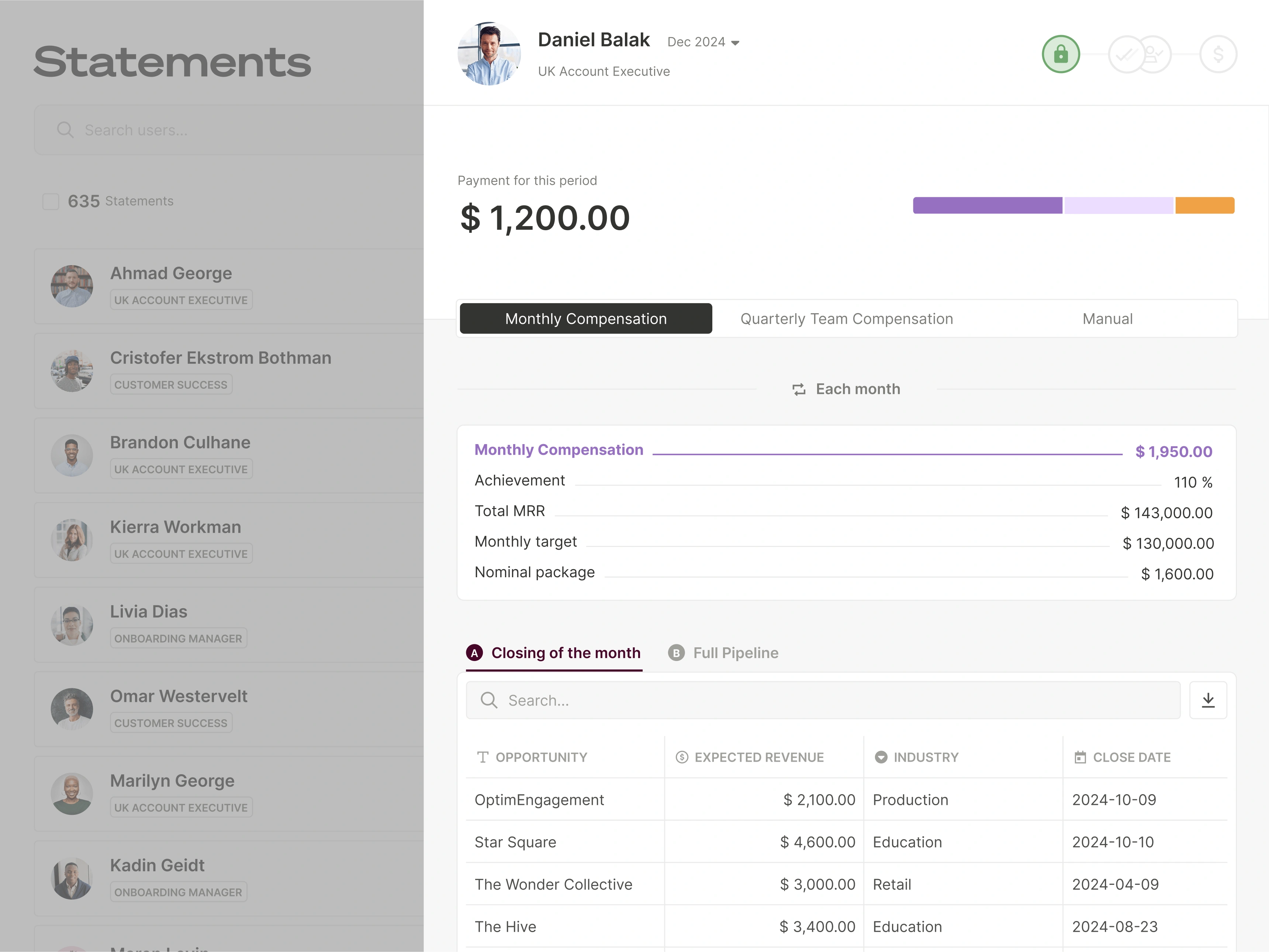
Solution: The only scalable solution is to use a dedicated commission management platform. Tools like Qobra automate the entire process. Qobra integrates directly with your CRM (like Salesforce or HubSpot) and billing systems to calculate commissions accurately. Qobra syncs CRM data automatically throughout the day, and on demand in one click. Our no-code editor allows you to build and modify even the most complex residual and tiered rules in minutes, without any technical help. This eliminates errors and provides reps with transparent, real-time dashboards showing exactly what they've earned.
Delayed Earnings for New Reps
A new salesperson starting from zero can find the initial months challenging, as their residual income takes time to build. This can impact motivation and create financial instability.
Solution: Implement a hybrid model. Offer a guaranteed base salary or a recoverable/non-recoverable draw to provide a safety net. You can also structure the plan with a higher commission on the initial contract value and a smaller percentage for subsequent renewals.
Data Quality is Non-Negotiable
Automated commission platforms are powerful, but they rely on the accuracy of your source data. "Garbage in, garbage out" applies here. Ensure your CRM data is clean, consistent, and up-to-date. A solid data hygiene policy is the foundation of a trustworthy and automated commission process.
Impact of Customer Churn
A salesperson's income can fluctuate if a major client cancels their subscription. While this is part of the incentive model, it can create unpredictability.
Solution: Encourage multi-year contracts by offering a "kicker" or bonus for deals signed with longer commitments. You can also tie a portion of the commission to customer success metrics, such as product adoption or usage rates, to promote proactive engagement.
How to Implement a Residual Commission Plan
Transitioning to or creating a recurring commission plan requires careful planning and clear communication.
- Define Clear Objectives: Start with the "why." Are you aiming to reduce churn by 15%? Increase LTV? Improve sales rep retention? Your goals will shape the structure of your plan.
- Choose the Right Model: Select a percentage, tiered, or fixed-time model that aligns with your business's revenue structure and sales cycle. Do not be afraid to create a hybrid model.
- Set Fair and Motivating Rates: Your rates must be competitive enough to attract and retain top talent but financially sustainable for the business. Analyze your margins and customer acquisition costs when calculating the right commission rates.
- Document Everything in a Formal Plan: Create a detailed commission plan document that outlines every rule: eligibility, commission rates, payout schedule, definitions (e.g., "active customer"), and clauses for termination or promotion. Having a clear commission agreement is crucial for avoiding the common pitfalls that lead to disputes.
- Automate with the Right Software: The success of your plan hinges on its execution. Implementing a tool like Qobra is not a luxury but a necessity for managing recurring commissions at scale. It ensures accuracy, provides transparency, and saves your finance and operations teams dozens of hours each month, allowing you to focus on strategy instead of spreadsheets.
By carefully building a comprehensive sales commission plan, you create a system that is not only fair and motivating but also a powerful driver of your company's strategic goals.
Warning: Address the Termination Clause
One of the most frequent points of contention is what happens to a salesperson's residual income after they leave the company. Be explicit in your contract. Will payments cease immediately? Continue for a set period (e.g., 90 days)? Or continue as long as the client remains active? This must be clearly defined and legally reviewed to prevent future disputes.
A well-designed residual commission plan is more than just a payment method; it is a strategic tool that fosters a culture of long-term thinking. It aligns the motivations of your sales team with the health of your customer relationships, creating a virtuous cycle of retention, growth, and shared success. While the administrative complexity can be daunting, leveraging modern automation platforms like Qobra transforms this challenge into a competitive advantage, enabling you to build a motivated, loyal, and highly effective sales organization.

FAQ
What's the difference between residual commission and a one-time commission?
A one-time commission is a single payment made to a salesperson for closing a deal. Once paid, there are no further commissions from that transaction. A residual commission is an ongoing series of payments earned for as long as the customer continues to generate recurring revenue (e.g., through a monthly subscription). It rewards customer retention, not just acquisition.
How do you calculate residual commission?
The calculation is typically straightforward. The formula is:
Residual Commission = Recurring Revenue x Residual Commission Rate
For example, if a customer generates $2,000 in monthly recurring revenue (MRR) and the salesperson's commission rate is 5%, their monthly residual commission from that single client is $2,000 * 0.05 = $100.
Which software is best for managing residual commissions?
The best software is a specialized Sales Performance Management (SPM) or commission automation platform. While CRMs can store deal data, they lack the calculation engines to handle complex rules like tiered rates or time-based cutoffs. A platform like Qobra is designed specifically for this purpose, offering a no-code rule editor, direct CRM integration, and real-time transparent dashboards for reps and managers, making it a leading solution for businesses with recurring revenue models.
What happens to my residual income if I leave the company?
This depends entirely on the terms outlined in your employment contract or commission plan agreement. Some companies cease all payments upon termination. Others may continue to pay for a specified period (e.g., 3-6 months), while some might offer a buyout. It is critical to have this clause clearly defined in writing before you sign an agreement.
Residual commissions are hard to track by hand — a sales commission software automates recurring calculations and payouts.