Webinar: The Biggest Release Sales Comp Has Ever Seen. Come See For Yourself (Wednesday, October 7)
Register
- Design compensation to reward long-term recurring value, not just one‑time bookings—pay commissions on ARR/MRR and incentivize renewals and expansion to reduce churn.
- Set clear OTE and pay‑mix by role (e.g., AE 50/50, SDR 65/35, CSM 80/20) so leverage matches responsibility, experience, and risk tolerance.
- Define simple, role‑specific metrics (new ARR for AEs, SQOs for SDRs, expansion/NRR for AMs/CSMs) and keep the plan one page so reps instantly see how actions convert to pay.
- Use quotas, tiered accelerators, ramped targets for new hires, multi‑year bonuses and clawbacks to balance ambition with quality and discourage selling poor‑fit deals.
- Automate calculations and reporting with a commission platform integrated to your CRM to ensure accuracy, real‑time visibility, faster adjustments, and trust across the team.
How can you design a sales compensation plan that not only motivates your team but also fuels sustainable, long-term growth for your SaaS business? In a world of recurring revenue, customer retention, and high acquisition costs, a traditional sales commission structure can do more harm than good. Rewarding short-term wins might boost immediate bookings, but it can also lead to high churn, misaligned incentives, and a frustrated sales team.
The reality is that only 21% of companies are satisfied with their sales compensation plans. This staggering statistic reveals a massive opportunity. A well-designed incentive program is more than just a payment mechanism; it's a strategic tool that aligns your sales team's behaviour with your company's core objectives. It’s the engine that drives predictable revenue by rewarding the right actions: acquiring ideal customers, expanding existing accounts, and ensuring long-term value. This guide provides a practical framework for building a SaaS sales compensation plan that is fair, scalable, and built for growth in 2026 and beyond.
The Foundations of a Modern SaaS Compensation Plan
At its core, any effective sales compensation plan must answer three fundamental questions: how much a person can earn, what they need to do to earn it, and how the payout is structured. For SaaS, the answers are deeply tied to the recurring revenue model.
On-Target Earnings (OTE) and Pay Mix
On-Target Earnings (OTE) represents the total potential annual income a salesperson can achieve by hitting 100% of their quota. It consists of two key components:
- Base Salary: The fixed, guaranteed portion of their income. It provides stability and security.
- Variable Pay (or Commission): The performance-based portion, earned by achieving specific targets.
The ratio between these two elements is called the Pay Mix or "leverage." This mix is critical and should vary depending on the sales role's direct influence on revenue generation. A highly leveraged plan (e.g., a low base and high variable) can drive aggressive performance but may also attract risk-takers and deter senior talent seeking stability.
Here are some common pay mix benchmarks in the SaaS industry:
| Role | Typical Pay Mix (Base/Variable) | Primary Focus |
|---|---|---|
| Account Executive (AE) | 50/50 | Closing new business (ARR/ACV) |
| Sales Development Rep (SDR) | 65/35 or 70/30 | Generating qualified opportunities |
| Sales Manager/Director | 60/40 | Team quota attainment |
| Account Manager (AM) | 70/30 | Renewals and expansion revenue |
| Customer Success Manager (CSM) | 80/20 or 90/10 | Customer adoption and retention |
| Sales Engineer (SE) | 80/20 | Technical validation and support |
Getting the OTE right is essential for attracting and retaining top talent. It fluctuates by region and experience level, so consulting local recruiting firms or using industry salary benchmark data is highly recommended.
Aligning Incentives with Key SaaS Metrics
Unlike traditional sales, where the deal is done at the point of sale, SaaS success is measured over the entire customer lifecycle. Your compensation plan must reflect this reality by rewarding behaviours that contribute to long-term health, not just initial bookings.
Key metrics to build your plan around include:
- Annual Recurring Revenue (ARR) / Monthly Recurring Revenue (MRR): The lifeblood of any SaaS company. Commissions should be directly tied to the new ARR generated.
- Annual Contract Value (ACV): Incentivizing larger ACVs encourages reps to sell higher-value plans or packages.
- Customer Lifetime Value (LTV): While harder to measure in the short term, plans can reward actions that increase LTV, such as selling to ideal customer profiles (ICPs).
- Net Revenue Retention (NRR): A critical indicator of health. Rewarding expansion revenue (upsells/cross-sells) and renewals directly impacts NRR.
- Customer Acquisition Cost (CAC) Payback Period: Plans can include kickers or bonuses for deals with upfront payments or multi-year terms, which significantly shorten the CAC payback period.
A plan that only pays on Total Contract Value (TCV) without considering the recurring nature of the revenue is a recipe for disaster. It encourages reps to pull in large, one-time service fees or heavily discount year two of a multi-year deal, which harms long-term ARR growth. The golden rule is to pay commissions on the recurring revenue component of the deal.
Structuring Compensation Plans by Sales Role
A one-size-fits-all approach doesn't work. Each role in the go-to-market engine contributes differently to revenue, and their compensation should reflect their specific responsibilities and influence.
Sales Development Representative (SDR) / Business Development Representative (BDR)
SDRs are at the top of the funnel, focused on prospecting and generating qualified leads. Their compensation should not be tied to closed deals, as they have no control over the final outcome.
- Key Metrics: Number of Sales Qualified Opportunities (SQOs) or Sales Accepted Leads (SALs), meetings booked, or pipeline generated.
- Structure: A common model is to pay a fixed amount per qualified opportunity that moves to a certain stage in the sales funnel. Some plans add a small kicker if the opportunity eventually closes to foster better lead quality.
Account Executive (AE) - New Business
AEs are the closers, responsible for acquiring new customers. Their plan should be simple, direct, and heavily weighted towards new ARR.
- Key Metrics: New ARR or MRR booked.
- Structure: A single-rate commission on all new ARR is the simplest model. For example, a 10% commission on the first year's ARR for every deal closed.
Account Manager (AM) / Expansion AE
AMs or expansion-focused AEs are responsible for growing revenue from the existing customer base. Their focus is on NRR.
- Key Metrics: Expansion ARR (from upsells and cross-sells) and renewal rates.
- Structure: Compensation can be split. For instance, a lower commission rate for standard renewals (e.g., 2-4%) and a higher rate for expansion revenue (e.g., 8-12%). This incentivizes active growth over passive renewals.
Customer Success Manager (CSM)
While CSMs are primarily focused on adoption, satisfaction, and retention, a portion of their compensation can be tied to commercial outcomes to ensure alignment.
- Key Metrics: Gross Renewal Rate (GRR), Net Revenue Retention (NRR), or customer health scores.
- Structure: A bonus structure is more common than a commission plan. For example, a quarterly bonus tied to the team or company achieving a specific NRR or GRR target.
Keep It Simple
No matter the role, a compensation plan should fit on a single page. If a rep needs a Ph.D. in mathematics to understand how they get paid, the plan is too complex. Simplicity fosters trust and ensures reps can easily see the causal link between their performance and their earnings, which is a powerful motivator.
Building the Mechanics: Quotas, Accelerators, and More
Once you've defined the OTE, pay mix, and key metrics for each role, the next step is to build the mechanics of the plan.
Setting Achievable Quotas
A quota is the performance target a salesperson must achieve within a specific period (monthly, quarterly, or annually) to earn their full variable pay. Setting the right quota is a balancing act between ambition and realism.
Quota Frequency:
- Monthly: Best for high-velocity, transactional sales with smaller ACVs.
- Quarterly: The most common frequency for SaaS, balancing the need for urgency with longer sales cycles.
- Annual: Suitable for enterprise sales with very large ACVs and long, complex cycles.
How to Set Quotas: A common method is the Quota-to-OTE ratio. A typical ratio is 5x to 8x. For example, if an AE has an OTE of $140,000 (with $70,000 in variable pay), their annual quota might be set between $350,000 and $560,000 in new ARR. This should be cross-referenced with top-down financial goals and bottom-up territory potential.
The Power of Accelerators and Tiers
A flat commission rate is simple, but it doesn't incentivize overperformance. Accelerators are higher commission rates that kick in after a rep hits their quota. They are one of the most effective tools for motivating top performers.
Example of a Tiered Accelerator Plan:
An AE has a quarterly quota of $100,000 in new ARR and a base commission rate of 10%.
0-80% of Quota: 8% commission rate (a decelerator to discourage underperformance).
81-100% of Quota: 10% commission rate (the standard rate).
101%+ of Quota: 15% commission rate (the accelerator).
If the rep closes $150,000 in a quarter, they don't just earn 15% on the extra $50,000. The best practice is to apply the higher rate to all bookings once the tier is reached, or at least on every euro above the threshold. This creates a powerful psychological incentive. For more details, explore different examples of commission plans.
Other popular incentives include:
- Multi-Year Contract Bonuses: A cash bonus or a commission multiplier for signing deals longer than one year.
- SPIFs (Sales Performance Incentive Funds): Short-term contests (e.g., a bonus for the first rep to sell a new product) used to drive focus on specific strategic goals.
- Clawbacks: A policy to reclaim commissions if a customer churns within a specified period (e.g., 3-6 months). This discourages reps from signing bad-fit customers just to hit a number.
The Perils of Capped Commissions
Capping commissions—setting a maximum amount a rep can earn—is one of the most demotivating things a company can do. It tells your top performers, "We appreciate your hard work, but not that much." If a rep is crushing their quota, they are delivering immense value to the company. Their earnings should reflect that. Explore the arguments for and against decapping sales commissions to make an informed decision.
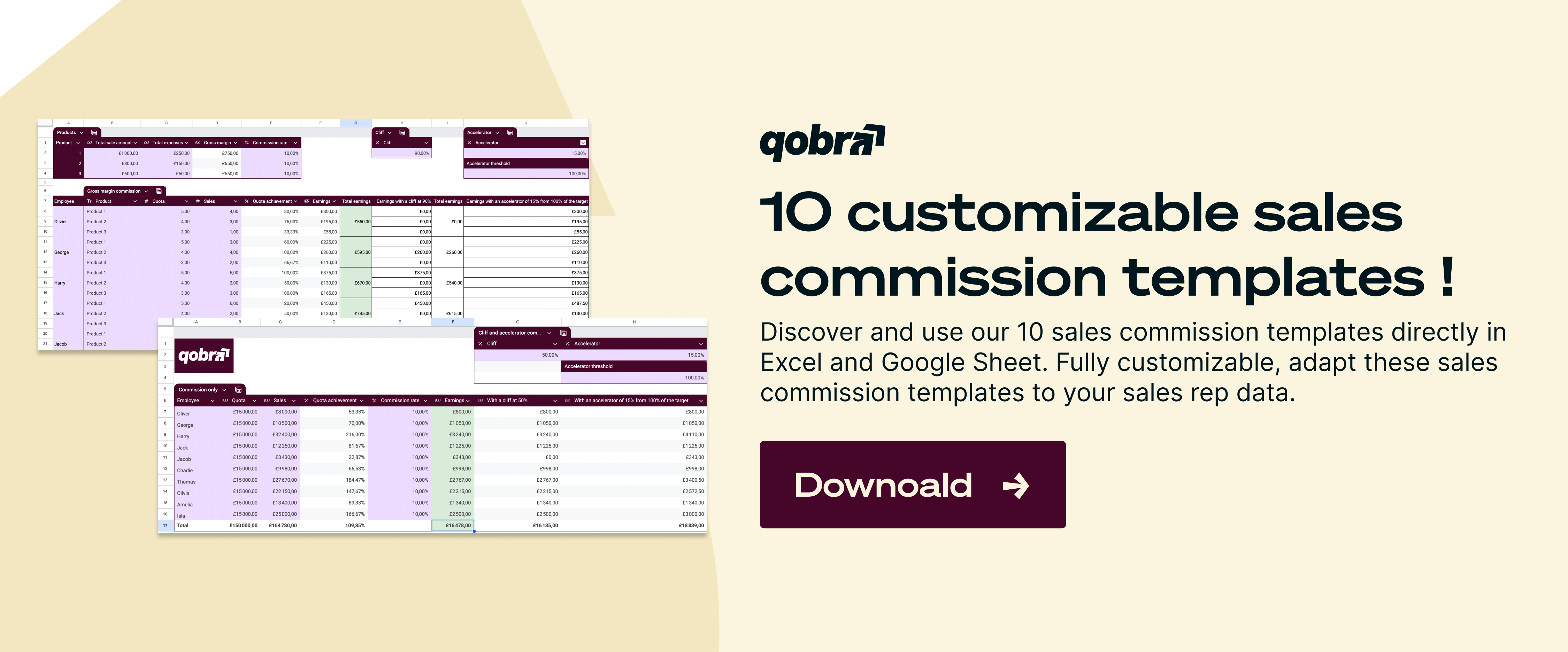
Implementation: Moving from Spreadsheet Chaos to Automated Clarity
Designing a great compensation plan is only half the battle. The other half—and often where things fall apart—is implementation. Managing commissions on spreadsheets is a common starting point, but it quickly becomes a bottleneck as the team grows. Manual calculations are prone to errors, lead to disputes, and offer zero real-time visibility for reps. This opacity can destroy trust and motivation.
This is where a dedicated commission management platform becomes essential. Automating the process ensures that your well-designed plan actually works in practice.
A platform like Qobra revolutionizes this process by connecting directly to your CRM (like Salesforce or HubSpot) and other data sources. With a no-code rule editor, sales ops or finance teams can build and modify even the most complex plans without writing a single line of code.
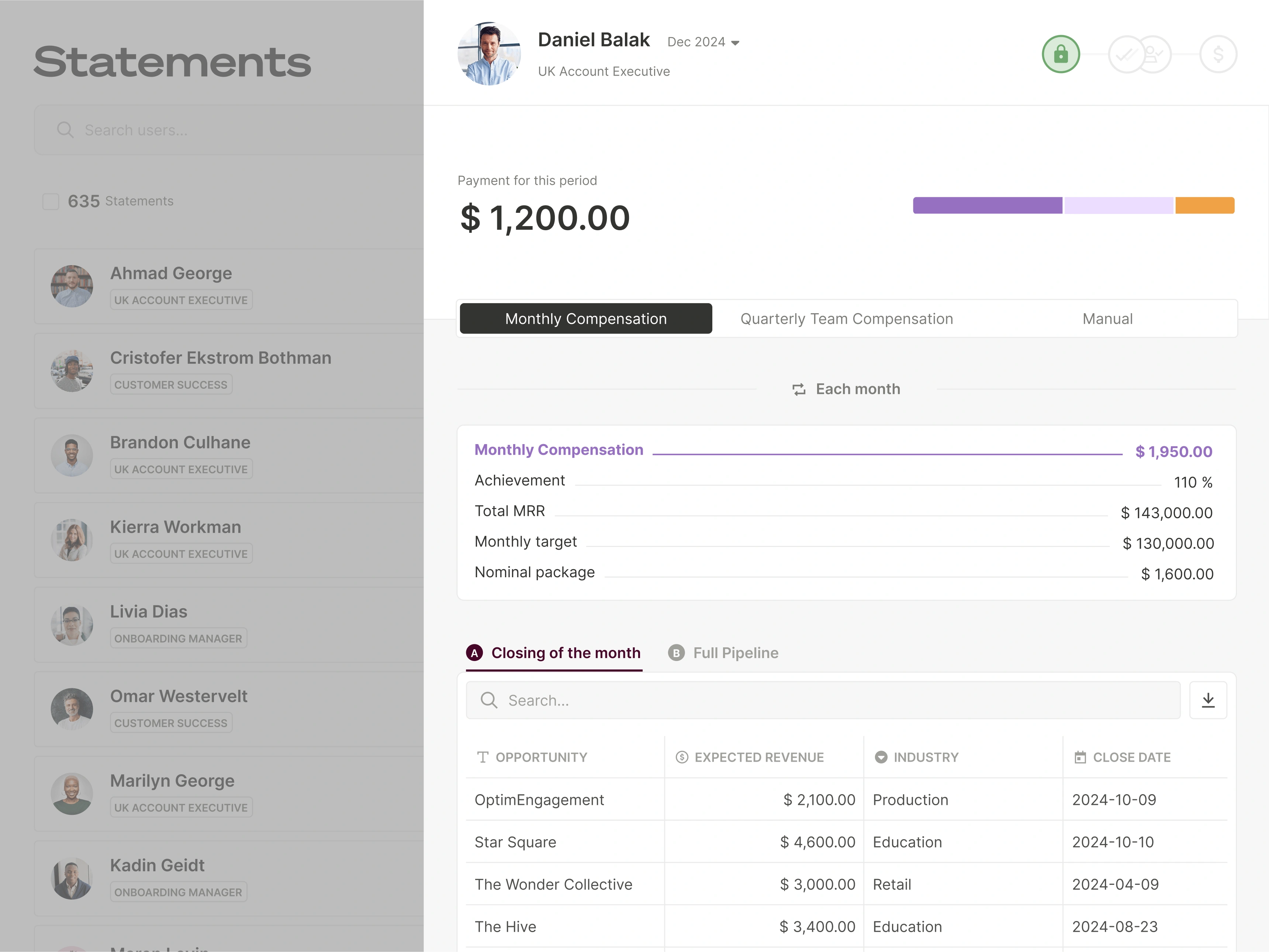
The benefits are immediate:
- Accuracy and Trust: Calculations are automated and error-free, eliminating disputes and building trust.
- Real-Time Visibility: Reps get a live dashboard showing their current attainment and potential earnings for deals in their pipeline. This real-time feedback loop is a powerful, continuous motivator.
- Time Savings: Finance and ops teams save dozens of hours each month on manual calculations and reconciliations, freeing them up for more strategic work.
- Agility: Plans can be adjusted quickly as business strategy evolves, without a massive administrative headache.
By moving off spreadsheets, you transform compensation from a painful administrative task into a strategic, transparent, and motivating system that drives performance across the entire sales organization.
A well-structured SaaS sales compensation plan is a strategic asset. It aligns your team with the unique economics of the subscription model, rewarding the creation of long-term, recurring value. By defining clear roles, setting fair OTEs, tying incentives to key SaaS metrics, and using mechanics like accelerators, you can motivate the right behaviours. However, the plan's success ultimately hinges on its implementation. Automating your commission process with a dedicated platform ensures the accuracy, transparency, and agility needed to turn your plan into a true engine for predictable growth.
The move from spreadsheet chaos to automated clarity described above has a concrete form. Qobra's sales compensation platform connects to Salesforce, HubSpot or your warehouse and recalculates every plan as deals close.
FAQ
How often should I review and update our sales compensation plan?
Best practice is to review your compensation plan annually. This allows you to align it with the upcoming fiscal year's business goals. However, avoid making major changes more frequently unless there's a significant shift in strategy, such as launching a new product or entering a new market. Constant changes create confusion and instability for the sales team.
What is a typical quota-to-OTE ratio for a SaaS AE?
A common rule of thumb for SaaS Account Executives is a quota-to-OTE ratio between 4x and 6x. For example, if an AE's On-Target Earnings (OTE) is $150,000, their annual quota would typically fall between $600,000 and $900,000 in new ARR. This can vary based on factors like average deal size, sales cycle length, and market maturity.
How do I handle compensation for a new hire during their ramp-up period?
New hires need time to build their pipeline and learn the product. A ramp-up period with a non-recoverable draw or guaranteed commission for the first 3-6 months is standard. This provides them with financial stability while they get up to speed. Their quota should also be tiered during this period, starting low (e.g., 25% of full quota in month 1) and gradually increasing to 100% by the end of the ramp.