Sales Compensation Software Benchmark | Compare 15+ Sales Compensation Platforms
Download
- Design compensation from core building blocks—base salary, variable incentive, OTE, quota, accelerators/SPIFs, and clawbacks—explicitly aligned to ARR, churn and NRR metrics.
- Set competitive OTE and pay-mix by role and segment (e.g., SDR ~65/35, AE ~50/50, CSM ~80/20), using market benchmarks to attract and retain talent.
- Set quotas by combining top‑down targets, bottom‑up quota-to‑OTE rules (4–6x OTE for AEs) and historical performance, and match quota cadence to sales cycle (monthly/quarterly/annual).
- Keep mechanics simple: use tiered commissions with accelerators/decelerators, protect with ramp periods and multi‑year TCV kickers, and enforce clawbacks for early churn (90–180 days).
- Automate pay calculations with an ICM tool, publish one‑page role templates, and provide downloadable calculators and implementation checklists to ensure transparency and fast deployment.
Are you struggling to build a sales compensation plan that truly motivates your SaaS team while protecting your bottom line? You are not alone. The transition from founder-led sales to a scalable, team-driven model is a critical juncture for any SaaS company. A well-designed compensation structure is the engine that powers this transition, aligning individual incentives with corporate objectives, attracting top talent, and ultimately driving predictable revenue growth.
This guide provides a complete framework for designing an effective SaaS sales compensation plan. We will break down the core components, walk through the strategic questions you need to answer, and provide role-specific templates with concrete examples. Eliminate ambiguity and complex spreadsheets; it is time to build a plan that is simple, fair, and powerful.
The Core Components of a High-Impact SaaS Comp Plan
Before diving into numbers and structures, it is crucial to understand the building blocks of any effective plan. A robust structure goes far beyond a simple commission percentage. It is a balanced system designed to reward desired behaviours and ensure financial stability for both the salesperson and the company.
Here are the key elements you will need to define:
- Base Salary: This is the fixed, guaranteed portion of a salesperson's income, paid regardless of performance. It provides financial stability and is essential for attracting and retaining talent, especially in roles with longer sales cycles.
- Variable Compensation (Incentive): This is the performance-based component, typically in the form of commissions or bonuses. It is the primary driver for motivating sales reps to hit and exceed their targets. The core philosophy is a pay-for-performance model, directly linking earnings to results.
- On-Target Earnings (OTE): OTE is the total potential income a salesperson can earn by achieving 100% of their sales quota. It is calculated as Base Salary + Variable Compensation at target. OTE is the most important figure when recruiting and benchmarking against the market.
- Sales Quota: The specific target a salesperson must achieve within a defined period (e.g., monthly, quarterly) to earn their full variable compensation. Quotas can be based on Annual Recurring Revenue (ARR), new logos, qualified meetings set, or other key metrics.
- Accelerators & Decelerators: These are mechanisms that modify commission rates based on quota attainment. Accelerators increase the commission rate for performance above 100% of the quota, while decelerators reduce the rate for significant underperformance.
- SPIFs (Sales Performance Incentive Funds): Short-term contests or bonuses designed to motivate reps to focus on a specific goal, such as selling a new product or closing deals before the end of the quarter.
- Clawbacks: A contractual provision that allows the company to reclaim commission payments under specific circumstances, most commonly when a new customer churns within the first few months. This ensures sales reps are focused on signing good-fit customers, not just closing any deal.
Understanding these fundamental components of compensation is the first step toward building a plan that works.
Step 1: Define Your Philosophy – "How Much?"
The first foundational question to answer is how much your sales team members should earn. This involves setting the On-Target Earnings (OTE) for each role and determining the right pay mix between fixed and variable compensation.
On-Target Earnings (OTE)
OTE is the anchor of your entire compensation plan. It sets expectations for earning potential and is the primary figure candidates will compare when considering your offer. OTE should be competitive for your market, region, and industry. It varies significantly based on the role, the required experience level, and the segment they are selling into (SMB, Mid-Market, Enterprise).
Pay Mix
The pay mix is the ratio of base salary to variable compensation. This ratio reflects the nature of the role and how much of a salesperson's performance is directly tied to revenue generation. A more aggressive pay mix (e.g., 50/50) places more emphasis on performance, while a more conservative mix (e.g., 80/20) provides more stability.
Here are common pay mix benchmarks for different SaaS sales roles:
| Role | Typical Pay Mix (Base/Variable) | Rationale |
|---|---|---|
| Sales Development Rep (SDR) | 70/30 or 65/35 | Role is focused on top-of-funnel activities (setting meetings) which are a leading indicator of revenue, but not revenue itself. |
| Account Executive (AE) | 50/50 | Directly responsible for closing new business and generating revenue. This mix provides a strong incentive to close deals. |
| Account Manager (AM) | 60/40 or 70/30 | A blended role focused on retaining existing customers and expanding accounts. Requires both relationship management and sales skills. |
| Customer Success Manager (CSM) | 80/20 or 90/10 | Primarily focused on product adoption, customer health, and retention. Variable pay is often tied to Net Revenue Retention (NRR) or upsell leads. |
| Sales Manager / Director | 60/40 | Performance is based on the team's collective success. A higher base provides stability while the variable portion rewards team overachievement. |
Benchmark Your OTE and Pay Mix
Do not set your OTE in a vacuum. Use industry reports, consult with specialized recruiting firms in your area, and talk to your network to understand competitive compensation packages. A plan that is misaligned with the market will fail to attract or retain top performers.
Step 2: Set Clear Targets – "For What?"
Once you know how much a rep can earn, you need to define what they must do to earn it. This is where quota setting comes in. A well-set quota is ambitious enough to stretch your team but realistic enough to be achievable by a majority of them (typically 60-70%).
Quota Setting Methodologies
Setting a quota is not an art; it is a science that involves triangulating data from multiple sources.
- Top-Down Approach: Start with the company's overall revenue target from the financial forecast. Distribute this target across the sales team, factoring in territory potential and individual experience.
- Bottom-Up Approach (Quota-to-OTE Ratio): A common rule of thumb in SaaS is to set an annual quota that is 4x to 6x the Account Executive's OTE. For example, an AE with a $150,000 OTE would typically have an annual quota between $600,000 and $900,000 in new ARR.
- Historical Performance: Analyze past performance data to understand what has been achievable. Consider factors like average deal size, sales cycle length, and win rates to set a realistic baseline.
By combining these three methods, you can arrive at a quota that is aligned with business goals, grounded in reality, and mathematically sound relative to compensation costs. This strategic process is often managed by RevOps as part of compensation planning.
Quota Frequency
How often should quotas reset? The answer depends on your average sales cycle length and deal size.
- Monthly Quotas: Best for high-velocity sales environments with short sales cycles (under 30 days) and smaller contract values.
- Quarterly Quotas: The most common model in B2B SaaS. It provides a good balance, creating urgency without punishing reps for a single slow month, which is common with deals that take 60-90 days to close.
- Annual Quotas: Suited for enterprise sales roles with very long and complex sales cycles (6-12+ months) and high ACVs.
Step 3: Structure the Incentives – "How?"
This is the mechanics of your plan—how commissions are calculated and paid. Simplicity is key; a plan that a salesperson cannot calculate on the back of a napkin is a plan that will not motivate them.
Commission Structures
- Single-Rate Commission: A fixed percentage is paid on all sales (e.g., 10% of new ARR). It is simple to understand but does not incentivize overperformance.
- Tiered Commission with Accelerators: This is the most effective and popular structure for SaaS. It rewards top performers disproportionately, creating powerful motivation to exceed targets.
Here is an example of a tiered structure for an AE with a 10% on-target commission rate:
| Quarterly Quota Attainment | Commission Rate on New ARR | Description |
|---|---|---|
| 0% – 79% | 7.5% | Decelerator: Protects the company from high commission costs on underperformance. |
| 80% – 100% | 10% | On-Target Rate: The standard commission earned when the quota is met. |
| 101% – 125% | 12.5% | Accelerator 1: The first tier of reward for exceeding the goal. |
| 126%+ | 15% | Accelerator 2: A higher tier to strongly incentivize top performance. |
Special Considerations for SaaS
- Ramp-Up Period: New hires need time to build their pipeline and learn the product. During their first 3-6 months, provide a "ramp" with reduced quotas and often a guaranteed, non-recoverable draw to ensure they have a stable income while they get up to speed.
- Multi-Year Deals: To encourage long-term customer commitments, offer a bonus or a higher commission rate on multi-year contracts. For example, you could pay an extra 2-3% on the Total Contract Value (TCV) for any deal longer than one year, then compare that payout with ARR and ACV in a SaaS commission calculator.
- Clawbacks & Churn: To align sales with long-term customer success, implement a clawback policy. A standard approach is to reclaim 100% of the commission if a customer churns within the first 90 or 180 days. This makes reps accountable for the quality of their deals and is a crucial part of managing your churn calculation. You can learn more about how clawback policies work in practice.
Keep It Simple
The best compensation plans fit on a single page. If your plan requires a complex spreadsheet with dozens of "if/then" statements to understand, it is too complicated. Complexity creates confusion and distrust, which are killers of motivation. The goal is clarity and a direct link between action and reward.
Role-Specific SaaS Sales Compensation Plan Templates
Here are concrete examples of how to apply these principles to the most common roles in a SaaS sales organization.
Account Executive (AE) Compensation Plan Template
This template is for a mid-market AE focused on acquiring new logos.
- OTE: $160,000
- Pay Mix: 50/50 (Base: $80,000, Variable: $80,000)
- Annual Quota: $800,000 ARR (5x OTE)
- Quarterly Quota: $200,000 ARR
- Commission Rate: 10% on New ARR (On-target rate)
- Accelerators:
- 101%-125% of quota: 12.5% commission
- 126%+ of quota: 15% commission
- Bonuses: +2% commission kicker on the TCV of multi-year deals.
- Clawback: 100% commission clawback on customers churning within 90 days.
Sales Development Representative (SDR) Compensation Plan Template
This plan for an inbound SDR focuses on generating high-quality meetings for the AE team. For more details, explore our guide on how to properly pay an SDR.
- OTE: $80,000
- Pay Mix: 70/30 (Base: $56,000, Variable: $24,000)
- Quarterly Quota: 40 Sales Qualified Opportunities (SQOs)
- Variable Pay Structure:
- $150 per SQO generated (up to 40).
- $250 bonus for each SQO that converts to a Closed-Won deal.
- Accelerators:
- $200 for every SQO generated above the quarterly quota of 40.
Customer Success Manager (CSM) Compensation Plan Template
This CSM plan is designed to drive retention and identify expansion opportunities. For a deeper dive, check out our analysis of CSM compensation models.
- OTE: $95,000
- Pay Mix: 80/20 (Base: $76,000, Variable: $19,000)
- Variable Components (MBOs):
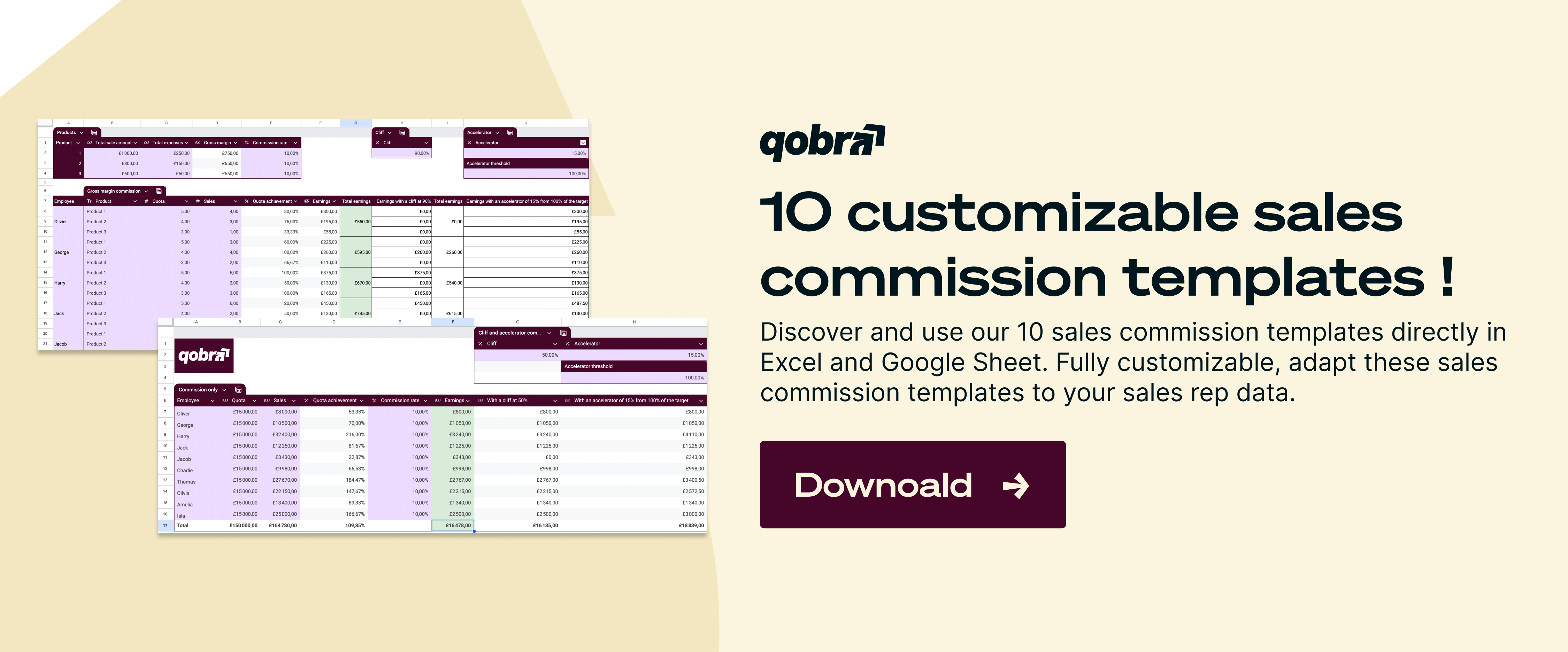
- 60% tied to Team Net Revenue Retention (NRR): Paid quarterly based on the team achieving an NRR target of 115%.
- 40% tied to Expansion Revenue Sourced: A 5% commission on all expansion ARR from deals sourced by the CSM and closed by an Account Manager.
Automating and Communicating Your Plan
A brilliantly designed plan is useless if it is managed on a chaotic spreadsheet. Manual commission tracking is a recipe for disaster—it's slow, prone to costly errors, and completely opaque to your sales team. This leads to disputes, demotivation, and hours wasted by your finance and ops teams.
The Hidden Costs of Spreadsheets
Beyond calculation errors, spreadsheets create a fundamental lack of trust. When reps cannot see how their earnings are calculated in real-time, they spend time shadow accounting instead of selling. This friction erodes motivation and can be a major contributor to sales team turnover.
This is where an Incentive Compensation Management (ICM) solution like Qobra becomes essential. By automating the entire process, you can:
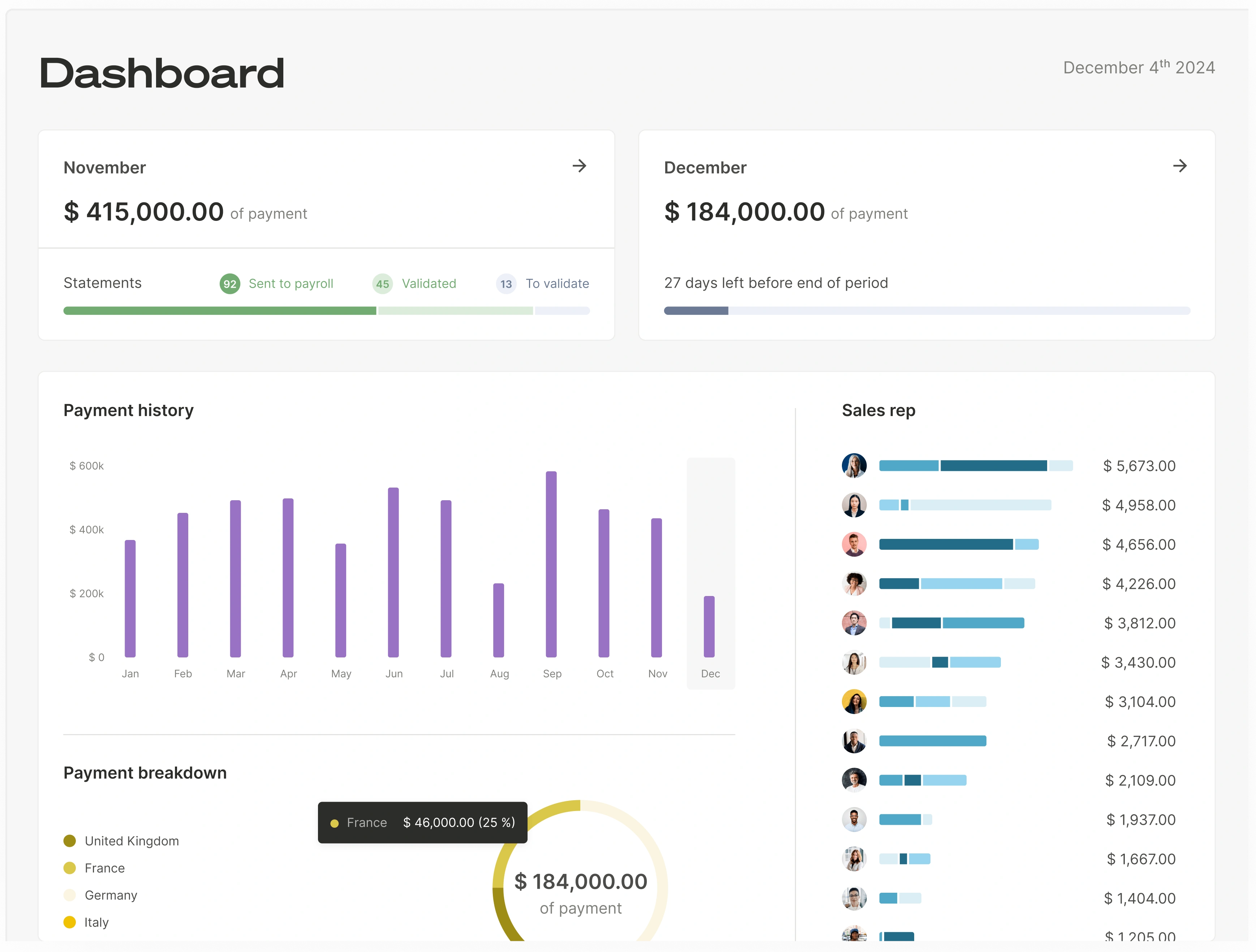
- Ensure 100% Accuracy: Qobra connects directly to your CRM (like Salesforce or HubSpot) and automatically calculates commissions from closed deals. Qobra syncs CRM data automatically throughout the day, and on demand in one click. This automation eliminates manual errors and saves dozens of hours per month.
- Provide Full Transparency: Sales reps get a live dashboard showing their quota attainment, current earnings, and potential future commissions. This real-time visibility is a powerful motivator.
- Increase Agility: With a no-code plan editor, Sales Ops or Finance can easily model, adjust, and deploy new compensation plans in minutes, not weeks.
Switching from manual processes to a dedicated platform like Qobra is one of the highest-leverage finance tasks you can automate.
Finally, once you have designed and automated your plan, you must communicate it clearly. Hold a team-wide meeting to walk through the plan, provide a simple one-page document outlining the mechanics for each role, and ensure managers are equipped to answer any questions. Transparency is the foundation of a successful compensation strategy.
A great SaaS sales compensation plan is a strategic asset. It aligns your sales team with your most important business goals, rewards high performance, and creates a predictable revenue engine. By following this framework and leveraging modern tools to ensure accuracy and transparency, you can build a compensation structure that attracts the best talent and fuels your company's growth.
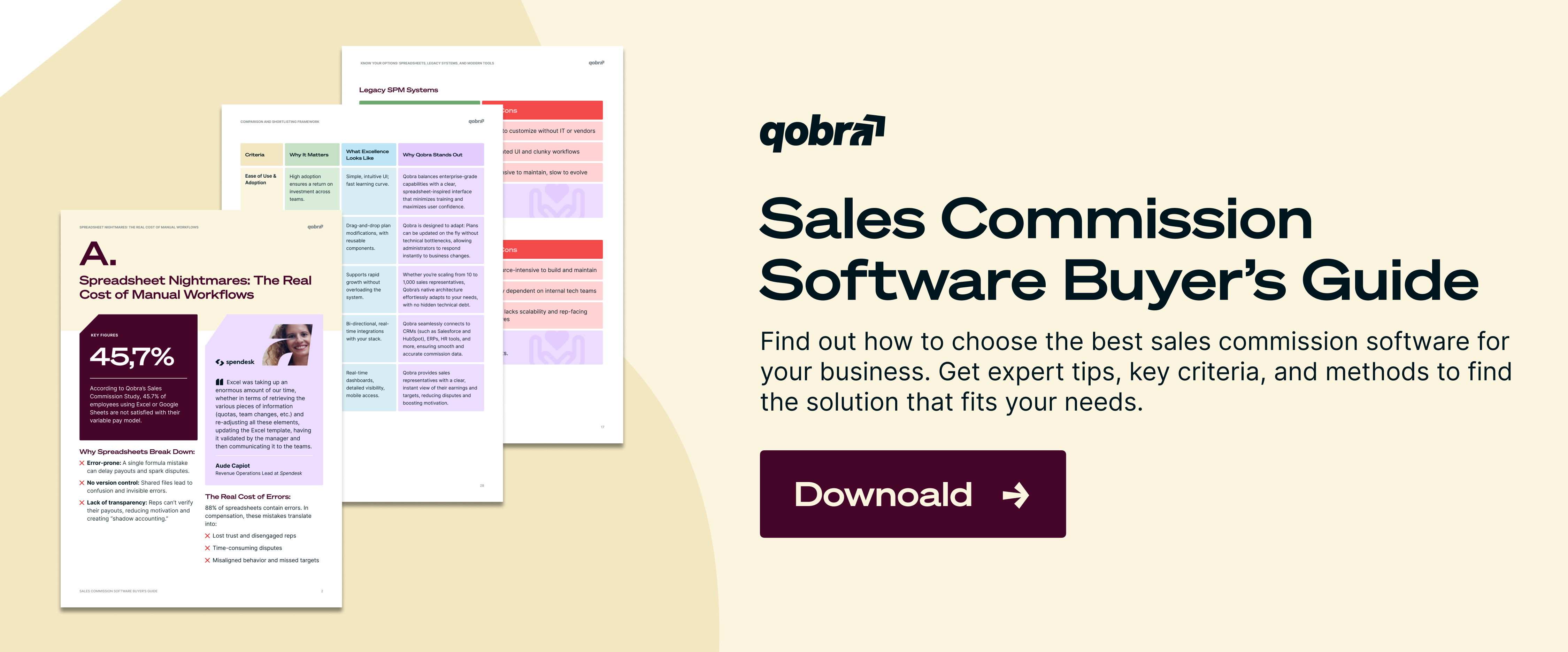
Ramp quotas and non-recoverable draws are simple to describe and tedious to run month after month. Qobra's sales compensation platform encodes them once, then applies them per rep and per hire date.
Frequently Asked Questions
What is a SaaS sales compensation plan?
A SaaS sales compensation plan is the structured system of payment for salespeople in a software-as-a-service company. It typically includes a fixed base salary and a variable component (commissions, bonuses) tied to achieving specific performance metrics, such as generating Annual Recurring Revenue (ARR), setting qualified appointments, or hitting retention targets.
How do you structure a compensation plan for a SaaS startup?
For a startup, simplicity and cash conservation are key. Often, this means a slightly lower base salary but a more aggressive, uncapped commission structure with strong accelerators to heavily reward the early salespeople who are instrumental in finding product-market fit. The focus should be almost exclusively on new logo acquisition and generating new ARR.
What is a good commission rate for SaaS sales?
A standard on-target commission rate for a SaaS Account Executive is typically between 8% and 12% of the Annual Recurring Revenue (ARR) for a new deal. This rate can be higher for more transactional, high-volume sales or lower for enterprise deals with very high contract values. The rate should be set so that if a rep hits 100% of their quota, they earn 100% of their target variable pay.
How do you handle ramp-up periods for new sales hires?
During a ramp-up period (typically 3-6 months), new hires are given reduced quotas that gradually increase each month until they reach their full target. To ensure financial stability during this time, they are often paid a non-recoverable draw, which is a guaranteed minimum commission payment, regardless of their actual sales performance. This allows them to focus on learning without financial stress.