Webinar: The Biggest Release Sales Comp Has Ever Seen. Come See For Yourself (Wednesday, October 7)
Register
- Centralizes and automates variable-pay calculations—from CRM deal data to payroll-ready payouts—handling SaaS-specific logic (MRR/ARR, prorations, accelerators, clawbacks).
- No-code plan builder with sandboxing allows RevOps and Finance to model, simulate, and deploy complex compensation plans without engineering support.
- Native, real-time integrations (Salesforce/HubSpot, Stripe/Chargebee, Workday/ADP) plus secure APIs and full audit trails create a single source of truth for commissions and compliance.
- Eliminates manual errors and disputes, saves Finance/RevOps hours each period, and boosts rep trust through transparent, real-time dashboards and detailed calculation breakdowns.
- Migrate safely with a staged approach—audit current workflows, define requirements, run a pilot to validate calculations and payroll exports, then roll out with training and CSM support to measure ROI.
Are your spreadsheets buckling under the weight of your SaaS commission plans? As recurring revenue models grow more complex with accelerators, clawbacks, and multi-year contracts, the manual processes that once worked are now a significant source of errors, disputes, and wasted hours for Finance and RevOps teams. The final, painful step of translating those complex calculations into accurate payroll is often where the most costly mistakes happen.
This isn't just an operational headache; it's a strategic bottleneck. In the SaaS world, where long-term customer value is paramount, your sales compensation plan is one of the most powerful tools you have to drive the right behaviors. If your reps don't trust the numbers or if your finance team spends the first week of every month untangling formulas, you're losing momentum and motivation.
The solution lies in a new breed of software designed specifically for this challenge: SaaS sales compensation payroll software. This isn't just another commission tracker; it's a fully integrated system that automates the entire process, from deal closure in your CRM to the final variable pay amount ready for your payroll system.
What is SaaS Sales Compensation Payroll Software?
SaaS sales compensation payroll software is a specialized platform that automates the calculation, tracking, and management of variable pay for sales teams and provides a seamless connection to payroll systems. Unlike a simple calculator, it serves as the central hub connecting performance data (from your CRM) with financial payout systems (HRIS and payroll), ensuring accuracy, transparency, and compliance.
The core distinction lies in its holistic approach. While traditional tools might calculate a commission percentage, a modern platform handles the entire lifecycle:
- Data Aggregation: It pulls data in real-time from systems like Salesforce or HubSpot.
- Complex Logic: It applies complex rules specific to SaaS, such as prorated commissions for MRR, bonuses on multi-year contracts, or deductions for churn.
- Validation: It provides workflows for managers and finance to review and approve payouts.
- Integration: It pushes the final, verified commission data directly to payroll platforms like Workday or ADP, eliminating manual data entry.
SaaS companies don’t operate like traditional businesses. You’re not just closing one-time deals; you’re selling subscriptions, renewals, and long-term value. That means your compensation plan can’t just reward sales volume. It has to drive outcomes that sustain growth, and your tools must be built to support that reality.
This shift transforms commission management from a reactive, error-prone accounting task into a proactive, strategic function that aligns sales behavior with company goals.
The Core Components of a Modern Compensation Platform
To effectively manage SaaS commissions and connect them to payroll, a platform must offer a robust set of features. These components work together to build a reliable, scalable, and motivating system.
The No-Code Plan Builder: Agility for Evolving Strategies
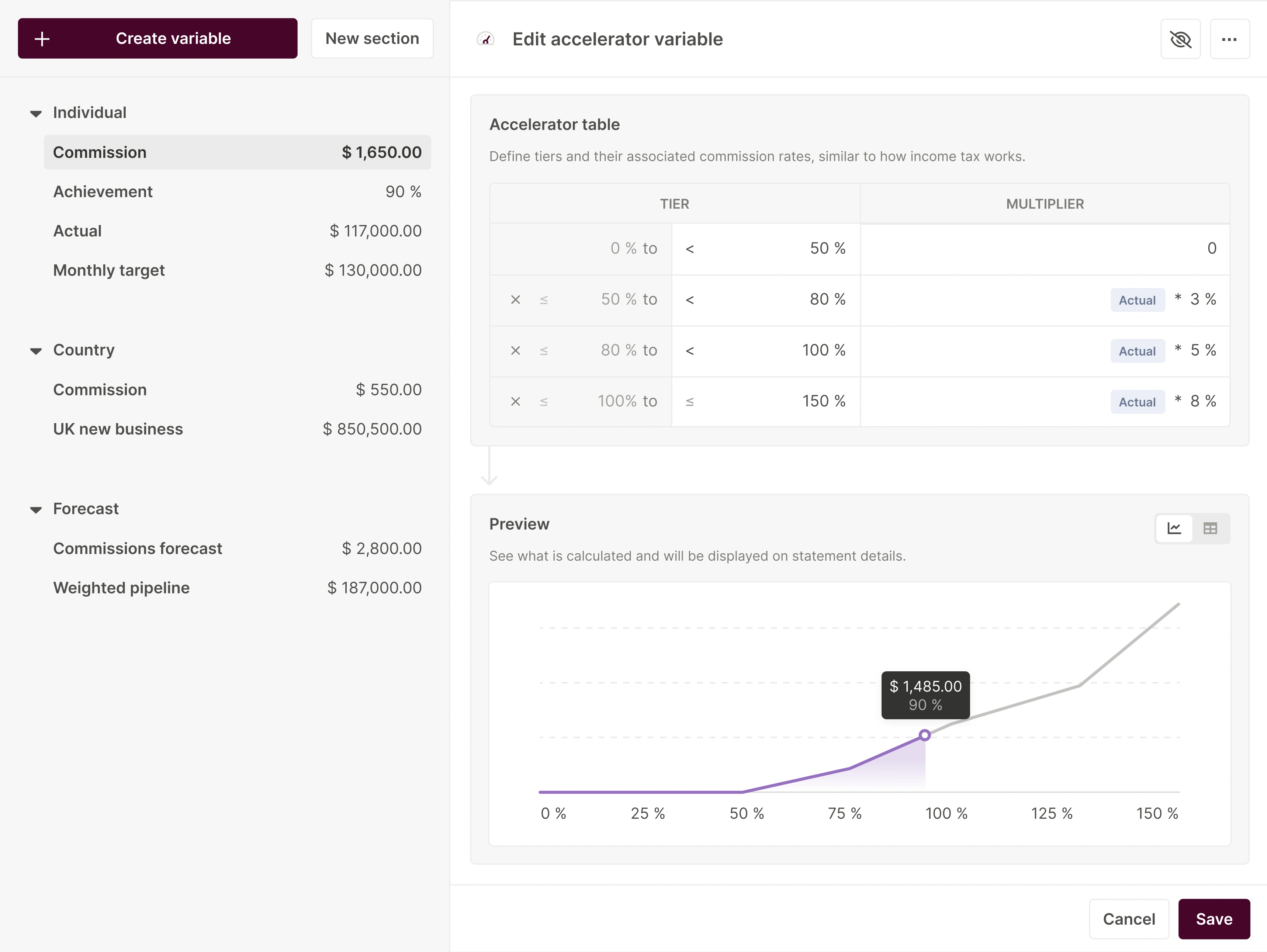
Your go-to-market strategy isn't static, and your compensation plans shouldn't be either. A key feature of leading platforms is a no-code plan editor. This empowers RevOps, Sales Ops, and Finance teams to build, model, and deploy sophisticated compensation plans without writing a single line of code or relying on expensive consultants.
With an intuitive, drag-and-drop interface, administrators can easily define any type of logic:
- Tiered commission rates and accelerators.
- Product-specific bonuses and SPIFs.
- Complex rules based on contract length or deal type.
- Draw structures and guarantees for new hires.
Platforms such as Qobra combine the flexibility of a spreadsheet with the power of an enterprise-grade engine, letting you design and manage incentive plans that map perfectly to your sales goals. Qobra now adds an AI layer: generate a plan or a view from a single natural-language sentence, let reps understand their pay just by asking, and make reporting queryable in plain language, with no technical setup. Furthermore, features like plan simulation and sandboxing allow you to test changes in a safe environment, ensuring accuracy before rollout, while version control provides a complete audit trail for compliance.
Real-Time Data Integration and Calculation
The mantra "garbage in, garbage out" has never been more true. The accuracy of your commissions depends entirely on the quality and timeliness of your source data. Modern compensation software eliminates manual CSV imports by offering native, real-time integrations with your CRM and other business systems.
Data from Salesforce, HubSpot, or even data warehouses like Snowflake can be synced automatically on a scheduled basis—or even in real-time as deals are closed. This ensures that calculations are always based on the most up-to-date information. When a deal value changes or a new contract is signed, the platform's calculation engine instantly recalculates the commission, providing immediate feedback to the sales rep. This automation is a key step in automating finance tasks and freeing up valuable team resources.
Transparency and Motivation for Sales Reps
For a compensation plan to be effective, it must be understood and trusted by the sales team. The "black box" of spreadsheet calculations often leads to frustration, disputes, and a lack of motivation. A dedicated platform replaces this opacity with complete transparency.
Sales reps get access to personalized, real-time dashboards where they can see:
- Progress toward their quota.
- Commissions earned to date, broken down by deal.
- Potential earnings from their pipeline.
- Detailed explanations of how each commission was calculated.
This visibility is a powerful motivator. When a rep sees their commission update the moment they close a deal, it creates a direct and immediate link between action and reward. To further boost engagement, platforms can embed these dashboards directly within Salesforce, integrate with Slack for performance notifications, and even offer gamified elements like challenges and leaderboards.
From Calculation to Payout: The Payroll Connection
The final—and most critical—piece of the puzzle is bridging the gap to payroll. This is where most manual processes fail, as figures are copied and pasted between systems, introducing a high risk of error.
An integrated compensation platform streamlines this "last mile" with a structured validation workflow and direct payroll integration.
- Calculation: The system automatically calculates all commissions for the period.
- Validation: Managers, Finance, and HR are prompted through an automated workflow to review, adjust (if necessary), and approve the payouts. Every adjustment is tracked.
- Export & Sync: Once approved, a clean, error-free statement is generated. This can be exported in a format ready for your payroll system or, with advanced integrations, pushed directly via an API.
This automated handoff ensures that the amount calculated is the exact amount paid, eliminating costly overpayments and the trust-eroding impact of underpayments.
Expert Tip: Build a Complete Compensation Stack
The best software isn’t a standalone tool. It’s the hub of a compensation stack that connects your CRM (e.g., Salesforce), accounting platform, and payout workflows. This creates an error-proof system where data flows seamlessly, providing real-time visibility for reps, managers, and finance teams alike.
Why SaaS Companies Must Move Beyond Spreadsheets
While spreadsheets are versatile, they were not built to manage the unique complexities of SaaS sales compensation. As your company scales, the limitations become critical risks.
The Problem with Recurring Revenue Metrics
SaaS compensation isn't based on a single transaction value. It relies on nuanced metrics that are difficult to track in a spreadsheet:
- Annual Recurring Revenue (ARR): Calculating commissions on ARR, especially for multi-year deals with varying payment terms, is complex.
- Expansion & Upsells: Rewarding account managers for growing existing accounts requires tracking incremental revenue changes over time.
- Churn & Down-sells: Implementing penalties or commission clawbacks for customers who churn early is a manual nightmare in Excel.
An automated platform is built to handle these SaaS-specific metrics natively, allowing you to design plans that truly incentivize long-term value creation.
The High Cost of Errors and Disputes
Manual processes are inherently prone to error. Studies show that only 21% of companies are satisfied with their sales compensation plans, often due to inaccuracies and disputes. These errors have a tangible cost.
Overpaying commissions directly impacts your bottom line and customer acquisition cost (CAC) efficiency. Underpaying reps erodes trust, damages morale, and can lead to top performers leaving. Beyond the direct financial impact, consider the "soft costs": the dozens of hours your highly-paid Finance and RevOps teams spend each month manually calculating, verifying, and correcting commissions instead of focusing on strategic analysis.
| Aspect | Manual Process (Excel/Sheets) | Automated Platform (e.g., Qobra) |
|---|---|---|
| Accuracy | High risk of formula errors, typos, and version control issues. | 95%+ reduction in errors through automated calculations. |
| Time Spent | Days per month for Finance/Ops teams. | Hours per month, primarily for validation. |
| Rep Trust | Low. Calculations are opaque, leading to frequent disputes. | High. Real-time visibility and clear calculation logic build confidence. |
| Scalability | Breaks down quickly with team growth or plan changes. | Easily scales with new hires, teams, and plan iterations. |
| Audit Trail | Non-existent. No record of changes or approvals. | Complete and auditable history of all calculations and adjustments. |
The Need for a Single Source of Truth and Audit Trails
For compliance and financial audits (like SOC 2 or ASC 606), you need a clear, traceable record of how commissions were calculated and approved. Spreadsheets offer no such audit trail. A change to a single cell can alter payouts with no record of who made the change or why.
A dedicated compensation platform acts as the single source of truth for all variable pay. It logs every data sync, every calculation, every manual adjustment, and every approval step. This creates an unshakeable audit trail that satisfies auditors and provides leadership with full confidence in the financial data.
A Step-by-Step Guide to Migrating Your Payroll Compensation Process
Transitioning from spreadsheets to an automated platform is a strategic project. Following a structured approach ensures a smooth and successful implementation.
- Audit Your Current Process: Before you look at software, map your existing workflow. Document every step from when a deal is marked "Closed-Won" in the CRM to when the commission appears on a payslip. Identify all manual interventions, data sources, and stakeholders. This will reveal your biggest pain points and clarify your needs.
- Define Your Requirements: Create a checklist of non-negotiable features. Prioritize native CRM and HRIS integrations, the ability to handle your specific SaaS metrics, and the user experience for both admins and sales reps. Consult our guide on the top incentive compensation software to see what's possible.
- Evaluate Your Options: Compare vendors based on your requirements. Pay close attention to the plan builder. A platform with a powerful no-code editor, like Qobra, will provide the long-term agility needed to adapt your plans as your strategy evolves, without ongoing developer costs.
- Plan the Implementation: Don't try to switch everything overnight. Start with a pilot program for a single team. This allows you to test the data sync, validate the calculation logic, and perfect the payroll export process in a controlled environment. Crucially, ensure your source data in the CRM is clean and reliable before you begin.
- Roll Out and Train: Once the pilot is successful, plan the company-wide rollout. Communicate the benefits clearly to the sales team, focusing on transparency and accuracy. Provide thorough training on the new dashboards to drive adoption and ensure everyone knows how to get the most from the new system.
Onboarding and Support Matter
When selecting a platform, don't just look at the software—evaluate the support. A dedicated Customer Success Manager (CSM) and a structured onboarding process can make the difference between a smooth transition and a frustrating one. Platforms like Qobra offer tiered support packages, ensuring you have the right level of guidance for your team's needs.
As we look toward 2026, the need for integrated, automated, and intelligent compensation systems will only intensify. SaaS sales compensation is no longer a simple back-office function; it is a critical driver of growth, talent retention, and financial predictability. By moving away from brittle spreadsheets and embracing a platform that connects performance directly to payroll, you equip your entire GTM organization with the clarity and motivation needed to win.
Frequently Asked Questions
How does this software differ from a standard payroll system?
Sales compensation software is a specialized tool that sits between your CRM and your payroll system. It is designed to handle the complex logic of variable pay, which standard payroll systems cannot do. Its job is to calculate the variable component accurately and then feed that single, verified number to your payroll platform (like ADP or Workday), which then handles taxes, deductions, and final payment.
What is the typical implementation time?
Implementation time varies depending on the complexity of your plans and the quality of your data. However, with modern no-code platforms and native connectors, the process is much faster than it used to be. For many companies, a full implementation can be completed in a matter of weeks, not months.
How secure is the integration between the CRM, compensation tool, and payroll?
Leading platforms are built with enterprise-grade security standards. This includes using secure APIs for data transfer, offering Single Sign-On (SSO) for user access, providing granular permission controls to restrict data visibility, and adhering to strict data privacy regulations like GDPR and SOC 2 compliance.
Can we still use Excel for modeling or one-off scenarios?
Yes. Most platforms allow you to export data to CSV or Excel for further analysis or ad-hoc modeling. However, the goal is to reduce reliance on spreadsheets for core processes. The best platforms include powerful built-in simulation and sandboxing features, allowing your RevOps team to model the financial impact of plan changes without ever leaving the system, making the process faster and far more secure.