Sales Compensation Software Benchmark | Compare 15+ Platforms (Features, Pricing, User Reviews, etc.)
Download
- Align pay to company priorities: design compensation to reward the behaviours that drive your strategic goals (new logos, NRR, pipeline growth) so every role has 1–2 primary KPIs tied to variable pay.
- Follow practical benchmarks: typical AE commission ranges ~11–14% of ACV/ARR, pay mixes by role (AE 50/50, SDR 60–70/30, AM 75–80/20) and OTE examples (SDR ~$95–110k, SMB AE ~$140–180k, Enterprise AE $250k+).
- Use a step-by-step design workflow: align goals → set clear KPIs → set attainable quotas (target 60–70% team attainment) → model payouts and scenarios → implement accelerators and uncapped commissions to reward overperformance.
- Avoid common pitfalls: keep plans simple and transparent, prevent misaligned incentives (don’t pay same rate for low-value renewals vs new business), include clawbacks for churn, and stop managing commissions on fragile spreadsheets.
- Automate and equip teams: adopt an ICM platform integrated with your CRM to enable real-time visibility, accurate calculations, sandbox modeling, and provide templates, calculators and an implementation checklist for smooth rollout.
You have a powerful product, a skilled sales team, and a promising pipeline. Yet, the results consistently fall short of expectations. Deals are delayed, representatives lose momentum, and motivation wanes. What is the underlying cause of this performance gap?
More often than not, the culprit is the software sales compensation plan. While it may seem like a back-office administrative task, in the fast-paced world of software sales, your remuneration strategy is the engine that drives behaviour. A misaligned plan can erode morale, stifle ambition, and ultimately lead to revenue leakage. For any revenue leader, RevOps professional, or finance manager, mastering compensation design is not just an option—it's a critical component of sustainable growth.
The solution lies in structuring, scaling, and optimizing a strategy that aligns individual incentives with overarching business objectives. This guide provides a clear, actionable framework to build compensation plans that are fair, motivating, and designed to evolve with your company. We will explore the core components, benchmark models, and the modern tools that eliminate complexity and foster transparency.
Core Components of a Software Sales Compensation Plan
A well-structured software sales compensation plan is a balanced ecosystem designed to provide stability while rewarding high performance. It's the mechanism that translates company revenue goals into individual targets and incentives. Understanding its fundamental building blocks is the first step toward creating a system that retains top talent and drives predictable growth.
Base Salary
The base salary is the fixed, guaranteed income a sales professional receives, irrespective of their performance. It provides financial stability, which is crucial, especially in roles with long or complex sales cycles where commissions are less frequent. This component varies significantly based on geographic location, role seniority, and market demand.
For example, a Sales Development Representative (SDR) in the U.S. might have a base salary around $79,000, while a mid-market Account Executive (AE) could command between $92,000 and $120,000. In enterprise sales, where deals can take over a year to close, a higher base salary is common to compensate for the extended time to commission payout.
Variable Pay (Commission & Bonuses)
Variable pay is the performance-driven portion of a salesperson's income. It's directly tied to achieving specific, measurable outcomes and is the primary tool for motivating desired behaviours. This includes commissions, which are typically a percentage of revenue generated, and bonuses, which are often fixed amounts awarded for hitting specific targets.
The variable component is where you align sales activities with strategic goals, whether that's acquiring new logos, expanding existing accounts, or pushing a new product line. A well-designed variable pay structure makes it clear to reps how their efforts contribute directly to their earnings and the company's success.
On-Target Earnings (OTE) and the Pay Mix
On-Target Earnings (OTE) represents the total potential income a salesperson can earn by achieving 100% of their assigned quota. It is the sum of the base salary and the target variable pay.
OTE = Base Salary + Variable Pay (at 100% Quota Attainment)
The ratio between these two components is known as the pay mix. This mix is a strategic choice that reflects the role's influence on the sale.
- Account Executives (AEs): A 50/50 split (50% base, 50% variable) is the industry standard. This balance provides a safety net while heavily incentivizing closing deals. For roles with more complex, longer sales cycles, a 60/40 mix is also common.
- Sales Development Reps (SDRs): A 70/30 or 60/40 mix is more typical. Since their primary role is generating qualified leads rather than closing revenue, a larger portion of their compensation is guaranteed.
- Account Managers/Customer Success Managers (AM/CSMs): Often have a mix like 80/20 or 75/25, as their focus is on retention and relationship management, with smaller incentives for upsells and cross-sells.
What is the Standard Software Sales Commission Rate in 2026?
The standard commission rate for a software sales Account Executive typically falls between 11% and 14% of the Annual Contract Value (ACV) or Annual Recurring Revenue (ARR). However, this figure is not a one-size-fits-all metric. Several critical factors influence the final percentage, creating a dynamic model tailored to each company's unique go-to-market strategy.
Factors Influencing Commission Percentages
- Sales Cycle Length: Shorter sales cycles (e.g., SMB or self-serve SaaS) often feature higher commission percentages. Reps close a higher volume of deals, so each individual commission is smaller. Conversely, long enterprise sales cycles have lower rates but much larger absolute payouts per deal.
- Deal Size (ACV/ARR): An AE closing a $500,000 enterprise contract at a 6% commission rate earns $30,000. Another AE closing a $50,000 SMB deal at a 12% rate earns $6,000. The percentage is lower for larger deals, but the total earnings are significantly higher.
- Role & Seniority: An SDR focused on booking qualified meetings might earn 8-12% on the value of the opportunities they generate, whereas a senior enterprise AE responsible for the entire sales process will command a higher rate tied directly to closed-won revenue.
- Revenue Type: New business is the lifeblood of growth and is often incentivized with the highest commission rates. However, many SaaS companies also offer strong incentives for expansion revenue (upsells, cross-sells) and renewals, reflecting the strategic importance of Net Revenue Retention (NRR).
- Territory & Market Maturity: A salesperson pioneering a new, underdeveloped territory may receive a higher commission rate to compensate for the increased difficulty and to motivate aggressive market penetration.
Here is a sample breakdown of compensation structures by role:
Role | Typical OTE (USD) | Pay Mix (Base/Variable) | Target Commission | Primary Metric |
|---|---|---|---|---|
SDR/BDR | $95,000 - $110,000 | 70/30 or 60/40 | 8-12% of generated pipeline | Qualified Meetings/Opportunities |
SMB AE | $140,000 - $180,000 | 50/50 or 60/40 | 10-14% of New ARR | New Business ARR |
Enterprise AE | $250,000 - $350,000+ | 50/50 | 8-12% of New ARR | New Business ARR |
Account Manager | $120,000 - $160,000 | 75/25 or 80/20 | 4-8% of expansion/renewal ARR | Net Revenue Retention (NRR) |
Common Software Sales Compensation Models
While the salary-plus-commission structure is the most prevalent, several models can be layered on top to drive specific behaviours and outcomes. Choosing the right mix depends on your company's maturity, sales process, and strategic priorities.
Salary + Commission
This is the foundational model, combining a fixed base salary with a variable commission. The commission itself can be structured in a few ways:
- Single-Rate Commission: A fixed percentage is paid on every dollar of revenue closed. For example, a rep earns 10% on all deals, regardless of volume. It's simple, predictable, and easy to calculate.
- Tiered Commission: The commission rate increases as a rep achieves certain performance milestones. This model is powerful for motivating reps to exceed their targets.
Tiered Commissions & Accelerators
Accelerators are a form of tiered commission designed to reward over-performance aggressively. Once a rep hits their quota, their commission rate "accelerates" for all subsequent deals within the period.
For example, a plan might offer:
0-80% of Quota: 8% commission
81-100% of Quota: 10% commission
101%+ of Quota: 15% commission (the accelerator)
This structure ensures reps don't stop selling once they've hit their number, creating a culture of excellence and maximizing revenue potential.
Expert Tip: The Power of Uncapped Commissions
Avoid capping commissions. While it may seem like a way to control costs, it sends a message to your top performers that you want to limit their success. An uncapped plan with well-designed accelerators is far more effective. It aligns the interests of your best reps with the company's growth, ensuring they are motivated to close every possible deal.
Bonuses & SPIFFs
Unlike commissions, which are tied to revenue percentages, bonuses are typically fixed cash amounts paid for achieving specific objectives. A SPIFF (Sales Performance Incentive Fund) is a short-term bonus used to drive focus on a particular goal.
Examples include:
- A $500 bonus for every demo conducted with a target account.
- A SPIFF of $1,000 for the first rep to close a deal with a new product feature.
- A quarterly bonus for achieving a specific Net Revenue Retention (NRR) target.
These are excellent tools for short-term campaigns or shifting focus without overhauling the entire compensation plan. To learn more about different incentive structures, you can explore the various types of incentive compensation available.
Designing Your Plan: A Step-by-Step Guide
Creating an effective compensation plan is a strategic process that requires careful planning and modeling. Following a structured approach ensures alignment, fairness, and clarity.
Step 1: Align with Business Goals
Before defining a single metric, answer the fundamental question: what is the company's primary growth objective for the coming year? Is it aggressive new logo acquisition? Is it expanding footprint within the existing customer base to boost NRR? Or is it entering a new market segment? The compensation plan must directly reflect and reward the behaviours that lead to these outcomes.
Step 2: Define Key Performance Indicators (KPIs)
Translate your high-level business goals into measurable KPIs for the sales team.
- Goal: New Logo Acquisition - KPI: New Business ARR Booked, Number of New Customers.
- Goal: Increase NRR - KPI: Upsell/Cross-sell ARR, Renewal Rate.
- Goal: Fuel the Pipeline - KPI: Qualified Opportunities Created, Demos Completed.
Each role should have one or two primary KPIs that determine the majority of their variable pay. This focus prevents confusion and ensures effort is directed where it matters most.
Step 3: Set Attainable Quotas
A quota is a rep's passport to earning their OTE. Quotas must be challenging but achievable. A common rule of thumb is that 60-70% of your sales team should be able to achieve or exceed their quota in a given period. If only your top 10% are hitting their numbers, the quotas are likely too high, leading to widespread demotivation. Conversely, if 95% are hitting quota, they are too low and you are leaving revenue on the table. Use a combination of top-down (company revenue target) and bottom-up (territory potential, historical performance) analysis to set realistic targets.
Step 4: Model and Simulate Your Plan
Never roll out a new compensation plan without thoroughly modeling its financial impact. Simulate different scenarios: what is the total payout if 50% of the team hits quota? What if 80% hits quota? What if top performers achieve 200% of their target? This ensures there are no surprises and that the plan is financially sustainable. Modern tools are invaluable here, as they allow RevOps teams to sandbox and test new plans without affecting live data. This is a core part of the compensation planning process for RevOps.

Avoiding Common Pitfalls in Compensation Design
Even the most well-intentioned plans can fail if they fall into common traps. Awareness of these pitfalls is key to building a resilient and effective compensation structure.
Overly Complex Plans
If a sales rep needs a spreadsheet and an hour to figure out their commission on a deal, the plan is too complex. Complexity breeds mistrust, confusion, and "shadow accounting," where reps spend valuable selling time trying to calculate their own pay. A good plan should be easily explainable and allow a rep to quickly estimate their earnings from a potential deal. Simplicity drives motivation.
Misaligned Incentives
Incentives drive behaviour—for better or for worse. Be cautious of unintended consequences. For example:
- Paying the same rate for all revenue: If you want to drive new business but pay the same commission for an easy renewal, reps will naturally gravitate toward the path of least resistance.
- Focusing solely on ACV: If reps are only paid on the first-year contract value of a multi-year deal, they have no incentive to secure longer-term commitments.
- Lack of Clawbacks: Without a policy to reclaim commissions on deals that churn quickly or are cancelled for non-payment, reps may be incentivized to close bad-fit customers. You can learn more about clawback policies to protect your business.
Warning: The Hidden Costs of Manual Management
Managing compensation plans on spreadsheets is a significant operational risk. It's not a matter of if an error will occur, but when. These errors lead to incorrect payouts, damaged trust with the sales team, and countless hours for Finance and RevOps teams spent on manual calculations, dispute resolution, and reconciliation. The cost of a single major payroll error can far exceed the investment in a dedicated automation platform.
The Role of Automation and Commission Software
As organizations scale, managing sales compensation on spreadsheets becomes unsustainable. The administrative burden grows exponentially, and the lack of real-time visibility becomes a major drag on performance. This is where dedicated sales commission software provides a transformative advantage.
Why Move Beyond Spreadsheets?
Spreadsheets were not designed for the complexity of modern sales compensation. Their limitations are clear:
- Error-Prone: Manual data entry and complex formulas are a recipe for mistakes.
- Time-Consuming: Finance and RevOps teams can spend days each month calculating, verifying, and distributing commission statements.
- Not Scalable: As the team grows and plans evolve, spreadsheets become unwieldy and break.
- Lack of Transparency: Reps are left in the dark about their earnings until the end of the month, creating anxiety and frustration.
Benefits of a Dedicated Platform
Automating commission management with a platform like Qobra revolutionizes the process for everyone involved. As a leading no-code solution, it empowers teams to manage compensation with speed, accuracy, and transparency. The benefits are immediate and impactful.
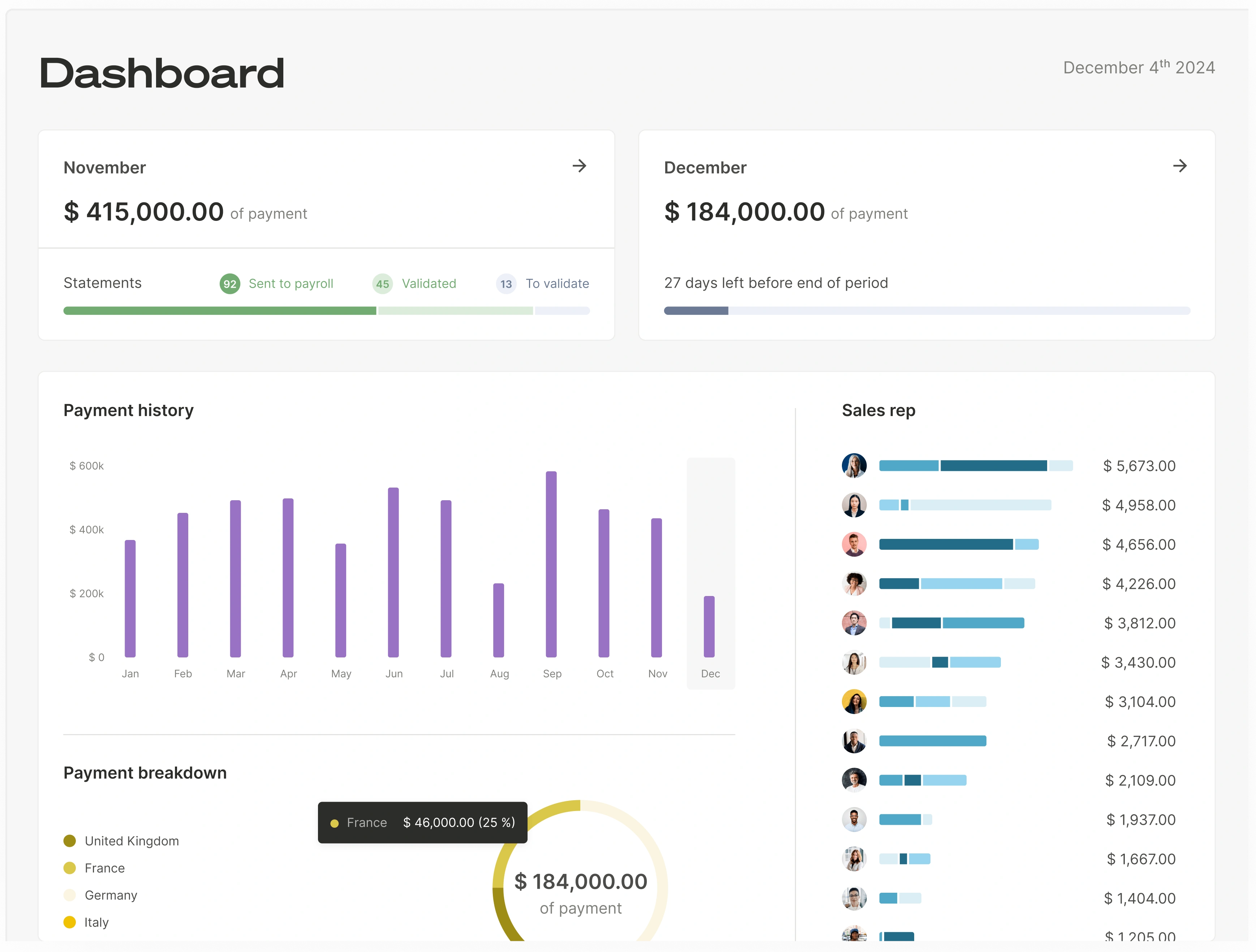
- Real-time Transparency & Motivation: With a direct, native integration to your CRM (like Salesforce or HubSpot), deals are reflected in commission dashboards instantly. Reps can see their earnings accumulate in real-time, which has been shown to boost target achievement by 15-20%. This level of pay transparency builds trust and keeps motivation high throughout the quarter.
- Accuracy and Trust: By automating calculations directly from the data source, a dedicated platform eliminates manual errors. Every calculation is traceable, providing a clear audit trail and ending disputes over payouts. This reliability is why many companies choose a specialized tool over competitors like Spiff or Everstage.
- Operational Efficiency: Qobra's no-code plan editor allows Ops and Finance teams to build, simulate, and adjust complex plans in clicks, not weeks. What once took days of manual work each month is reduced to a few hours of oversight, freeing up strategic resources to focus on optimizing the plan rather than just administering it.
- Flexibility & Scalability: As your business strategy evolves, your compensation plan must adapt. A flexible platform allows you to easily model and roll out changes, add SPIFFs, or create new team structures without relying on expensive consultants or developers.
Investing in an incentive compensation management (ICM) solution is no longer a luxury; it's a foundational element of a modern, high-performing sales organization.
A well-crafted software sales compensation plan is more than just a payment system; it's a strategic communication tool that tells your sales team exactly what matters most to the business. By combining a stable base salary with motivating variable incentives, aligning KPIs with company goals, and leveraging automation to ensure transparency and accuracy, you can build a high-performance culture that attracts and retains top talent. A thoughtful, scalable, and automated plan is one of the most powerful levers you have to drive sustainable revenue growth.
Frequently Asked Questions (FAQ)
How do you calculate OTE for a software sales role?
On-Target Earnings (OTE) is calculated by adding the annual base salary to the total variable commission a rep would earn if they achieve 100% of their sales quota. For example, if a rep has a base salary of $80,000 and a target variable commission of $80,000, their OTE is $160,000.
What is a typical pay mix for an Account Executive (AE) vs. a Sales Development Rep (SDR)?
For an Account Executive, who is directly responsible for closing deals, a 50/50 pay mix (50% base, 50% variable) is the industry standard. For a Sales Development Rep, whose primary role is pipeline generation, a 70/30 or 60/40 mix is more common, providing more income stability. You can find more detail on how to properly pay an SDR in dedicated resources.
Should I cap commissions?
It is generally not recommended to cap sales commissions. Capping can severely demotivate your top performers once they reach their limit, encouraging them to stop selling or "sandbag" deals for the next period. A better approach is to use accelerators, which increase the commission rate for performance above the quota, continuously rewarding overachievement.
How often should we review or change our sales compensation plan?
Sales compensation plans should be reviewed annually to ensure they are still aligned with evolving business objectives. However, you should avoid making major changes more frequently unless there is a significant strategic pivot, such as a new product launch or a change in the go-to-market model. Constant changes can create confusion and instability for the sales team.