Use this commission clawback calculator to see how much commission comes back when a deal churns, is downgraded, refunded or left unpaid inside the clawback period.
01
Pick the event and enter the deal
Choose churn, downgrade, refund or non-payment, then enter the deal value (ARR or ACV), the commission rate, the rep's credit share and the months of service before the event.
02
Set the clawback policy and plan
Set the clawback period and the full, prorated or stepped method, say whether the commission is already paid, then add the plan's accelerator if it pays one.
03
Compare methods and plan the recovery
Compare payout reversal, negative credit and retroactive recalculation, then set a cap per statement to build the recovery plan. Copy a shareable link or export the scenario to CSV.
What you can model
Every part of a commission clawback policy, from the triggering event to the recovery, in one calculator.
01
Four clawback events
Model a full churn, a downgrade to a lower ARR, a partial refund or an unpaid invoice. Only the lost value is in scope.
02
Full, prorated or stepped
Claw back everything, prorate by months of service or set your own bands, and see the amount at each month of the period.
03
Treatment methods compared
See how payout reversal, negative credit and retroactive recalculation change the clawback when the plan pays an accelerator above quota.
04
Recovery plan
Spread the balance over future commission statements with a cap per statement, and read the deduction, net pay and balance after each one.
05
Split deals and Finance exposure
Scale the clawback to the rep's credit share, see the team commission still exposed in open periods and get a clause draft.
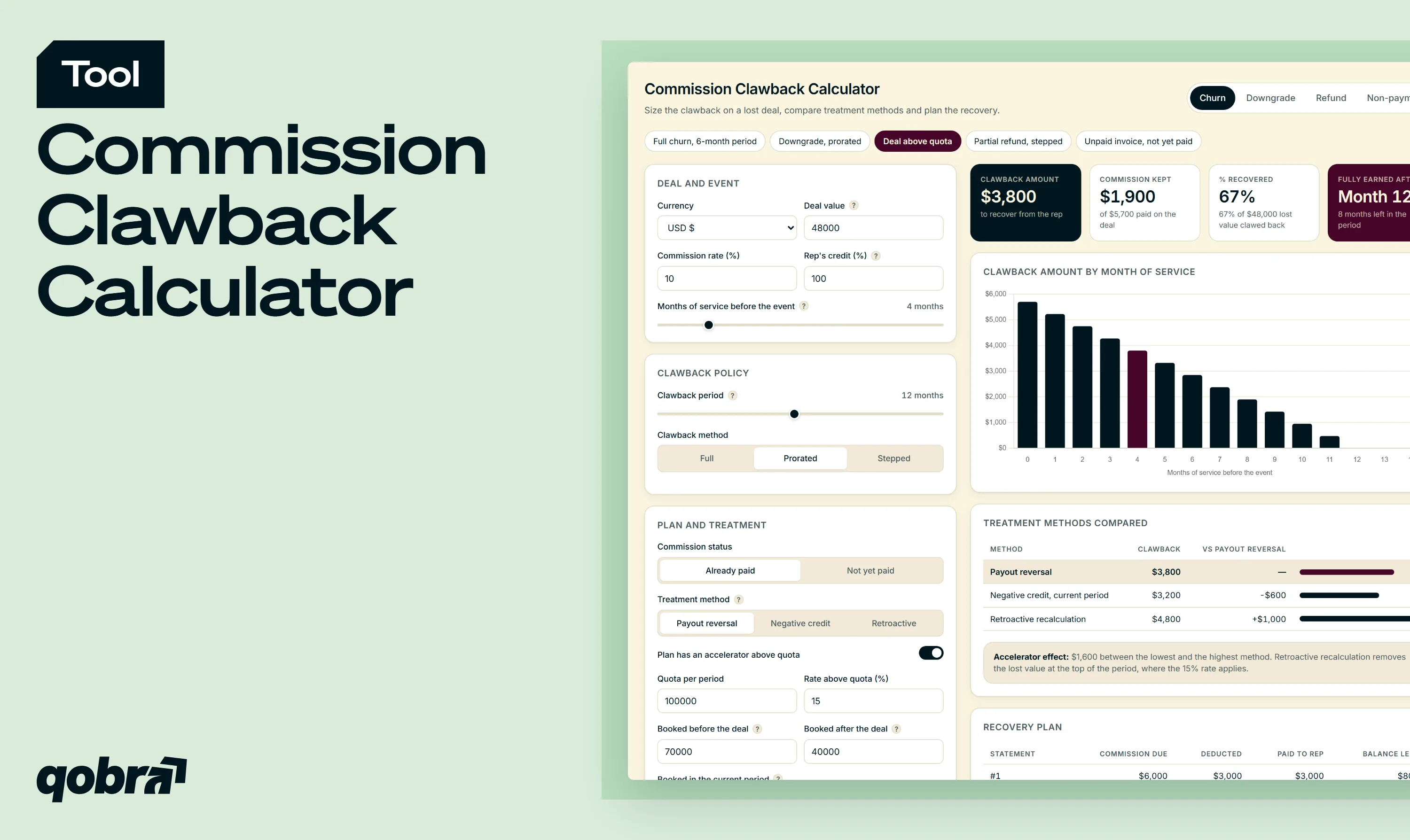
Commission Clawback Calculator
Size the clawback on a lost deal, compare treatment methods and plan the recovery.
Deal and event
Clawback policy
Clawback method
Until month%
Until month%
Rest of period%
Plan and treatment
Commission status
Treatment method ?
Recovery and Finance
Clawback amount
—
—
Commission kept
—
—
% recovered
—
—
Fully earned after
—
—
Clawback amount by month of service
Treatment methods compared
Method
Clawback
vs payout reversal
Recovery plan
Statement
Commission due
Deducted
Paid to rep
Balance left
The clawback amount is what comes back from the rep, or what is withheld if the commission is still due. The other KPIs, the method comparison and the recovery plan put it in context.
How to calculate a commission clawback
Every clawback in sales starts from the commission paid on the lost value; the method sets the share that comes back.
Full clawback formula
Clawback amount = lost value × commission rate, as long as the event happens inside the clawback period. Outside it, nothing comes back.
Prorated clawback formula
Prorated clawback = lost value × commission rate × (clawback period − months of service) ÷ clawback period. Each month of service lowers the amount at risk: with a 12-month period, a churn after 4 months claws back 8/12 of the commission.
Stepped clawback schedule
A stepped schedule applies a fixed percentage per band of months, for example 100% until month 3, 50% until month 6 and 25% until the period ends (an example, not a market standard). On a $30,000 refund paid at 10%, an event in month 4 claws back $1,500.
Worked commission clawback example
Each case is a preset in the calculator, at a 10% commission rate.
Full churn inside the window
A $24,000 ARR customer cancels after 3 months of a 6-month full clawback period. The clawback of commission is $24,000 × 10% = $2,400, all of what the rep received. A 50% cap on a $6,000 statement recovers it in one statement.
Partial downgrade
A $60,000 customer downgrades to $36,000 after 3 months, under a 12-month prorated policy. Only the $24,000 lost is in scope. The prorated share is 9/12, so the clawback is $24,000 × 75% × 10% = $1,800, and the rep keeps $4,200 of the $6,000 paid on the deal.
When accelerators are involved
A rep with a $100,000 quota per period earns 10% up to quota and 15% above. They book $70,000, then a $48,000 deal, then $40,000. The deal line paid $5,700 ($30,000 at 10%, $18,000 at 15%). The customer churns after 4 months of a 12-month prorated period, so $32,000 of value is clawed back.
The treatment method changes the sales commission clawback: payout reversal takes back 2/3 of the deal line ($3,800), a negative credit in a current period with $80,000 booked costs $3,200 at 10%, and retroactive recalculation removes $32,000 from the top of the original period at 15% ($4,800).
What triggers a clawback and how long the window lasts
The trigger defines the lost value; the clawback period decides whether it still counts.
Churn, cancellation and refunds
A full churn or cancellation puts the whole deal value in scope. A partial refund only covers the amount returned. Some teams call it a commission chargeback when it shows as a negative line on the statement.
Downgrades and non-payment
A downgrade claws back commission on the ARR lost only. Non-payment works the same way on the unpaid amount; if the plan pays on cash collected, the commission is simply held back. To see how the commission was paid in the first place on ARR, ACV or multi-year deals, use the saas commission calculator.
Choosing a clawback period
The period should match the risk it covers: long enough to catch customers who never onboarded, short enough that reps know when a commission is earned. Test lengths such as 3, 6 or 12 months and watch the Finance exposure move.
Recovering the clawback amount
Once the amount is known, the plan must say how it comes back.
Offset against future commissions
An offset deducts the balance from the next commission statements. A cap per statement, such as 50%, keeps the rep's pay predictable. The calculator shows the deduction, net pay and balance after each statement.
Direct repayment
A direct repayment clears the balance at once, for example when a rep leaves before future commissions can absorb it. This is where the legal points below matter most.
Splitting a clawback across reps
When several people shared the credit, the clawback follows the same split: at a 60% credit share, every amount scales to 60%. To set the split itself between an AE, an SDR or an overlay role, use the commission split calculator.
Are commission clawbacks legal in the US?
Whether a clawback holds up depends on the plan's wording, on when the commission counts as earned and on state law. General information, not legal advice: have employment counsel review your plan.
Put it in the written plan
In California, Labor Code §2751 requires commission contracts to be in writing and to set out how commissions are computed and paid, with a signed copy for the employee. New York Labor Law §191 requires a signed written agreement with commission salespersons that explains how commissions are calculated and paid at termination.
Write the triggers, period, method and recovery terms into that document. Our sales commission agreement template gives you a structure to start from.
Deductions and minimum wage
California Labor Code §221 makes it unlawful for an employer to collect back any part of wages already paid. That is why the plan's definition of when a commission is earned matters as much as the formula. At federal level, wages must be paid free and clear under 29 CFR §531.35: a recovery that takes pay below the minimum wage does not meet the FLSA.
From calculator to automation
From calculator to automated clawbacks
A commission clawback calculator handles one deal at a time. In a live plan, clawbacks arrive every month: churn flagged in the CRM, refunds, unpaid invoices, each with its own period and method.
Qobra picks up these events from your CRM, applies each plan's clawback rules and adds the adjustment to the rep's commission statement, with an audit trail. Reps see why their commission changed, and Finance sees what is still exposed.
Events picked up from the CRMChurn, refunds and unpaid invoices flagged in the CRM trigger the clawback, with no calculation to rebuild by hand.
Each plan's rules appliedThe clawback period and method of every plan are applied, and the adjustment lands on the rep's commission statement.
Clear for reps, visible to FinanceReps see why their commission changed, Finance sees what is still exposed, and every adjustment keeps an audit trail.
FAQ — Commission clawback calculator
What is a commission clawback?
A commission clawback is a clause that lets a company recover commission already paid, or cancel commission not yet paid, when the revenue behind it is lost. Typical triggers are churn, cancellation, refunds, downgrades and non-payment inside a set clawback period written into the commission plan.
How is a clawback calculated?
Multiply the lost value by the commission rate, then by the share your method claws back: 100% for a full clawback, (period − months of service) ÷ period for a prorated one, or the band's percentage for a stepped schedule. With accelerators, the treatment method matters too.
Can you give me an example of a clawback?
Yes. A rep earns 10% on a $24,000 deal and receives $2,400. The customer cancels after 3 months, inside a 6-month full clawback period, so the full $2,400 comes back. Under a 12-month prorated policy, a churn after 4 months would claw back 8/12 of it: $1,600.
Are commission clawbacks legal?
They can be, depending on the plan and on state law. California and New York require written commission agreements, California restricts collecting back wages already paid, and federal rules bar recoveries that push pay below minimum wage. This is not legal advice: have counsel review your policy.
Are bonus clawbacks enforceable?
It depends on the written terms and on state law. A clawback is easier to defend when the conditions were agreed in writing before payment, the agreement states when the bonus is earned, and the recovery keeps pay above minimum wage. Check with employment counsel first.
What is a clawback payment?
A clawback payment is the money a rep returns, or the deduction taken from future commission, once a clawback is triggered. It can be one repayment or several capped deductions. For commission taxed in a prior year, IRS Publication 525 sets specific rules, including above $3,000.
How long after a sale can a company claw back commission?
As long as the clawback period written in the plan allows, and no longer. The period is a plan choice, so test lengths such as 3, 6 or 12 months against your own churn before committing. After it ends, the commission is fully earned.
What is the difference between a clawback and a chargeback?
In sales compensation, both terms describe the same recovery from different angles. A clawback is the policy that takes back commission when revenue is lost. A commission chargeback usually means the resulting negative line on the rep's statement, a term also common in insurance. The math is identical.



.webp)


