Webinar (Wednesday, October 21) — Aligning HR, Finance, and Sales: Mastering Sales Comp Without Breaking Your Plan
Register

For years, RevOps got lumped into “systems” work.
Keep Salesforce clean.
Patch broken workflows.
Pull last-minute numbers for the QBR.
Useful? Yes.
Strategic? Not always.
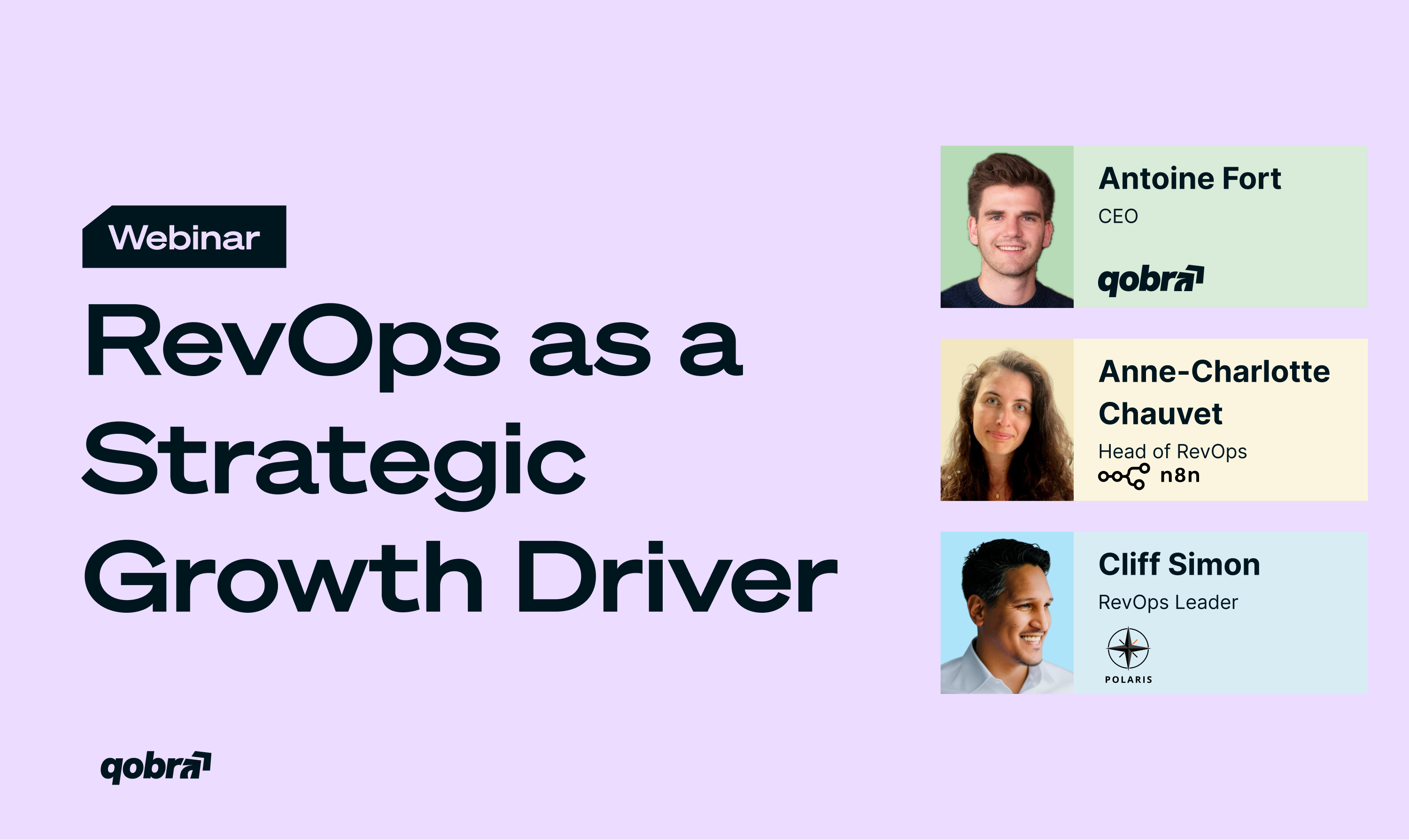
In this webinar with Anne-Charlotte (Head of RevOps at n8n), Cliff Simon (RevOps leader), and Qobra’s team, one idea kept coming up:
RevOps isn’t a support function. It’s an enabler. And with AI + automation, it finally has the leverage to act like one.
Here’s what that looks like in practice.
1. RevOps becomes strategic when it owns the hard questions
Anne-Charlotte put it simply: RevOps should drive efficiency and performance across the entire funnel, from acquisition to retention.
That means the job isn’t “CRM hygiene.” That’s maybe 20% of the value.
The real value is earlier:
- Modeling growth plans (what resources you need, by motion)
- Spotting bottlenecks fast (actual vs plan, in real time)
- Helping GTM leaders make tradeoffs (where to invest, where to stop)
Cliff added a useful nuance: sometimes RevOps already has a seat at the table… but lacks the authority to make change stick. AI doesn’t solve org politics, but it does remove a big excuse: “we don’t have bandwidth.”
2. AI doesn’t just save time — it changes what RevOps can build
The best part of the discussion wasn’t theory. It was the examples.
A. Shipping workflows without waiting on engineering
At n8n, RevOps launched a self-serve “Business Plan” flow on the website, built by RevOps. It went live in weeks, not quarters.
The impact was direct:
- Less back-and-forth for Sales
- Fewer manual steps
- A new revenue line (because self-serve actually converted)
Anne-Charlotte’s point: RevOps sits between business and technical reality. It understands APIs and what reps actually need. That combo makes it faster than most teams to ship the “good enough” version.
B. Automating the “sales ops grind”
Cliff shared workflows they’ve built around:
- Territory mapping
- Lead routing
- Automated research + battlecards
- Pushing enriched context into the CRM
The goal isn’t to replace reps. It’s to stop burning hours on prep work. More time on customers, less time on tabs.
3. SalesOps is getting a quiet superpower: better context, automatically
If you want a simple rule: AI works best when it gives humans better inputs, not when it tries to “be the human.”
Some concrete use cases from n8n:
- Auto-populating CRM fields from call transcripts (qualification, MEDDICC-style data, deal context)
- Suggested email replies via a Chrome extension, based on internal processes and knowledge
- Account intelligence inside Salesforce that pulls internal + external signals and suggests next steps
And beyond Sales: automation is eating the heavy ops work too.
Anne-Charlotte mentioned workflows to:
- Validate signed contracts
- Check accuracy
- Populate Salesforce correctly
- Build Slackbots that answer deal policy questions (so reps don’t wait on Ops)
This is where SalesOps stops being “the team that fixes things” and becomes “the team that clears the path.”
4. Most AI projects don’t fail because of the tech
Anne-Charlotte listed three failure modes. They’re worth printing.
Failure mode #1: No real sponsorship
RevOps can prioritize an AI initiative. But if Sales leadership doesn’t sponsor it, it stalls.
Their example: an AI SDR concept didn’t move until leadership:
- Put it in their own OKRs
- Dedicated bandwidth
- Aligned incentives
AI needs operational input. If stakeholders don’t show up, quality drops, adoption drops, and the project dies.
Failure mode #2: Automating a process that isn’t real yet
If the process isn’t stable, AI just automates chaos.
n8n didn’t start with self-serve. They sold manually first, learned the steps, then automated what was already working.
Failure mode #3: Too big, too fast
The winning approach: ship small, iterate, improve prompts over time.
Their method was practical:
- Start with “suggested answers” (human in the loop)
- Keep prompts in Notion so teams can update quickly
- Add evaluations to measure prompt quality before changing production behavior
Cliff added a key point: teams often implement AI like old software. But AI is not “set and forget.” It’s a living system. You need feedback loops.
5. The build vs buy decision is changing — but it’s not “build everything”
This part of the webinar was refreshingly honest.
Cliff’s take: building is finally realistic, and it can cut serious tech spend. Especially for companies paying for big platforms but using only a slice.
Anne-Charlotte agreed, with guardrails:
- Building gives tailored solutions
- But it comes with maintenance, governance, and risk
- Sensitive domains need more control
She gave a great example of when buying still wins: commissions.
They chose Qobra because:
- It fits their model
- It’s supported by a vendor invested in success
- Commissions are sensitive and need strong guardrails
- And it’s not n8n’s core revenue driver
New buying criteria also came up: teams are more likely to buy tools that are easy to integrate (open APIs, clean connectors). If a tool can’t connect, it’s harder to justify.
6. RevOps can even become a revenue generator
This one landed.
If RevOps can build systems that:
- unlock self-serve revenue,
- speed up deals,
- or reduce time-to-value,
then RevOps stops being seen as a pure cost.
Even “offsetting its own cost” changes the internal conversation. It’s no longer “how lean can we keep Ops?” It becomes “how much impact can Ops create?”
7. Will CRMs disappear?
The answer was balanced.
- In large companies: not soon. Too much complexity, too much change management.
- In AI-native startups: maybe faster than we think.
Cliff’s view: a CRM is mostly a database. If data gets injected automatically from call notes, emails, and workflows, you could run on a “headless CRM” style setup.
Anne-Charlotte’s view: even if the CRM stays, time spent inside it will shrink. Reps should be with customers, not updating fields.
What to take away
If you lead RevOps, SalesOps, or GTM Ops, the playbook is getting clearer:
- Earn the seat by owning the strategic questions (not just the tools).
- Use AI to reduce busywork and speed up iteration.
- Start small, keep humans in the loop, and treat AI like a living system.
- Build where it creates advantage. Buy where risk and maintenance aren’t worth it.
And if you’re launching an AI project soon: the first thing to check isn’t the model.
It’s whether the process is defined, the stakeholders are committed, and you’re ready to iterate.
.webp)


