Webinar: The Biggest Release Sales Comp Has Ever Seen. Come See For Yourself (Wednesday, October 7)
Register
- Commission errors cost organizations 3-5% of their variable compensation budget — dedicated sales commission software eliminates manual miscalculations and the spreadsheet bottlenecks that cause them.
- The right platform serves three stakeholders at once — Operations needs no-code plan management, Finance needs audit-ready reporting, and Sales needs real-time payout visibility that builds trust.
- Integration depth matters more than integration count — a tool that syncs bi-directionally with your CRM (Salesforce, HubSpot) and ERP in real time will outperform one that lists 50 connectors but batch-imports nightly.
- Implementation speed separates winners from shelf-ware — platforms offering in-house onboarding teams (rather than outsourced SI partners) consistently reach go-live in weeks, not quarters.
- Qobra leads this category with a 4.8/5 on G2 and a 4.9/5 on Capterra, trusted by organizations from 10 to 5,000+ reps including SAP, AstraZeneca, and JCDecaux.
The best sales commission software in 2026 for US revenue teams includes Qobra, EasyComp, Spiff by Salesforce, Xactly Incent, Performio, Varicent, QuotaPath, Commissionly, Visdum, and Everstage. This buyer's guide scores the 10 platforms on setup and administration, calculation accuracy and auditability, CRM and payroll integration, rep experience, finance reporting, and total cost of ownership in USD. Manual commission processes introduce errors affecting 3 to 5% of variable compensation spend, so for a team paying $5 million a year the software decision is a $150,000 to $250,000 question.
The cost is not just financial. When reps do not trust their commission statements, they spend hours building their own tracking sheets instead of selling. When Finance cannot reconcile payouts to the penny, audit risk climbs. When Operations dreads every plan change because it means rewriting formulas across dozens of tabs, agility disappears.
Sales commission software solves this by centralizing plan design, automating calculations, and giving every stakeholder — Ops, Finance, and Sales — a single source of truth they can access in real time.
In this guide, you will learn what sales commission software actually does, the criteria that matter most when evaluating platforms, and how the 10 leading solutions in 2026 compare on the dimensions that drive successful adoption. Whether you are replacing spreadsheets for the first time or switching from a legacy tool, this article gives you the framework to make a confident decision.
Key takeaways
- Two of the 10 platforms publish US prices: Spiff by Salesforce at $75 per user per month billed annually and QuotaPath from $35 per user per month plus a $525 monthly platform fee. EasyComp, Xactly, Performio, Varicent, Everstage, Visdum, and Commissionly are quote-based (vendor websites, Sept 2026).
- Performio, and Everstage list ADP Workforce Now among their HRIS integrations; QuotaPath lists Rippling; Xactly and Varicent name Workday but no US payroll vendor. Qobra lists Workday, BambooHR, and HiBob on qobra.co/integrations.
- Vendor-stated implementation windows range from 0.65 months (Visdum) and 4 to 8 weeks (Performio) to 45 to 90 days (QuotaPath) and a 2.5-month average (Everstage). Xactly and Varicent do not publish timelines.
- Spreadsheets usually break past 20 reps, 2 plan types, or monthly plan changes; at that point a single misplaced cell reference can cascade errors across a full payout run.
- US buyers should add five checks to the shortlist: payroll cycle support, supplemental wage handling (22% federal flat rate), ASC 606 / ASC 340-40 reporting, SOC 2 Type II, and US support hours.
What Is Sales Commission Software?
Sales commission software is a purpose-built platform that automates the calculation, tracking, reporting, and payment of variable compensation for sales teams. It replaces the manual spreadsheet workflows that most organizations start with and eventually outgrow.
At its core, a commission management platform handles four jobs:
- Plan design and modeling — Define compensation plans (quotas, accelerators, SPIFs, multi-role crediting rules) using a visual or no-code builder, then simulate the financial impact before rolling plans out.
- Automated calculation — Pull deal data from your CRM, apply plan logic, and calculate commissions in real time so every stakeholder sees accurate numbers without waiting for a monthly batch run.
- Rep-facing transparency — Give salespeople a dashboard (and proactive notifications) showing exactly what they earned, deal by deal, so they stop building shadow spreadsheets and start trusting the process.
- Finance-grade reporting — Provide auditable records, accrual-ready exports, and approval workflows that satisfy accounting standards and reduce close-cycle friction.
Plan modeling deserves its own evaluation. We compare simulation and what-if features in sales compensation modeling and simulation software, and SPIFF and contest tooling in our guide to the best SPIFF software.
When Do Spreadsheets Stop Working?
Spreadsheets are fine for small, simple scenarios. The breaking points typically arrive when your organization hits one or more of these thresholds:
- More than 20 reps — formula complexity grows exponentially, and a single misplaced cell reference can cascade errors across the entire workbook.
- More than 2 plan types — managing different commission structures (e.g., AEs on quota-based plans, SDRs on activity-based plans, CSMs on renewal-based plans) in one spreadsheet becomes unmanageable.
- Multi-role crediting — when a deal must credit an AE, an overlay, and a manager simultaneously, spreadsheet logic breaks down or requires unsustainable manual overrides.
- Multi-currency payouts — organizations with international teams need real-time exchange rate handling that static formulas cannot provide.
- Audit or compliance requirements — SOX, ASC 606, or internal audit standards demand a complete change log and approval trail that spreadsheets simply do not offer.
If any of these apply to your organization, dedicated commission software is no longer a nice-to-have — it is a prerequisite for accurate, trusted compensation.
How We Evaluated These Platforms
Transparency matters in a buyer's guide. Here is the exact methodology behind these rankings.
Data sources: We analyzed verified user reviews from G2 and Capterra (published between January 2024 and April 2026), conducted structured interviews with RevOps and Finance leaders who have implemented these tools, and reviewed each vendor's publicly available documentation.
Evaluation criteria: Every platform was scored against six weighted dimensions. The weights reflect what matters most to the RevOps leaders, Sales Ops Managers, Finance Directors, and CROs who typically own this decision.
What this list is not: This is not a pay-to-play ranking. No vendor paid for placement. Qobra is included because it meets the evaluation criteria — and scores highest — not because this guide appears on Qobra's blog.
Criterion 2 (auditability) and criterion 5 (finance reporting) matter more for US public companies and pre-IPO teams. We go deeper on version history, approval chains, and SOX-ready exports in commission software audit trails for SOX and ASC 606.
The 10 Best Sales Commission Software Platforms in 2026
At a glance: US payroll and HRIS integrations, USD pricing, audit trail, rep app, and time to go live
The existing feature table further down covers plan builders, dashboards, and CRM connectors. This table adds the criteria US buyers ask about most, for the same 10 platforms in the same order.
1. Qobra — Best for Teams That Want Commissions Trusted Across Ops, Finance, and Sales

Overview: Qobra is a sales commission management platform built around a single idea: commissions should be visible, accurate, and trusted by every stakeholder — not just the person running the spreadsheet. Where many tools focus primarily on the admin experience, Qobra gives equal weight to what Operations, Finance, and Sales each need from the commission process.
Key capabilities:
- No-code plan builder — Design and modify commission plans without engineering support. Handles quota-based, tiered, accelerator, SPIF, multi-role crediting, and custom logic. Plan changes can be modeled and deployed in minutes, not sprint cycles.
- Real-time visibility for all stakeholders — Operations sees plan health and exceptions. Finance sees accruals, team-level and individual-level commission amounts accessible at any time. Sales reps see a real-time overview of commissions so they know exactly what they will receive when they close a deal.
- Deal-level payout preview — Reps can see the commission impact of a specific deal before it closes, which directly supports forecasting accuracy and motivation.
- Proactive email notifications — Reps receive email notifications that help them understand the impact of each deal. This combination of real-time access plus proactive updates supports confidence across the organization.
- In-house implementation team — Qobra runs onboarding with its own team (not outsourced partners), which compresses time-to-value and ensures institutional knowledge stays within the vendor relationship.
- Multi-currency support — Built for international teams with automatic exchange rate handling, critical for organizations operating across regions.
- Audit trail and approval workflows — Every calculation, adjustment, and override is logged with full traceability for Finance and compliance teams.
Ratings: G2: 4.8/5 | Capterra: 4.9/5
Notable customers: SAP, AstraZeneca, JCDecaux, ElevenLabs, GoCardless, Factorial, Go1, DataSnipper, Quantcast, Make
Best for: Organizations with 10 to 5,000+ reps that need a commission tool trusted by Operations, Finance, and Sales equally. Particularly strong for teams that value fast implementation, rep adoption, and cross-functional visibility over "enterprise feature checkbox" selling.
Qobra, headquartered in New York and Paris, manages $1B+ in commissions across 300+ companies. It connects to Salesforce, HubSpot, Microsoft Dynamics, Zoho, Pipedrive, Snowflake, BigQuery, Redshift, and the HRIS platforms Workday, BambooHR, and HiBob (full list on the Qobra integrations page). For a US Finance close, Qobra locks the commission period, runs approvals, and produces deal-level statements that payroll can consume on a biweekly or semi-monthly cycle. ADP, Paylocity, Rippling, and Gusto: payroll export.
Pricing (USD): Quote-based. See how vendors structure per-payee and platform fees in our sales commission software pricing guide, then book a Qobra demo to run your own plans in a sandbox.
Why Qobra ranks #1: The combination of real-time rep transparency, proactive notifications, and an in-house implementation approach addresses the three most common failure modes of commission software adoption: reps ignore it, finance does not trust it, or it takes six months to go live. Qobra's review scores (4.8 on G2, 4.9 on Capterra) reflect consistently high satisfaction across all three stakeholder groups.
AI-Powered Agents — A Unique Differentiator
Qobra includes three purpose-built AI agents that handle real work — not just analytics overlays. The Architect replaces hours of plan implementation with minutes of conversation, building or editing compensation plans autonomously on the platform. The Sales Coach answers rep questions about their commissions instantly, reducing admin ticket volume and building trust between sales teams and operations. The Analyst creates reports and dashboards from plain-language requests and surfaces proactive business intelligence — flagging anomalies, identifying trends, and delivering insights that would take hours of manual analysis.
More on the agents at Qobra AI agents for sales compensation. For how these reporting layers compare across vendors, see our review of the best commission reporting and analytics software.
2. EasyComp — Best for AI-Native Sales Compensation Administration
Overview: EasyComp is an AI-native sales compensation platform built to make complex commission plans easier to administer while keeping calculations controlled, explainable, and auditable. It is particularly strong for teams that change plans frequently and want to reduce manual RevOps and Finance work without sacrificing historical accuracy.
Key capabilities:
- AI-assisted administration for plan changes, onboarding, exceptions, ramps, draws, and other recurring compensation tasks
- Versioned plans and effective dating that preserve historical quotas, rates, assignments, and payout logic
- Retroactive change control and audit trails that help teams manage CRM changes without unintentionally rewriting prior commission results
- Real-time rep visibility with deal-level commission explanations, attainment tracking, and support for complex crediting and payout structures
Ratings: G2: 5.0/5
Best for: Growing and mid-market teams with frequently changing or exception-heavy compensation plans that want modern automation, fast plan administration, and clear rep visibility.
Considerations: EasyComp is a newer entrant than legacy SPM vendors, so organizations prioritizing a decades-long installed base or a broad traditional SPM suite may prefer a more established enterprise platform.
3. Spiff — Best for Salesforce-First Teams
Overview: Spiff is a commission management platform that has built its core value proposition around deep Salesforce integration. For teams that run their entire revenue process inside Salesforce, Spiff offers a native-feeling experience that minimizes context-switching.
Key capabilities:
- Deep Salesforce connector with real-time data sync and the ability to surface commission data directly inside Salesforce records
- Visual plan designer that uses a drag-and-drop interface for building commission structures
- Rep-facing motivational dashboards with leaderboards and earnings projections
- Automated ASC 606 reporting for finance teams managing commission capitalization
Ratings: G2: 4.7/5
Best for: Mid-market to enterprise teams (50-1,000 reps) running Salesforce as their primary CRM. Teams using HubSpot or other CRMs will find the integration story less compelling.
Considerations: Spiff's tight Salesforce coupling is both its greatest strength and a limitation. Organizations planning a future CRM migration should factor in the re-integration cost. Implementation timelines tend to be longer than lighter-weight alternatives.
4. Xactly Incent — Best for Large Enterprises Needing Benchmarking Data
Overview: Xactly is one of the longest-established players in the sales performance management space. Xactly Incent, its commission management product, is part of a broader suite that includes territory planning, quota setting, and compensation benchmarking powered by over 19 years of aggregated pay data.
Key capabilities:
- AI-powered benchmarking using Xactly's proprietary compensation dataset to compare your plans against industry peers
- Enterprise-grade workflow engine with multi-level approval chains, exception handling, and cross-entity rollups
- Comprehensive territory and quota management modules that integrate with commission calculations
- Advanced analytics and modeling for scenario planning at scale
Ratings: G2: 4.2/5
Best for: Large enterprises (1,000+ reps) with dedicated compensation teams, complex organizational hierarchies, and a need for market benchmarking data. Organizations that value breadth of suite over simplicity of any single module.
Considerations: Xactly's breadth comes with complexity. Implementation cycles are typically measured in months, often requiring system integrator involvement. The user interface feels dated compared to newer entrants, and G2 reviewers frequently cite admin complexity as a friction point.
5. Performio — Best for Complex Multi-Source Data Environments
Overview: Performio differentiates on its ability to ingest and reconcile commission-relevant data from a wide range of sources — CRMs, ERPs, billing systems, HR platforms, and custom databases — without requiring a centralized data warehouse.
Key capabilities:
- Multi-source data engine that connects to virtually any data source via native connectors, SFTP, or API
- No-code plan builder with support for tiered, matrix, and custom calculation logic
- Approval and exception workflows designed for multi-stakeholder sign-off processes
- Detailed audit logging with point-in-time snapshots for compliance and dispute resolution
Ratings: G2: 4.5/5
Best for: Mid-market to enterprise teams (100-2,000 reps) where commission data lives across multiple disconnected systems (e.g., one CRM for new business, another for renewals, a separate billing system for usage-based components). Particularly strong in industries with complex data landscapes like manufacturing, distribution, and financial services.
Considerations: The platform's flexibility requires thoughtful upfront configuration. Teams with simpler data environments may find lighter tools sufficient.
6. Varicent — Best for Territory-Based Commission Structures
Overview: Varicent (formerly IBM's Incentive Compensation Management) provides an enterprise-grade platform that combines territory management, quota planning, and commission calculations into an integrated suite.
Key capabilities:
- Integrated territory and quota planning that flows directly into commission calculations
- Advanced modeling engine for simulating plan changes across geographies and business units
- AI-driven insights for identifying pay-performance gaps and optimizing plan effectiveness
- Robust data management layer for handling complex organizational hierarchies
Ratings: G2: 4.2/5
Best for: Enterprise organizations (500+ reps) with geography-based sales structures and a need for tight alignment between territory assignments, quotas, and commission payouts.
Considerations: Varicent's enterprise orientation means longer implementation cycles and higher total cost of ownership. Smaller teams will find the platform over-engineered for their needs.
7. QuotaPath — Best for Early-Stage and SMB Sales Teams
Overview: QuotaPath targets startups and small-to-mid-sized businesses that need commission tracking without the complexity or cost of enterprise platforms.
Key capabilities:
- Quick-start plan templates for common compensation structures (AE quota, SDR activity-based, tiered accelerators)
- Earnings estimator that lets reps model "what if" scenarios on their own
- HubSpot and Salesforce integrations with a straightforward setup process
- Transparent, per-user pricing with no hidden implementation fees
Ratings: G2: 4.7/5
Best for: Early-stage and SMB sales teams (5-150 reps) that want to move off spreadsheets quickly without a lengthy implementation. Strong fit for HubSpot-centric organizations.
Considerations: QuotaPath's simplicity is intentional, but it means advanced features (multi-currency, complex crediting hierarchies, enterprise-grade audit trails) are limited compared to mid-market and enterprise platforms.
8. Commissionly — Best for Small Teams Under 150 Reps
Overview: Commissionly is a lightweight commission tracking tool designed for small businesses that need basic automation without enterprise pricing.
Key capabilities:
- Simple plan setup with support for flat-rate, percentage, tiered, and goal-based commission structures
- CRM integrations with Salesforce, HubSpot, Pipedrive, and Zoho
- Rep portal for viewing earnings and deal-level commission breakdowns
- Affordable pricing positioned below most mid-market competitors
Ratings: G2: 4.5/5
Best for: Small sales teams (5-150 reps) with straightforward commission structures who need basic automation at a lower price point.
Considerations: Commissionly's feature set is intentionally lean. Teams with complex plan logic, multi-role crediting, or advanced reporting needs will outgrow it quickly.
9. Visdum — Best for SaaS-Specific Commission Logic
Overview: Visdum is built specifically for SaaS companies, with native support for subscription-based commission scenarios like ARR-based commissions, renewal credits, expansion revenue splits, and usage-based components.
Key capabilities:
- SaaS-native calculation engine that understands ARR, MRR, net revenue retention, and expansion revenue out of the box
- Plan builder designed around subscription lifecycle events (new business, renewal, expansion, churn clawback)
- Integration with subscription billing platforms in addition to standard CRM connectors
- Real-time dashboards with SaaS-specific metrics tied to compensation
Ratings: G2: 4.6/5
Best for: SaaS companies (20-500 reps) where commission logic is tightly coupled to subscription metrics. Particularly useful for organizations with hybrid compensation models that blend new-business and expansion-revenue commissions.
Considerations: Visdum's SaaS focus is a strength for subscription businesses but a limitation for organizations in non-SaaS industries. Companies with diverse business models (SaaS + services + hardware) may need a more general-purpose platform.
10. Everstage — A Mid-Market Platform With AI Forecasting
Overview: Everstage is a commission management platform that has invested heavily in AI-powered features, including Crystal AI for commission forecasting and pipeline-linked compensation predictions.
Key capabilities:
- Crystal AI forecasting that projects commission expenses based on pipeline data and historical patterns
- No-code plan builder with a visual interface for designing multi-tier compensation structures
- Gamification features including leaderboards, badges, and earnings contests for rep engagement
- Native integrations with Salesforce, HubSpot, and several other CRMs
Ratings: G2: 4.8/5
Best for: Mid-market teams (50-500 reps) looking for a modern interface with AI-powered forecasting capabilities. Particularly appealing to organizations that want commission software to double as a sales motivation and engagement tool.
Considerations: Everstage's AI forecasting features, while promising, are most accurate with larger historical datasets. Teams with fewer than 50 reps or less than 12 months of historical data may see limited forecasting value initially.
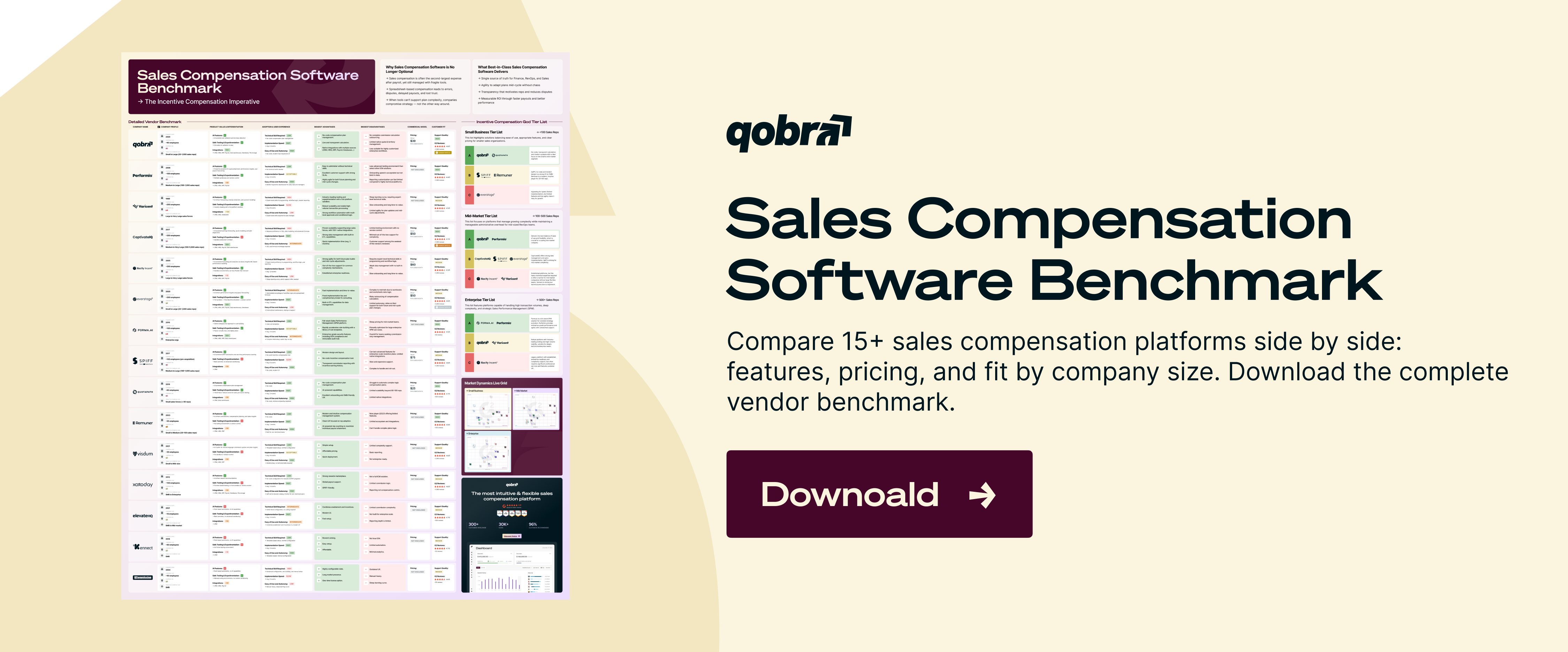
Feature-by-Feature Comparison Table
How to Choose the Right Sales Commission Software
Choosing a commission platform depends on four key variables. Use this decision framework to narrow your shortlist before scheduling demos.
Variable 1: Team Size
- 5-50 reps — Prioritize speed of setup and simplicity. QuotaPath, Commissionly, and Qobra all support fast go-lives for smaller teams. Avoid over-investing in enterprise platforms you will not fully utilize for years.
- 50-500 reps — This is where most platforms compete. Focus on the admin experience (how easy is it to change plans mid-quarter?) and the rep experience (will your team actually use it?). Qobra, Spiff, and Everstage are strong fits.
- 500-5,000+ reps — Scalability, multi-entity support, and enterprise-grade security become non-negotiable. Qobra, Xactly Incent, Varicent, and Performio are designed for this range.
Variable 2: Plan Complexity
- Simple plans (flat rate, single-tier quotas) — Almost any tool will handle this. Choose based on price and ease of use.
- Moderate complexity (accelerators, SPIFs, multi-role crediting) — You need a no-code builder that lets Ops make changes without engineering. Qobra excel here.
- High complexity (matrix-based, territory-weighted, custom business logic) — Evaluate calculation engines carefully. Run your most complex plan through each vendor's sandbox during the trial. Performio and Xactly handle extreme edge cases; Qobra's no-code builder covers the vast majority of complex scenarios without requiring code.
Variable 3: CRM Ecosystem
- Salesforce-centric — Spiff offers the deepest native integration. Qobra and most others provide strong Salesforce connectors.
- HubSpot-centric — QuotaPath and Qobra offer the smoothest HubSpot experiences. Evaluate carefully if your shortlisted vendor treats HubSpot as a first-class integration or an afterthought.
- Multi-CRM or non-CRM data sources — Performio's multi-source engine and Qobra's flexible data ingestion stand out when commission data spans multiple systems.
Add a fifth check for US teams: the payroll hand-off. Our commission software integrations matrix shows which vendors connect natively to ADP, Paylocity, Rippling, Gusto, and Workday and which rely on file exports.
Variable 4: Budget
- Under $500/month — Commissionly and QuotaPath offer entry-level pricing for small teams.
- $500-$5,000/month — Most mid-market platforms (Qobra, Spiff, Everstage) fall in this range, typically priced per-rep-per-month.
- $5,000+/month — Enterprise platforms (Xactly, Varicent) command premium pricing that includes dedicated support, custom integrations, and advanced analytics.
Public US list prices as of September 2026: Spiff by Salesforce at $75 per user per month billed annually; QuotaPath from $35 per user per month plus a $525 monthly platform fee; EasyComp from $30 per user per month; Xoxoday Compass from $29.99 per user per month with a 50-user minimum. Everstage, Xactly, Performio, Varicent, Visdum, and Commissionly are quote-based. Qobra: Quote-based. Full breakdown, including platform fees and implementation charges, in our 2026 sales commission software pricing guide.
Pro tip: Always calculate total cost of ownership, not just license fees. Factor in implementation costs, integration development, ongoing admin time, and the cost of errors your current process creates. A platform that costs more per seat but eliminates $200,000 in annual commission disputes pays for itself immediately.
Two resources for the business case: how to measure sales compensation ROI and the Qobra ROI calculator.
Best Practices for Evaluating Commission Software
Before signing a contract, follow these seven steps to ensure you choose a platform that your team will actually adopt.
1. Run your real plans through the sandbox. Do not evaluate on demo data. Export your actual commission plans and ask each vendor to configure them in a trial environment. The complexity that matters is yours, not a generic demo scenario.
2. Include all three stakeholder groups in the evaluation. The biggest adoption failures happen when Ops selects a tool that Finance does not trust or Sales refuses to use. Involve at least one representative from each group in the evaluation process.
3. Ask for customer references at your scale. A platform that works beautifully for 30 reps may struggle at 300. Request references from organizations with similar team sizes, plan complexity, and industry.
4. Test the plan-change workflow. Commission plans change constantly — mid-quarter SPIFs, annual plan redesigns, territory realignments. Evaluate how long it takes an admin to implement a plan change and deploy it to reps. If it requires a support ticket and a two-week turnaround, factor that friction into your decision.
5. Evaluate the rep experience on mobile. Sales reps check commissions on their phones. If the mobile experience is a second-class afterthought, adoption will suffer. Ask to see the rep-facing dashboard on a mobile device during the demo.
6. Understand the implementation model. Ask whether onboarding is handled by the vendor's own team or outsourced to a system integrator. In-house implementation teams (like the one Qobra provides) typically deliver faster go-lives and better knowledge transfer.
7. Negotiate the exit. Before you sign, understand how your data is exported if you leave. Commission history is sensitive, and you need a clear data portability guarantee in the contract.
What US buyers should check before signing
US commission software buyers should verify five things: payroll cycle support, supplemental wage handling, ASC 606 reporting, SOC 2 Type II, and US support hours. These points decide whether the platform fits a US Finance close, not just a sales dashboard.
- Payroll cycle support. Most US companies pay biweekly or semi-monthly. Confirm the platform can lock a commission period, run approvals, and export a payroll file on your cycle to ADP, Paylocity, Rippling, Gusto, or Workday. See our commission software integrations comparison.
- Supplemental wage withholding. Commissions are supplemental wages. The IRS federal flat rate is 22% up to $1 million in a calendar year and 37% above that (IRS Publication 15). Your commission platform does not withhold, but statements should separate commission from base pay so payroll applies the right rate.
- ASC 606 and ASC 340-40 reporting. If you capitalize commissions as costs to obtain a contract, you need deal-level commission data with amortization exports. Spiff and Xactly state ASC 606 support. Read our ASC 606 commissions guide and how audit trails support SOX and ASC 606.
- SOC 2 Type II. Ask for the report, not the badge. Qobra holds a SOC 2 Type 2 attestation; Visdum and EasyComp also state SOC 2 Type II on their sites.
- US support hours and onboarding. Confirm support coverage in US time zones and a named implementation lead. Qobra: US support hours and New York-based onboarding team.
- State commission laws. California Labor Code 2751 requires written commission agreements signed by the employee (text of the statute). Storing plan documents and acceptance in the platform simplifies compliance.
Frequently Asked Questions
What Is the Difference Between Sales Commission Software and a Spreadsheet?
Sales commission software automates the entire commission lifecycle — plan design, calculation, rep communication, and finance reporting — in a centralized platform with audit trails and real-time updates. Spreadsheets require manual data entry, are prone to formula errors, lack version control, and cannot provide the real-time rep-facing visibility that drives trust. The breaking point typically arrives when your organization exceeds 20 reps, manages more than two plan types, or needs multi-role crediting.
How Long Does It Take to Implement Commission Software?
Implementation timelines vary significantly by platform and complexity. Lightweight tools like QuotaPath can be live in one to two weeks. Mid-market platforms like Qobra typically reach go-live in four to eight weeks, particularly when the vendor provides an in-house implementation team. Enterprise platforms like Xactly or Varicent often require three to six months, especially when system integrators are involved. The key variables are the number of compensation plans, the complexity of data integrations, and the availability of your internal team.
Can Commission Software Handle Complex Plan Structures Like Multi-Role Crediting and Accelerators?
Yes, most modern commission platforms support complex plan structures including tiered accelerators, multi-role crediting (where a single deal credits multiple reps), SPIFs, clawbacks, and custom business logic. The difference is in how they handle complexity. No-code plan builders (offered by Qobra, Everstage, and others) let Operations build and modify complex plans without engineering support. Some legacy platforms require code or vendor-side configuration for advanced scenarios.
How Does Sales Commission Software Integrate With My CRM?
Most platforms offer native integrations with Salesforce and HubSpot, pulling deal data (opportunity amounts, close dates, rep assignments) into the commission engine automatically. Integration depth varies: some tools offer real-time, bi-directional sync (deal closes in Salesforce, commission updates instantly), while others run batch imports on a schedule. For teams with data spread across multiple systems, look for platforms with flexible data ingestion capabilities — API connectors, SFTP imports, and CSV upload fallbacks.
What Should I Budget for Sales Commission Software?
Pricing models vary but most platforms charge per-rep-per-month. Entry-level tools (Commissionly, QuotaPath) start in the low hundreds per month for small teams. Mid-market platforms (Qobra, Spiff) typically range from $500 to $5,000/month depending on team size and feature tier. Enterprise solutions (Xactly, Varicent) can exceed $5,000/month. Beyond license fees, budget for implementation costs (ranging from included to six figures for enterprise deployments), integration development, and ongoing admin time. Calculate total cost of ownership, not just the sticker price.
Is My Commission Data Secure in a Cloud-Based Platform?
Reputable commission software vendors maintain enterprise-grade security practices including SOC 2 Type II compliance, data encryption at rest and in transit, role-based access controls, and regular penetration testing. Commission data is sensitive (it includes individual compensation details), so during evaluation, request each vendor's security documentation, ask about data residency options if relevant to your region, and confirm their data portability and deletion policies.
Which sales commission software works best for mid-sized teams needing quick implementation in the US?
For US teams of 50 to 500 reps that need to go live fast, shortlist Qobra, QuotaPath, and Performio. Qobra typically goes live in weeks with its own onboarding team, Performio states 4 to 8 weeks with AI-assisted configuration, and QuotaPath quotes 45 to 60 days on its Growth plan with implementation included. Before signing, confirm payroll export or connector support for ADP, Paylocity, Rippling, or Gusto, plus US support hours.
Which commission automation software is best for mid-market SaaS companies?
Mid-market SaaS companies should weight ARR and MRR plan logic, native HubSpot or Salesforce sync, no-code plan changes, and rep-facing statements. Qobra, Visdum, and QuotaPath fit that profile: Qobra adds deal-level statements, approval workflows, and AI agents for plan building and rep questions; Visdum is built around subscription metrics; QuotaPath publishes pricing from $35 per user per month. Everstage suit SaaS teams with more complex, finance-led plans.
Which commission platforms have the fastest implementation time?
Based on vendor statements in September 2026, the shortest published windows are Spiff by Salesforce ("days, not weeks or months"), Visdum (0.65-month average go-live), Commissionly (as little as 4 weeks), and Performio (4 to 8 weeks with AI-assisted configuration). Qobra typically goes live in weeks for a US mid-market team, QuotaPath quotes 45 to 90 days depending on plan, and Everstage a 2.5-month average. Xactly and Varicent do not publish timelines and usually take months with a system integrator.
What tools can automate commission calculations for my sales team?
All 10 platforms in this guide automate commission calculations: Qobra, Spiff, Xactly Incent, Performio, Varicent, QuotaPath, Commissionly, Visdum, and Everstage pull closed deals from your CRM and apply plan rules such as tiers, accelerators, SPIFs, splits, and clawbacks. The differences are how plans are built (no-code editor versus formulas or vendor services), how quickly reps see results, whether every payout carries an audit trail, and which payroll system receives the approved amounts.
What is the best sales commission software for small business?
For teams under 50 reps, the practical options are QuotaPath (from $35 per user per month plus a $525 monthly platform fee, implementation included), Commissionly (quote-based, simple plans, live in as little as 4 weeks), and Qobra (quote-based, a fit if you expect to pass 100 reps and want reps, Finance, and Ops working from one platform). Enterprise suites such as Xactly and Varicent are oversized at this stage.
Ready to run your real plans through a sandbox? Book a Qobra demo. Qobra is headquartered in New York and Paris and works with US revenue teams on Salesforce and HubSpot.