Webinar (Wednesday, October 21) — Aligning HR, Finance, and Sales: Mastering Sales Comp Without Breaking Your Plan
Register
- A bonus structure is a variable pay framework that links individual or team performance to company goals to boost motivation, align behaviors, and improve retention—while poorly designed plans risk gaming, demotivation, and legal issues.
- Common types include KPI-driven (non‑discretionary) plans, individual vs. team bonuses, commissions for sales, and one‑off spot, sign‑on and retention bonuses—choose the mix by role, cycle and business objective.
- Design by aligning with strategy, selecting SMART KPIs per function, setting baselines/targets and weightings, and using a transparent weighted formula (e.g., performance% × target bonus) with thresholds/accelerators or caps.
- Operationalize with clear eligibility rules, payout frequency and prorating for joiners/leavers, explicit treatment of discretionary vs. non‑discretionary pay for compliance, and proactive communication plus real‑time visibility for employees.
- Govern and iterate: automate calculations to eliminate spreadsheet risk, review effectiveness annually, gather manager/employee feedback, and provide practical assets (templates, calculators, sector examples) to simplify implementation.
How can you transform your company's compensation plan from a simple expense into a powerful strategic driver for growth? The answer often lies in designing a robust and intelligent bonus structure. More than just an extra cheque for employees, a well-crafted incentive scheme aligns individual performance with overarching business goals, boosts motivation, and helps attract and retain top talent.
However, creating a system that is both effective and fair is a complex task. It requires balancing market trends, budgetary constraints, and employee expectations. This guide provides a comprehensive framework for understanding, designing, and implementing a bonus structure that not only rewards performance but actively shapes it.
What is a Bonus Structure and Why is it Essential?
A bonus structure, or incentive plan, is the formal framework an organization uses to award additional compensation to employees based on the achievement of specific goals. This compensation is variable, meaning it's not part of the employee's fixed base salary. The primary purpose is to proactively influence behavior and reward contributions that go beyond standard job expectations.
The effectiveness of any bonus plan depends on its clarity, perceived fairness, and direct link to measurable outcomes. When designed well, the benefits are significant:
- Increased Motivation: A clear link between effort and financial reward can significantly boost employee engagement and drive.
- Alignment with Company Goals: By tying bonuses to key strategic objectives, you ensure that the entire team is pulling in the same direction.
- Talent Attraction and Retention: Competitive bonus schemes are a critical component of a compelling compensation package, making it easier to attract and keep high-performers.
- Performance Culture: It fosters a culture of accountability and high achievement, where exceptional results are recognized and celebrated.
Conversely, a poorly designed structure can lead to confusion, demotivation, unhealthy internal competition, and even unethical behavior as employees try to game the system.
The Core Components of a Modern Compensation Package
To understand where bonuses fit, it's helpful to look at the total remuneration package. Modern compensation models typically break down into fixed and variable components, often framed within a "3P" system.
Fixed vs. Variable Salary
- Fixed Salary: This is the employee's base salary, determined by their role, responsibilities, and market standards. It remains constant regardless of short-term performance.
- Variable Salary (Bonus): This is the performance-linked component that fluctuates based on the achievement of predefined goals. It serves to incentivize employees to exceed their targets.
Total Salary = Fixed Salary + Variable Salary (Bonus)
The 3P Salary System
Many organizations enhance this basic model by using a more nuanced 3P framework, ensuring compensation reflects multiple value drivers:
- P1 (Pay for Position): The base salary determined by the job title, scope of the role, and external market comparisons.
- P2 (Pay for Person): Compensation based on the individual’s unique skills, qualifications, experience, and professional credentials.
- P3 (Pay for Performance): The variable component linked directly to achieved results against defined Key Performance Indicators (KPIs).
This holistic approach ensures that pay is not only competitive but also fair, reflecting both the demands of the role and the unique contribution of the individual.
Types of Bonus Structures
Bonus schemes come in various forms, each suited to different roles, goals, and company cultures. Choosing the right mix is key to building a successful program.
Performance-Based Bonus (KPI-Driven)
This is the most common and objective type of structure. Bonuses are directly linked to the achievement of specific, measurable Key Performance Indicators (KPIs). These could include revenue growth, customer satisfaction scores, project completion rates, or cost savings. The system is transparent and emphasizes accountability, as rewards are based on data, not opinion.
Individual vs. Team-Based Bonuses
- Individual Bonuses: Reward an employee for their personal achievements. They are highly effective for roles where an individual has direct control over outcomes, such as in sales.
- Team-Based Bonuses: Reward a group of employees for achieving collective goals. This encourages collaboration, shared accountability, and is ideal for project-based work or departments where success depends on a group effort.
Commissions
Primarily used for sales roles, commissions are a direct percentage of the revenue an employee generates. This is one of the most direct forms of performance-based pay. Managing complex sales compensation plans with tiered rates, accelerators, and spiffs can be challenging. Manual processes using spreadsheets are prone to errors and lack the transparency needed to truly motivate reps.
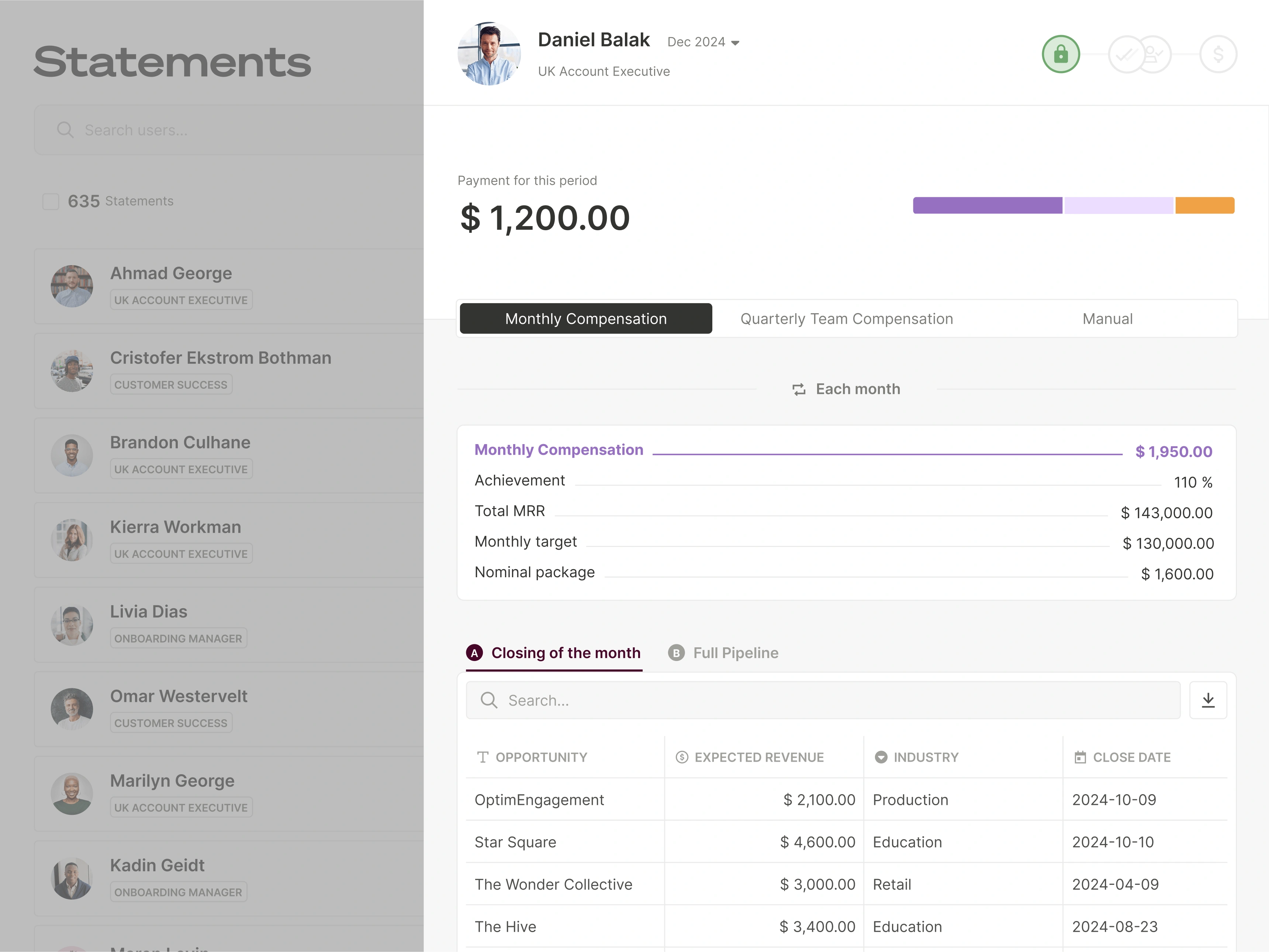
This is where a dedicated platform becomes essential. At Qobra, we provide a no-code solution that automates commission calculations in real-time. By integrating directly with your CRM, we eliminate manual errors and give your sales team a clear, live view of their earnings, turning their commission plan into a powerful daily motivator.
Spot Bonuses
Also known as "one-off" bonuses, these are discretionary rewards given on the spot to recognize exceptional effort or a specific achievement that falls outside regular KPIs. For example, an employee who works late for a week to fix a critical bug might receive a spot bonus. They are highly effective for reinforcing positive behaviors in real time.
Sign-On and Retention Bonuses
- Sign-On Bonus: A one-time payment offered to a new hire as an incentive to join the company. It's often used to attract top talent in competitive markets or to compensate a candidate for bonuses they forfeited by leaving their previous employer.
- Retention Bonus: A one-time payment offered to a key employee as an incentive to stay with the company for a specified period, often during a critical time like a merger or a major project.
Note: Discretionary vs. Non-Discretionary Bonuses
It's important to distinguish between these two legal classifications. Non-discretionary bonuses are formulaic and guaranteed if certain predefined criteria (like KPIs or sales targets) are met. Discretionary bonuses are awarded at the company's discretion without a prior promise or defined formula. This distinction can have implications for overtime pay calculations and legal obligations.
How to Design an Effective Bonus Structure: A Step-by-Step Guide
Building a bonus plan from scratch requires careful planning. Follow these steps to create a structure that is fair, motivating, and aligned with your business strategy.
Step 1: Align with Business Objectives
Start by asking: What behavior do we want to incentivize? The goals of your bonus plan must be directly tied to the company's strategic priorities. If your goal is to increase market share, the bonuses should reward new customer acquisition. If the focus is on profitability, they should be tied to margin improvements or cost-efficiency.
Step 2: Define Key Performance Indicators (KPIs)
KPIs are the backbone of any objective bonus structure. They must be SMART:
- Specific: Clearly defined and unambiguous.
- Measurable: Quantifiable with reliable data.
- Achievable: Challenging but realistic.
- Relevant: Directly linked to the employee's role and company goals.
- Time-bound: Tied to a specific timeframe (e.g., quarterly, annually).
The choice of KPIs will vary significantly by department.
| Department | Potential KPIs |
|---|---|
| Sales | Revenue Generated, New Customers Acquired, Customer Lifetime Value |
| Marketing | Lead Generation, Conversion Rate, Return on Ad Spend (ROAS) |
| Customer Support | Customer Satisfaction (CSAT), First Response Time, Ticket Resolution Rate |
| Production | Output Volume, Defect Rate, On-Time Delivery |
| R&D | Project Milestones Met, New Product Innovations, Bug Fix Time |
Step 3: Set Targets and Weightings
Once KPIs are defined, you need to set clear performance targets. This involves establishing a baseline, a target, and potentially a stretch goal.
Next, assign a weight to each KPI to reflect its strategic importance. Not all goals are created equal. For a sales role, revenue generation might have a 60% weighting, while customer satisfaction might have 40%.
- Equal Weighting: Every KPI is given the same importance (e.g., four KPIs at 25% each).
- Tiered Weighting: Critical KPIs receive higher weights (e.g., 50%, 30%, 20%) to focus efforts on what matters most.
Step 4: Create a Clear Calculation Formula
Transparency is key. Employees must be able to understand exactly how their bonus is calculated. A simple, weighted formula is often the most effective.
A common approach is to calculate a performance score for each KPI, then combine them based on their weighting.
Performance Score for a KPI = (Actual Achievement / Target Goal) × Weight
The sum of the scores for all KPIs gives the overall performance percentage, which is then multiplied by the target bonus amount.
Example Calculation:
Let's consider a Marketing Manager with a target bonus of $10,000.
| KPI | Weight | Target | Actual | Performance Score |
|---|---|---|---|---|
| New Leads | 50% | 500 | 600 | (600/500) * 50% = 60% |
| Conversion Rate | 30% | 10% | 11% | (11%/10%) * 30% = 33% |
| ROAS | 20% | 3:1 | 3.3:1 | (3.3/3) * 20% = 22% |
| Total | 100% | 115% |
Bonus Payout: $10,000 (Target Bonus) × 115% (Overall Performance) = $11,500
In this scenario, the manager exceeded their goals and earned a bonus higher than their target. It's also wise to define what happens if performance falls below a certain threshold (e.g., no bonus below 80% of target) and consider using a commission cap or, more motivatingly, accelerators for over-performance.
Step 5: Determine Payout Frequency and Eligibility
Decide how often bonuses will be paid out—annually, semi-annually, quarterly, or even monthly. Shorter cycles provide more immediate feedback and motivation, but increase administrative overhead. Annual bonuses are better for rewarding long-term strategic achievements.
You must also clearly define eligibility criteria in a formal commission agreement.
- Who is included in the plan (e.g., full-time employees only)?
- Is there a minimum tenure required (e.g., must be employed for 6 months)?
- How are bonuses handled for employees who join or leave mid-cycle (pro-rata basis)?
- What happens if an employee is on a performance improvement plan?
Warning: The Peril of Manual Calculations
As bonus structures become more complex with multiple KPIs, tiered weightings, and various eligibility rules, managing them on spreadsheets becomes a significant risk. A single formula error can lead to incorrect payouts, damaging trust and morale. This is why automating the calculation of variable compensation is crucial for accuracy and efficiency.
Step 6: Communicate the Plan Clearly
A bonus plan is only effective if employees understand it. Hold kickoff meetings to explain the structure, the KPIs, and the calculation logic. Provide access to documents outlining the full plan.
For performance-based plans, transparency is paramount. Employees should have visibility into their progress toward their goals throughout the performance period. This is where tools that provide real-time dashboards excel. For example, the Qobra platform gives sales reps a live view of their commission earnings, showing them exactly which deals contributed to their payout. This level of transparency removes ambiguity and turns the bonus plan into a constant source of motivation.
Step 7: Review and Adapt
A bonus structure is not a "set it and forget it" tool. The business environment changes, and so should your incentive plan. Review its effectiveness at least once a year. Are you driving the right behaviors? Is the plan still aligned with your strategic goals? Gather feedback from managers and employees to identify areas for improvement.
A well-designed bonus structure is a dynamic tool for steering your organization toward success. It transforms compensation from a static cost into a strategic investment in your people and your performance. By following a structured approach—aligning with goals, defining clear metrics, ensuring transparency, and leveraging automation—you can build an incentive program that truly motivates your team and drives exceptional results.

Frequently Asked Questions (FAQ)
How do you set appropriate bonus levels?
Setting bonus levels involves balancing several factors:
- Market Benchmarking: Research what competitors are offering for similar roles to ensure your total compensation is competitive.
- Budgetary Constraints: Determine what the company can realistically afford. The total bonus pool is often tied to overall company profitability.
- Internal Equity: Ensure that bonus targets are fair and consistent across different roles and departments, relative to their impact on the business.
- Pay Mix: Decide on the ratio of base salary to variable pay. For roles like sales, the variable portion is typically much higher than for administrative roles.
How often should bonuses be paid out?
The ideal frequency depends on the role and the nature of the goals.
- Monthly/Quarterly: Best for roles with short sales cycles or objectives, like sales and customer support. It provides rapid feedback and keeps motivation high.
- Annually: Better suited for strategic, long-term goals and senior leadership roles, where performance is measured over a longer horizon. Many companies use a mix, such as quarterly performance bonuses and an annual profit-sharing bonus.
What is the difference between a KPI-based bonus and a discretionary bonus?
A KPI-based bonus is non-discretionary. It is based on a pre-defined formula and objective metrics. If an employee meets the targets outlined in their incentive plan, they are contractually entitled to the bonus. This creates transparency and trust. A discretionary bonus is awarded at the company's sole discretion, without a pre-set formula. It's often used for spot rewards or to recognize contributions that are difficult to quantify.
How are bonuses typically taxed?
In most countries, bonuses are considered supplemental income and are subject to income tax. The specific tax withholding rate can sometimes be different from that of a regular salary, so it is important for both employers and employees to understand the local tax regulations. It's always best to consult with a payroll or tax professional to ensure compliance.
Once your bonus structure is defined, a variable compensation software turns it into automated, error-free payouts — no more spreadsheets.