Sales Compensation Software Benchmark | Compare 15+ Sales Compensation Platforms
Download
- An incentive pay plan links measurable performance to rewards (monetary or non-monetary) to align employee effort with company objectives.
- Core components include clear KPIs, SMART targets, a transparent payout structure (thresholds, accelerators, caps), eligibility rules, and payout frequency.
- Design step-by-step: define business objectives, choose KPIs, set SMART goals, build a simple payout formula, communicate clearly, and implement tracking (preferably automated).
- Common formats: bonuses, commissions (tiered/accelerators), profit-sharing, equity, and non-financial rewards (PTO, training, recognition); combine types to motivate both individual and team performance.
- Measure ROI and govern the plan: track performance, productivity, retention and cost vs. benefit; review regularly, ensure tax/legal compliance, and guard against gaming or “rowing boat” effects.
How do you transform your team's compensation from a simple paycheck into a powerful engine for growth and motivation? While a competitive base salary is essential for attracting talent, it's the strategic use of performance-based rewards that truly aligns employee efforts with company objectives, driving exceptional results. An incentive pay plan is the framework that makes this happen, creating a clear link between performance and reward.
A well-structured incentive program does more than just offer extra cash; it fosters a culture of high performance, clarifies strategic priorities, and empowers employees by giving them direct control over their earning potential. It answers the crucial question for every employee: "What's in it for me if I go the extra mile?" When designed thoughtfully, the answer to that question can unlock new levels of productivity and engagement across your entire organization.
What Is an Incentive Pay Plan?
An incentive pay plan, also known as performance-based pay, is a formal compensation structure that provides employees with additional rewards outside of their base salary for achieving specific, measurable goals. These goals are directly tied to individual, team, or company-wide performance. The core purpose of this compensation strategy is to motivate employees to exceed expectations and align their actions with the organization's most critical strategic milestones.
This additional compensation can be monetary, such as cash bonuses or commissions, or non-monetary, like extra paid time off or professional development opportunities. The key is that the reward is conditional—it is earned only when a predetermined target is met or surpassed.
A successful plan creates a symbiotic relationship: as employees work to achieve their performance targets and increase their earnings, they simultaneously drive the business forward. This makes it one of the most powerful tools in a company's arsenal for boosting productivity, improving employee retention, and fostering a results-oriented culture.
The Core Components of an Effective Incentive Program
To be effective, an incentive plan can't be arbitrary. It must be built on a clear, transparent, and logical foundation. The most successful programs share several key components that ensure fairness, clarity, and alignment with business goals.
Key Performance Indicators (KPIs)
The foundation of any plan is the metric used to measure success. These relevant key performance indicators (KPIs) must be directly linked to the desired business outcome. For a sales team, this might be sales revenue or new logos acquired. For a production team, it could be units produced per hour or defect rate reduction.
Specific and Measurable Goals
Goals must be unambiguous. Instead of a vague objective like "increase sales," a better goal is "achieve $500,000 in new sales revenue in Q3." Using the SMART (Specific, Measurable, Achievable, Relevant, Time-bound) framework is crucial for setting targets that are both challenging and realistic.
Payout Structure and Periodicity
This defines how and when rewards are distributed. Will it be a quarterly bonus, an annual profit-sharing distribution, or a real-time commission payout? The structure should also outline the rules, such as tiers, accelerators for overperformance, or caps. The frequency of payouts can significantly impact motivation; more frequent rewards often create a stronger and more immediate link between action and reward.
Eligibility Criteria
Who participates in the plan? Is it limited to the sales team, open to all employees, or tailored to specific departments? Clearly defining eligibility from the outset prevents confusion and perceptions of unfairness.
Common Types of Incentive Pay Plans
Incentive plans are highly flexible and can be customized to suit different roles, industries, and business objectives. They generally fall into two broad categories: monetary and non-monetary.
Monetary Incentives
These are the most common forms of incentive pay and involve direct financial rewards.
- Bonuses: One-time payments awarded for achieving a specific goal. This could be a project completion bonus for a development team, an annual performance bonus based on company profitability, or a spot bonus for exceptional work on a specific task.
- Commission: A percentage of revenue generated from a sale. This is the most prevalent model for sales roles, as it directly links a salesperson's earnings to their performance. There are many different sales commission structures, from straight commission to tiered models that reward overachievement.
- Profit Sharing: A system where employees receive a portion of the company's profits. Payouts are typically made annually or quarterly and give every employee a direct stake in the company's overall financial success.
- Stock Options & Equity: Granting employees the right to purchase company shares at a predetermined, often discounted, price. This is a long-term incentive designed to align employees with the company's long-term growth and increase retention.
Non-Monetary Incentives
While money is a powerful motivator, non-financial rewards can be equally effective in boosting morale and engagement.
- Paid Time Off (PTO): Offering extra vacation days or personal days as a reward for meeting targets.
- Career Development Opportunities: Providing access to valuable training, certifications, or tuition reimbursement. This type of incentive invests in the employee's future growth within the company.
- Recognition and Awards: Public acknowledgment, trophies, or prestigious titles can be highly motivating, especially in a competitive environment.
- Personalized Experiences: Flexible rewards like gift cards, travel vouchers, spa days, or tickets to an event allow employees to choose a reward that is personally meaningful to them.
Mix and Match for Maximum Impact
The most effective compensation strategies often blend different types of incentives. For instance, a sales team might have a commission-based plan for individual performance, supplemented by a team-wide bonus for hitting a regional target and an annual profit-sharing distribution. This layered approach helps motivate both individual effort and collaborative success.
How to Design a Motivating Incentive Pay Plan: A Step-by-Step Guide
Designing a plan that works requires careful thought and a structured approach. A poorly designed plan can backfire, leading to demotivation, unhealthy competition, or a focus on the wrong metrics. Follow these steps to build a robust and effective program.
Step 1: Define Clear Business Objectives
Start with the "why." What specific business outcome do you want to achieve? Is it to increase market share, improve customer retention, reduce operational costs, or boost profitability? Your incentive plan should be a tool to achieve this specific goal.
Step 2: Identify and Select Key Performance Indicators (KPIs)
Once your objective is clear, choose the metrics that best represent progress toward that goal. If your objective is to improve customer satisfaction, your KPIs might be Net Promoter Score (NPS) or customer churn rate. If it's sales efficiency, you might track the sales cycle length or cost of customer acquisition (CAC).
Step 3: Set SMART Goals
For each KPI, establish clear targets. These targets should be:
- Specific: "Increase Q4 revenue by 15%," not "Grow revenue."
- Measurable: The goal must be quantifiable.
- Achievable: The target should be challenging but realistic. Unattainable goals are demotivating.
- Relevant: The goal must align with the broader business objective.
- Time-bound: Set a clear deadline (e.g., "by the end of the fiscal year").
Step 4: Determine the Payout Structure and Rules
This is where you define the mechanics of the plan. Consider:
- Thresholds (Floors): Is there a minimum performance level required to earn any incentive?
- Accelerators: Will payout rates increase for performance that significantly exceeds the target?
- Caps: Is there a maximum payout? While caps can help with budget predictability, they can also discourage overperformance.
- Payout Formula: How will the reward be calculated? It should be simple enough for every employee to understand and calculate on their own.
Example of a Tiered Commission Structure:
- 0-80% of quota (up to $80,000): 5% commission
- 81-100% of quota ($80,001 - $100,000): 8% commission on this tier
- 101%+ of quota (above $100,000): 12% commission (accelerator) on all sales above the quota
Step 5: Communicate the Plan with Absolute Clarity
A plan is only effective if employees understand it. Hold kickoff meetings, provide detailed documentation, and offer a Q&A session. Every participant should know exactly what they need to do to earn a reward and how it will be calculated. Lack of transparency is a primary cause of plan failure.
Step 6: Implement, Track, and Manage
Once the plan is launched, you need a system to track progress and calculate payouts. For simple plans, spreadsheets might suffice initially. However, as the team grows or the plan becomes more complex, manual tracking becomes a significant bottleneck. It's prone to errors, lacks transparency, and consumes countless hours for sales ops or finance teams.
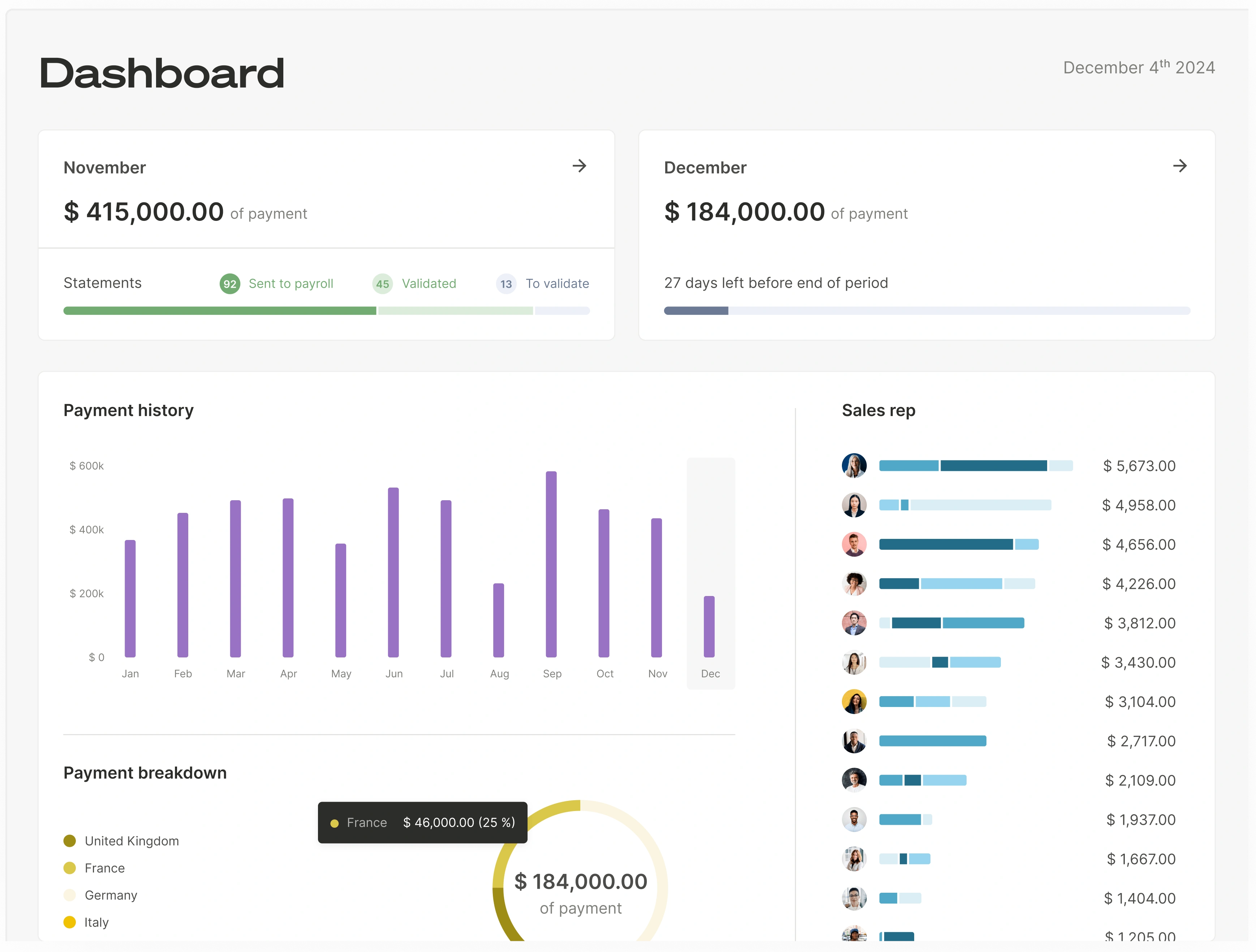
This is where automated solutions become essential. Platforms like Qobra are designed to handle the entire lifecycle of incentive compensation. By connecting directly to your CRM (like Salesforce or HubSpot), Qobra automates calculations, eliminating manual errors. It provides sales reps with transparent dashboards to track their performance and potential earnings, which is a powerful way to motivate your sales force day-to-day. For managers and finance, it offers reliable data for forecasting and performance analysis, transforming a complex administrative burden into a strategic advantage.
Calculating Payouts: From Simple Formulas to Complex Scenarios
The method for calculating incentive pay varies widely depending on the type of plan. The key is to ensure the formula is clear and the data is accurate.
Commission-Based Calculation
This is common in sales. The formula is typically: Payout = Sales Revenue x Commission Rate. For example, a salesperson who generates $50,000 in sales with a 10% commission rate earns $5,000. For tiered plans, the calculation becomes more complex, requiring careful tracking of performance against different thresholds.
Project-Based and MBO Bonuses
In these cases, the payout is often a fixed amount or a percentage of base salary, awarded upon completion of a specific objective (Management by Objectives). For instance, a marketing team might receive a $15,000 team bonus for successfully launching a new product ahead of schedule and exceeding initial lead generation targets by 20%.
Company Performance & Profit Sharing
This calculation is based on top-level company metrics.
- Example (Company Performance Bonus): An employee with a $90,000 base salary is eligible for a 10% annual bonus if the company achieves its target of 25% revenue growth. If the target is met, the employee receives $9,000.
- Example (Profit Sharing): A company allocates 3% of its annual profit of $10 million ($300,000) to a profit-sharing pool for its 150 eligible employees. Each employee would receive a $2,000 payout.
The administrative challenge of calculating commissions accurately and bonuses across an entire organization highlights the need for robust systems to ensure timeliness and accuracy.
Beware the "Rowing Boat Syndrome"
A poorly designed group incentive can lead to what's known as the "rowing boat syndrome," where a few high-performing employees feel they are doing all the work while others coast and still receive the same reward. To avoid this, ensure that even team-based plans have a component that recognizes individual contribution, or that team goals are structured in a way that requires everyone's active participation.
Measuring the ROI of Your Incentive Plan
An incentive pay plan is an investment, and like any investment, its return should be measured. Tracking the right metrics will help you understand if your plan is working and identify areas for improvement.
Key metrics to monitor include:
- Performance Metrics: Did you achieve the primary business objective? Track the KPIs you established in the design phase (e.g., revenue growth, profit margins, customer retention rate).
- Employee Productivity: Measure output per employee or team before and after the plan's implementation.
- Employee Engagement and Retention: A good plan should lead to higher morale and lower turnover. Track metrics like employee satisfaction scores and voluntary attrition rates.
- Cost of the Plan: Compare the total amount paid out in incentives to the financial gains generated (e.g., the incremental revenue or cost savings). This will give you a direct ROI calculation.
A well-designed sales compensation plan is a dynamic tool. It should be reviewed regularly—at least annually—to ensure it remains aligned with evolving business priorities and market conditions.
An incentive pay plan is far more than just a way to pay people more. It is a strategic communication tool that tells your employees what matters most to the business. When designed with care, transparency, and a clear link to business objectives, it transforms compensation from a fixed cost into a dynamic investment in performance, motivating your team to not only meet their goals but to shatter them.
Monthly, quarterly and annual payouts rarely share a calculation cycle, and each one adds a reconciliation. Incentive tracking software runs them on the same source data, so a change in one period does not silently break another.
Frequently Asked Questions
Is incentive pay taxable?
Yes, in most jurisdictions, incentive pay is considered taxable income. This includes bonuses, commissions, and the value of non-monetary rewards like gift cards. The tax rate and withholding rules can differ from regular salary (it may be classified as supplemental wages). It is essential to consult with tax professionals or refer to official government resources (like IRS publications in the U.S.) to ensure compliance.
What's the difference between merit pay and incentive pay?
Merit pay is typically an increase to an employee's base salary awarded for sustained past performance. It becomes a permanent part of their compensation. Incentive pay, on the other hand, is a one-time, variable reward for achieving a specific, forward-looking goal. It is not added to the base salary and must be re-earned during each performance period.
Who should be eligible for an incentive plan?
Eligibility depends on the company's goals. While sales commissions are specific to sales roles, broader plans like profit sharing can include all employees to foster a sense of shared purpose. You can also design department-specific plans for marketing, operations, or customer support, as long as you can define meaningful, measurable performance indicators for those roles.
How often should incentive pay be paid out?
The ideal frequency depends on the nature of the goal. For sales commissions tied to short sales cycles, monthly or quarterly payouts are effective at maintaining motivation. For longer-term strategic goals or company-wide profit targets, annual or semi-annual payouts are more appropriate. The key is to make the payout close enough to the performance period to reinforce the link between effort and reward.