Sales Compensation Software Benchmark | Compare 15+ Platforms (Features, Pricing, User Reviews, etc.)
Download
- A complete commission audit trail captures plan versions with effective dates, rule changes with author and timestamp, data overrides, adjustments with reason codes, approvals, payout files and dispute history.
- SOX Section 404 requires management of SEC-registered companies to assess internal control over financial reporting annually, and commission expense is in scope (SEC final rule).
- Under ASC 340-40, incremental costs of obtaining a contract, including most sales commissions, are capitalized and amortized, so auditors need deal-level evidence for each commission asset (FASB Codification).
- California Labor Code 2751 requires a written commission agreement stating how commissions are computed and paid, plus a signed receipt, which makes plan versioning a legal record.
- Two of eight platforms publish US pricing: QuotaPath from $35 per user per month plus a platform fee, and Spiff by Salesforce at $75 per user per month, both billed annually (vendor websites, Sept 2026).
Commission software with audit trails compared for compliance (2026)
All eight platforms advertise a change history, but they differ on plan versioning, reason codes, ASC 606 reporting and accrual export. "Not stated" means the claim was not found on the vendor pages reviewed in September 2026, not that the feature is absent.
For a broader comparison, see the best sales compensation software for RevOps and finance teams and the commission software integrations matrix.
What a commission audit trail must capture
A commission audit trail is complete when an auditor can pick any payout line and trace it to the plan version, source data and approvals in force on that date without asking a human. Seven record types make that possible.
- Plan versions with effective dates. Every plan, rate table and quota has a start and end date, and prior versions are stored, not overwritten. A December calculation must run on the December plan even if the plan was edited in January.
- Rule changes with author and timestamp. Each edit to a formula, tier or eligibility rule records who made it, when, and the previous value.
- Data overrides. When someone changes a CRM value inside the commission tool, such as a close date or owner, the override is stored apart from the source record.
- Manual adjustments with reason codes. Bonuses, corrections and clawbacks carry a category (data error, plan exception, SPIF, clawback) and a note, so auditors can sample by type.
- Approvals. Who approved each calculation run, adjustment and payout file, with a segregation-of-duties check that the approver is not the author.
- Payout files. The exact file sent to payroll, frozen at export, so paid amounts reconcile to calculated amounts.
- Dispute history. Every rep claim, response and outcome, linked to the statement it concerns. See how teams eliminate sales commission disputes once this history is visible to reps.
Immutability matters as much as coverage. If an administrator can edit or delete a log entry, the log is documentation, not evidence. Look for append-only records and role-based access that keeps plan authors out of the approval step.
Why US finance teams care about sales compensation audit trails
US finance teams treat commission audit trails as a control requirement because commission expense touches three regulated areas at once: SOX 404, ASC 606 with ASC 340-40, and state wage law.
SOX 404 internal controls over financial reporting
Section 404 of the Sarbanes-Oxley Act requires management of SEC-registered companies to include in each annual report an assessment of the effectiveness of internal control over financial reporting, and management cannot conclude controls are effective if a material weakness exists (SEC final rule). Accelerated filers also need an auditor attestation under Section 404(b), performed under PCAOB AS 2201.
Commission expense is one of the larger operating expense lines at most software and services companies, and it is calculated outside the general ledger. Auditors therefore test that plan changes are authorized, calculations are reviewed before payment and data cannot be altered without a trace. Pre-IPO companies usually start building this evidence 12 to 24 months before listing, since newly public companies must file a management ICFR report from their second annual report.
ASC 606 and ASC 340-40 commission capitalization
ASC 340-40 requires companies to capitalize incremental costs of obtaining a contract that they expect to recover, and sales commissions are the standard example (FASB ASU 2014-09, Subtopic 340-40). The asset is amortized over the period the company expects to benefit, which can include anticipated renewals; a practical expedient allows expensing when the amortization period would be one year or less.
Every deferred commission on the balance sheet therefore needs deal-level support: commission amount, related contract, amortization method and any true-up. A sampled balance that cannot be traced to a plan version and an approved payout is a finding. Our guides on ASC 606 commissions and ASC 606 commission accounting for sales ops cover the mechanics.
State wage-claim exposure
California Labor Code section 2751 requires that any employment contract involving commissions be in writing, state the method by which commissions are computed and paid, and be delivered to the employee with a signed receipt (California Legislative Information). In a wage claim, the employer must show which plan version applied to the disputed period and how the payout was derived; a versioned plan archive with acknowledgments is the fastest way to do that. Clawbacks are the most common trigger; see how clawbacks work.
How software automates the monthly commission accrual
Commission software automates the monthly accrual by calculating earned but unpaid commission per deal as soon as the CRM record closes, then replacing that estimate with the approved payout at true-up. The workflow has four steps.
- Accrue by deal. On each closed-won or invoiced opportunity, the platform applies the effective plan version and computes commission earned, tagged to deal, rep, plan and period. Finance exports this as the month-end accrual instead of applying a blended percentage to bookings.
- Review and approve. Managers and finance approve the run; adjustments entered here carry reason codes and enter the audit trail.
- True-up at payout. When commissions are paid, often the following month, the system books the difference between paid and accrued so expense lands in the period it was earned.
- Journal entry export. The platform produces a debit to commission expense (or to the deferred commission asset under ASC 340-40) and a credit to accrued liabilities, then a reversing entry at payment.
Because the accrual is deal-level, the same dataset feeds ASC 606 commission journal entries: capitalized amount, amortization schedule and period expense per contract. For examples, read our article on accrued commission.
Best commission software with audit trails for finance teams
All eight platforms log plan and payout changes; the differences are plan versioning depth, reason codes, ASC 606 reporting and how the accrual reaches the ledger.
Qobra
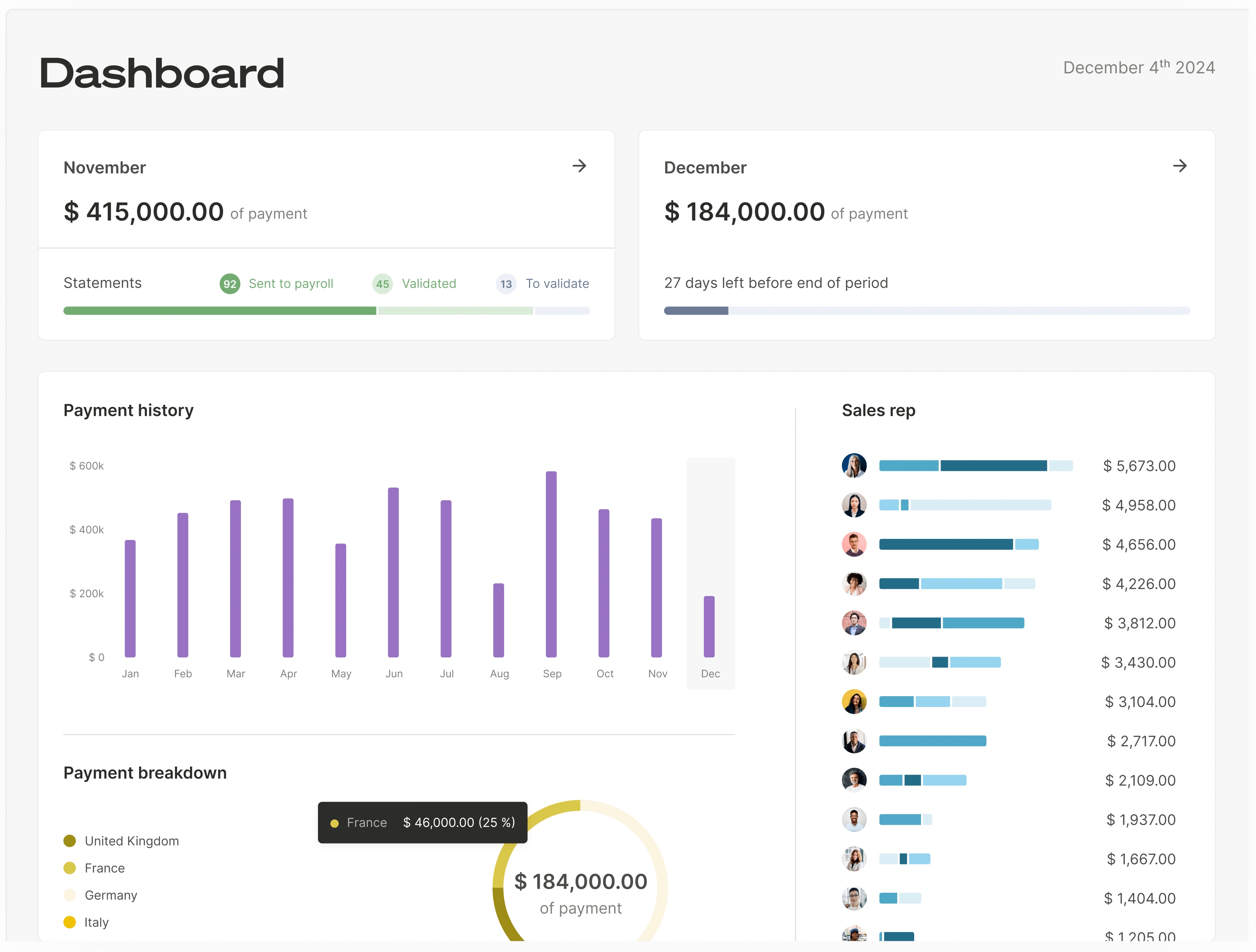
Qobra manages $1B+ in commissions across 300+ companies. Its no-code plan editor, automated calculation with approval workflows, deal-level statements and dispute workflow all write to an audit log of plan and payout changes, so finance can trace a payout line to the rule and data behind it. Real-time dashboards give reps, managers and finance the same numbers, which reduces the post-payout disputes that create manual adjustments.
Qobra connects to Salesforce, HubSpot, Microsoft Dynamics, Zoho, Pipedrive and Odoo; to Snowflake, BigQuery, Redshift, PostgreSQL and SQL Server; and to Workday, BambooHR and HiBob (integrations). Payout and accrual data export via CSV and SFTP. SOC 2 report. Pricing: Quote-based.
CaptivateIQ
CaptivateIQ markets "audit trails and approval workflows" for SOC 2 and SOX compliance, segregation of duties on compensation changes, and ASC 606 reporting with automated accruals (vendor site, Sept 2026). It states annual SOC 1 and SOC 2 audits. Specific ERP journal connectors are not listed on its finance page. Pricing is quote-based.
Everstage
Everstage states that "every action is logged: plan changes, edits, approvals, and payouts" and offers an ASC 606 module with amortization schedules and waterfalls classified at company or deal level (vendor site, Sept 2026). It reports SOC 2 Type II certification. Accrual export targets are not detailed publicly. Pricing is quote-based.
Xactly Incent
Xactly Incent advertises a "complete audit trail," plan rollover tools and a Commission Expense Accounting add-on for ASC 606 and IFRS 15 capitalization, amortization and true-ups (vendor site, Sept 2026). Xactly Connect integrates with NetSuite, Snowflake and Workday, and the Xactly trust site lists SOC 2. It is typically deployed at large sales organizations with a partner. Pricing is quote-based.
Varicent
Varicent ICM states it "maintains a full audit trail behind every calculation" and targets enterprise territory, quota and incentive processes (vendor site, Sept 2026). Its security page describes a third-party compliance program without naming certifications, and ASC 606 reporting is not described on the ICM product page, so ask for both in an RFP. Pricing is quote-based.
Performio
Performio advertises "complete audit trails for all changes," built-in approval workflows and ingestion from CRM, ERP, HRIS and finance systems (vendor site, Sept 2026). Its security page states SOC 1 Type II and SOC 2 Type II reports and ASC 606 support. Pricing is quote-based.
QuotaPath
QuotaPath publishes pricing: Growth at $35 per user per month plus a $525 monthly platform fee, Premium at $50 plus $800, both billed annually (vendor website, Sept 2026). Growth includes ledger and ASC 606 support and basic approvals; Premium adds multi-level approvals and QuickBooks, NetSuite, Sage Intacct and Xero integrations. Its pricing page does not describe an immutable change log, so confirm history depth before relying on it for SOX testing.
Spiff by Salesforce
Salesforce Spiff lists a "deep audit trail" with effective dates on any user, plan or logic, locked historical statements, every change tracked in an audit log, and ASC 606 / IFRS 15 expense reports (vendor site, Sept 2026). Pricing is $75 per user per month billed annually. It fits companies standardized on Sales Cloud; security is documented through Salesforce Trust rather than a Spiff-specific page.
How Qobra logs and reports commission changes
Qobra records plan and payout changes in an audit log and routes every calculation through an approval workflow before a payout file is produced. Finance teams use three views at month-end and during audits.
Plan and rule history. Each plan built in the no-code editor keeps a history of edits with author and time. When an auditor asks why a rep's rate changed in Q2, the answer is a log entry, not an email search. Plan versions with effective dates and side-by-side diff.
Deal-level statements and approvals. Every statement lists the deals, rates and amounts behind the payout, and the approval step records who signed off. Adjustments and clawbacks appear as separate lines rather than silent edits. Reason-code field on manual adjustments.
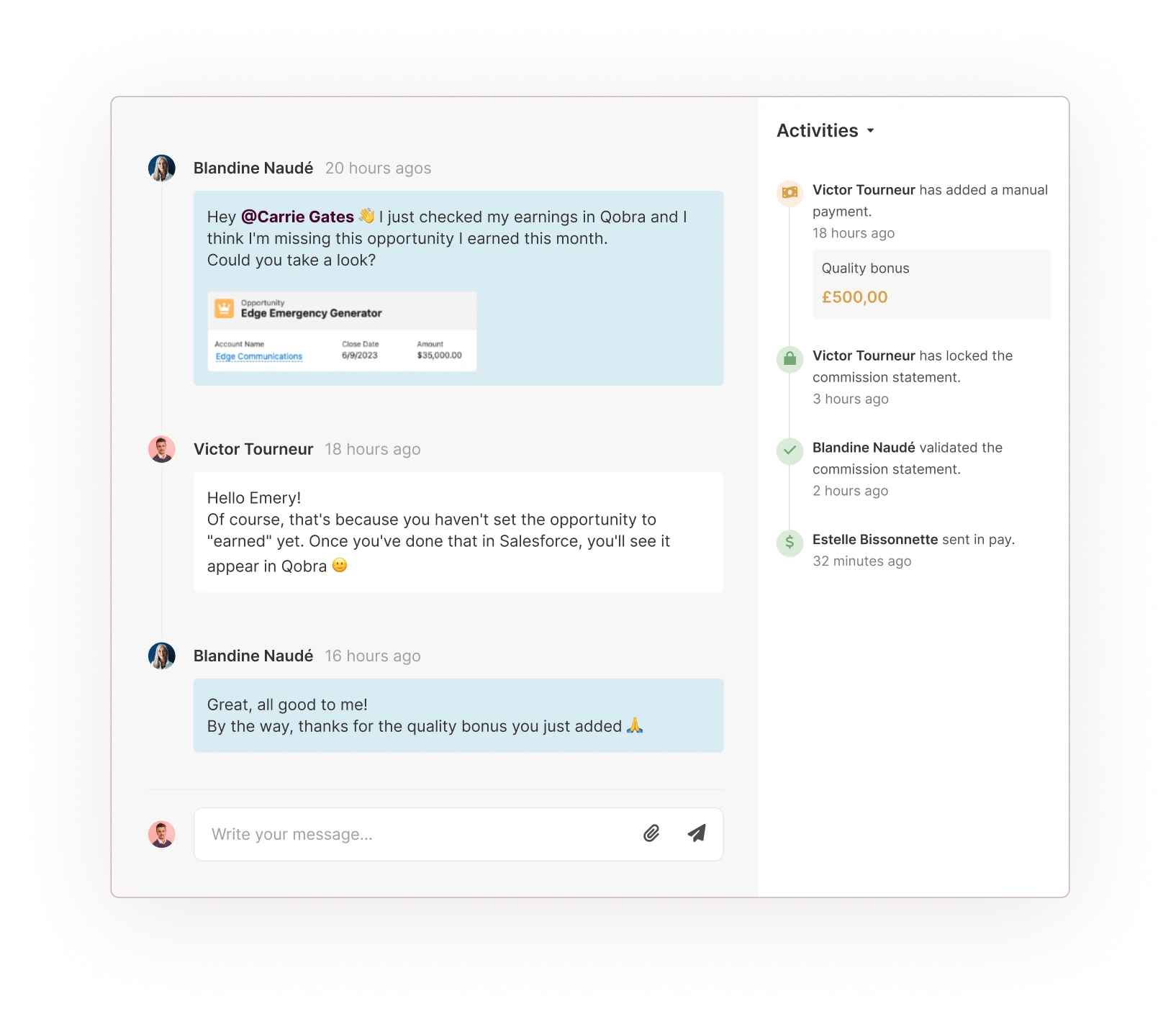
Dispute workflow. Reps raise a claim on a specific statement line; the exchange, decision and any correction are stored with the statement, giving finance a full dispute history for wage-claim defense and SOX walkthroughs. Qobra's AI agents for sales compensation can also flag anomalies before approval, such as a payout far above a rep's trailing average.
Pricing for commission software with audit trails (USD)
Two of the eight platforms publish US pricing. QuotaPath starts at $35 per user per month plus a $525 monthly platform fee, with accounting integrations on the $50 plus $800 Premium tier, billed annually; Spiff by Salesforce lists $75 per user per month billed annually (vendor websites, Sept 2026). CaptivateIQ, Everstage, Xactly, Varicent and Performio are quote-based, and enterprise vendors often price ASC 606 modules as add-ons. Qobra pricing: Quote-based. When comparing quotes, confirm that audit log retention, plan versioning and ASC 606 reporting are in the base tier, and use the ROI calculator to model savings against your current close.
Audit-readiness checklist for commission programs
Use this ten-item list to test whether your commission process would pass a SOX walkthrough or an ASC 606 sample without manual reconstruction.
- Every active plan exists as a versioned document with effective dates, and prior versions are retrievable.
- Each rep has acknowledged the current plan version with a stored signature or receipt (required in California under Labor Code 2751).
- Plan and rule edits log author, timestamp and previous value, and the log cannot be edited or deleted.
- CRM data overrides are stored separately from source values and visible on the statement.
- Manual adjustments require a reason code and appear as distinct lines.
- Calculation runs and payout files are approved by someone other than the plan author.
- The payout file sent to payroll is frozen and reconcilable to the approved calculation.
- Month-end accruals are generated per deal from the commission system, with true-ups recorded at payout.
- Capitalized commissions under ASC 340-40 tie to a deal, contract term and exportable amortization schedule.
- Dispute history is stored with the statement, and outcomes flow back into the adjustment log.
For attainment analytics and forecast views beyond audit needs, see the best commission reporting software.
FAQ: commission software audit trails and accruals
List the best commission software options that feature robust audit trails for compliance.
Platforms that document a change log on their websites include Qobra (audit log of plan and payout changes with approvals), CaptivateIQ, Everstage, Xactly Incent, Varicent, Performio and Spiff by Salesforce (deep audit trail with effective dates). Verify immutability and retention in a demo, since vendor sites rarely state either.
Which tools offer the most reliable history logs for reviewing past pay adjustments?
Choose tools that store adjustments as separate lines with reason codes, author and timestamp, and that lock statements once paid. Spiff by Salesforce advertises locked historical statements; Qobra keeps adjustments and clawbacks visible on deal-level statements with the dispute record. Ask each vendor to trace one prior-year adjustment back to its approver.
Identify automated incentive management solutions with robust audit trails for finance teams.
CaptivateIQ, Everstage, Performio and Xactly state SOC 2 reports and ASC 606 reporting alongside their audit trails. Qobra pairs its audit log and approval workflow with deal-level statements and CRM, warehouse and HRIS integrations; SOC 2 status. Public and pre-IPO companies need SOX-grade evidence; private companies can prioritize accrual accuracy.
Find simple tools for calculating sales commission accruals.
For a quick estimate, Qobra's free commission calculator computes earned commission from deal value and rate. For a recurring monthly accrual, a platform that calculates per deal on CRM close and exports by rep and period, such as Qobra or QuotaPath, replaces the blended-percentage spreadsheet most finance teams start with.
Show me software options that integrate with CRM data to streamline monthly commission accrual reporting.
Qobra connects natively to Salesforce, HubSpot, Microsoft Dynamics, Zoho, Pipedrive and Odoo and to Snowflake, BigQuery and Redshift, so accruals are computed on closed deals without manual imports. QuotaPath integrates with HubSpot and Salesforce and, on Premium, with QuickBooks and NetSuite. Xactly, CaptivateIQ, Everstage and Performio also connect to major CRMs; compare depth in our integrations matrix.
What ASC 606 commission journal entries does commission software produce?
At signing: debit deferred commission costs (asset), credit accrued commissions or cash. Each period: debit commission expense, credit the deferred asset, over the expected benefit period including likely renewals. Contracts with an amortization period of one year or less can be expensed under the ASC 340-40 practical expedient.